

Burning when you pass urine, or a drop at the tip? Call 97907 83856 or message me on WhatsApp.
For sudden, severe pain in a testicle, do not message: call at once, or go to the nearest hospital casualty if it is out of hours. You are seen in private, by me, in T Nagar.
Hello! Vanakkam and Namaste.
This is Dr Shah Dupesh, consultant sexologist in Chennai. I offer urethritis treatment in Chennai from my clinic in T Nagar.
Some men take a course of “UTI” tablets before they see a doctor. The burning eases, then comes back.
That is the problem with urethritis: it is not one disease. It is a sign that something is inflaming the tube, so the treatment depends on which germ it is.
This page covers every common cause, symptom, test and treatment. Use the list below to jump to what worries you most.
Read this first
Urethritis in men: the whole answer in six points
NGU is a label, not a diagnosis
It only means “not gonorrhoea”. The actual germ still has to be found (CDC, 2021).
Chlamydia is only part of it
In one study of 155 men with NGU, chlamydia alone was found in 34%. Mycoplasma alone was found in 17% (Jordan, 2020a).
A routine urine test can look normal
A urine culture cannot grow these germs, but a DNA (NAAT) panel on a swab or first urine finds them.
Mild symptoms: test first, then treat
Results take 2 days, then the drug that matches the germ. Fever, a painful swollen testicle or heavy pus?
Treatment starts the same day, after the swab. Sudden, severe testicle pain: call 97907 83856 at once; out of hours, go to the nearest casualty.
Mycoplasma needs two drugs
Doxycycline alone clears only about 3 to 4 in 10 infections (Jensen, 2022), so a resistance test picks the second drug.
Your partner is treated too
Otherwise it passes back to you. Avoid sex until you both finish, and retest at 3 months.
Most sections below are short numbered lists, so you can scan for the part that matches you.
What is urethritis? Non-gonococcal urethritis (NGU), NSU and gonorrhoea in plain words
The urethra is the tube that carries urine, and semen, out through the penis. “Urethritis” simply means that tube is inflamed. The inflammation can come from an infection or from something non-infectious (CDC, 2021).
Doctors then split it into two groups. Gonococcal urethritis is caused by gonorrhoea. Everything else is non-gonococcal urethritis, or NGU.
NGU is the most common treatable sexually transmitted condition in men (Moi, 2015). But it is a group of infections, not one. The label tells you what it is not, so only a test tells you what it is.
What does NGU stand for? NGU and non-specific urethritis
In medicine, NGU stands for non-gonococcal urethritis. In the UK you may also see NSU, non-specific urethritis, which means the same thing.
How do doctors confirm urethritis, and how do I know if I have it?
Any one of three findings confirms it (CDC, 2021):
- a discharge from the tip of the penis on examination;
- white blood cells on a stained smear of that discharge (2 or more per field, or 5 or more in some clinics);
- white cells in the first part of the urine stream, on a dipstick or under the microscope (10 or more per field).
Symptoms alone are not enough to keep giving antibiotics (CDC, 2021). That matters later, when we talk about burning that will not settle.
Is urethritis a UTI or an STD?
In young, sexually active men, it is usually an STD. A true urinary tract infection is less usual at that age; it is more typical of older men, often alongside an enlarged prostate or a blocked bladder outflow.
Still, this mix-up is common, and costly. In a large US insurance-claims study of men whose STI treatment was potentially delayed, 52.1% of their episodes had first been diagnosed as a UTI or cystitis, and chlamydia or gonorrhoea testing was recorded afterwards in only 4.6% (Kuritzky, 2023).
The 8 causes of non-gonococcal urethritis (NGU) in men, and how often each is found
Chlamydia is the single commonest cause of NGU, followed by Mycoplasma genitalium. Guidelines put chlamydia at 15–40% of cases and Mycoplasma at 10–25% (CDC, 2021). But in about half of men, no germ is found even with full testing (CDC, 2021).
Each man was tested for gonorrhoea, chlamydia, Mycoplasma, Ureaplasma and Trichomonas. Viruses and throat bacteria were not in the panel.
- 34%Chlamydia only
- 27%No germ found
- 17%Mycoplasma only
- 11%Ureaplasma only (not linked to NGU in this study)
- ~9%Mixed infection
- 2%Trichomonas only
Source: Jordan, 2020a (Indiana University, USA; 155 men with NGU and 103 controls). Mixed share calculated from the paper’s “12% of cases with a pathogen”.
In this study, 27% had no germ found. The 11% with Ureaplasma alone were counted separately, although Ureaplasma was not linked with NGU here (Jordan, 2020a). Guidelines put “no germ found” at about half (CDC, 2021).
NGU causes in men, one by one
In the study shown in the chart, chlamydia alone was found in a third of cases, and Mycoplasma alone in another 17% (Jordan, 2020a). Below are the eight groups of causes, from the best established to the least.
- Chlamydia. The commonest single cause, though less common in older men (CDC, 2021). See my page on chlamydia treatment in Chennai.
- Mycoplasma genitalium. A tiny bacterium with no cell wall. It causes 10–35% of NGU that is not chlamydia (Jensen, 2022), and it is the main reason NGU comes back (CDC, 2021).
- Trichomonas. A parasite, found in 1–8% of cases depending on the place (CDC, 2021). My page on trichomoniasis in men explains it in full.
- Ureaplasma (debated). Often found, but probably not the cause unless present in a high load, so experts advise against routine testing for it (Horner, 2018). My PCR panel still checks for it.
- Viruses: adenovirus and herpes. Often caught through oral sex (CDC, 2021). Adenovirus often comes with a red, sore tip or a sore eye (Samaraweera, 2016). Herpes can also cause sores; see my page on genital herpes.
- Throat bacteria: Haemophilus and meningococcus. These live in the throat and reach the penis through oral sex. In one series, 81% of men with Haemophilus urethritis reported only oral sex (Vives, 2021), and in another, most had a pus-like discharge (Deza, 2016). Read more on STDs from oral sex.
- Gut bacteria such as E. coli. An uncommon cause, which might be linked with insertive anal sex (CDC, 2021).
- Non-infectious causes. Sometimes the tube is irritated by something that is not an infection at all (CDC, 2021). Examples often given include a catheter or instrument, strong soaps or spermicides, and repeated squeezing to check for discharge.
When the first test is not chlamydia
When the first test is negative for chlamydia, the list widens. In Japan, among men with NGU that was not chlamydia, Mycoplasma led the list (Ito, 2016).
154 Japanese men with NGU that was not chlamydia. More than one germ was possible.
Source: Ito, 2016 (297 men with NGU, Japan; 143 had chlamydia).
What about India?
Indian data, however, look different from Western data. In two South Indian studies, gonorrhoea was still the commonest cause in men with discharge: 35% in Karnataka (Becker, 2010) and 45% in Bengaluru (Nayak, 2017).
Men with urethral discharge or urethritis in two South Indian studies.
Source: Becker, 2010 (Karnataka; men with urethral discharge, from 401 male clinic attendees); Nayak, 2017 (Bengaluru, 100 men with urethritis). No Chennai data exist.
Chlamydia was also found in 15% of men at a New Delhi STD clinic (Rawre, 2019). Mycoplasma was found in 6 of 100 men with NGU at Indian STD and HIV clinics, 70 of whom had HIV (Manhas, 2009). In India, therefore, the first job is to rule gonorrhoea in or out, and then find the rest.
“No germ found”: what it means
About half of NGU has no identifiable germ, even with extensive testing (CDC, 2021). In a Seattle clinic study, 45.2% of cases were negative for gonorrhoea, chlamydia, Mycoplasma, trichomonas, adenovirus and herpes (Srinivasan, 2021).
The outlook in these cases is reassuring, because no complications and no harm to partners have been found (CDC, 2021).
Can a girl give a guy Mycoplasma or chlamydia?
Yes, because both pass between partners through sex. Mycoplasma passes by direct contact between the genitals during sex (Jensen, 2022). Many infected partners feel nothing (CDC, 2021), which is why both of you are treated.
9 symptoms of urethritis in men, and the ones that need same-day care
The typical symptoms are burning when you pass urine, a discharge from the tip, and itching inside the penis (CDC, 2021). At two Thai STD clinics, 78% of men with urethritis symptoms (gonorrhoea included) had burning and 68% noticed a discharge (Chandeying, 2000).
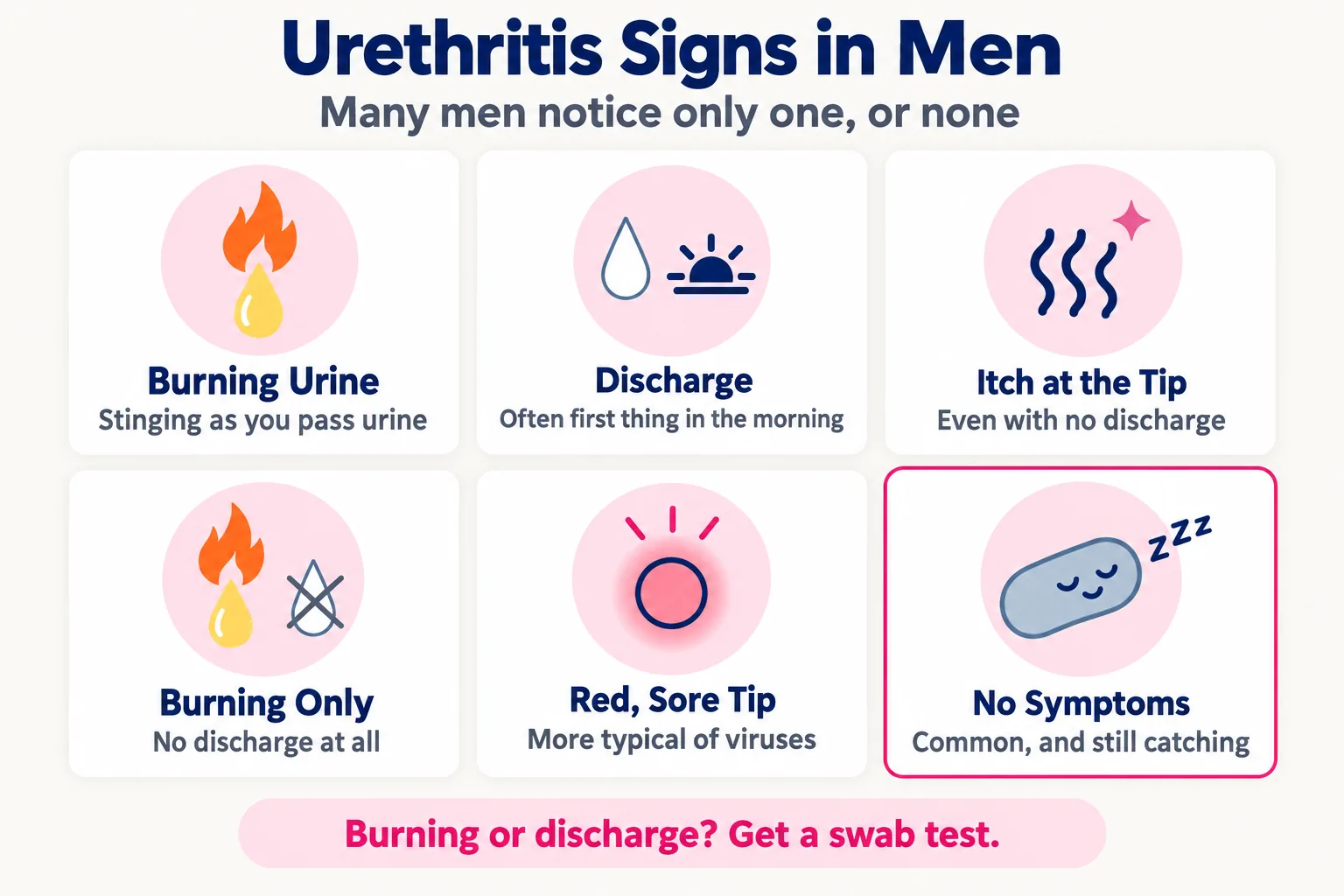
These are the nine symptoms men commonly report, including some that point elsewhere:
- Burning or stinging as you pass urine.
- A discharge from the tip: clear, white, cloudy, yellow or green.
- Itching or tingling inside the tip of the penis (CDC, 2021).
- A drop or crust in the morning, or a stain on your underwear.
- Needing to pass urine more often, in some men. But marked frequency or urgency points more to a bladder or prostate infection.
- A red, sore opening at the tip, more typical of viruses (Samaraweera, 2016).
- Blood in the urine or semen. This is not a usual sign of urethritis, so it always needs examination for other causes.
- Testicle pain or swelling, a sign the infection may have spread (CDC, 2021), or pain on ejaculation, which can also point to the prostate.
- Sore, red eyes, common with adenovirus (Samaraweera, 2016), or painful joints, rarely, after chlamydia (CDC, 2021).
When to see a doctor the same day
Call 97907 83856 the same day if you have a fever, testicle pain or swelling, or a heavy pus-like discharge. With these, I take the swab and start treatment at that same visit, without waiting 2 days.
I give a ceftriaxone injection and start doxycycline tablets. Blood in your urine also needs a same-day examination, to look for causes other than urethritis.
Sudden, severe pain in one testicle is different. It can be testicular torsion, a twisted testicle, which needs urgent examination. Guidelines state that “immediate referral to a urologist for evaluation for testicular torsion is vital” (CDC, 2021).
In clinic hours, call 97907 83856 at once. Out of hours, go straight to the casualty of the nearest hospital. Do not send a message and wait, and do not wait for the morning.
Burning but no discharge: is it still urethritis?
Yes, often. In one Bengaluru study, about a quarter of men with urethritis (27%) had burning alone, with no discharge (Nayak, 2017). A dry tip, then, does not rule it out.
My male urethra is itchy but I don’t have any discharge. What could be causing this?
Itching inside the tip is a recognised symptom of NGU, even without discharge (CDC, 2021). Chlamydia, Mycoplasma and trichomonas can all do this, so the itch alone cannot name the germ. A sore, itchy foreskin and head, on the other hand, points more to balanitis.
What causes a clear discharge in men?
A thin, clear or white drop is common with NGU, while gonorrhoea tends to cause a heavier, yellow or green, pus-like discharge. But the germ cannot be told apart reliably by how the discharge looks (Werner, 2025).
Clear fluid during arousal is normal. A drop that appears on its own with burning is not.
Symptoms overlap. Only the test tells the germs apart. Shaded cells are patterns reported in published series; a dash (—) means the pattern is not typical or has not been reported.
Swipe sideways to see all 7 germs →
| Gonorrhoea | Chlamydia | Mycoplasma | Trichomonas | Adenovirus | Herpes | Haemophilus | |
|---|---|---|---|---|---|---|---|
| Discharge | often | sometimes | sometimes | sometimes | — | — | sometimes |
| Burning on passing urine | often | sometimes | sometimes | sometimes | sometimes | sometimes | often |
| Red, sore tip of the penis | — | — | — | — | often | often | — |
| Sore, red eye | — | rarely | — | — | sometimes | — | — |
| Sores or blisters | — | — | — | — | — | sometimes | — |
| Lasting over 1–2 weeks | — | — | sometimes | rarely | — | — | often |
| No symptoms at all | rarely | often | often | often | — | — | — |
Source: Patterns drawn from guidelines (CDC, 2021); adenovirus (Samaraweera, 2016), with burning from two case reports (Avolio, 2014); Haemophilus (Vives, 2021; Deza, 2016); Mycoplasma (Lee, 2022; Horner, 2017); chlamydia (Nayak, 2017; Hocking, 2023, men and women). Shading summarises published case series, not measured percentages. No single sign predicts the germ in NGU (Jordan, 2020b).
That grid is a guide, not a test, because in a study of 220 men no single sign or symptom predicted which germ was responsible (Jordan, 2020b).
How many men have no symptoms at all?
Many. Across men and women, chlamydia causes no symptoms in more than 80% of cases (Hocking, 2023).
Mycoplasma in men is also usually silent (Horner, 2017). In a Seattle clinic cohort checked every 6 months, 78% of new NGU picked up at those visits caused no symptoms (Rowlinson, 2021).
Silent does not mean harmless, because a man without symptoms can still pass the infection on. For the full list by sign, see my guide to STD symptoms in men.
Burning urine: urethritis, UTI, prostatitis or balanitis?
Burning urine in a man has four common sources, and the right one changes the treatment completely. The table shows how they usually differ.
| Condition | Who it usually affects | Clues | The test that sorts it |
|---|---|---|---|
| Urethritis (NGU or gonorrhoea) | Sexually active men, any age | Burning, discharge or itch at the tip; a recent new partner | Swab or first-urine NAAT panel |
| Urinary tract infection | More often older men; prostate or bladder outflow problems | Frequent urine, cloudy or smelly urine, sometimes fever | Urine culture |
| Prostatitis | Men of any adult age | Pain between the legs, in the penis or lower belly; pain during or after ejaculation | Examination; urine and semen tests |
| Balanitis | Often uncircumcised men, or men with diabetes | Red, sore head and foreskin; burning on the skin as urine passes | Examination; swab; blood sugar |
These are typical patterns, not rules; the prostatitis clues follow CDC guidance (CDC, 2021). The pattern helps, but it is never certain. In a North Indian study of 100 hospital in-patients, men and women, with white cells in the urine but no growth on culture, 19% had chlamydia (Aggarwal, 2026).
If you have pain deep between the legs, read my page on prostatitis. If you have had sex with a new partner, start with an STD panel, not a UTI tablet.
How urethritis is tested: 4 tests compared, plus blood tests, and why your urine report looked normal
The cause of urethritis is found with a DNA test, called a NAAT, on the first part of your urine or a urethral swab. Every man with NGU should be tested for chlamydia and gonorrhoea this way (CDC, 2021). A routine urine report or culture often misses these germs.
Why a routine urine report can look normal
A urine culture grows ordinary urine bacteria, but chlamydia and Mycoplasma do not grow on it at all. As a result, a man with NGU can hold a perfectly “normal” culture. A routine report may show pus cells, but it cannot name the germ.
The same men, tested five ways on the same day.
Source: Chernesky, 2003 (237 men at an STD clinic; number of chlamydia-positive men found by each test).
On the same day, in the same 237 men, a DNA test on first urine found 26 chlamydia infections. Even a specialised chlamydia culture of a swab found only 6 (Chernesky, 2003).
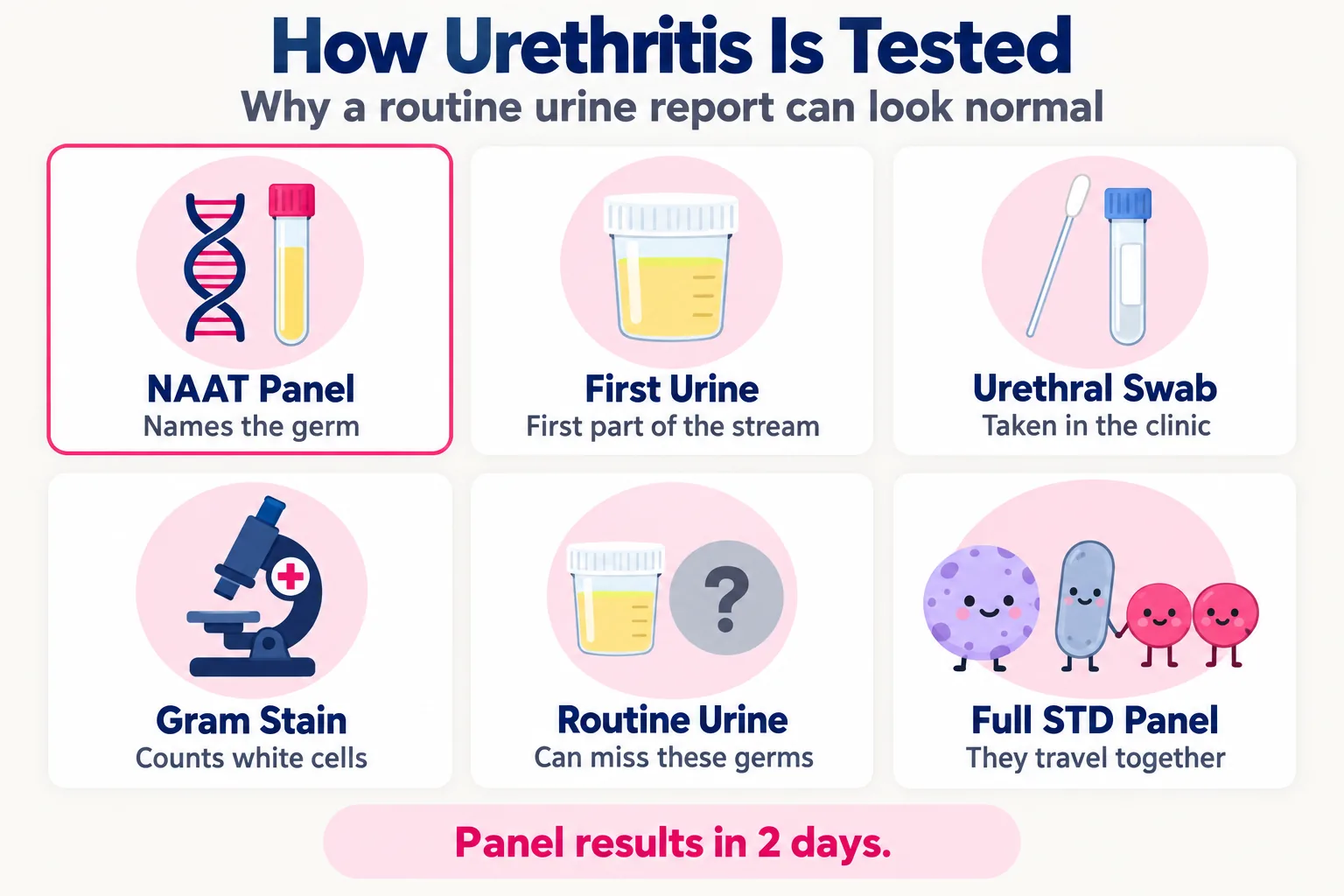
Urine and swab tests for urethritis, compared
Each of the four urine and swab tests has its own use:
| Test | Sample | What it tells you | How it is used |
|---|---|---|---|
| NAAT (DNA) panel | First urine or urethral swab | Names the germ: chlamydia, gonorrhoea, Mycoplasma, trichomonas | My routine test, with a Mycoplasma resistance check |
| Gram stain | Urethral swab smear | Confirms inflammation; shows gonorrhoea. At the 5-cell cut-off it missed about 44% of NGU in one small study of 27 men with NGU (Sarier, 2018) | To confirm urethritis, never to name an NGU germ |
| Leukocyte dipstick | First urine | White cells present or not. Sensitivity for gonorrhoea or chlamydia about 59–78% (Chandeying, 2000; Bowden, 1998) | A quick screen only |
| Routine urine and culture | Midstream urine | Finds ordinary urine bacteria. Cannot grow chlamydia or Mycoplasma | When a true UTI is likely |
Every man with NGU should also be tested for HIV and syphilis (CDC, 2021). In my clinic, every man also gets tests for hepatitis B and hepatitis C, because these germs often travel together. The full list is on my STD clinic in Chennai page.
What my 2-day panel checks
When a man has burning or discharge, I take a swab. It goes for a PCR (NAAT) panel covering gonorrhoea, chlamydia, Mycoplasma genitalium, Ureaplasma and trichomonas, and the results come back in 2 days. If Mycoplasma is found, the lab also checks it for macrolide resistance.
European guidance supports testing for Mycoplasma from the start, because it is highly likely to improve outcomes (Horner, 2016). US guidance tests for it mainly when NGU comes back (CDC, 2021). Either way, its diagnosis should always include a resistance check (Jensen, 2022).
First urine or swab: which is better?
Both work well when a good DNA test is used. In a recent study of 148 men with multiple sexual partners, first urine found at least one germ in more men than a doctor’s swab: 128 against 100 (Shishniashvili, 2026).
For the urine sample, give the first 20–30 mL of the stream, not the middle. You do not need to hold your urine for hours, because in one study the time since you last passed urine, up to 8 hours, made little difference to the DNA test (Chernesky, 2003).
How does a man know he has Mycoplasma?
Only with a DNA test. Symptoms cannot identify it, and culture can take up to 6 months (CDC, 2021). For this reason, if NGU keeps coming back, ask specifically for a Mycoplasma NAAT.
Should men without symptoms be tested for Mycoplasma?
No. Screening men without symptoms for Mycoplasma is not recommended (CDC, 2021). It is tested when there are symptoms, or when a partner has it.
How I treat urethritis and NGU: wait 2 days for mild symptoms, then the drug that matches the germ
The best treatment for urethritis depends on the germ. For NGU in general, guidelines recommend doxycycline 100 mg twice a day for 7 days (CDC, 2021). But gonorrhoea needs an injection, and Mycoplasma needs two drugs in a row.
Mild symptoms: test first, then the drug that matches the germ. Severe symptoms: treated the same day.
1
2
3
4
5
Source: Dr Shah’s clinic protocol; regimens from CDC, 2021.
Why I wait 2 days for the panel
Guidelines advise starting treatment on the day NGU is diagnosed, before results are back (CDC, 2021). For mild symptoms, I prefer to wait two days for the panel; when symptoms are severe, I treat the same day.
In a French study of symptom-free sexual contacts, waiting for results would have avoided nearly 60% of unnecessary antibiotic treatments (Ben Said, 2025). That was in contacts, not men with symptoms, so the figure does not apply directly to you. While you wait, avoid all sex, including oral sex.
Guidelines advise starting doxycycline on the day of the visit, before the results (CDC, 2021). For mild symptoms, I prefer to wait two days for the panel.
Why? Because the panel tells me which germ it is, and whether a Mycoplasma is resistant.
As a result, the first course is matched to the germ, and you are less likely to take an antibiotic you do not need.
The wait is for mild symptoms only. If you have a fever, a painful or swollen testicle, or a heavy pus-like discharge, I take the swab and start treatment the same day: a ceftriaxone injection plus doxycycline tablets. For sudden, severe testicle pain, call 97907 83856 at once; out of hours, go to the nearest hospital casualty.
If the panel finds no germ but the swab confirms inflammation, I give doxycycline 100 mg twice a day for 7 days.
Treatment by germ, once the panel is back
Once the panel is back, each germ has its own regimen:
| Germ found | Treatment | Notes |
|---|---|---|
| Gonorrhoea | Ceftriaxone 500 mg, one injection | 1 g if you weigh 150 kg or more. Doxycycline added if chlamydia is not excluded |
| Chlamydia | Doxycycline 100 mg twice a day for 7 days | Now preferred to a single azithromycin dose |
| Mycoplasma, macrolide-sensitive | Doxycycline 7 days, then azithromycin 1 g, then 500 mg daily for 3 more days | 2.5 g azithromycin in total |
| Mycoplasma, macrolide-resistant | Doxycycline 7 days, then moxifloxacin 400 mg once a day for 7 days | Also used when resistance cannot be tested |
| Trichomonas | Metronidazole | See my trichomoniasis page for the full course |
| No germ found, inflammation confirmed | Doxycycline 100 mg twice a day for 7 days | The standard NGU treatment |
Do not use these doses as a self-treatment list, because the right drug and dose depend on your result, your weight and your other medicines. For gonorrhoea, see my page on gonorrhoea treatment.
What antibiotics treat urethritis?
Doxycycline is the first-line drug for NGU (CDC, 2021; Horner, 2016). Ceftriaxone treats gonorrhoea. Azithromycin and moxifloxacin are used for Mycoplasma, chosen by a resistance test, while ordinary UTI antibiotics are not a reliable treatment.
Why not the old single dose of azithromycin?
For years, a single 1 g dose of azithromycin was the standard, but today it is no longer first line (Horner, 2016). One trial shows why.
Share of men in whom the germ was cleared. Azithromycin here was the old single dose, not today’s 4-day course.
94.8%
77.4%
30.8%
66.7%
doxycycline
azithromycin
(1 g once)
doxycycline
azithromycin
(1 g once)
Source: Schwebke, 2011 (randomised trial in men with NGU; azithromycin 1 g single dose, no longer first line).
In that trial, doxycycline cleared chlamydia in 94.8% of men against 77.4% with azithromycin (Schwebke, 2011). Overall cure rates in another large trial were similar (Manhart, 2013), but doxycycline is the stronger choice for chlamydia.
The single dose has a worse problem, too. In Mycoplasma, it selects resistant germs in 10–12% of sensitive infections (CDC, 2021). In a Swedish clinic, all 7 people who were tested after a failed 1 g dose had developed macrolide resistance (Anagrius, 2013).
Which tablets should I avoid?
Levofloxacin is no longer recommended for NGU, because it works poorly, especially against Mycoplasma (CDC, 2021). Penicillins and cephalosporin tablets do not touch Mycoplasma at all, since it has no cell wall (CDC, 2021).

Private 1-on-1 consultation
Burning or discharge? Find the germ before the tablets.
A confidential consultation in T Nagar, Chennai: one swab for a 2-day NAAT panel with a Mycoplasma resistance check, an antibiotic matched to the germ, and treatment for your partner after I speak to her.
Book a Confidential Consultation
Mycoplasma genitalium: the germ that beats a single antibiotic
Mycoplasma genitalium (often called M. gen or Mgen) is a tiny sexually transmitted bacterium. It has no cell wall, so many common antibiotics cannot touch it (CDC, 2021). It causes about 10–25% of NGU and about 40% of NGU that keeps coming back (CDC, 2021).
What are the symptoms of Mycoplasma genitalium in men?
Usually none. Most infected men have no symptoms, and some clear it without harm (Horner, 2017). When it does cause NGU, men with Mycoplasma in one Hong Kong study more often had a discharge, and symptoms lasting over 2 weeks, than men with other NGU (Lee, 2022).
How do you get Mycoplasma genitalium?
Mainly through sex, and partners very often carry it together (CDC, 2021). It passes by direct contact between the moist linings of the genitals during sex (Jensen, 2022). No study links it to toilet seats or hugging.
How long does Mgen take to show up?
No one knows exactly. Its incubation is probably longer than that of chlamydia (Horner, 2017), so no exact date can be given. If you have symptoms, or your partner has it, get tested.
Why one antibiotic is not enough
Doxycycline alone cures only about 30–40% of Mycoplasma infections (Jensen, 2022). Azithromycin cures 85–95%, but only if the strain is not resistant (Jensen, 2022), and resistance is now common.
Macrolide-resistance mutations, by place. Different years and patient groups.
Source: Chua, 2025 (global); Tsai, 2024; Drud, 2023; Biswal, 2024 (13 strains from men who have sex with men; the paper prints 46.2%, but 5 of 13 = 38.5%); Lee, 2022; Chromy, 2024; Conway, 2021; Adriaens, 2026.
By 2018–21, about a third of strains worldwide resisted azithromycin (Chua, 2025). Similarly, Asia is not spared: 24.3% in Taiwan (Tsai, 2024). In Sweden it rose to 31% by 2018 (Drud, 2023), and in Austria, mostly in men who have sex with men, it reached 68% (Chromy, 2024).
For India, the only figure we found comes from 13 Mycoplasma infections in men who have sex with men in New Delhi, and it cannot be applied to all men (Biswal, 2024). Even moxifloxacin is slipping: in Melbourne, its success fell from 100% (11 of 11) in 2015 to 79.3% in 2023 (Matthews, 2026). Guessing, in short, is no longer safe.
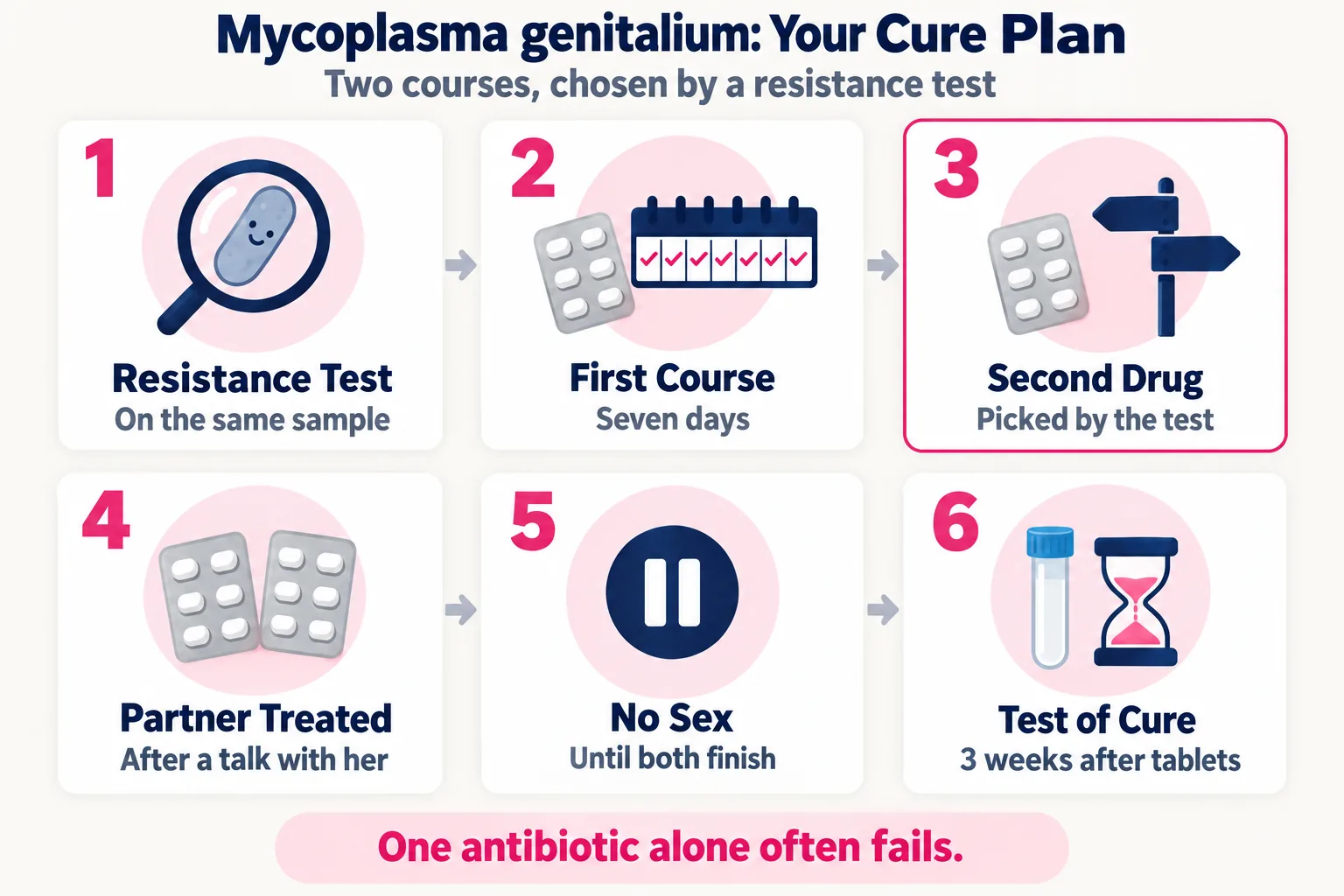
The two-step plan: resistance-guided treatment
Doxycycline is given first, for 7 days, because it lowers the number of germs (CDC, 2021). Then the second drug depends on the resistance test:
- Sensitive strain: azithromycin 1 g, then 500 mg a day for 3 more days (CDC, 2021).
- Resistant strain: moxifloxacin 400 mg once a day for 7 days (CDC, 2021).
Moxifloxacin is not safe for everyone, because it can affect tendons and heart rhythm (standard prescribing advice). Your history and medicines are therefore checked first, and neither drug should ever be started on your own.
First two columns: Melbourne, doxycycline then the drug the resistance test chose. Third: 11 studies pooled (low certainty).
93.0%
85.0%
94.6%
then azithromycin
then moxifloxacin
Source: Vodstrcil, 2022 (Melbourne, 347 people); Bordignon, 2026 (11 studies pooled, low-to-very-low certainty).
In Melbourne, 93.0% of sensitive and 85.0% of resistant infections were cured this way (Vodstrcil, 2022). Overall, resistance-guided treatment cures more than 9 in 10 people in published studies, though most of the evidence is short-term and from one centre (CDC, 2021; Bordignon, 2026). In one UK clinic, treatment failure fell from 27% to 3% once resistance testing was used (Conway, 2021).
Is Mycoplasma genitalium 100% curable, and will it ever go away?
Not 100%, but over 90% with resistance-guided treatment in published studies (Bordignon, 2026). If both drugs fail, other options exist, though they cure fewer people (Jensen, 2022).
Left alone, it does not reliably go away. Some silent infections do clear (Horner, 2017), but no test can tell in advance which ones will.
Is Mycoplasma genitalium serious for men?
Usually not for the man himself. Data are insufficient to link it with epididymitis, prostatitis or infertility in men (CDC, 2021). For a female partner, though, it is linked with roughly double the risk of pelvic infection and some pregnancy problems (CDC, 2021).
Test of cure: why I recheck at 3 weeks
CDC guidelines do not recommend a test of cure after a recommended regimen if you have no symptoms (CDC, 2021). I still recheck, at least 3 weeks after the last tablet, because resistance is so common. That timing is my own practice.
A 2015 expert review advised no test earlier than three weeks after starting treatment (Moi, 2015), and Melbourne’s clinic tests 14–28 days after the last tablet (Vodstrcil, 2022).
Your partner needs treatment too
Your partner needs testing and treatment, or the infection passes straight back to you. All sex partners from the previous 60 days should be tested and treated (CDC, 2021). Many of them, however, will feel perfectly well (CDC, 2021).
Here is how I handle it, step by step:
- I speak to your partner. With your permission, I explain the result and the plan to her directly. I never treat anyone without their knowledge.
- She gets treatment that matches your result. If she is pregnant, may be pregnant or is breastfeeding, her treatment is chosen separately, because doxycycline and moxifloxacin are avoided in pregnancy. Tell me if any of these apply.
- No sex until both of you finish. That means at least 7 days, and until your symptoms have gone (CDC, 2021). For Mycoplasma, it means until both of you have finished the full two-step course, about 11–14 days, and your symptoms have settled.
- Both retest at about 3 months. For chlamydia, most infections found after treatment are reinfections, not treatment failures (CDC, 2021).
The same steps apply if your partner is a man.
Expedited partner therapy, and why I speak to her first
In trials, giving patients treatment to pass to their partners cut repeat chlamydia or gonorrhoea by about a quarter, compared with simply telling partners (Trelle, 2007). Some guidelines allow this expedited partner therapy when a partner cannot get care in time (CDC, 2021). I prefer to speak to her first, so she knows what she is taking and why.
Exact days depend on the germ found.
Source: Dr Shah’s protocol; CDC, 2021 (abstinence, partners, 3-month retest).
Reinfection, and the “did she cheat?” worry
Reinfection really is common. In a Dutch home-testing study, 8.8% of people treated for chlamydia were positive again at 6 months (Götz, 2013), so the 3-month retest is not optional.
“Does this mean she cheated?” Not necessarily. Mycoplasma and chlamydia often cause no symptoms (Horner, 2017; Hocking, 2023), so either partner can carry one without knowing. In one US study of 7 men whose Mycoplasma survived azithromycin, it persisted for a median of 143 days before effective treatment (Romano, 2019).
A positive result cannot say when it was caught, or from whom. If fear or guilt is taking over, my page on STD and HIV fear may help.
If this followed a single risky encounter in the last 72 hours, ask about HIV PEP too, and see my guide to a condom break or unprotected sex.
7 rules during treatment
The tablets do the work, but these seven rules make sure they can.
- Finish every tablet, even when the burning stops on day 2. In one US emergency-department study, 18% of patients treated for chlamydia never collected their doxycycline, and they were 3 times more likely to come back with the same complaint (Apato, 2024).
- No sexual intercourse until you and your partner have both finished and your symptoms have gone (CDC, 2021). I also advise no oral sex in that time, and for Mycoplasma, no sex until the full two-step course is done.
- Take doxycycline with a full glass of water, sitting or standing, and not just before bed, because this protects your food pipe (standard doxycycline prescribing advice).
- Keep doxycycline 2–3 hours away from milk, curd, antacids, iron and calcium tablets, since they stop it being absorbed (standard prescribing advice).
- Cover up in strong sun. Doxycycline can make the skin burn more easily.
- Drink enough water. Diluted urine stings less. It eases the symptom; it does not cure the infection.
- Never share or save tablets. A half course for a friend helps no one, and breeds resistance.
How to calm an inflamed urethra while the tablets work
Drink water through the day, avoid friction and sex, and wear loose cotton underwear. These steps ease the burning, but only an antibiotic matched to the germ clears it.
Does urethritis go away on its own?
NGU does not reliably go away on its own. Symptoms may ease while the germ stays, and it could still pass to a partner.
In a Dutch study, all 7 men whose Mycoplasma survived azithromycin, and who had no second drug, were still positive at 6 weeks, even as their symptoms generally improved (Adriaens, 2026). Feeling better, in other words, is not proof of cure.
Some silent infections do clear eventually (Horner, 2017). But you cannot know which ones, and meanwhile your partner is exposed. For this reason, I treat every proven infection.
How long does urethritis last after treatment?
In a Ugandan study of men given standard syndromic treatment, symptoms settled in a median of 4 days, but about 1 in 6 (16%) still had symptoms at day 14 (Pasco, 2025).
If the burning lasts beyond 2 weeks after treatment, come back, and do not start another course on your own.
How long can urethral irritation last?
For some men, 2 weeks or longer, as the Ugandan figures above show. When burning persists with no sign of inflammation on testing, symptoms alone are not a reason for more antibiotics (CDC, 2021). It needs a different explanation.
Still burning after antibiotics? 7 reasons NGU comes back
The commonest cause of NGU that persists or returns is Mycoplasma genitalium, especially after doxycycline alone (CDC, 2021). In one Birmingham audit, 8% of 533 treated men came back within 3 months (Ng, 2016).
Men who returned with urethritis within 3 months; each germ was tested in a different number of men.
Source: Ng, 2016 (Birmingham audit; 43 of 533 men re-attended). CDC 2021: Mycoplasma causes about 40% of persistent or recurrent urethritis.
Persistent non-gonococcal urethritis: the 7 common reasons
These are the seven reasons to check:
- Mycoplasma not cleared. Doxycycline alone often fails against it (Jensen, 2022).
- A partner was not treated, so the germ came straight back (CDC, 2021).
- Tablets never collected, missed or stopped early. Checking this is the first step (CDC, 2021).
- Sex too soon, before both of you had finished.
- A germ was never tested for, such as trichomonas (CDC, 2021).
- It was not the urethra at all. Pain for over 3 months may be chronic prostatitis or pelvic pain (CDC, 2021).
- Tested too soon. A chlamydia DNA test within 4 weeks of finishing treatment can pick up dead germs (CDC, 2021). For Mycoplasma, I do the test of cure at least 3 weeks after the last tablet.
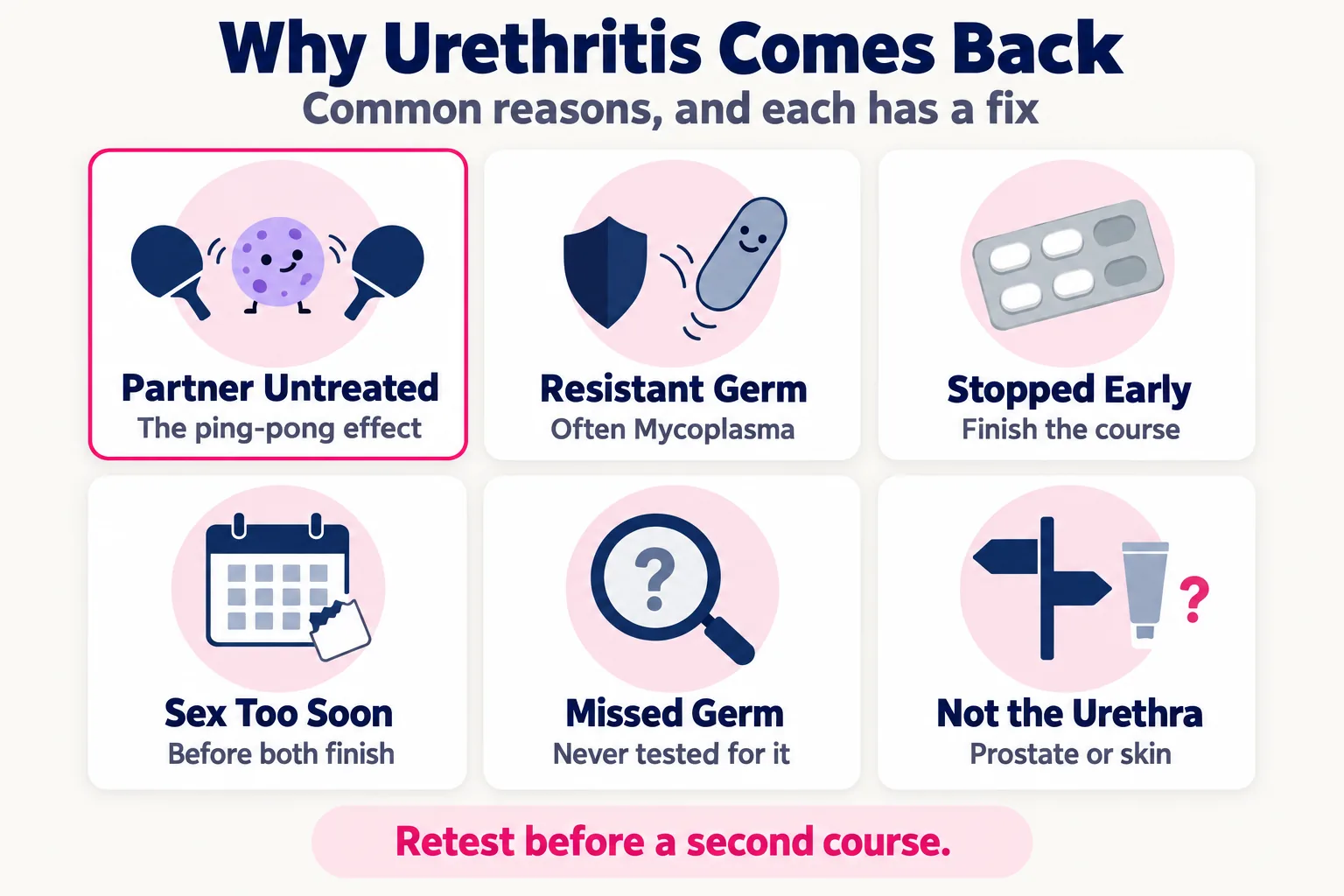
What happens at the return visit
When a man comes back with burning, a stronger prescription is not the answer, because higher doses of azithromycin do not work after it has failed (CDC, 2021). These are the steps to follow.
No second course until the first steps are done.
1
2
3
Source: CDC, 2021 (persistent and recurrent NGU).
Longer antibiotic courses have not been shown to help persistent symptoms without real inflammation (CDC, 2021). If that is you, my pages on prostatitis and pus cells in semen explain the other causes.
5 complications of untreated urethritis
Most men treated promptly have no lasting problem. When NGU has no identifiable germ, no complications have been found at all (CDC, 2021). The risks below apply mainly to untreated chlamydia.
- Epididymitis. Infection spreads to the coiled tube behind the testicle (CDC, 2021). In Japanese men under 40 with epididymitis, half had chlamydia (Ito, 2012).
- Reactive arthritis. Painful joints, sometimes with sore eyes, after chlamydia (CDC, 2021). It is rare and has become rarer (Mason, 2016).
- Easier HIV spread. NGU might make HIV easier to pass on (CDC, 2021): in people with HIV, urethritis roughly triples the odds of the virus being found in genital fluids (Johnson, 2008). Get tested for HIV and AIDS, and see the HIV window period for timing.
- Semen quality. Some genital infections are linked with poorer semen, and treating them can improve it. There is no proof it improves the chance of pregnancy (Vives Suñé, 2026). Mycoplasma itself was not linked with male infertility in one review (Huang, 2015).
- Your partner’s health. This is the biggest risk. In women, Mycoplasma is linked with pelvic infection (Htaik, 2026), and untreated chlamydia can cause infertility (Hocking, 2023).
If you are trying for a baby, read my page on male infertility. Treating an infection is often one simple step in that plan.
Common myths
Urethritis in men: myths vs facts
Myth: burning means a UTI
In young men it is usually an STD. In a US claims study, over half of men’s delayed-STI episodes had first been labelled a UTI (Kuritzky, 2023).
Myth: a normal urine report rules it out
A routine urine culture is not designed to grow chlamydia or Mycoplasma. Even a specialised culture missed most infections a DNA urine test found (Chernesky, 2003).
Myth: no discharge, no infection
Burning alone, with no discharge, is a common pattern of urethritis (Nayak, 2017).
Myth: it clears by itself
When azithromycin failed, Mycoplasma persisted for months in one study (Romano, 2019).
Myth: a stronger dose fixes a failure
Higher azithromycin doses do not work after it fails (CDC, 2021). A resistance test does.
Myth: only I need treatment
Without treating your partner, it returns. For chlamydia, most infections after treatment are reinfections (CDC, 2021).
These myths cause many delays. If one has already cost you a course of tablets, you are not alone, and it is easily put right with the correct test.
Home remedies for urethritis: what eases the burning, and what never cures it
No home remedy cures urethritis. The germ needs an antibiotic matched to it. But a few simple steps can ease the burning while you wait for results or take the tablets.
- Water through the day. Diluted urine stings less.
- Rest the area. No sex, and avoid friction.
- Loose cotton underwear, and wash with plain water.
What not to do: do not apply antiseptics, creams or powders inside the tip, and do not take leftover antibiotics. One in 10 men with new NGU had treated himself first, for about a week on average (Carlin, 1995).
About a third of them used antibiotics, mostly without a prescription; the rest used antiseptics, vitamins and creams (Carlin, 1995). In other words, self-treatment hides the symptoms, not the germ.
It can also affect test results (Carlin, 1995) and breed resistance. The safer rule is simple: test first, every time.
How to avoid urethritis: 5 ways to prevent it
- Condoms, every time. Consistent use reduces chlamydia, gonorrhoea and trichomonas (CDC, 2021). Most failures come from inconsistent use, not breakage (CDC, 2021).
- Remember oral sex. Viruses and throat bacteria reach the penis this way (CDC, 2021).
- Treat both partners together, every time either of you tests positive.
- Retest at 3 months after chlamydia, gonorrhoea or trichomonas (CDC, 2021), and after any infection, in my practice.
- Test before a new relationship, with an STD panel for both of you.
A massage parlour visit that ended in sex, or a new partner without a condom, is a reason to test even if you feel fine.
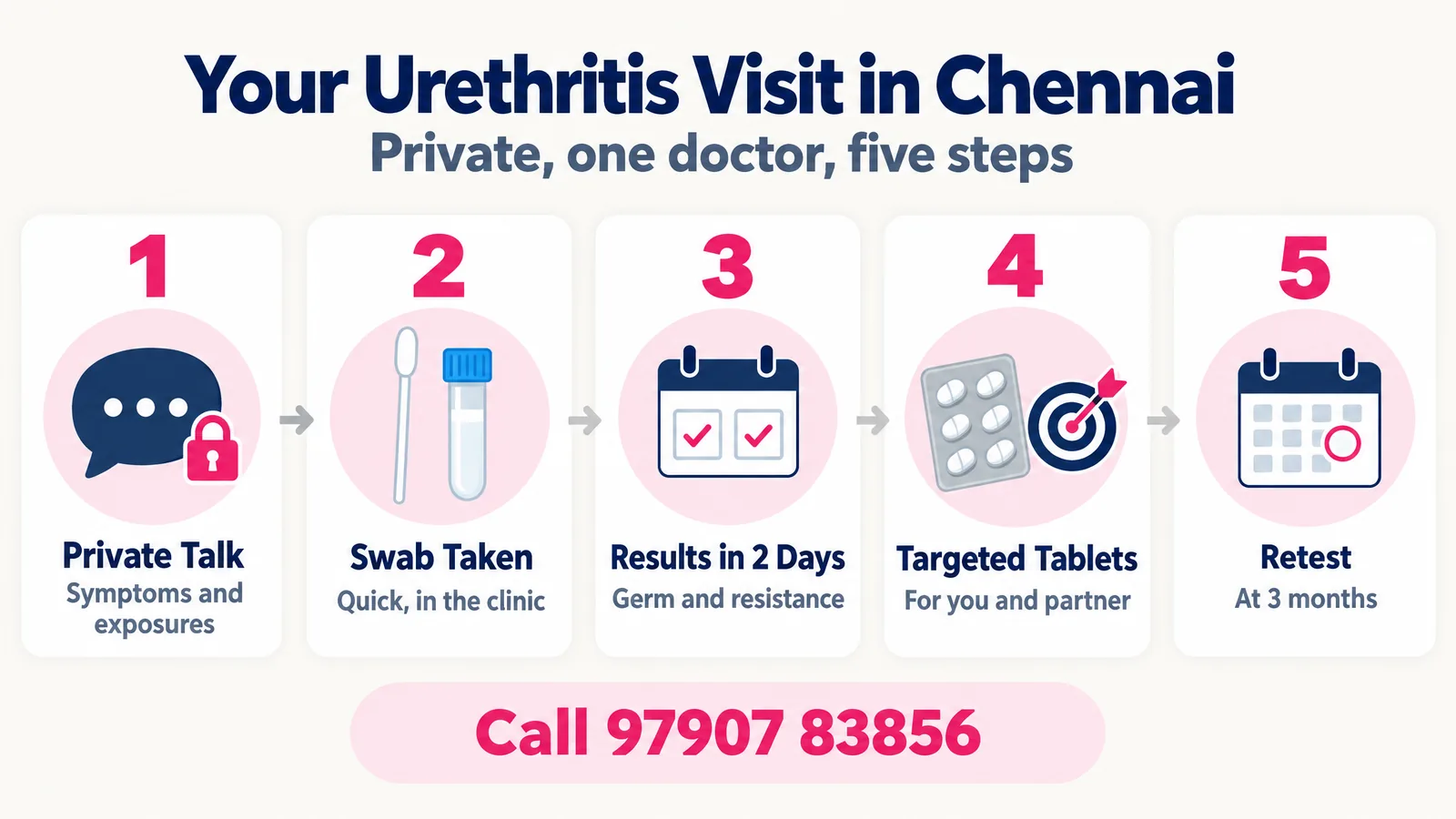
Urethritis treatment in Chennai: what a visit involves
Here is what happens when you come to my clinic in T Nagar for burning urine or discharge:
- A private talk. Your symptoms, your partners, and any tablets or reports you already have.
- A gentle examination of the tip of the penis, the foreskin and the testicles.
- A Gram stain on the swab, in the clinic, when it is needed to confirm inflammation.
- One swab or first-urine sample for the NAAT panel, with a Mycoplasma resistance check. Results in 2 days.
- Blood tests for HIV, syphilis, hepatitis B and hepatitis C, for every man.
- Targeted treatment for you. Your partner’s treatment is matched to your result after I speak to her, and chosen separately if she is pregnant or breastfeeding. When symptoms are severe, treatment starts at this first visit.
- A retest plan, so you know when you are truly clear.
How much does urethritis treatment cost in Chennai?
The tests you need depend on your history, so no single price is quoted here. Call or WhatsApp 97907 83856, and we will tell you exactly what your visit includes.
No 21, Sree Kalki Apartments, Ground Floor, Bazullah Road, T-Nagar, Chennai 600017
+91 97907 83856 · WhatsApp · Mon–Sat, 9:00 AM–6:00 PM · Sudden, severe testicle pain: call any time
Men visit from across Chennai, including T Nagar, Anna Nagar, Velachery and Adyar. Your visit is private, and nothing you tell me is shared. For other infections, see the syphilis and genital warts pages.
Private consultation
Test first, then the drug that matches the germ
Examination, a PCR panel for the main germs, including Mycoplasma and Ureaplasma, with results in 2 days, HIV, syphilis and hepatitis blood tests, and targeted treatment for you and your partner, from a practising andrologist in Chennai.
Urethritis in men: FAQs
What is non-gonococcal urethritis and what are its causes in men?
NGU, non-gonococcal urethritis, is inflammation of the urine tube not caused by gonorrhoea. In the UK it is also called NSU, non-specific urethritis. Chlamydia and Mycoplasma genitalium are the commonest causes, and antibiotics treat it.
What causes urethritis?
In men, mostly sexually transmitted germs: gonorrhoea, chlamydia, Mycoplasma genitalium and trichomonas. Viruses and throat bacteria spread by oral sex cause some cases. In about half of NGU, no germ is found (CDC, 2021).
What causes discomfort in the urethra?
Usually urethritis from a sexually transmitted germ. A urinary infection, prostatitis or a sore foreskin (balanitis) can feel similar. An examination and a swab or first-urine NAAT panel tell them apart.
How is urethra pain treated in men?
By treating the cause. A swab or first-urine panel names the germ in 2 days, and the matching antibiotic settles the pain in most men within days. Pain lasting months needs a prostate and pelvic assessment.
Can Mycoplasma genitalium occur naturally?
It is not known to arise on its own. It passes through direct contact during sex (Jensen, 2022). No study links it to toilet seats or hugging.
How to stop burning urination in a male, and what to drink?
Treat the cause: a swab or urine NAAT test, then the antibiotic that matches the germ. Meanwhile, plain water through the day makes urine sting less. Burning after a new partner, or burning that keeps returning, needs a test.
Is NGU the same as chlamydia?
No. Chlamydia is one cause of NGU, the commonest single one. But in most men with NGU the test finds another germ, such as Mycoplasma, or none at all (Jordan, 2020a).
Can a man get urethritis without an STD?
Yes, sometimes. Urethritis can have non-infectious causes (CDC, 2021), and in older men a urinary infection, often linked with an enlarged prostate, can cause burning. In young, sexually active men, though, an STD is the usual cause.
Why would it burn when I pee as a man, and what can be mistaken for a UTI in males?
The commonest reasons are urethritis from an STD, a urinary tract infection, prostatitis or balanitis. Urethritis, prostatitis and balanitis can all be mistaken for a UTI. A new partner points to urethritis, and a NAAT panel sorts them out.
Is Mycoplasma genitalium an STD or an STI?
Both terms mean the same thing. Mycoplasma genitalium is a sexually transmitted bacterium, passed by direct contact during sex (Jensen, 2022). Many doctors say STI because most infected people have no symptoms.
Does Mycoplasma genitalium mean my partner cheated?
Not necessarily. It often causes no symptoms (Horner, 2017), so a positive test cannot say when it was caught, or from whom. Treat both of you, and talk it through calmly.
What are the treatment options for white or yellow discharge in males?
Treatment depends on the germ, which a swab NAAT panel names in 2 days. Chlamydia gets doxycycline, gonorrhoea an injection, trichomonas metronidazole, and Mycoplasma a two-step course. Severe symptoms are treated the same day.
Why does my UTI pain come and go?
If it is really urethritis, symptoms can ease while the germ stays. In one Dutch study, Mycoplasma that survived azithromycin persisted as symptoms improved (Adriaens, 2026). Get a NAAT panel rather than another UTI course.
What could be causing sharp pain in my urethra that isn’t associated with urination?
Urethritis can do it, but so can prostatitis, pelvic muscle tension or, rarely, a stone. Sharp pain with fever, blood or testicle swelling needs a same-day examination.
Is Mycoplasma genitalium macrolide resistant?
Often. By 2018 to 2021, about a third of strains worldwide resisted azithromycin, a macrolide (Chua, 2025), and in parts of Europe two-thirds or more. That is why every Mycoplasma I find is tested for resistance.
What is a man’s tip hole called, and what causes swelling in the urethral opening?
The opening at the tip of the penis is the urethral meatus. A red, sore or swollen opening, called meatitis, is more typical of viral urethritis such as adenovirus or herpes (Samaraweera, 2016; CDC, 2021).
Is NGU an STD?
Often, yes. The germs found in NGU, such as chlamydia and Mycoplasma, are sexually transmitted. In about half of men no germ is found, and those cases have not been linked with harm to partners (CDC, 2021).
What is the best medicine and first-line treatment for urethritis?
The one that matches the germ. Doxycycline 100 mg twice a day for 7 days is the recommended NGU treatment (CDC, 2021). Ceftriaxone treats gonorrhoea, metronidazole trichomonas, and a resistance-guided pair Mycoplasma.
Which antibiotics treat Mycoplasma genitalium (Mgen)?
Doxycycline for 7 days first, to lower the germ load, then azithromycin if the strain is sensitive or moxifloxacin if it is resistant (CDC, 2021). Doxycycline alone clears only 30 to 40% (Jensen, 2022).
How to treat Mycoplasma found in urine?
A positive urine NAAT is treated exactly like a swab result: doxycycline first, then azithromycin or moxifloxacin depending on resistance. Do not treat it with ordinary UTI tablets.
Will burning pee go away?
If it is urethritis, it usually settles within days of the antibiotic that matches the germ. Burning that keeps returning is often Mycoplasma or an untreated partner, and needs retesting, not more tablets.
How to stop urethral discharge?
Treat the germ causing it. A swab test names it in 2 days, and the matching antibiotic stops the discharge in most men. Squeezing or washing inside the tip does not help.
Is it normal to have discharge from your urethra?
Clear fluid during arousal, and semen, are normal. A drop that appears on its own, stains your underwear or comes with burning is not. That needs a test.
Can I have sex while being treated for NGU?
No. Avoid sexual intercourse until you both finish treatment and symptoms have gone, at least 7 days (CDC, 2021); I also advise no oral sex. For Mycoplasma, wait until both finish the two-step course, about 11 to 14 days.
Is NGU contagious?
Yes, when it is caused by a germ such as chlamydia or Mycoplasma. It passes through sex, including oral sex for some germs. Your partner needs testing and treatment.
Can women get NGU?
NGU is a diagnosis made in men. In women the same germs mainly infect the cervix, though they can also inflame the urethra. They can cause pelvic infection, which is why partners are treated.
Is urethritis the same as a urethral stricture?
No. Urethritis is inflammation, usually from infection.
A stricture is a narrowing of the tube from scarring, which slows the urine stream. They need different tests and treatment.
Can urethritis cause infertility?
Untreated chlamydia can spread to the epididymis, and some infections are linked with poorer semen. Prompt treatment of you and your partner lowers the risk of complications, especially for her.
Should I get tested if my partner has chlamydia or Mycoplasma?
Yes, even if you feel fine. Partners very often carry the same germ. You need a test and treatment, and both of you should avoid sex until you finish.
Who should I see for urethritis in Chennai?
A doctor who tests for the main germs, including Mycoplasma with a resistance check, and treats your partner. I see men privately in T Nagar. Call or WhatsApp 97907 83856.
The bottom line on urethritis in men
Urethritis is common and curable, but it is not one disease. Get a DNA panel, not just a routine urine report. For mild symptoms, wait for the result, take the drug that matches the germ, and treat your partner too.
Then retest, and do not keep swallowing “UTI” tablets. This is Dr Shah, consultant andrologist in Chennai.
Call or WhatsApp 97907 83856. Nothing you say leaves the room.
References
Guidelines, definitions and causes
- Workowski KA, et al. Sexually Transmitted Infections Treatment Guidelines, 2021. 2021. PMID 34292926.
- Moi H, et al. Management of non-gonococcal urethritis. 2015. PMID 26220178.
- Jensen JS, et al. 2021 European guideline on the management of Mycoplasma genitalium infections. 2022. PMID 35182080.
- Horner PJ, et al. 2016 European guideline on the management of non-gonococcal urethritis. 2016. PMID 27147267.
- Horner PJ, et al. Mycoplasma genitalium Infection in Men. 2017. PMID 28838074.
- Horner P, et al. Should we be testing for urogenital Mycoplasma hominis, Ureaplasma parvum and Ureaplasma urealyticum in men and women? – a position statement from the European STI Guidelines Editorial Board. 2018. PMID 29924422.
- Jordan SJ, et al. Aetiology and prevalence of mixed-infections and mono-infections in non-gonococcal urethritis in men: a case-control study. 2020a. PMID 31515293.
- Jordan SJ, et al. No Pathogen-Specific Sign or Symptom Predicts the Etiology of Monomicrobial Nongonococcal Urethritis in Men. 2020b. PMID 32149960.
- Ito S, et al. Male non-gonococcal urethritis: From microbiological etiologies to demographic and clinical features. 2016. PMID 26845624.
- Srinivasan S, et al. Urethral Microbiota in Men: Association of Haemophilus influenzae and Mycoplasma penetrans With Nongonococcal Urethritis. 2021. PMID 32750107.
- Becker M, et al. Etiology and determinants of sexually transmitted infections in Karnataka state, south India. 2010. PMID 19901864.
- Nayak AK, et al. A clinico-etiological study of urethritis in men attending sexually transmitted disease clinic at a tertiary hospital. 2017. PMID 30148266.
- Rawre J, et al. Distribution of. 2019. PMID 31417035.
- Manhas A, et al. Association of genital mycoplasmas including Mycoplasma genitalium in HIV infected men with nongonococcal urethritis attending STD & HIV clinics. 2009. PMID 19491424.
- Samaraweera GR, et al. Characteristics of adenovirus urethritis among heterosexual men and men who have sex with men: a review of clinical cases. 2016. PMID 26574571.
- Avolio M, et al. When should adenoviral non-gonococcal urethritis be suspected? Two case reports. 2014. PMID 24531179.
- Vives A, et al. Epidemiological, clinical and laboratory differences between male urethral infections due to Haemophilus spp. and those due to Neisseria gonorrhoeae, Chlamydia trachomatis, Mycoplasma genitalium and Ureaplasma urealyticum: A descriptive study. 2021. PMID 34933533.
- Deza G, et al. Isolation of Haemophilus influenzae and Haemophilus parainfluenzae in urethral exudates from men with acute urethritis: a descriptive study of 52 cases. 2016. PMID 26139207.
- Kuritzky L, et al. Potential delayed and/or missed STI diagnoses among outpatients presenting with lower genitourinary tract symptoms: a real-world database study. 2023. PMID 37961909.
- Carlin EM, et al. How common is self-treatment in non gonococcal urethritis?. 1995. PMID 8566983.
Symptoms and testing
- Chandeying V, et al. Can a two-glass urine test or leucocyte esterase test of first-void urine improve syndromic management of male urethritis in southern Thailand?. 2000. PMID 10772086.
- Hocking JS, et al. Update on the Epidemiology, Screening, and Management of Chlamydia trachomatis Infection. 2023. PMID 37005162.
- Rowlinson E, et al. Incidence of Nongonococcal Urethritis in Men Who Have Sex With Women and Associated Risk Factors. 2021. PMID 33044377.
- Lee SS, et al. Emergence of antibiotic-resistant Mycoplasma genitalium as the cause of non-gonococcal urethritis in male patients at a sexually transmitted infection clinic. 2022. PMID 34971729.
- Werner RN, et al. German evidence- and consensus-based guideline on the management of penile urethritis. 2025. PMID 39822084.
- Chernesky M, et al. Impact of urine collection order on the ability of assays to identify Chlamydia trachomatis infections in men. 2003. PMID 12671557.
- Sarier M, et al. Microscopy of Gram-stained urethral smear in the diagnosis of urethritis: Which threshold value should be selected?. 2018. PMID 30238498.
- Bowden FJ. Reappraising the value of urine leukocyte esterase testing in the age of nucleic acid amplification. 1998. PMID 9662768.
- Aggarwal A, et al. Prevalence of Chlamydia trachomatis, Ureaplasma spp., Mycoplasma hominis and Mycoplasma genitalium in patients with sterile pyuria. 2026. PMID 41308921.
- Shishniashvili D, et al. FIRST-VOID URINE VERSUS URETHRAL SWAB FOR MOLECULAR DETECTION OF SEXUALLY TRANSMITTED INFECTIONS IN MEN WITH MULTIPLE SEXUAL PARTNERS. 2026. PMID 42830059.
Treatment and Mycoplasma resistance
- Ben Said L, et al. Partner treatment strategies for Chlamydia and Gonorrhea: Time for a reappraisal. 2025. PMID 39947479.
- Schwebke JR, et al. Re-evaluating the treatment of nongonococcal urethritis: emphasizing emerging pathogens–a randomized clinical trial. 2011. PMID 21288838.
- Manhart LE, et al. Standard treatment regimens for nongonococcal urethritis have similar but declining cure rates: a randomized controlled trial. 2013. PMID 23223595.
- Anagrius C, et al. Treatment of Mycoplasma genitalium. Observations from a Swedish STD clinic. 2013. PMID 23593483.
- Chua TP, et al. Evolving patterns of macrolide and fluoroquinolone resistance in Mycoplasma genitalium: an updated systematic review and meta-analysis. 2025. PMID 40147462.
- Tsai MJ, et al. Mycoplasma genitalium infection and resistance-associated mutations to macrolides and fluoroquinolones among high-risk patients in Taiwan. 2024. PMID 38777653.
- Drud ST, et al. Changes in prevalence of. 2023. PMID 37704364.
- Biswal D, et al. Macrolide and fluoroquinolone resistance associated mutations in Mycoplasma genitalium in men who have sex with men attending STI clinic: A pilot study from India. 2024. PMID 38899414.
- Chromy D, et al. High cure rates of Mycoplasma genitalium following empiric treatment with azithromycin alongside frequent detection of macrolide resistance in Austria. 2024. PMID 38649669.
- Conway RJ, et al. Resistance-guided treatment of. 2021. PMID 33755520.
- Adriaens N, et al. Antibiotic resistance mutations in Mycoplasma genitalium and non-gonococcal urethritis treatment outcomes. 2026. PMID 42740648.
- Matthews LG, et al. Declining Efficacy of Moxifloxacin for Mycoplasma genitalium Infection: Time for Fluoroquinolone Resistance-Guided Therapy?. 2026. PMID 42100861.
- Vodstrcil LA, et al. Combination Therapy for Mycoplasma genitalium, and New Insights Into the Utility of parC Mutant Detection to Improve Cure. 2022. PMID 34984438.
- Bordignon AL, et al. Declining Fluoroquinolone Efficacy in Resistance-Guided Therapy for Mycoplasma genitalium: A Systematic Review and Meta-Analysis of Microbiological Cure. 2026. PMID 42751736.
Partners, natural history and recurrence
- Trelle S, et al. Improved effectiveness of partner notification for patients with sexually transmitted infections: systematic review. 2007. PMID 17237298.
- Götz HM, et al. High yield of reinfections by home-based automatic rescreening of Chlamydia positives in a large-scale register-based screening programme and determinants of repeat infections. 2013. PMID 22728910.
- Romano SS, et al. Long Duration of Asymptomatic Mycoplasma genitalium Infection After Syndromic Treatment for Nongonococcal Urethritis. 2019. PMID 30281079.
- Apato A, et al. Doxycycline adherence for the management of Chlamydia trachomatis infections. 2024. PMID 38728936.
- Pasco C, et al. Post-treatment time to symptom resolution and associated factors in a cohort of Ugandan men with urethral discharge syndrome. 2025. PMID 40484936.
- Ng A, et al. Trichomonas vaginalis infection: How significant is it in men presenting with recurrent or persistent symptoms of urethritis?. 2016. PMID 25663246.
Complications
- Ito S, et al. Prevalence of genital mycoplasmas and ureaplasmas in men younger than 40 years-of-age with acute epididymitis. 2012. PMID 22142497.
- Mason E, et al. Reactive arthritis at the Sydney Sexual Health Centre 1992-2012: declining despite increasing chlamydia diagnoses. 2016. PMID 26378192.
- Johnson LF, et al. The effect of genital tract infections on HIV-1 shedding in the genital tract: a systematic review and meta-analysis. 2008. PMID 18685546.
- Vives Suñé Á, et al. Infection and inflammation of the seminal tract: A review of its relationship to male fertility. 2026. PMID 41500460.
- Huang C, et al. Mycoplasma and ureaplasma infection and male infertility: a systematic review and meta-analysis. 2015. PMID 26311339.
- Htaik K, et al. Systematic Review and Meta-analysis of the Association Between Mycoplasma genitalium and Pelvic Inflammatory Disease (PID). 2026. PMID 38845565.