
Can I use saliva as lube? Not for intercourse. Occasional use for masturbation is okay if you have no cold sore, mouth ulcer or sore throat.
Why? Saliva dries fast, adds friction, can carry herpes and gonorrhoea from mouth to genitals, and slows sperm.
Hello! Vanakkam and Namaste. This is Dr Shah Dupesh, consultant sexologist in Chennai.
“Doc, can I use saliva as lube?” This is probably the single most common question I get. Newly married couples ask it.
Young lovers ask it. Men who masturbate ask if spit on the penis does any harm.
Please do not feel shy about it. I answered it in a short video first.
A note on the video: I recorded it in 2021. The figures I quoted then for how fast sperm slow down do not appear in the studies.
Those studies show saliva slows sperm; they did not measure whether it kills them. You will find the updated facts, with the studies, below.
Spit as lube is free. It is always there. In the moment, it feels natural.
So I understand why so many people use it. But convenient is not the same as safe.
This page covers what saliva is and its twelve side effects as a lubricant. It covers who should never use it, what it does to sperm, and which lubricants are better.
Can I use saliva as lube? My answer for each situation
Can you use saliva during intercourse? My answer depends on whose saliva it is, and what you are doing.
For example, your own saliva during masturbation is one thing. A new partner’s saliva during anal sex is quite another.
Can I use saliva as lube? My answer, situation by situation
| Situation | My answer | What can go wrong |
|---|---|---|
| Masturbating with your own saliva | Okay now and then, if no cold sore, mouth ulcer or sore throat | Dries fast; friction can make the skin sore |
| A partner’s saliva on your penis | Risky with a new or casual partner | Can carry herpes or gonorrhoea from their mouth |
| Vaginal sex | Use a lubricant | Dries mid-way; linked with yeast infection |
| Anal sex | Avoid | Linked with rectal gonorrhoea |
| Trying to conceive | Avoid, and skip every other lube too | Slows sperm in lab tests; so do most lubes |
| With a condom | Water-based, or silicone labelled condom-safe | Not known to harm latex, but dries |
| Giving a semen sample | Never saliva; lube only if the lab gives it | Can affect the result |
The pattern is simple: the more partners involved, and the more delicate the skin, the worse saliva becomes. The rest of this page explains each row.
Seven things you have probably been told wrong about saliva as lube
- Saliva is not a natural antiseptic. The live gonorrhoea germ can be grown from the saliva of men with throat gonorrhoea (Chow, 2016b).
- Spit is not a contraceptive. It slows sperm. It does not replace contraception (Gonçalves Ferreira, 2014).
- Saliva was harder on sperm than every gel in one lab test. That included ordinary pleasure gels (Tomlinson, 2023).
- No study shows saliva stops every sperm. The 1982 study found sperm slowed down. At high saliva levels, 12% made a strange “shaking movement” (Tulandi, 1982).
- Anal sex is where the evidence against saliva is strongest. In men who have sex with men, a partner’s saliva for anal sex was linked with about twice the odds of rectal gonorrhoea (Chow, 2016a).
- Your own saliva for masturbation is not a proven gonorrhoea risk. A model suggested it (Xu, 2022). Real data from 3,114 men who have sex with men found no clear link (Tran, 2024).
- Oil is not “better than spit” with a condom. A minute of mineral oil badly weakened latex condoms in a lab test (Voeller, 1989).
Those are the facts most websites get wrong. Now, here is what to actually do, in one minute.
Saliva as lube in 60 seconds
Alone? Your own saliva is okay
For masturbation, now and then, it is low risk if you have no cold sore, mouth ulcer or sore throat. It just dries fast.
With a partner? Use a real lube
A partner’s saliva can carry herpes or gonorrhoea. A water-based lube avoids that.
Never for anal sex
This is where saliva is most strongly linked with infection. Use a proper lube and a condom.
Trying for a baby? Use no lube at all
Saliva slows sperm, and so do most lubes. Sperm-friendly ones add nothing proven. Give foreplay more time.
Condom? Water-based, or condom-safe silicone
Never baby oil, petroleum jelly or other oils with a latex condom.
Symptoms? Get checked
Burning, a discharge or a sore after a partner’s saliva needs a test, not more lube.
Is saliva a good lubricant? What is in it, and why it falls short
No, saliva is not a good lubricant. It has two jobs, and neither of them is sex. First, it starts digestion.
Enzymes such as amylase begin to break down starch. Second, it protects the mouth.
Saliva is mostly water. The slippery feel comes from mucins, such as MUC5B, which coat the mouth (Faruque, 2022).
It also carries defence proteins such as lysozyme and IgA. These keep the mouth’s own bacteria in check (Lynge Pedersen, 2019).
All this works well in a wet mouth that keeps refilling itself. But on the skin, it is different. The water evaporates.
The mucins thin out. So you are soon left with a tacky, dry film.
Doesn’t saliva kill germs?
Only inside the mouth, and only against the mouth’s usual visitors. Saliva does not sterilise itself. The live gonorrhoea germ can be grown from the saliva of men with throat gonorrhoea, and its genetic material is found there in large amounts (Chow, 2016b).
How many people use saliva as a lubricant?
Lubricants in general are very common. In a US national survey, 70% of men and 65.5% of women had used one (Reece, 2014; Herbenick, 2014).
Saliva is harder to count. That is because most surveys ask only about bought products.
The best counts come from studies of men who have sex with men. In San Francisco, 87% had used saliva for anal sex at some point (Butler, 2009). In a Chinese survey of 1,142 men, 19.7% had used it in the past three months (Li, 2025).
About half of them used it for masturbation. Saliva use was also more common in men who met partners on dating apps (Chow, 2018).
12 side effects and risks of using saliva as a lubricant
Here are the twelve disadvantages of spit as lube. I have grouped them by what is at stake.
Some apply to everyone. Others matter only in certain situations, and I say so where that is the case.
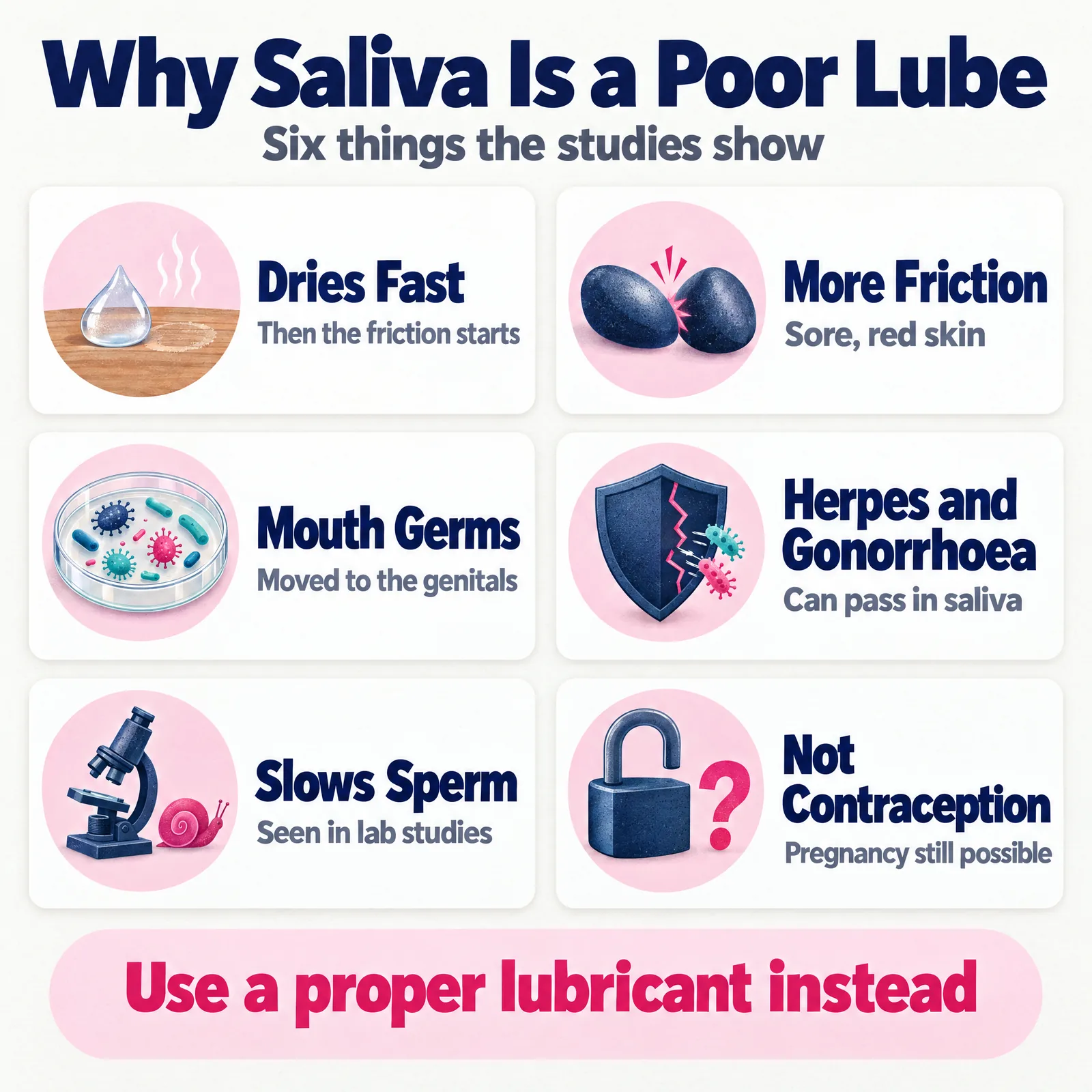
That card is the summary, so here is each side effect in detail.
Side effects on your skin and comfort (1 to 3)
1. It dries out fast
Saliva is mostly water, so it evaporates fast on warm skin. A lubricant must stay slippery for the whole act. Saliva loses its slip long before that.
So people stop to spit again, and again. That hardly helps the mood.
2. Dry friction makes the skin sore
Once saliva dries, the film turns tacky and the friction comes straight back. The skin of the penis head, the inner foreskin and the vagina is thin. So repeated dry rubbing leaves it red and sore, with tiny splits.
This matters most if you have a short, tight band under the head of the penis. That is because friction is exactly how that band tears.
I explain this in my guide to frenulum breve. A sore, red penis head can also look like an infection; see my balanitis page.
3. It was made for food, not for genitals
Saliva carries digestive enzymes and the mouth’s own bacteria (Lynge Pedersen, 2019). These are healthy in the mouth.
But on the genitals they are out of place. And what they bring depends on whose mouth they came from.
Infection risks (4 to 7)
Your own saliva cannot give you an infection you do not already carry. But it can move one you have, such as a cold sore, to your genitals. A partner’s saliva brings whatever lives in their mouth and throat.
4. A cold sore can become genital herpes
Cold sores are caused by herpes simplex virus type 1 (HSV-1). If saliva carrying the virus touches the genitals, it can cause genital herpes. In a large US model, more than 85% of genital HSV-1 infections came from oral-to-genital contact (Ayoub, 2019).
In Europe, HSV-1 now causes about a third of all genital herpes. It also causes about half of first episodes (Yousuf, 2020).
It can also infect the urine passage. In men with herpes urethritis, 68% of cases were HSV-1 (Ong, 2017).
So never use a partner’s saliva, or have oral sex, while either of you has a cold sore. My genital herpes guide explains the treatment.
One correction. This page used to say herpes causes genital warts. That was wrong.
Genital warts come from HPV, a different virus. See my genital warts guide.
5. Gonorrhoea can live in saliva
Throat gonorrhoea often causes no symptoms. Even so, the live germ can be grown from saliva (Chow, 2016b).
Some researchers argue that saliva plays a bigger part in spreading gonorrhoea than once believed (Chow, 2019; Fairley, 2019). But this is still debated.
For masturbation, the picture is less clear. One model suggested about one in four cases of urethral gonorrhoea could come from saliva used during masturbation (Xu, 2022).
But a real-world study of 3,114 men who have sex with men found no clear link (Tran, 2024). My gonorrhoea guide covers testing.
6. Saliva for anal sex is the riskiest use of all
Here the evidence is strongest. A Melbourne clinic studied 1,312 men who have sex with men.
Using a partner’s saliva as anal lube was linked with about twice the odds of rectal gonorrhoea (Chow, 2016a). The authors estimated that roughly half of those rectal gonorrhoea cases might be prevented without it.
In a San Francisco clinic, spit as lube was linked with a positive rectal infection test (Lee, 2021). For chlamydia, the link was weaker and faded after other risks were counted (Cornelisse, 2018).
So for anal sex, my advice is simple. Use a proper lubricant, and a condom, every time.
7. Other germs can ride along
The throat carries more than gonorrhoea. Neisseria meningitidis is a relative of the gonorrhoea germ that usually lives in the throat.
It is now a known cause of urethritis, the burning and discharge of an inflamed urine passage (Takahashi, 2023). It also caused an outbreak of urethritis in Vietnam (Nguyen, 2023).
That said, oral sex alone did not clearly raise the odds of non-gonococcal urethritis in one clinic study (Chambers, 2019). HIV passing through saliva is rarely known to occur.
In fact, in the lab, saliva even blocked the virus (Peacocke, 2012). The HIV risk comes from the sex itself, so a condom is still needed.
Hepatitis B can be found in saliva (Butler, 2009). But spread this way is rare, and the vaccine protects you. My hepatitis B guide explains the vaccine.
Her vaginal health (8 and 9)
8. It is linked with vaginal yeast infection
A vaginal yeast (fungal) infection is also called thrush. It is common. Receiving oral sex has been linked with it in several studies.
In one, women who received oral sex twice or more in two weeks had 3.5 times the odds (Geiger, 1996). Other studies also found links with infection or with yeast being present (Bradshaw, 2005; Brown, 2019).
But bacterial vaginosis (BV) is different. It was linked mainly with new and multiple partners, not with oral sex (Bradshaw, 2005). And in women treated for repeated yeast infection, oral sex made no difference to the treatment (Grinceviciene, 2018).
So there is a link, but these studies cannot prove saliva causes yeast infection. While she has symptoms, skipping saliva is a harmless precaution. For repeated infection, treatment matters more than changing sexual habits.
9. It is not matched to the vagina’s acidity
A healthy vagina is acidic. That acidity helps keep unwanted germs in check. Saliva, however, is close to neutral.
In one study its average pH ran from about 6.9 to 7.2 (Gonçalves Ferreira, 2014). Its pH also shifts with food, drink and smoking.
No study has measured how far saliva moves the vagina’s balance. But guidance for doctors recommends lubricants within the right pH and concentration ranges for women prone to infections (Vanderschee, 2025). Saliva is made for neither.
Fertility (10)
10. It slows sperm, but it is not contraception
My video made the point strongly. The studies show saliva slows sperm. In a 1982 lab study, sperm mixed with saliva lost motility and forward movement (Tulandi, 1982).
At high saliva levels, 12% developed a “shaking movement”. So the authors said saliva should not be used as a vaginal lubricant by infertile couples.
A later study found sperm slowed rapidly in acidic saliva (Gonçalves Ferreira, 2014). The most striking result is recent.
In a 2023 test of lubricant gels, saliva was the “bad” comparison. It slowed sperm more than every gel tested at one hour, even pleasure gels (Tomlinson, 2023).
The direction holds up, though the exact numbers I once quoted did not. But slowing sperm is not stopping them.
Saliva does not replace contraception (Gonçalves Ferreira, 2014). If a condom slipped or split, see my page on what to do when a condom breaks.
Condoms and the bigger picture (11 and 12)
11. It is a poor partner for condoms
Saliva is not known to damage latex. The problem is that it dries, and a dry condom drags. In a study of 268 couples, a water-based lube cut breakage of older condoms from 4.5% to 2.1% (Steiner, 1994).
But it made slipping a little more common. Skipping water-based lube is one of the commonest condom mistakes (Sanders, 2012).
Breakage of older latex condoms in a study of 268 couples
Source: Steiner, 1994.
The bigger danger is what people reach for when saliva runs out. Sixty seconds of pure mineral oil, the main ingredient of baby oil, cut a latex condom’s burst volume by about 90% (Voeller, 1989). Baby oil cut burst time from nearly a minute to about 11 seconds (Rosen, 1999).
12. It can hide the real problem
Sometimes, needing lots of saliva is itself a clue. Dryness and pain can come from nerves or too little foreplay.
They can also come from a short frenulum in him, or vaginal dryness in her. Lubricant helps with dryness, pain and sexual difficulties (Vanderschee, 2025).
But lube should support treatment, not replace it. Is sex painful every time? Do erections fade before you finish?
Then see a doctor, not the spit. Her gynaecologist can check for dryness. I can check the man’s side.
Oral sex vs saliva as lube: is there a difference?
Here is a fair question I am often asked. With oral sex, the genitals are covered in saliva anyway.
So why does using it as lube matter? The answer is: partly the same, partly not.
The same: the infections are the same ones. Herpes, gonorrhoea, syphilis and HPV can pass during oral sex. So with a regular partner you already have oral sex with, their saliva for vaginal sex adds little new infection risk.
Different: saliva used as lube travels to places oral sex may not reach, especially the anus. That is where the gonorrhoea link is clearest (see side effect 6).
It is also used during intercourse, so friction and tiny splits come with it. And in the fertile days, it lands exactly where sperm need to swim.
Oral sex carries its own risks, which I cover on my page about STDs from oral sex. Saliva as lube adds the comfort problem, the anal-sex risk and the fertility problem on top.
Saliva on the penis: what men ask me
Many men reaching this page are not asking about partner sex at all. They want to know about saliva on the penis during masturbation. These are the questions I hear most.
Is saliva good for the penis?
No, it has no special benefit. It does not heal or strengthen the skin, and it has no effect on size.
Now and then, your own saliva is harmless if you have no cold sore or mouth ulcer. But used often, it leaves the skin dry and sore.
Can I use saliva as a lubricant for masturbation?
Yes, now and then, if you have no cold sore, mouth ulcer or sore throat at the time. Beyond those, your own saliva cannot give you an infection you do not already carry.
One model raised the idea that throat gonorrhoea could reach your own urine passage this way (Xu, 2022). But a study of 3,114 men who have sex with men did not find that in practice (Tran, 2024).
So the real issue with masturbating with saliva is comfort. It dries mid-way, and the friction is hard on the skin. A water-based lube is kinder, especially if you masturbate often.
Saliva got into the penis opening. Is that a problem?
Your own saliva at the tip is very unlikely to cause trouble. But a partner’s saliva is different. Germs from their throat can reach the urine passage.
Watch for burning when you pass urine, a discharge, or soreness at the tip. If you notice any, get tested. My page on STD symptoms in men lists what to look for.
Is dry masturbation better than using saliva?
No, it is worse. A dry, very tight grip trains the penis to need pressure a partner cannot copy.
Doctors call atypical masturbation, such as rubbing face-down, traumatic masturbatory syndrome (Sank, 1998). Also, heavy pressure on the penis is more common in men with erection problems (Can, 2023).
So use a lighter grip with a lubricant. I explain how to retrain it on my death grip syndrome page.
Is spitting on your hand first any safer?
No. In a survey of men who have sex with men in China, most spat on their hands first (Li, 2025).
But it makes no difference. The germs are the same wherever the saliva lands.
Does saliva kill sperm? What the studies show
Saliva slows sperm down. In the lab the drop is rapid, especially in acidic saliva (Gonçalves Ferreira, 2014). Saliva was worse than every gel tested at one hour (Tomlinson, 2023).
But the studies measured movement, not survival. So “kill” is the wrong word.
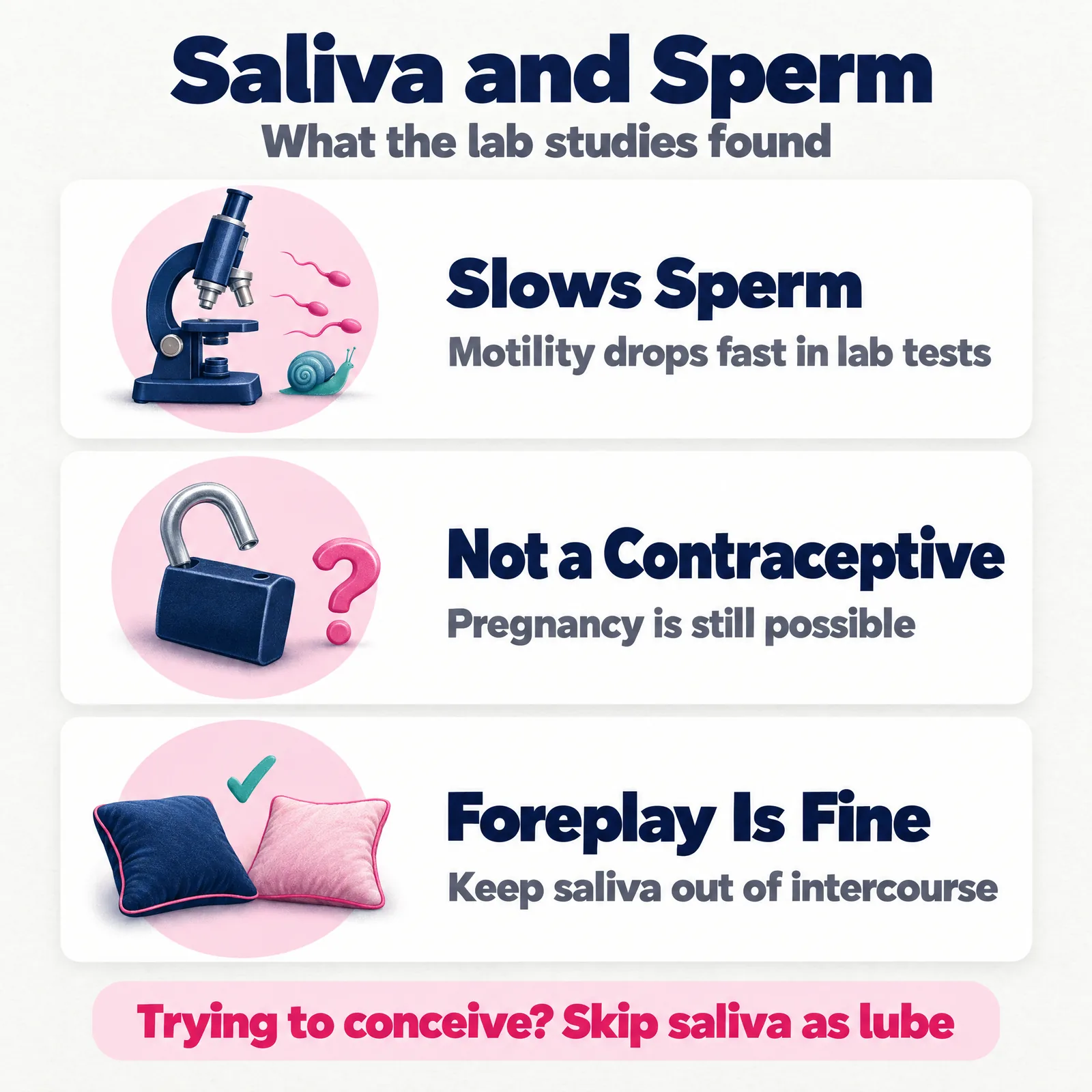
Keep in mind, those studies mixed saliva straight into semen in a dish. But real life is messier.
Still, even low saliva levels slowed sperm in the lab (Tulandi, 1982). So while trying for a baby, keep saliva out of intercourse.
How fast does saliva affect sperm?
In lab tests, the fall in motility is rapid, and greater in acidic saliva (Gonçalves Ferreira, 2014). One study saw a clear effect at one hour (Tomlinson, 2023).
No study I found timed it to the minute. How much it matters inside the body has never been measured.
Can you get pregnant if sperm is mixed with saliva?
Yes. Saliva slows sperm but does not reliably stop them. So it is not contraception.
If semen enters the vagina, pregnancy is possible. Semen in the mouth, or swallowed, cannot cause pregnancy.
Does oral sex before sex lower the chances of pregnancy?
Not in a way that should stop you. Oral sex as foreplay leaves far less saliva than using it as the lubricant. No study has shown it lowers pregnancy rates.
What I advise against is saliva as the lubricant for intercourse in the fertile days. That puts it right where the sperm need to swim.
Trying to conceive? Saliva, lubricants and sperm
Using saliva as lubricant when trying to conceive is a common worry. Here is something many couples do not know.
Most ordinary lubricants slow sperm too. So any bottle off the shelf is not automatically safer.
The lab evidence is consistent. A lubricant prescribed in fertility settings cut forward-moving sperm to about half within ten minutes, even at 5% strength (Mackenzie, 2019).
In another study, some lubricants also harmed sperm DNA (Agarwal, 2008). In both studies, a product designed for conception did best (Agarwal, 2008; Mowat, 2014).
A 2025 lab study tested K-Y jelly, a Durex lubricant, petroleum jelly and baby oil. All of them reduced sperm movement. Pre-Seed, a lubricant designed for conception, behaved like the control (Pradit, 2025).
In a larger study, though, even Pre-Seed reduced forward movement (Markram, 2022). Only egg white did not.
In one more test, every gel slowed sperm. The best gel sold as sperm-safe cut forward-moving sperm from 47% to 24% at one hour. Pleasure gels did worse (Tomlinson, 2023).
Parabens, a common preservative, also harmed sperm (Samarasinghe, 2018). A review of 24 studies found the data too patchy for a firm guideline (Gumerova, 2024).
Do sperm-friendly lubricants actually help?
I do not think so. “Sperm-friendly” only means a gel harmed sperm less in a dish. It does not mean it helps you conceive.
Even the best of them slowed sperm in some tests (Markram, 2022; Tomlinson, 2023). And no study I found shows that a sperm-friendly lube raises the chance of pregnancy.
Does this actually lower the chance of pregnancy?
Much less than the lab results suggest, at least in fertile couples. In 296 women aged 30 to 44 with no history of infertility, lubricant users got pregnant at a similar rate (Steiner, 2012).
But whether that holds for infertile couples is not known. A review calls it unresolved (Mesen, 2014).
So do not panic if you have used lube while trying. It is not a disaster for fertile couples. But it brings nothing to conception, and in the lab it costs sperm.
What lube should you use when trying to conceive?
None. That is my advice. When you are trying for a baby, use no lubricant at all.
Not saliva, not an ordinary gel, and not one sold as sperm-friendly. Kitchen oils are no exception, and that includes coconut oil as lube.
Instead, give it time. Longer foreplay brings her own lubrication.
Around ovulation, her body also makes a slippery, stretchy mucus that helps sperm swim. That is the only sperm-friendly lubricant I recommend.
Is sex still dry or painful every time? Then the dryness needs a check, not a bottle (see side effect 12). My fertility tips for men cover the rest.
Giving a semen sample? No saliva, and no ordinary lube
For a semen test, collect the sample by masturbation, without saliva or ordinary lube. That is because both can lower the motility the lab measures. A falsely poor result causes needless worry.
In one study, an isotonic lubricant designed for conception did not affect the sample. Also, 73% of men preferred it (Agarwal, 2013). Another lab found no motility difference with or without lube (Abadie, 2014).
So use a lubricant only if the lab gives you one. If your motility is low, see my guides to reading a semen analysis and low sperm motility.
Who should never use saliva as lube
For most couples, saliva is a comfort problem more than a danger. In these seven situations, though, skip it altogether.
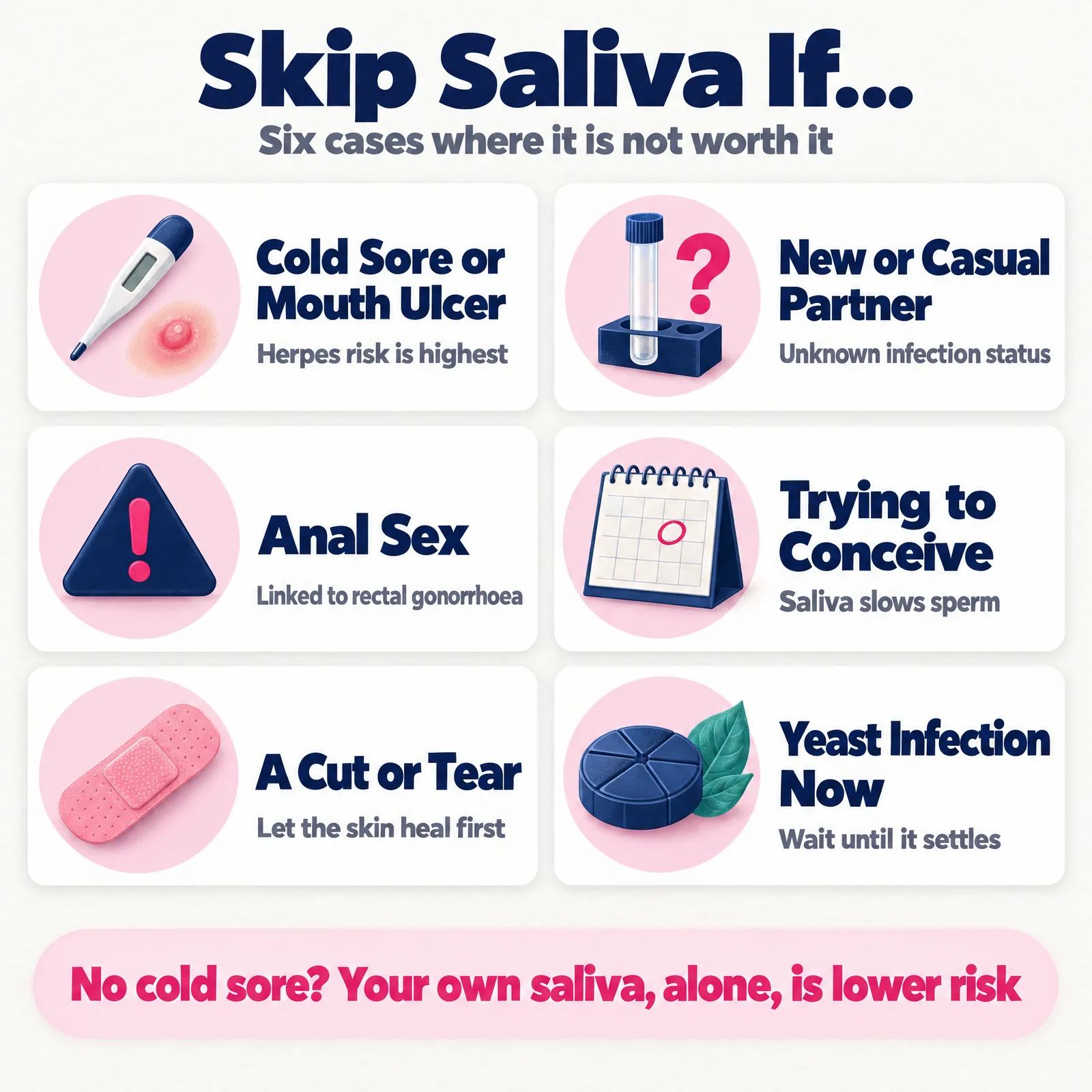
- Either of you has a cold sore, mouth ulcer or sore throat. This is when herpes and throat infections pass most easily. This also applies to your own saliva.
- A new or casual partner. You do not know what their throat carries. In fact, throat gonorrhoea is often silent.
- Anal sex. This is the use most clearly linked with infection (see side effect 6).
- You are trying to conceive. Keep saliva to foreplay in the fertile days, and skip other lubricants too.
- A cut, split or fresh tear on the penis or vagina. Broken skin lets germs in. So let it heal first.
- She has a yeast infection right now. Skip saliva until it settles (Grinceviciene, 2018).
- You are giving a semen sample. Saliva can spoil the result.
Outside these, a little saliva between two healthy partners who have sex only with each other is low risk. Still, “low risk” is not “the best choice”.
Better alternatives to saliva, ranked
The right lubricant is easy to find at any chemist. Here are the options, best first. Then come the ones to avoid.
Lubricant types compared
| Type | Safe with latex condoms? | Best for, and what to watch |
|---|---|---|
| Saliva | Not known to harm latex | Nothing in particular; dries fast, carries mouth germs |
| Water-based lube | Yes | Most people, condoms and toys; reapply as needed |
| Silicone-based | Only if labelled condom-safe | Longer sex and anal sex; not with silicone toys |
| Sperm-friendly | Yes | No proven help with conceiving; when trying, I advise no lube at all |
| Natural oils | No | Massage or masturbation without a condom |
| Petroleum jelly, baby oil | No | Nothing; mineral oil weakens latex |
Now, a little more on each option.
1. Water-based lube: the best all-rounder
For most people, a water-based lube is the first choice. It is safe with latex condoms and toys.
It also washes off with water and rarely irritates. Guidance for doctors recommends water-based or silicone lubricants for condom users and for women prone to infections (Vanderschee, 2025).
Concentration matters too. In a lab model of vaginal tissue, very concentrated lubricants damaged the tissue barrier (Ayehunie, 2018). But ones close to body levels did not.
Glycerin is one of the ingredients that makes many lubricants concentrated. So choose a simple, gentle gel. For women who get yeast infections, I prefer glycerin-free.
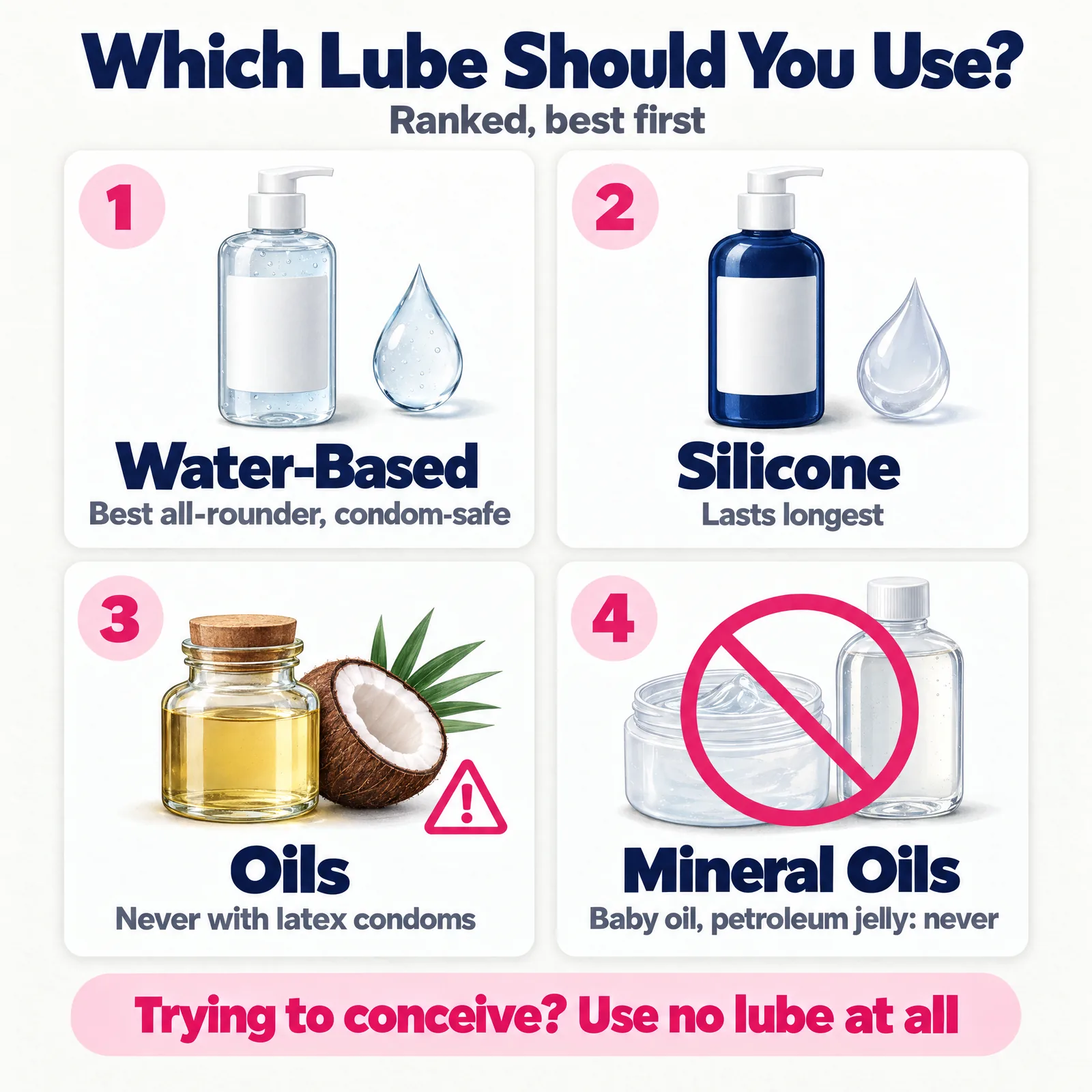
The card above sums up the ranking in four steps.
2. Silicone-based lube: lasts the longest
Silicone lubricants stay slippery far longer. Also, they do not wash away in water. That makes them popular for longer sex and anal sex.
Many are latex-safe. But in one lab test, two of four made latex swell and loosen (Sarkar Das, 2014).
So use only one labelled condom-safe. Avoid them with silicone toys.
3. Natural oils such as coconut oil: only without latex condoms
Plain coconut or olive oil is slippery and lasts long. Many couples like it for massage and masturbation. The catch is condoms.
Vegetable oils also weaken latex (Rosen, 1999). So use oils only when you are not relying on a latex condom.
If she is prone to yeast infections, keep oils outside the vagina. My guide to coconut oil as lube has the details.
4. Never: petroleum jelly or baby oil
These sit at the bottom because mineral oil weakens latex condoms (see side effect 11). I list them, with other household mistakes, in the next section.
What about sperm-friendly lube?
It is not on my list. A sperm-friendly lube is a gentle gel that harmed sperm less in lab tests. That is all.
It has not been shown to help you conceive. So when you are trying for a baby, I advise no lubricant at all. The section on trying to conceive above explains why.
Which lubricant suits which situation?
Here is the whole picture in one grid. Each row is a lubricant.
Each column is a situation. Every cell says it in a word.
My clinical pattern, built on the studies quoted on this page
On a phone, swipe the grid sideways.
| Masturbation | Vaginal sex | With a latex condom | Anal sex | Trying to conceive | |
|---|---|---|---|---|---|
| Your own saliva | okay | caution | caution | avoid | avoid |
| Water-based lube | best | best | best | okay | avoid |
| Silicone, labelled condom-safe | okay | okay | okay | best | avoid |
| Sperm-friendly lube | okay | okay | okay | okay | avoid |
| Coconut or olive oil | okay | caution | avoid | caution | avoid |
| Petroleum jelly or baby oil | caution | avoid | avoid | avoid | avoid |
Source: Dr Shah’s clinical pattern, drawing on Voeller, 1989; Rosen, 1999; Chow, 2016a; Tomlinson, 2023; Markram, 2022.
Read across your situation. The “best” cells are where I would start. The “avoid” cells are the mistakes I see most often.
Notice the last column. When you are trying to conceive, every lubricant says avoid, the sperm-friendly one included.
What not to use instead of saliva, and what genuinely helps
When saliva runs out, people reach for whatever is in the bathroom or kitchen. Many search for a natural lube or a homemade lube.
Honestly, some of these are worse than saliva. Here is the list I give my patients.
Petroleum jelly (such as Vaseline)
It feels slippery, but it is a petroleum product like mineral oil, which weakens latex (see side effect 11). Petroleum jelly also clings to the skin and is hard to wash off. And it reduced sperm movement in a lab study (Pradit, 2025).
Baby oil
Baby oil is almost pure mineral oil. In one test it cut a condom’s burst time from nearly a minute to about 11 seconds (Rosen, 1999). So never use it with a condom, for vaginal or anal sex.
Hand lotion and body cream
Many lotions contain mineral oil. One lotion tested in the lab weakened condoms the same way (Voeller, 1989). Lotions also carry perfumes that sting thin genital skin.
Soap, shampoo or body wash
Foam feels slippery for a few seconds. Then it dries the skin and stings, especially in the urine opening or the vagina. So keep soap for washing afterwards.
Hair oil or cooking oil with a condom
Vegetable oils, including coconut and mustard oil, also weaken latex (Rosen, 1999). Without a condom they are a different matter, as the ranking above explains.
A numbing cream or delay spray used as a lubricant
These are medicines for premature ejaculation, not lubricants. Spread over the whole penis, they numb both of you.
Also, too much can soften the erection. If timing is the real worry, my page on delay sprays explains how to use them.
Food from the kitchen
Butter, ghee, honey and yoghurt all turn up on forums. None was made for the genitals. Egg white was the one thing that did not slow sperm in one lab study.
But raw egg can carry Salmonella and cause allergy. So I do not recommend it.
What genuinely helps
- More time and more foreplay. Arousal brings natural lubrication. Rushing is the commonest cause of dryness.
- A relaxed pace. Nerves dry things up, especially on the first nights of a marriage.
- A plain water-based lube. It is the closest thing to natural moisture, and condom-safe.
- A lighter grip when masturbating. It needs less lubrication. And heavy pressure on the penis is more common in men with erection problems (Can, 2023).
No lubricant at hand? What to do tonight
First, slow down. Arousal is the body’s own lubricant.
If you must use spit as lube in a pinch, use your own. Keep it to masturbation, or to vaginal sex if she has no yeast infection. Skip it with a cold sore, a new partner, or anal sex.
With a condom, saliva soon dries, so a water-based lube is better. Buy one the next day, and the question never comes up again.
Is using saliva as lube ever okay? The honest middle ground
Only in one narrow setting. Not for intercourse.
Occasional use for masturbation is okay if you have no cold sore, mouth ulcer or sore throat. Between two long-term partners with no infections, not trying for a baby, it is mostly a comfort problem, not a health one.
But even there, it is the weakest option. It dries fast, and it offers nothing a water-based lube does not.
Which lubricant suits you?
Here is a simple way to pick one. Answer four questions, in order.
Start at the top and stop at the first yes
Source: Vanderschee, 2025; Sarkar Das, 2014; Ayehunie, 2018.
Most readers stop at the first or second question. Still unsure? Ask me privately; it takes a minute.
What saliva as lube means for your partner
Most of this page is written for the man asking. But sex involves two people. And the partner usually feels the downside first.
Her comfort
When saliva dries mid-way, she feels the drag. Sex that is often sore becomes sex she quietly avoids.
Then couples wonder why desire has dropped. A lubricant is one of the simplest fixes for dryness and pain (Vanderschee, 2025).
Her vaginal health
If she has a yeast infection, skip saliva until it settles. Receiving oral sex has been linked with yeast infection (Geiger, 1996).
But researchers did not recommend treating a partner who has no symptoms (Grinceviciene, 2018). So he does not need tablets “just in case”.
Talking about lube
Many couples never discuss lubricant. It feels like admitting something is wrong. It is not.
Most American women have used one, mainly for comfort and pleasure (Herbenick, 2014). So buy one together. The saliva question disappears.
If either of you has symptoms
Burning, discharge, sores or itching in either partner? Then both of you should be checked, not just one. Otherwise the infection simply passes back and forth.
Dr Shahs notes (from my clinical observation)
Here are four things I have noticed in my consultations. You will not find them in a study.
1. The question usually comes at the very end.
Patients rarely book an appointment to ask about saliva. Instead, it comes up quietly as they are leaving. Often it is newly married couples who used saliva on the first nights, because nothing else was at hand.
2. The real problem is rarely the saliva.
Often, the dryness came from nerves and too little time. Once a couple slows down, and keeps a water-based lube by the bed, the question answers itself.
3. A sore head of the penis often has a simple cause.
I often see a red, sore penis head after long weekends of masturbation with saliva, or with nothing at all. Once the man switches to a lubricant and a lighter grip, it settles.
4. My rule of thumb is short.
Not for intercourse. Occasional use for masturbation is okay if you have no cold sore, mouth ulcer or sore throat. Anyone else’s saliva, saliva for anal sex, or saliva while trying for a baby is not worth it.

Private 1-on-1 consultation
Burning, a sore or pain after sex? Get it checked privately.
A confidential consultation in T Nagar, Chennai, with the right tests for what actually happened, and clear advice on lubricants, fertility and safe sex.
Book a Confidential Consultation
When to see a doctor after using saliva
Book an appointment if any of these apply:
- Burning when you pass urine, or a discharge, in the days after oral sex or a partner’s saliva.
- A sore, blister or ulcer on the penis, the lips or around the anus.
- Redness, itching or white patches on the penis head that last more than a few days.
- Pain, discharge or bleeding from the anus after anal sex.
- Pain during sex every time, or erections that fade before you finish.
- Your partner keeps getting yeast infections or a discharge.
- A condom broke with a new partner. For HIV, PEP must start within 72 hours, and the sooner the better. Call the same day.
- You have tried to conceive for a year without success (six months if she is 35 or older).
Bring your partner if she is willing. Also, you do not need to wait until things are bad. A short, private talk usually settles the worry in one visit.
Saliva as lube: your questions answered
Quick answers to the questions people search most, each in a few lines.
Is it okay to use saliva as a lubricant?
For intercourse, no: saliva dries fast, adds friction, and a partner’s saliva can carry herpes or gonorrhoea. Occasional use for masturbation is okay if you have no cold sore, mouth ulcer or sore throat.
Can I use spit if I don’t have lube?
In a pinch, a little of your own saliva for masturbation, or vaginal sex if she has no yeast infection, is unlikely to harm. Avoid it for anal sex, with cold sores, new partners, or when trying to conceive.
What can I use for lube if I have none?
Slow down and spend longer on foreplay; arousal is the body’s own lubricant. Otherwise use a water-based lube. Avoid petroleum jelly, baby oil, lotion, soap and cooking oil, especially with condoms.
What is the best natural lubricant?
Natural is not automatically safer. Plain coconut oil suits massage and masturbation, but it weakens latex condoms. With condoms, a water-based lube is the safest choice.
Do you last longer with or without lube?
Lube itself does not make you finish faster or slower. Comfortable, pain-free sex usually lasts longer, while dryness and soreness make it tense. My page on how long sex lasts explains normal timing.
Can spit cause a yeast infection?
In women, receiving oral sex has been linked with yeast infections (Geiger, 1996) and with yeast being found in the vagina (Brown, 2019). If she has one, skip saliva and use a gentle water-based lube.
Can using saliva as lube cause irritation?
Yes. As saliva dries, the friction rubs thin genital skin, and it can leave the penis head or vagina red and sore.
A gentle water-based lube usually settles it. Redness lasting days needs an examination.
Can saliva give you an STD?
Yes. A partner’s saliva can carry herpes from a cold sore and gonorrhoea from an infected throat.
HIV passing through saliva is very rare. Saliva used for anal sex carries the highest risk.
Which STD is easiest to catch from oral sex?
Herpes and gonorrhoea are the infections most clearly linked with oral sex in the studies on this page (Ayoub, 2019; Chow, 2019). That is exactly why a partner’s saliva is not a safe lubricant.
Can saliva cause a UTI in men?
A true bladder infection from saliva is unlikely. Burning on urination after oral sex or saliva use is more often urethritis from a sexually transmitted germ, and a urine test tells which.
Does saliva kill sperm?
It clearly slows them; the studies mainly measured movement, not survival. Lab studies found motility fell after mixing with saliva (Tulandi, 1982), and fell faster in acidic saliva (Gonçalves Ferreira, 2014).
Can sperm survive in saliva?
Saliva slows sperm in lab tests (Tulandi, 1982), but the studies measured movement, not survival, so it is not contraception. Semen in the mouth, or swallowed, cannot cause pregnancy.
Does coconut oil kill sperm?
There is little data on coconut oil itself. In one study olive oil reduced sperm movement (Markram, 2022). When trying to conceive, skip every lubricant, coconut oil included.
Is baby oil safe as lube?
No. It weakens latex condoms and is not made for vaginal or anal use. Sixty seconds of mineral oil, the main ingredient of baby oil, cut latex condom strength by about 90% in a lab test (Voeller, 1989).
Can I use saliva as lube with a condom?
Saliva is not known to damage latex, but it dries quickly. Water-based lubricant lowered breakage of older condoms (Steiner, 1994), so use a water-based lube, or a silicone one labelled condom-safe.
What is lubricant and what is it used for?
A lubricant is a gel or liquid that reduces friction. It makes sex and masturbation more comfortable, helps with dryness or pain, and is recommended for condom users (Vanderschee, 2025).
Can using saliva as lube cause BV?
Bacterial vaginosis is linked mainly with new or multiple partners rather than with oral sex itself (Bradshaw, 2005). Clean hands and a proper lubricant are sensible, but saliva is not the main cause.
What if my partner has a cold sore?
Then skip oral sex and never use their saliva as lube until the sore has fully healed. In a US model, most genital herpes type 1 infections came from oral sex (Ayoub, 2019).
Is it safe to use saliva for anal sex?
It is the riskiest use. In men who have sex with men, a partner’s saliva used for anal sex was linked with about twice the odds of rectal gonorrhoea (Chow, 2016a). Use a proper lubricant and a condom.
Can saliva cause an infection in the penis?
Your own saliva rarely does, unless you have a cold sore, mouth ulcer or sore throat. A partner’s saliva can carry herpes or gonorrhoea to the penis and urine passage. Burning, discharge or sores afterwards need a test.
Is saliva better than nothing?
Only for a moment. It eases the first strokes, but it dries fast and the friction comes straight back. Keep a water-based lubricant at home instead.
Is saliva better than lube?
No. A proper lubricant lasts longer, is gentler on the skin, suits condoms and carries no germs from another person. Saliva wins only on being free and always at hand.
Does saliva cause balanitis?
Not usually by itself. But friction from drying saliva can make the head of the penis sore, and yeast from a partner can inflame it. Redness that lasts more than a few days needs an examination.
Can I use coconut oil instead of saliva?
For masturbation or massage without a latex condom, yes; it lasts far longer than saliva. With condoms it is not safe, because vegetable oils weaken latex (Rosen, 1999).
Does saliva work as a lubricant for a sex toy?
It dries just as fast on a toy, and it carries mouth germs onto it. A water-based lubricant suits every toy; avoid silicone lubricants on silicone toys.
Is it safe to get lubricant in your mouth?
A little water-based lubricant in the mouth is generally harmless, though most taste unpleasant. Avoid swallowing oils or numbing products, and choose a lube labelled safe for oral use if oral sex is involved.
What happens if he gives oral sex while she has a yeast infection?
It is not dangerous, but it can irritate already inflamed skin, and yeast can occasionally pass to his mouth or penis. It is kinder to wait until the infection has settled.
Is saliva as lube okay for newly married couples?
Between two partners without infections it is low risk, unless you are trying for a baby. But it dries fast, and the first nights are often tense and dry; a water-based lube and more time help.
The bottom line
Can you use saliva as lube? For sex, I advise against it. It is the weakest option you have.
Not for intercourse. Occasional use for masturbation is okay if you have no cold sore, mouth ulcer or sore throat.
The side effects of using saliva as lubricant are real. It dries fast. The friction makes skin sore.
A partner’s saliva can carry herpes and gonorrhoea. Also, it slows sperm without stopping pregnancy. So for anal sex or a new partner, use a water-based lube instead.
Trying for a baby? Use no lube at all. And never use oils with a latex condom.
Has something gone wrong, such as burning, a discharge, a sore or painful sex? I can see you privately at my STD clinic in T Nagar, Chennai. Call 97907 83856 or message me on WhatsApp.
This is Dr Shah, Consultant Andrologist and Sexologist. Please do ask your questions below.
A straight answer, without embarrassment
Questions about sex, lubricants, infections or fertility, answered privately by a practising andrologist in Chennai.
References
Saliva, sperm and contraception
- Tulandi T, et al., 1982: Effect of saliva on sperm motility and activity (PMID 6890474).
- Gonçalves Ferreira N, et al., 2014: Some immunological properties of female saliva and its effect on sperm motility (PMID 24797779).
How often saliva is used in sex
- Li G, et al., 2025: The use of saliva as a lubricant in relation to sexual behavioural patterns in men who have sex with men: an exploratory cross-sectional study (PMID 40977199).
- Butler LM, et al., 2009: Use of saliva as a lubricant in anal sexual practices among homosexual men (PMID 19131893).
- Chow EP, et al., 2018: Saliva use in sex: Associations with use of smartphone dating applications in men who have sex with men (PMID 28835197).
- Reece M, et al., 2014: Men’s use and perceptions of commercial lubricants: prevalence and characteristics in a nationally representative sample of American adults (PMID 24612606).
- Herbenick D, et al., 2014: Women’s use and perceptions of commercial lubricants: prevalence and characteristics in a nationally representative sample of American adults (PMID 24521034).
Saliva and gonorrhoea
- Chow EPF, et al., 2016a: Saliva use as a lubricant for anal sex is a risk factor for rectal gonorrhoea among men who have sex with men, a new public health message: a cross-sectional survey (PMID 26941362).
- Chow EP, et al., 2016b: Neisseria gonorrhoeae Bacterial DNA Load in the Pharynges and Saliva of Men Who Have Sex with Men (PMID 27413195).
- Fairley CK, et al., 2019: Models of gonorrhoea transmission from the mouth and saliva (PMID 31324517).
- Chow EP, et al., 2019: The role of saliva in gonorrhoea and chlamydia transmission to extragenital sites among men who have sex with men: new insights into transmission (PMID 31468730).
- Xu X, et al., 2022: Modelling the potential role of saliva use during masturbation in the transmission of Neisseria gonorrhoeae at multiple anatomical sites (PMID 34914887).
- Tran J, et al., 2024: Association between saliva use for masturbation and urethral gonorrhoea in men who have sex with men: A cross-sectional study (PMID 39181439).
- Lee A, et al., 2021: Lubrication Practices and Receptive Anal Sex: Implications for STI Transmission and Prevention (PMID 33789174).
- Cornelisse VJ, et al., 2018: Associations Between Anorectal Chlamydia and Oroanal Sex or Saliva Use as a Lubricant for Anal Sex: A Cross-sectional Survey (PMID 29465648).
Herpes, urethritis and HIV
- Ayoub HH, et al., 2019: Characterizing the transitioning epidemiology of herpes simplex virus type 1 in the USA: model-based predictions (PMID 30853029).
- Yousuf W, et al., 2020: Herpes simplex virus type 1 in Europe: systematic review, meta-analyses and meta-regressions (PMID 32675066).
- Ong JJ, et al., 2017: Clinical Characteristics of Herpes Simplex Virus Urethritis Compared With Chlamydial Urethritis Among Men (PMID 28079748).
- Takahashi H, et al., 2023: Detection of Novel US Neisseria meningitidis Urethritis Clade Subtypes in Japan (PMID 37877502).
- Nguyen HT, et al., 2023: Outbreak of Sexually Transmitted Nongroupable Neisseria meningitidis-Associated Urethritis, Vietnam (PMID 37735771).
- Chambers LC, et al., 2019: Cross-sectional study of urethral exposures at last sexual episode associated with non-gonococcal urethritis among STD clinic patients (PMID 30181326).
- Peacocke J, et al., 2012: The role of crude saliva and purified salivary mucins in the inhibition of the Human Immunodeficiency Virus type 1 (PMID 22929306).
Vaginal yeast and bacterial vaginosis
- Geiger AM, et al., 1996: Risk factors for vulvovaginal candidiasis: a case-control study among university students (PMID 8834559).
- Bradshaw CS, et al., 2005: Higher-risk behavioral practices associated with bacterial vaginosis compared with vaginal candidiasis (PMID 15994624).
- Brown SE, et al., 2019: The Vaginal Microbiota and Behavioral Factors Associated With Genital Candida albicans Detection in Reproductive-Age Women (PMID 31517769).
- Grinceviciene S, et al., 2018: Sexual behaviour and extra-genital colonisation in women treated for recurrent Candida vulvo-vaginitis (PMID 29998617).
Lubricants and sperm
- Mackenzie SC, et al., 2019: Vaginal lubricants in the couple trying-to-conceive: Assessing healthcare professional recommendations and effect on in vitro sperm function (PMID 31086364).
- Agarwal A, et al., 2008: Effect of vaginal lubricants on sperm motility and chromatin integrity: a prospective comparative study (PMID 17509584).
- Mowat A, et al., 2014: The effects of vaginal lubricants on sperm function: an in vitro analysis (PMID 24390681).
- Pradit L, et al., 2025: The effects of coital lubricants on sperm motility and vitality (PMID 40080784).
- Gumerova E, et al., 2024: Do sperm and lubricants gel well with each other? A systematic review (PMID 38044638).
- Markram J, et al., 2022: Sperm-friendly lubricant: Fact or fiction (PMID 35318650).
- Tomlinson J, et al., 2023: Sperm toxicity testing on lubricant gels: should we be recommending ‘fertility-friendly’ specialist products? (PMID 35369832).
- Samarasinghe SVAC, et al., 2018: Parabens generate reactive oxygen species in human spermatozoa (PMID 29722171).
Fertility in real life and semen tests
- Steiner AZ, et al., 2012: Effect of vaginal lubricants on natural fertility (PMID 22914390).
- Mesen TB, et al., 2014: Effect of vaginal lubricants on natural fertility (PMID 24717914).
- Agarwal A, et al., 2013: Effect of an isotonic lubricant on sperm collection and sperm quality (PMID 23490168).
- Abadie JM, et al., 2014: Effects of lubricants and wash solutions on semen evaluation in a fertility clinic laboratory (PMID 24868991).
Lubricants, condoms and skin
- Voeller B, et al., 1989: Mineral oil lubricants cause rapid deterioration of latex condoms (PMID 2535978).
- Rosen AD, et al., 1999: Study of condom integrity after brief exposure to over-the-counter vaginal preparations (PMID 10094272).
- Steiner M, et al., 1994: The impact of lubricants on latex condoms during vaginal intercourse (PMID 8142525).
- Sanders SA, et al., 2012: Condom use errors and problems: a global view (PMID 22348636).
- Sarkar Das S, et al., 2014: Exposure of natural rubber to personal lubricants–swelling and stress relaxation as potential indicators of reduced seal integrity of non-lubricated male condoms (PMID 24680185).
- Ayehunie S, et al., 2018: Hyperosmolal vaginal lubricants markedly reduce epithelial barrier properties in a three-dimensional vaginal epithelium model (PMID 29854584).
- Vanderschee R, et al., 2025: Approach to lubricant use for sexual activity (PMID 40730448).
Saliva biology and masturbation
- Lynge Pedersen AM, et al., 2019: The role of natural salivary defences in maintaining a healthy oral microbiota (PMID 30696553).
- Faruque M, et al., 2022: A review on the role of salivary MUC5B in oral health (PMID 36206992).
- Sank LI, 1998: Traumatic masturbatory syndrome (PMID 9509379).
- Can U, et al., 2023: Traumatic masturbation and erectile dysfunction: A matched case-control study (PMID 37605604).
A private, judgment-free space to talk through fertility and men’s sexual health. Walk in, or book ahead by phone.
No 21, Sree Kalki Apartments, Ground Floor, Bazullah Road, T-Nagar, Chennai 600017