
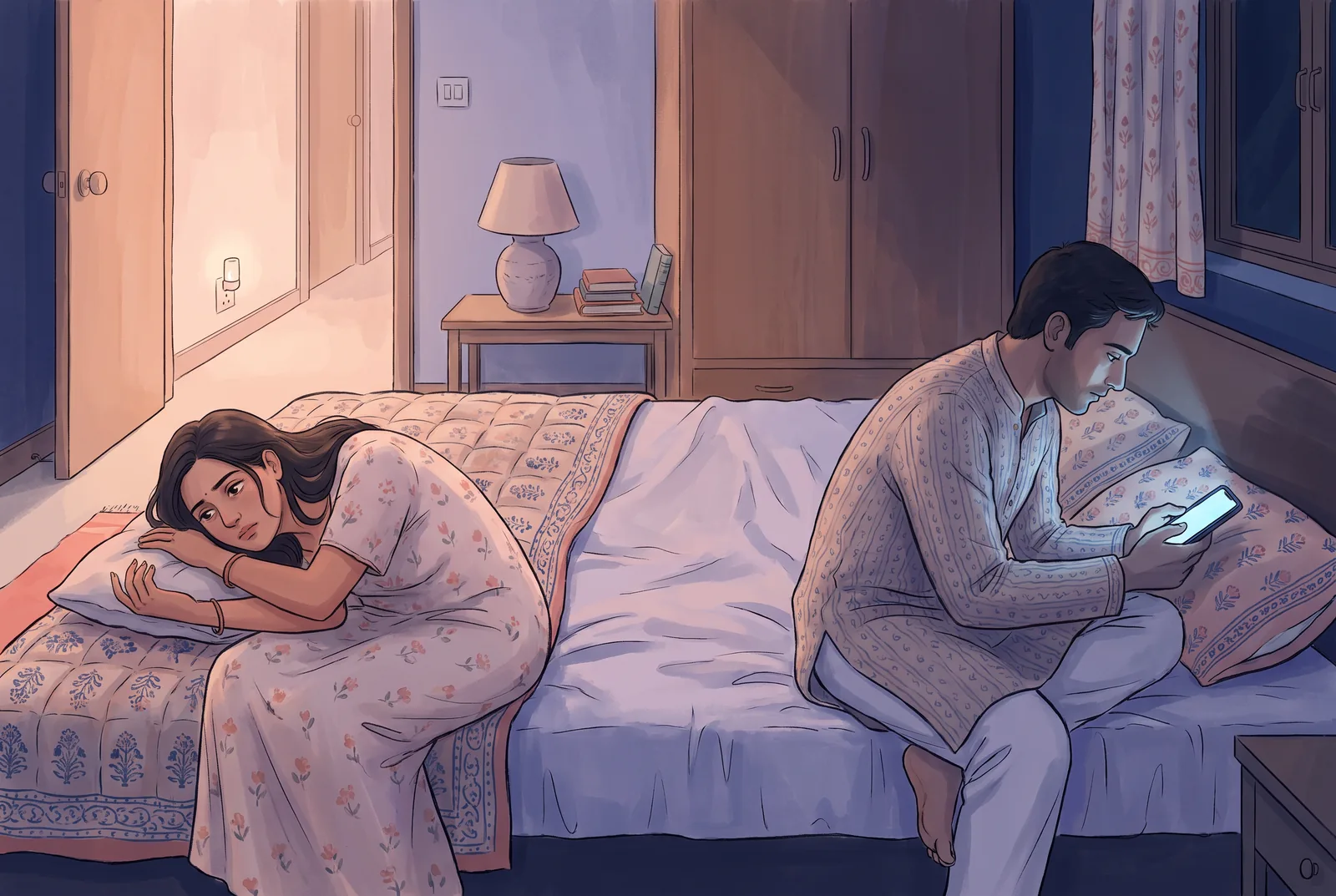
Yes. Most men masturbate, married or not. In Britain’s national survey, fielded in 2010–12, 77.5% of men aged 16 to 74 reported doing it in the past month (Fischer, 2026). No national survey reports a separate figure for married men, but nothing suggests marriage stops it.
On its own that does not mean your sex life is bad, and it is not cheating. It does not cause disease either.
But common is not the same as harmless. After marriage, this habit costs you something very specific.
I am Dr Shah Dupesh, an andrologist in chennai. Men ask me about masturbation after marriage almost every day — usually in a low voice, usually last, usually after we have finished discussing whatever they actually booked the appointment for.
So let me tell you plainly where I stand.
I am not going to tell you that you have damaged your body, burnt your sperm or drained your strength. You have not. Those are myths, and I have spent years arguing against them.
But I am also not going to give you the comfortable answer the rest of the internet gives you. In a marriage, I ask my patients to stop. Here is my reasoning, along with the evidence that supports me and the evidence that does not.
Masturbation after marriage is fairly common in men. Watch the video below, where I go through why the habit continues after the wedding and the problems it causes.
If you would rather read it, everything in that video is below — with the studies attached.
In a nutshell
Masturbation after marriage: the nine-line version
It is common
77.5% of men — married and unmarried together — reported masturbating in the past month. You are not abnormal (Fischer, 2026).
It is not damaging your body
No blindness, no weakness, no infertility, no lost testosterone. Those myths are false and I will not repeat them.
But it tracks a struggling sex life
The men having the most intercourse were the least likely to masturbate (Fischer, 2026).
Frequency tracks lower satisfaction
In 3,586 men, higher masturbation frequency was associated with lower sexual and lower overall relationship satisfaction — though those authors judged the association weak overall (Rowland, 2023).
Secrecy has a measurable cost
On days a man’s solo use was hidden from his partner, he himself reported lower intimacy and satisfaction (Vaillancourt-Morel, 2024).
Technique matters more than frequency
Men with erectile dysfunction were 2.2 times more likely to use an atypical technique such as prone rubbing or heavy pressure (Can, 2023).
The pattern is striking
In men with both ED and that pattern (n = 98), erections were firmer alone (60.2%) than during partnered sex (38.8%). Direction is not proven (Can, 2023).
Get the physical causes excluded first
Erectile trouble can be the first sign of diabetes or heart disease. That workup comes before any of this.
My position
The upside after marriage is close to nil. The downside is real for a minority. I cannot tell in advance which man you are — so I ask you to stop.
That is the summary. Now the detail — and I would ask you to read the part where I argue against myself.
1. 📊 Yes, married men masturbate — the real numbers
Let us get the fact out of the way. A lot of men arrive convinced they are the only married man on earth doing this.
You are not.
Britain has run the same national sexual-behaviour survey for decades. Across 26,000 people, the proportion of men reporting masturbation in the previous month rose from 73.4% to 77.5% between the two rounds, the later one fielded in 2010–12 (Fischer, 2026). That is roughly three men in four, married and unmarried together.
American national data shows the same picture and adds something more useful. Men who wanted partnered sex much more often than they were getting it were 4.40 times more likely to be frequent masturbators (Herbenick, 2023).
| Finding | The number | Source |
|---|---|---|
| Men reporting masturbation in the past month | 77.5% (up from 73.4%) | Fischer, 2026 — Britain, n = 26,323, fielded 2010–12 |
| Men wanting more partnered sex: odds of frequent masturbation | 4.40× higher | Herbenick, 2023 — US, nationally representative |
| Men with the highest intercourse frequency | Least likely to masturbate | Fischer, 2026 |
| Men using an atypical technique (prone, pressure, through clothing) | 10.97% | Wang, 2024 — Chinese online sample, n = 2,743 |
| Sexually active young men with some degree of erectile dysfunction | 21.5% | Jacobs, 2021 — n = 2,067 sexually active, of 3,419 surveyed |
So the honest answer to “do married men masturbate?” is: most of them, at least sometimes. If your only worry was whether you are strange, stop worrying. For the frequency question specifically, I have written about how many times masturbation can be done in a day.
But read that third row again. That is the one that matters.
2. 🔍 The finding that changed how I think about this
Here is the result most articles quietly skip.
In the British national data, the men having the most intercourse were the least likely to have masturbated in the past month (Fischer, 2026).
Sit with that. If masturbation were simply an expression of a healthy, high sex drive, you would expect the opposite — the most sexual men doing the most of everything. In men, that is not what the data shows.
The same study found men who masturbated in the past month were more likely to report:
- Wanting sex more often than they were having it.
- Mismatched desire with their partner.
- Dissatisfaction, distress or worry about their sex life.
- A sexual difficulty — in themselves or in their partner.
The authors’ own conclusion: when partnered sexuality faces challenges, masturbation may serve as a replacement (Fischer, 2026). Their hedge, not mine.
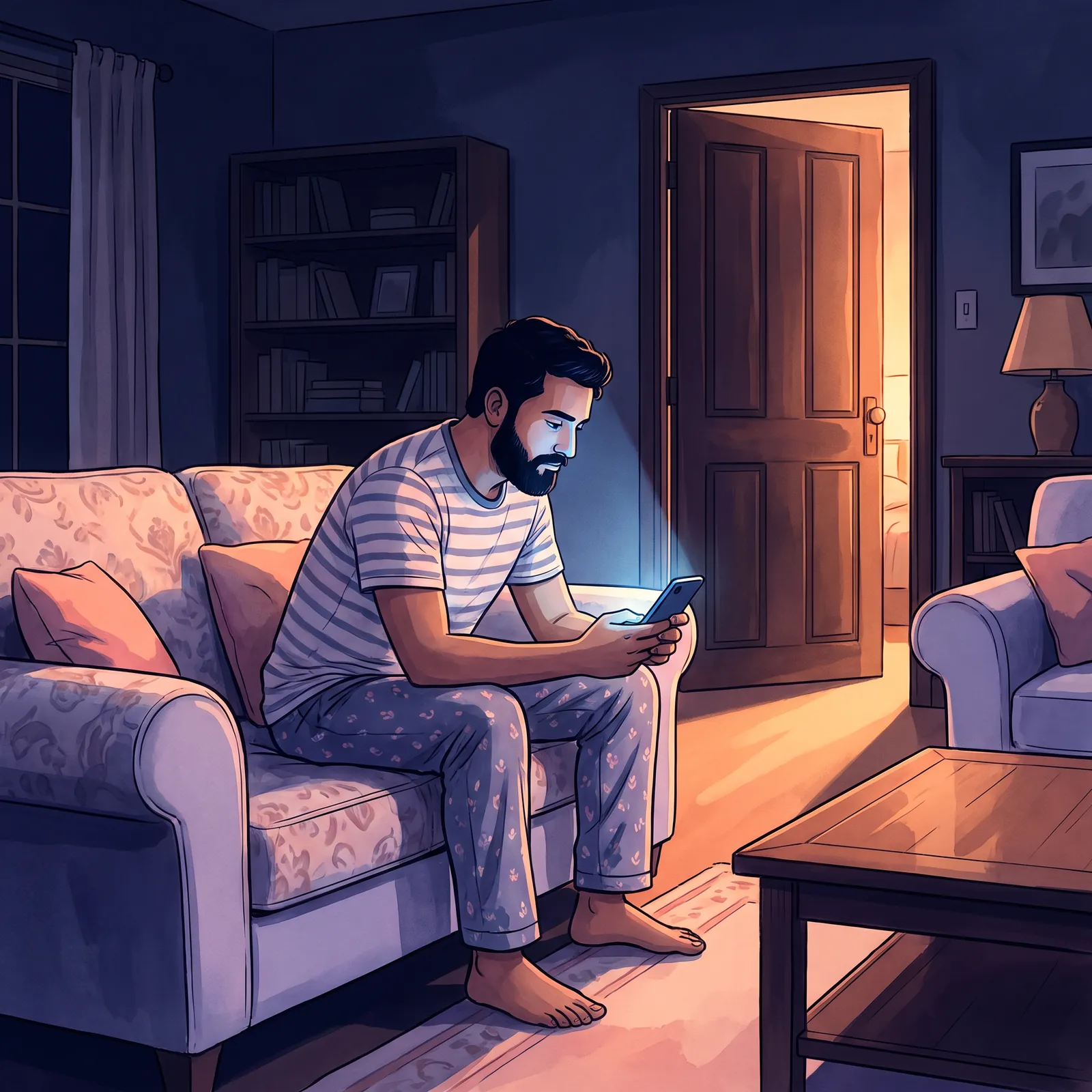
This is why I stopped treating the habit as a neutral private matter. In men it looks compensatory. It goes up when the marriage’s sex life goes down.
So when a married man tells me he masturbates four times a week, I am not hearing a harmless preference. I am hearing a signal.
Something in that bedroom is not working, and the habit is patching over it. Often the honest name for what is underneath is a slow slide towards a sexless marriage, and the patch is what stops a couple noticing in time.
A patch is not a repair. Everything below is detail.
3. 🧭 Why married men keep the habit — seven reasons I hear
These are not from a textbook. These are the answers men give me across the desk, in rough order of how often I hear them.
1. Mismatched desire
He wants sex more often than she does, or the timings never align. Rather than have an uncomfortable conversation, he handles it himself.
This is the commonest reason, and the data agrees — wanting more partnered sex raised the odds of frequent masturbation 4.40-fold (Herbenick, 2023).
2. It is faster
Three minutes alone versus an evening of effort, mood, privacy and negotiation. In a joint family home with thin walls and a child in the room, the maths is brutally simple.
3. Stress and sleep
Many men have used it as a sleeping tablet since they were fifteen. The habit was never really about sex. It was about switching the brain off after a bad day.
4. It started long before the marriage
Most men began in their early teens and never stopped. The wedding did not delete twenty years of nightly repetition.
Habits do not resign when circumstances change.
5. Pornography and novelty
This is the one that has changed most in my career. It is no longer a magazine under the mattress. It is unlimited, escalating, on-demand novelty in the pocket.
I have written separately on porn-induced erectile dysfunction, because it now needs its own page.
6. Avoiding rejection
A man who has been turned down a few times stops asking. Solo sex has a 100% acceptance rate.
That is not a small thing psychologically, and it is corrosive over years.
7. Performance anxiety
If he is struggling with erections or finishing too quickly, sex with his wife has become an examination he might fail. Alone, there is no examiner.
So he retreats — which worsens exactly the problem he is retreating from. Men in this loop usually need the underlying premature ejaculation treated first, not a lecture about willpower.
The national survey, incidentally, gives different answers: the commonest reasons people endorse are pleasure, arousal, stress relief and relaxation (Herbenick, 2023). I do not doubt it.
But that is not the language across my desk, where it is avoidance, convenience and habit. I accept the difference is because I see a filtered sample — not because the survey is wrong.
4. 💔 Masturbation in marriage — what it actually costs, in four measured effects
I want to be careful here. These are associations found in real studies, not prophecies about your marriage.
| Effect | What was found | Study |
|---|---|---|
| Lower satisfaction, both kinds | In 3,586 men, higher masturbation frequency was associated with lower sexual and lower overall relationship satisfaction (p < 0.001) — inside a model where age, anxiety and illness mattered more | Rowland, 2023 |
| Secrecy costs the man himself | When solo use was unknown to the partner, he reported lower relationship satisfaction and intimacy that same day | Vaillancourt-Morel, 2024 — 217 couples, daily diary |
| Doing it alone is the harmful pattern | Watching alone was associated with poorer relationship quality for men. Watching together was associated with more intimacy — though both patterns also tracked more psychological aggression | Huntington, 2021 — n = 1,234, unmarried couples at baseline |
| Relationship quality is part of the pathway | In 66 married Turkish men with psychogenic ED, pornography frequency correlated with erectile function (r = −0.535); relationship adjustment partly accounted for it, though pornography frequency also predicted ED independently | Kazan Kizilkurt, 2024 |
Look closely at the first row, because it contains a genuine surprise. In that study of 3,586 men, pornography frequency predicted neither sexual nor relationship satisfaction. But masturbation frequency predicted both, downward (Rowland, 2023).
Everyone blames the pornography. That study says the solo act itself carried the association. I quote the same authors against myself in section 8 — they judged the overall association weak, and you should see that too.
The fourth row tells you the likely route. In those married men, relationship adjustment partly explained the link between pornography use and erectile function — though pornography frequency also had an independent effect (Kazan Kizilkurt, 2024).
It is a small, cross-sectional, single-clinic sample of 66 men. It cannot establish direction. But it points at something I see constantly: the bedroom is downstream of the marriage.
Nobody comes to me because they masturbate. They come because of an erection that fails with the wife but works alone, or a marriage that has gone quiet. The habit turns up in the history, never in the complaint. That is why it goes unexamined for years.
The wife usually knows. Men are certain they are being discreet. In the couples I see together, she worked it out long ago. What the research actually found here is uncomfortable in both directions: concealment cost the man his own sense of intimacy, while disclosure cost the partner hers over the following year (Vaillancourt-Morel, 2024). There is no clean answer, which is why I focus on the conversation rather than the confession.
The men who improve fastest stop negotiating. The ones who ask me for a safe weekly quota tend to still be at that quota a year later.
5. 🍽️ The buffet meal — how I explain this in clinic
I have used this comparison for years because it lands where medical language does not.
Imagine eating at a lavish buffet every single day. Forty dishes. Endless variety. Something new whenever the last thing stops exciting you. You choose, you consume, you walk away. Nothing is asked of you.
Now imagine a simple home-cooked meal. The same few dishes. Someone made it for you. It asks for your presence, your appetite, your company at the table.

Eat the buffet daily and two things happen. The simple meal starts to taste of nothing. And your health quietly deteriorates while your mouth is having a wonderful time.
That is what unlimited on-demand novelty does to a married man’s sexuality. Not because the pictures are evil. Because the brain calibrates.
It sets its expectations against whatever it is fed most often, and a real human being on an ordinary Tuesday night was never designed to compete with an infinitely-refreshing screen.
Park’s review proposed exactly this mechanism — that internet pornography’s novelty and easy escalation may condition arousal to cues that do not transition to a real partner (Park, 2016). It is a hypothesis built on case reports, not a proven mechanism, and I show you the direct challenge to it in section 8.

Private 1-on-1 consultation
Struggling with this after marriage? Let us sort it out properly.
Erections that work alone but fail with your wife, finishing too fast, or a marriage that has gone quiet — these are common, treatable and nothing to be ashamed of. A private, judgement-free consultation with a practising andrologist.
Book a Confidential Consultation
Let me be careful about one thing, because a lot of writing on this subject is not.
The problem is never your wife’s body. I have had men repeat back to me things they read online about their partner being somehow physically insufficient. That is nonsense, and it is cruel nonsense.
Nothing about her changed. Your reference point moved. That is a problem in your calibration, not a defect in her.
6. 🩺 Before anything else — get the physical causes excluded
This section exists because the next one is about conditioning, and I do not want a single man to read it and skip a medical assessment he needs.
Erectile dysfunction is often the first warning sign of diabetes, high blood pressure or cardiovascular disease — sometimes years before anything else shows up. It is also strongly linked to depression, anxiety and the medicines used to treat them.
If your erections have changed, including your morning erections, get a proper assessment: blood sugar, blood pressure, lipids, testosterone where indicated, and an honest conversation about mood.
Everything in the next section applies to men in whom that workup is clean. Do not use a behavioural explanation to postpone a medical one.
In the largest study I quote on this page, the strongest predictors of erectile trouble were not habits at all. They were age, anxiety and depression, chronic medical illness, low sexual interest and low relationship satisfaction (Rowland, 2023).
Keep that ranking in mind. Masturbation is nowhere near the top of it.
7. 🔧 The technique problem — where the real risk sits
Read this section twice. This is where the argument stops being philosophical.
How a man masturbates matters more than how often.
Doctors call it atypical or traumatic masturbation: a technique meaningfully different from anything a partner could reproduce. It was first described in 1998, in four case reports of men who masturbated in an idiosyncratic manner — typically prone, and daily, over years — and presented later with erectile or orgasmic problems (Sank, 1998).
Four cases is a thin foundation, and I say so. The later work is better.
The usual patterns are:
- Prone — face down, rubbing against the bed, mattress or pillow.
- High pressure — a grip far firmer than intercourse.
- Through clothing or against a hard surface.
- Very rapid and goal-driven — racing to finish before someone knocks.
This is what men here often call hand practice, and the side effects of hand practice after marriage are mostly about this — the technique, not the frequency.
About 11% of men in a Chinese online sample of 2,743 used an atypical technique, and those men had lower erectile-function scores and higher rates of erectile dysfunction (Wang, 2024).
A matched case-control study of 448 men in Turkey found those with erectile dysfunction were 2.2 times more likely to have at least one atypical masturbatory behaviour (Can, 2023). Among 1,819 men attending with premature ejaculation, prone and through-clothing techniques were commoner in those who also had erectile dysfunction (Kafkasli, 2021).
But here is the most revealing number I know on this subject.
In that case-control study, among the men who had both erectile dysfunction and a traumatic masturbation pattern (n = 98), firm erections were recorded in 60.2% during masturbation but only 38.8% during partnered sex. In men with ordinary erectile dysfunction and no such pattern, the two matched (Can, 2023).
Their bodies worked better alone than with their wives.
That pattern is consistent with a body conditioned to a signal no partner can reproduce. I will be straight with you: it is a cross-sectional study and it cannot prove which came first. A man whose partnered erections are failing might equally retreat to the technique that still works.
It is the pattern I act on clinically, and it is not proof.
If any of this describes you, the specific fix is on my page for prone masturbation, and the step-by-step method is at how to stop prone masturbation.
The good news is real: conditioning can be untrained. This is learning, not injury. Learning reverses.
8. ⚖️ What the evidence does not show — my argument against myself
I hold a firm position. That obliges me to show you the evidence that undercuts it. A doctor who only quotes the studies that agree with him is selling you something.
Here is the other side, at full strength.
- My own headline study qualifies itself. Rowland’s concluding sentence is that masturbation frequency and pornography use show “weak or no association with erectile functioning, ED severity, and relationship satisfaction”. The significant satisfaction result I quote sat inside a model where age, anxiety/depression, chronic illness and low sexual interest were far stronger predictors (Rowland, 2023).
- The direct test of my thesis came back null. In 1,028 Spanish adults, no masturbation parameter — age of first masturbation, frequency, or solitary desire — was associated with self-reported erection during partnered sex in men. Age was the only predictor (Sánchez-Pérez, 2026). The same study did find men’s pattern partly consistent with a compensatory model, which supports the first half of my argument and not the second.
- The “cheap sex” theory has been tested and failed. Across two national American surveys, masturbation was not associated with men finding marriage less desirable — the thesis was unsupported. Pornography use was associated with a higher likelihood of wanting to marry (Perry, 2020). That is a direct challenge to the logic behind my buffet comparison.
- The study I quote for that 21.5% figure disagrees with me too. It found masturbation frequency was not a significant factor for erectile dysfunction. Its signal was problematic pornography use, not masturbation (Jacobs, 2021).
- Ordinary pornography use is not linked to erectile dysfunction. Across three samples including a year-long follow-up, there was little or no association between mere use and erectile function, and no causal link. Only self-reported problematic use correlated (Grubbs, 2019).
- The satisfaction effect is tiny and null in men. Pooling 41 studies and 70,541 people, the correlation between pornography use and sexual satisfaction was r = −0.06 (95% CI −0.09 to −0.02) — statistically significant and small enough to be clinically meaningless. In men alone it was not significant at all (r = −0.07, 95% CI −0.16 to 0.02) (Abdi, 2025).
- No link to ejaculation disorders. In 528 men in São Paulo, frequent pornography use was not associated with premature or delayed ejaculation (Reis, 2025).
- Reviewers are unconvinced. An integrative review concluded there is little if any evidence that pornography use induces delayed ejaculation or erectile dysfunction (Dwulit, 2019).
- And the specialist societies disagree with me. A review committee convened by the International Society for Sexual Medicine explicitly warned against attitudes hostile to sexual pleasure, and against the belief that masturbation and pornography use represent inherently unhealthy sexual behaviour (Briken, 2024).
The mainstream sexual-medicine position is not my position. The consensus is that masturbation in marriage is normal, and becomes a clinical problem only when it meets the criteria for compulsive sexual behaviour disorder (Briken, 2024).
So why do I still tell married men to stop?
Because of who walks through my door. Those population studies describe everybody, including the large majority for whom this causes no trouble at all.
I do not see everybody. I see the men in whom it has caused trouble, and I see them daily. Nothing in those studies lets me look at a particular man across my desk and tell him in advance which group he is in.
Now set that against the other side of the ledger. What does a married man actually gain by continuing? Stress relief he could get from his wife. A faster orgasm. Convenience.
Against a real, if minority, risk of conditioning himself away from the one sexual relationship he intends to keep for thirty years.
That is not a close call for me. But you are entitled to know it is a clinical judgement, not a guideline, and that the evidence is genuinely mixed. You have both sides now. Weigh them yourself.
9. 🧪 What it does not do — the myths I correct daily
Having spent a section arguing against the habit, let me be equally firm the other way. Almost everything frightening you have read is false.
Myths, settled
Six things masturbation after marriage does NOT do
It does not cause weakness
No blindness, no hair loss, no thin bones, no permanent weakness. This is the commonest fear I hear and it has no basis.
It does not finish your sperm
You are not born with a fixed quota. Production is continuous.
Your hormones are unchanged
There is no meaningful lasting drop in testosterone.
It does not cause infertility
It does not make you sterile, and it is not why a pregnancy has not happened yet.
Your skin is not affected
No connection whatsoever, despite this being one of the most-searched fears in India.
Semen loss is not draining you
The exhaustion of “Dhat” is real distress with a false explanation.
Each of these deserves more than a line, so I have written them up properly. Start with the general case: masturbation side effects and myths.
The hormone question I have answered with the actual data at does masturbation reduce testosterone, and the skin one at does masturbation cause acne.
If your worry is that you are running out — that daily release is emptying a finite store — the physiology is set out at what happens if sperm is released every day. And the exhaustion many men describe as semen loss has a name and a proper explanation: Dhat syndrome and sexual tiredness.
Hold both of those halves at once. Nothing has been damaged inside your body. And the habit is still worth stopping — for reasons that have nothing to do with damage, and everything to do with where your attention is going.
10. 👶 “But we are trying for a baby”
This comes up constantly, and here the evidence points somewhere most men do not expect.
Masturbation does not cause infertility, and it does not reduce your lifetime sperm production. The detail is on my page for does masturbation cause infertility.
On timing, the honest summary is more interesting than the internet’s version.
A dose-response meta-analysis of 85 studies found shorter abstinence was associated with lower ejaculate volume and lower total sperm count — but that short abstinence may be more beneficial for men who are already subfertile, particularly within the first four days. Its authors urge caution about causation (Du, 2024).
And in 1,349 men, higher ejaculation frequency was associated with better sperm vitality and lower DNA fragmentation, without harming progressive motility (Xi, 2025).
So, practically:
- Have sex across the fertile window and stop counting. That is the whole instruction for most couples.
- Do not stockpile. Saving up for a week to produce a bumper sample is the actual mistake — longer abstinence raises DNA fragmentation.
- If your parameters are borderline, ask your andrologist what abstinence interval to use rather than following an internet rule. It genuinely differs between men.
- What I would still avoid is a habit that leaves you uninterested in sex during the fertile window. Every session alone then is a session not spent conceiving. That is arithmetic, not morality.
A related question I get almost as often: does finishing alone an hour or two beforehand help a man last longer with his wife? Short version — it buys some men a few minutes and costs others their erection, and I would not build a marriage on it. The full reasoning is at does masturbation before sex increase sex time.
11. 📋 Is my habit actually a problem? A six-question check
You do not need me to answer this. Answer these honestly and you will know.
- Do you hide it? Not “is it private” — privacy is fine. Would you actively lie if asked directly?
- Does it come before her? Have you turned down sex, or been unable, because you had already finished alone that day?
- Does your body respond better alone than with her? Firmer erection, easier orgasm, or you can finish alone but not inside her.
- Has the content escalated? Do you now need material that would have shocked you five years ago?
- Have you tried to cut down and failed? Repeatedly promising yourself you will stop, and not stopping.
- Is it costing you elsewhere? Sleep, work, mood, time, or your sense of yourself.
| Your score | What it means | What to do |
|---|---|---|
| 0–1 yes | Probably not what is holding your marriage back | Look at the relationship itself — and if erections are the issue, get the medical workup in section 6 done |
| 2–3 yes | It is now shaping your marriage | Act before it shapes it further. The plan below is enough for most men here |
| 4+ yes | Worth a proper assessment | Especially question 5. Repeatedly trying to stop and failing is a core feature of compulsive sexual behaviour disorder, which is treatable |
This is not a diagnostic test and no score here is a diagnosis. It is the conversation-starter I use in clinic.
I say that deliberately, because the same specialists I quoted against myself warn about self-labelling — men deciding they have a disorder because their habit conflicts with their values rather than because it is genuinely out of control (Briken, 2024). In India, among 589 people who sought treatment for this, how it presents varied with age and relationship status (Gokani, 2025).
12. 🗓️ How to actually stop — the staged plan I use
Willpower alone fails, and I never prescribe it. What works is removing the triggers, correcting the technique, and rebuilding the partner connection at the same time.
Step 1 — Cut the cue, not just the act
Nearly every episode starts with a trigger, and for most men it is the phone in bed. Charge it outside the bedroom.
That single change does more than a month of resolutions, because you remove the cue instead of fighting the urge after it has started.
Step 2 — Stop the harmful technique immediately
If you are prone, or using heavy pressure, that stops today, before anything else. This is the part with a plausible physical consequence (Can, 2023).
And do not simply swap prone for a firm hand. That trains the body to a new pressure your wife equally cannot reproduce.
Step 3 — Rebuild non-demand contact with your wife
Do not go from nothing straight to attempting intercourse. That turns every night into an examination, and you will fail it.
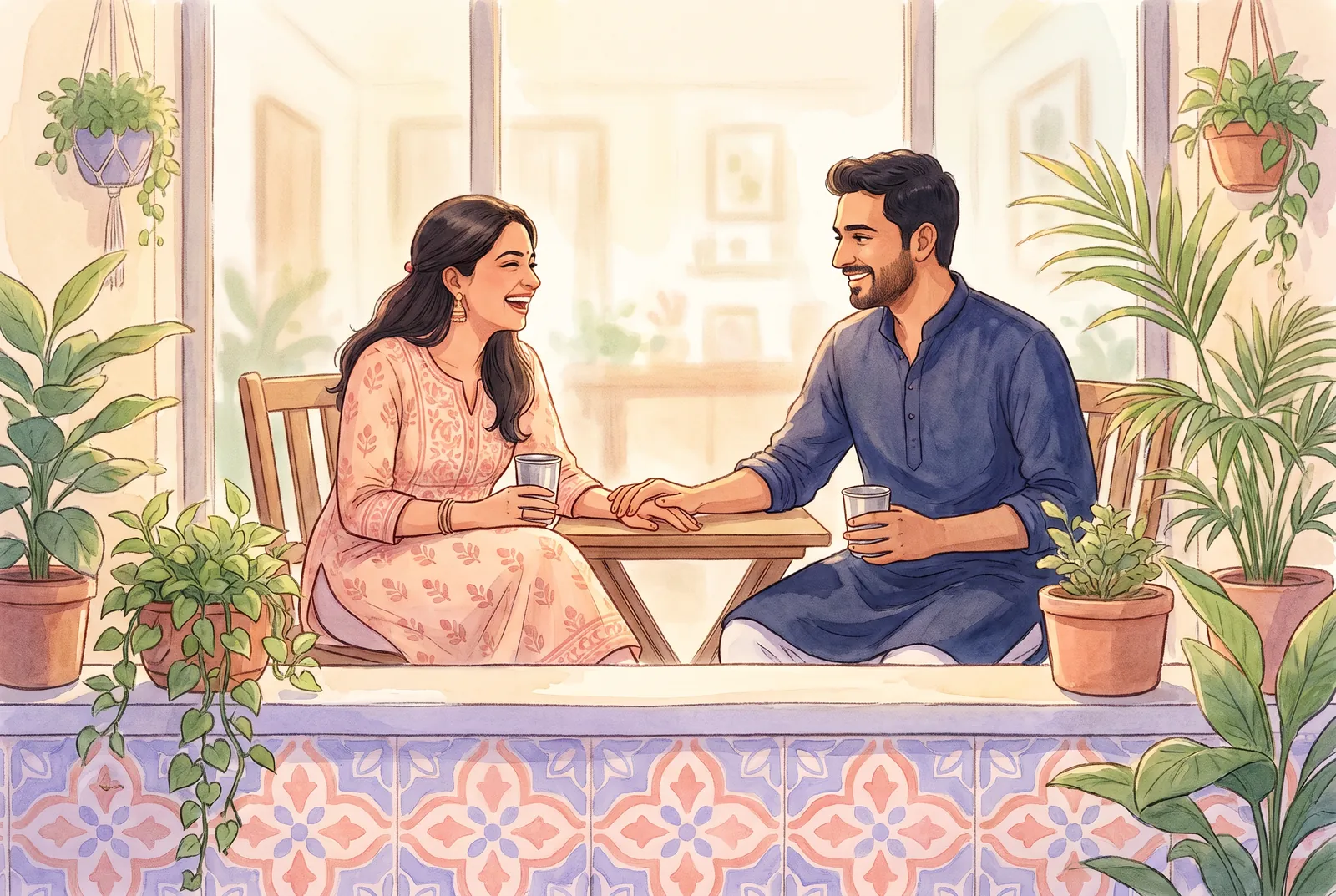
Start with contact that has no target: sitting close, a proper hug, a hand held for longer than usual. No study is needed for this one. It is just how people find their way back to each other.
Step 4 — Expect a rough patch around week two
Restlessness, poor sleep, irritability, intrusive urges. This is ordinary and it passes.
Men who know it is coming get through it. Men who do not decide they are broken and start again.
Step 5 — Give it eight weeks before you judge
Reconditioning is not fast. In my clinical experience — my own patients, uncontrolled, no trial behind it — most report a genuine shift between six and eight weeks: morning erections firmer, arousal with their wife easier, less mental preoccupation.
Judging at day ten is judging too early.
Step 6 — Treat the sexual problem underneath, if there is one
This is where men most often go wrong on their own. If you are avoiding sex because you finish in under a minute, or cannot maintain an erection, stopping the habit alone will not fix it — and you will relapse into avoidance.
Those conditions have specific, effective treatments. If you finish too quickly, read the link between masturbation and premature ejaculation and get it assessed in parallel.
If the problem is the opposite — you can finish alone but not with her — that is delayed ejaculation, and it responds to a different approach entirely.
Keep the goal in view. The goal is not abstinence as an achievement. The goal is that your sexual attention returns to the person you married.
13. 💬 What to tell your wife — and what not to
Men ask me this constantly, and usually get it wrong in one of two directions.
The evidence here is genuinely uncomfortable. On days when solo use was hidden, the man reported lower intimacy and satisfaction himself. But when use was known, he reported higher intimacy over the following year while his partner reported lower intimacy over the same period (Vaillancourt-Morel, 2024).
Disclosure helped him and cost her. Neither hiding nor confessing is a solution by itself.
That asymmetry is exactly why I say the conversation should be about the marriage, not the mechanics.
Do:
- Talk about the marriage. “I have been avoiding you and I want to fix that” is a conversation. A detailed inventory is not.
- Take the blame off her explicitly. Many women I see in couples consultations have concluded it means they are not attractive enough. Say clearly that it does not.
- Tell her what you are actually going to do differently.
Do not:
- Confess in graphic detail to relieve your own guilt. That transfers the burden to her and buys you comfort at her expense.
- Frame it as her failing to meet your needs. Even when desire genuinely is mismatched, that sentence ends the conversation.
- Promise total abstinence forever in the first conversation. Promise the next eight weeks.
If the sexual relationship has already been quiet for a long time, that is its own problem needing its own approach. The full roadmap is at how to fix a sexless marriage.
14. 🕊️ The religious question — briefly, and honestly
A large share of the people searching this are really asking whether it is a sin. Some arrive from questions about fasting, prayer or ritual purity — including whether masturbation after pooja matters.
I will answer that straightforwardly: I am a doctor, not a religious authority, and I do not issue rulings. Your faith is yours to consult.
What I will say is clinical. In the American national survey, one of the commonest reasons people gave for not masturbating was conflict with their morals or religion (Herbenick, 2023). This is a widespread consideration, not a fringe one.
But guilt is a poor engine for change.
In my experience the men who quit on shame alone relapse, and then feel considerably worse than when they started — because now they have failed twice. If your faith gives you a reason to stop, use it as a reason. Never as a stick.
Not sure where you stand?
Get a straight answer from a practising andrologist
Erections that work alone but not with your wife, finishing too quickly, or a habit you have tried and failed to stop — all common, all treatable, all discussed without judgement.
Frequently asked questions about masturbation after marriage
Do married men masturbate?
Yes, most do at least occasionally. In Britain’s national survey 77.5% of men — married and unmarried together — reported masturbating in the past month (Fischer, 2026). It is common and it is not a sign that you are abnormal. What matters clinically is not whether you do it, but whether it is hidden, whether it uses an atypical technique, and whether it is displacing sex with your wife.
Is it OK to masturbate after marriage?
My answer is no — after marriage I ask men to stop. The gain is small and the risk of conditioning yourself away from your own partner is real; higher masturbation frequency was associated with lower sexual and relationship satisfaction in 3,586 men (Rowland, 2023). You should know the mainstream sexual-medicine position is more permissive: normal unless it becomes compulsive (Briken, 2024). I set out both cases in full above.
Is masturbation after marriage cheating?
No. It is not infidelity and I would not call it that. But secrecy has a measurable cost — on days when solo use was hidden from a partner, the man reported lower relationship satisfaction and intimacy that same day (Vaillancourt-Morel, 2024). The dishonesty is what damages trust, not the act.
Is it wrong to masturbate alone after marriage?
Not morally wrong in any medical sense, and I do not treat it as a character failing. My objection is practical: in men the habit behaves as a substitute for partnered sex rather than an addition to it, and the men reporting the most intercourse were the least likely to masturbate (Fischer, 2026). If it is replacing intimacy with your wife, that is the problem worth fixing — not the act itself.
Is masturbating after marriage good or bad?
Neither, physically — it causes no disease. Relationally, the evidence leans mildly negative: higher frequency tracked lower relationship satisfaction (Rowland, 2023), though those authors judged the overall association weak, and a direct test found no masturbation parameter predicted partnered erections in men (Sánchez-Pérez, 2026). My clinical judgement is that after marriage the honest cost-benefit does not favour continuing.
What are the side effects of hand practice after marriage?
There are no physical side effects in the sense most men fear — no weakness, no lost sperm quota, no reduced testosterone, no infertility. The genuine risks are behavioural: conditioning your erection to a technique your wife cannot reproduce, and displacing partnered sex. Men with erectile dysfunction were 2.2 times more likely to use an atypical technique such as prone rubbing (Can, 2023).
Why do married men masturbate even when they have a wife?
The commonest reasons I hear are mismatched desire, convenience, stress and sleep, long-standing habit from the teenage years, pornography, avoiding rejection, and performance anxiety. The data supports the first: men who wanted partnered sex much more often were 4.40 times more likely to be frequent masturbators (Herbenick, 2023).
Can masturbation cause erectile dysfunction with my wife?
Frequency alone is weakly related to erectile function, and one direct study found no masturbation parameter predicted partnered erections in men (Rowland, 2023; Sánchez-Pérez, 2026). Technique is the more plausible issue: among men with both ED and a traumatic masturbation pattern, firm erections occurred in 60.2% during masturbation but only 38.8% during partnered sex (Can, 2023). Get diabetes, blood pressure and hormones checked first — ED is often the first sign of those.
Does masturbation affect our chances of having a baby?
It does not cause infertility. On timing, higher ejaculation frequency was associated with better sperm vitality and lower DNA fragmentation (Xi, 2025), and short abstinence may benefit subfertile men especially within four days (Du, 2024). Practically: have sex across the fertile window and stop counting. Do not save up for a week — longer abstinence raises DNA damage.
Is it healthy to masturbate daily?
Daily masturbation will not damage your body. But in married men, daily frequency is usually a marker that something in the partnered sex life is not being met — the men reporting the most intercourse were the least likely to masturbate (Fischer, 2026). If it is daily, I would want to know what it is compensating for.
Is it a sin to masturbate if you are married?
That is a question for your faith, not for me — I am a doctor and I do not issue religious rulings. Clinically, conflict with morals or religion was one of the commonest reasons people gave for not masturbating (Herbenick, 2023), so the concern is widespread and legitimate. I would only caution that guilt is a poor engine for lasting change.
What is the 7-7-7 rule for married couples?
It is a popular relationship habit, not a medical guideline: every 7 days a date night, every 7 weeks a day out together, every 7 months a short trip away. There is no trial evidence behind the specific numbers. I mention it because the principle — protected, scheduled, non-negotiable couple time — is genuinely what I ask couples to build when solo habits have crowded out shared ones.
What is the 72-hour rule in marriage?
Another popular rule rather than a clinical one: raise a grievance within 72 hours rather than letting it harden, or alternatively wait 72 hours before reacting to something in anger. No evidence base either way. The useful part for this topic is the instinct behind it — an unspoken resentment about sex or secrecy tends to get worse, not better, with silence.
Can I recover after masturbating for many years?
Yes. This is conditioning, not injury, and conditioning can be untrained. Case reports describe men whose difficulties resolved after stopping pornography (Park, 2016) — that is low-grade evidence, and my confidence comes mostly from my own patients, most of whom notice a genuine shift between six and eight weeks.
Should I tell my wife?
Talk about the marriage rather than the mechanics. The research is uncomfortable in both directions: hiding it cost the man his own sense of intimacy, while disclosure was followed by higher intimacy for him and lower intimacy for his partner over a year (Vaillancourt-Morel, 2024). Say that you have been avoiding her, that it is not about her attractiveness, and what you intend to do differently.
Does watching pornography with my wife count the same?
The research separates these. Watching alone was associated with poorer relationship quality for men — lower commitment, less emotional intimacy — while watching together was associated with greater intimacy, in 1,234 people who were in unmarried relationships at baseline. The same study found both patterns tracked more psychological aggression between partners, so I would not present joint viewing as a fix (Huntington, 2021).
How long does it take to stop?
Expect a difficult patch around week two — restlessness, poor sleep, intrusive urges — and a genuine change between six and eight weeks. Remove the cue first, correct any harmful technique immediately, and rebuild non-demand physical contact with your wife in parallel. If a sexual problem such as premature ejaculation is underneath it, treat that at the same time or you will relapse into avoidance.
The bottom line
Most married men masturbate. It has not damaged your body, and you are owed no shame for it.
But in men the habit behaves like a substitute rather than a supplement.
It rises as the marriage’s sex life falls (Fischer, 2026). It tracks lower satisfaction (Rowland, 2023). It does its damage through secrecy (Vaillancourt-Morel, 2024).
And where the technique is atypical, it is associated with an erection that works better alone than with your wife (Can, 2023).
The mainstream position is that all this is fine in moderation. My position, after years of seeing who ends up in my consulting room, is that after marriage the honest cost-benefit does not favour continuing.
You now have both views and the evidence for each. That is how it should be.
If your erection works alone but not with your wife, if you finish too quickly, or if you have tried to stop and could not — none of that makes you a lesser man, and all of it is treatable. Come and talk to me about it.
References
- Fischer N, et al. Trends in Masturbation Prevalence and Associated Factors: Findings from the British National Surveys of Sexual Attitudes and Lifestyles. Journal of Sex Research. 2026. PMID: 40932457.
- Herbenick D, et al. Masturbation Prevalence, Frequency, Reasons, and Associations with Partnered Sex in the Midst of the COVID-19 Pandemic: Findings from a U.S. Nationally Representative Survey. Archives of Sexual Behavior. 2023. PMID: 36575264.
- Rowland DL, et al. Do pornography use and masturbation play a role in erectile dysfunction and relationship satisfaction in men? International Journal of Impotence Research. 2023. PMID: 35840678.
- Sánchez-Pérez GM, et al. Associations Between Solitary Masturbation Parameters and Sexual Arousal in Partnered Sexual Activity. Behavioral Sciences. 2026. PMID: 42510297.
- Perry SL. Does Low-Cost Sexual Gratification Make Men Less Eager to Marry? Pornography Use, Masturbation, Hookup Sex, and Desire to Be Married Among Single Men. Archives of Sexual Behavior. 2020. PMID: 32761283.
- Vaillancourt-Morel MP, et al. Partner Knowledge of Solitary Pornography Use: Daily and Longitudinal Associations with Relationship Quality. Journal of Sex Research. 2024. PMID: 37310384.
- Huntington C, et al. Watching Pornography Alone or Together: Longitudinal Associations With Romantic Relationship Quality. Journal of Sex & Marital Therapy. 2021. PMID: 33107786.
- Wang C, et al. The Association Between Atypical Masturbation and Male Sexual Dysfunction: A Study Based on Men in Heterosexual Relationships. Archives of Sexual Behavior. 2024. PMID: 38918329.
- Can U, et al. Traumatic masturbation and erectile dysfunction: A matched case-control study. International Journal of Urology. 2023. PMID: 37605604.
- Kafkasli A, et al. Traumatic masturbation syndrome may be an important cause of erectile dysfunction in pre-mature ejaculation patients. Andrologia. 2021. PMID: 34170042.
- Sank LI. Traumatic masturbatory syndrome. Journal of Sex & Marital Therapy. 1998. PMID: 9509379.
- Kazan Kizilkurt O, et al. Effect of internet pornography use frequency on psychogenic erectile dysfunction severity in young Turkish men: the mediating role of dyadic adjustment. International Journal of Impotence Research. 2024. PMID: 38052977.
- Jacobs T, et al. Associations Between Online Pornography Consumption and Sexual Dysfunction in Young Men: Multivariate Analysis Based on an International Web-Based Survey. JMIR Public Health and Surveillance. 2021. PMID: 34534092.
- Park BY, et al. Is Internet Pornography Causing Sexual Dysfunctions? A Review with Clinical Reports. Behavioral Sciences. 2016. PMID: 27527226.
- Grubbs JB, Gola M. Is Pornography Use Related to Erectile Functioning? Results From Cross-Sectional and Latent Growth Curve Analyses. The Journal of Sexual Medicine. 2019. PMID: 30621919.
- Abdi F, et al. Effect of pornography use on the sexual satisfaction: a systematic review and meta-analysis. Journal of Addictive Diseases. 2025. PMID: 39267458.
- Dwulit AD, Rzymski P. The Potential Associations of Pornography Use with Sexual Dysfunctions: An Integrative Literature Review of Observational Studies. Journal of Clinical Medicine. 2019. PMID: 31247949.
- Reis MMFD, et al. Ideal time and self-reported time to ejaculate, frequent use of virtual pornography, and disorders of ejaculation among internet users in the Metropolitan Region of São Paulo, Brazil. Cross-sectional study. Einstein (São Paulo). 2025. PMID: 40053047.
- Briken P, et al. Assessment and treatment of compulsive sexual behavior disorder: a sexual medicine perspective. Sexual Medicine Reviews. 2024. PMID: 38529667.
- Gokani N, et al. Clinical and Demographic Correlates of Pornography Addiction: A Cross-sectional Study from India. Indian Journal of Psychological Medicine. 2025. PMID: 41163695.
- Du C, et al. Association of abstinence time with semen quality and fertility outcomes: a systematic review and dose-response meta-analysis. Andrology. 2024. PMID: 38197853.
- Xi Q, et al. Impact of ejaculation frequency on semen parameters and DNA fragmentation. Reproductive Biology and Endocrinology. 2025. PMID: 40671092.
Written and medically reviewed by Dr Shah Dupesh, MBBS, DCE, FASM, Consultant Andrologist & Sexologist, Dr Shah’s Clinic, Chennai. This article is for general information and does not replace an individual consultation. If your erections have changed, or you have a specific sexual or fertility concern, please seek a personal medical assessment.
Visit us in Chennai
A private, judgment-free space to talk through fertility and men’s sexual health. Walk in, or book ahead by phone.
No 21, Sree Kalki Apartments, Ground Floor, Bazullah Road, T-Nagar, Chennai 600017