
Here’s the honest answer: prone masturbation — rubbing the penis face-down against a surface instead of the hand — is the one habit I tell men to stop. The high pressure trains the body to a sensation ordinary intercourse cannot reproduce, and that mismatch is what later makes sex difficult.
I want to say this plainly to the man lying awake, terrified he has broken himself before marriage. As a practising andrologist in Chennai, I see this every week. You have not damaged the organ — in almost every case I examine, the penis is fine. It has simply been trained to a sensation a partner can’t give it: a wiring problem, not a hardware problem, and I rewire it routinely.
Quick Facts
- Prone masturbation = stimulating the penis face-down against a surface (bed, pillow, floor), not by hand. Also spelt prone mastrubation and prone masterbation.
- It trains the body to a high-pressure sensation normal sex cannot replicate — so the man struggles to ejaculate, stay erect, or feel enough with a partner.
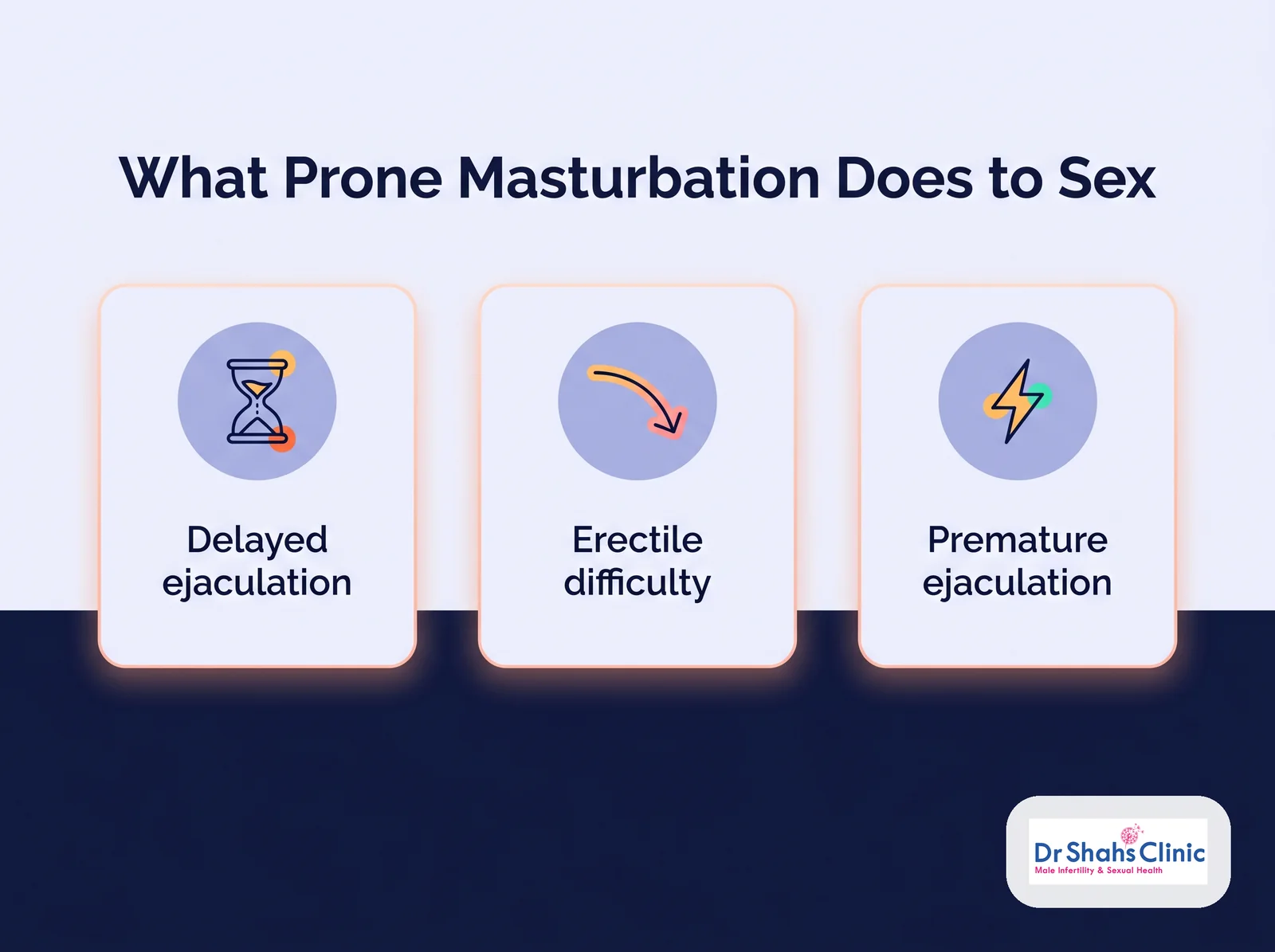
- The usual results are delayed ejaculation or anorgasmia with a partner, sometimes situational erectile difficulty, occasionally the reverse — premature ejaculation.
- It is a learned habit formed young, and a learnable one to unlearn — most men I retrain recover within six to twelve weeks.
- Recovery is behavioural and medical: stop the prone position, recondition the over-trained sensitivity, and where needed use medical therapy to support a reliable erection and ejaculation while partnered sex becomes the retraining ground — with psychosexual guidance if sex is already affected.
What is prone masturbation?
Prone masturbation means masturbating face down, grinding the penis against a firm surface — a mattress, a pillow, the floor. The defining feature is that stimulation comes from whole-shaft pressure against a surface, not from a hand stroking the penis.
Most men who do this did not choose it as adults. It usually starts in childhood or adolescence, and because it works and is private it gets locked in long before the first relationship — a grooved reflex by the time it causes trouble.
That is the first thing I tell my patients: you did nothing shameful. You stumbled onto a way of reaching climax as a boy, and your body kept the pattern. The trouble is not that you masturbated — it is how.
Why is prone masturbation harmful?
Let me explain what’s actually happening. The penis is not equally sensitive everywhere. Conventional sex relies on the most sensitive zones — the head and the rim beneath it — stimulated by the gentle friction of a vagina. Prone masturbation does the opposite: pressed face-down, you stimulate the base and underside of the shaft with heavy, relentless pressure far stronger than any partner can give.
Train the body for years on that signal and it sets a new threshold — I see this on every history I take. The nervous system learns that this exact combination of high pressure, firm surface and set angle is what “counts” as enough to finish, so a vagina’s warmer, lighter sensation does not reach the bar.
What prone masturbation does to sex
So in practice, one of three things happens.
- Delayed ejaculation / anorgasmia with a partner — the outcome I see most. You stay hard, keep going, yet cannot climax during penetration. This is the textbook picture of what the medical literature calls traumatic masturbatory syndrome — ejaculation conditioned to a technique a partner cannot reproduce [1].
- Erectile difficulty during sex — sometimes the penis softens with a partner though it is rock-hard solo, because the body is “waiting” for a stimulus that never arrives. Matched case-control work finds this high-pressure pattern is associated with higher ED rates in men with a traumatic-masturbation history [2][3].
- The reverse — premature ejaculation — occasionally, once you retrain, intercourse feels so intense you finish fast for a while; I find this settles as the body recalibrates.
None of this means the penis is broken — the target sensation is simply set too high and in the wrong place, which is exactly why I can reset it.
Is occasional prone masturbation a problem?
Men ask me this with the most fear, so let me be straight. A one-off as a curious teenager has not damaged you — the harm is driven by repetition, not a single instance — but that is not the same as saying prone is fine in small doses. I do not want any man keeping prone as an occasional technique, because every session re-files that high pressure in the nervous system; the only safe amount of a habit that conditions you away from real sex is none.
What changes with frequency is the urgency, not the instruction. If prone is your default — the only way you can reliably finish — you have a conditioned pattern that needs retraining now. If it has happened only a handful of times, you have a habit to drop before it grooves in. The quick self-test: ask whether you can finish any other way. Either way the instruction is the same — stop the prone position.
I see at least one man a day with this pattern, and roughly half are unmarried men who turn up in the months before a wedding, terrified they are “finished.” They aren’t. Most of the men I retrain are back to satisfying partnered sex within about six to twelve weeks once they stop the prone habit and we support the transition. The ones who stay stuck are not those with the worst habit — they are the ones who white-knuckle it alone in shame instead of getting one or two sessions of guidance.
Does prone masturbation cause erectile dysfunction or curvature?
These are the two questions men type at 2 a.m.
Does it cause ED? It can contribute to situational erectile difficulty — soft with a partner, fine alone — and to delayed ejaculation, which men mistake for ED. The mechanism I see is conditioning, not blocked arteries, which is why it shows up in young men with perfect morning erections — and why I find it reversible in a way vascular ED never is.
Does it bend the penis? A normal degree of curve is common and almost never caused by masturbation — most “bent penis” worries I see are simply normal anatomy, which I explain on is a curved penis normal. The distinction I want you to hold onto is lifelong-and-painless versus new-and-painful. A mild curve since your teens, with no pain and no lump, is just how you are built; prone masturbation did not cause it. A bend that is new, worsening, painful, or comes with a hard nodule felt along the shaft is different — that one I want examined promptly, because it points to something other than habit.
How to stop prone masturbation: the retraining pathway
Now the part you came for. Stopping is not about willpower or guilt — it is about deliberately re-conditioning the body toward a sensation that resembles real sex. This is the protocol I give patients, and I have laid it out in full in my step-by-step guide to stopping prone masturbation.
The retraining steps
- Stop the prone position entirely. I make this non-negotiable: every prone session re-deepens the groove you are erasing. I do not ask you to swap it for a firm hand habit either — that simply trains the body to a new pressure no partner can reproduce. The aim is to move toward the lighter, warmer sensation of real sex, not to condition yourself to another solo technique.
- Recondition the over-trained sensitivity. I treat the next few weeks as recalibration: keep any stimulation gentle and unhurried, let arousal build from desire and fantasy rather than raw intensity, and gradually lower the bar your body has set. This is the principle behind modern retraining for ejaculatory difficulty [4].
- Use medical therapy where it is needed. For many men I prescribe medical therapy that supports a reliable erection and helps ejaculation during the transition, so that partnered sex itself becomes the retraining ground rather than another solo habit. I have used this with a large number of patients and it shortens the road considerably — always tailored to the man, never a one-size pill.
- Cut pornography if it is paired in. When the prone habit is fused with fast, escalating porn, the two reinforce each other (the mechanism I unpack in porn-induced erectile dysfunction); stepping it down gives the reboot room to work.
- Give it weeks, not days. The body does not unlearn a decade-old reflex in a weekend, so treat a slip as data, not a verdict.
- Get psychosexual guidance if intercourse is already affected. If you already struggle with a partner, a few sessions of focused psychosexual therapy shorten the road — the established route for conditioned delayed ejaculation [5][6], and exactly what my delayed ejaculation and erectile-difficulty evaluation is for.
The men who recover fastest are simply the ones who stop fixing this in secret.

Private 1-on-1 consultation
Ready to stop this for good?
Get a clear, judgment-free answer from a practising andrologist — and a simple retraining plan made for you. No shame, no jargon.
Book a Confidential Consultation
Prone vs conventional masturbation: what actually differs
Both sit inside the same family of idiosyncratic technique. Where the fault is grip force from the hand rather than the face-down position, the condition is death grip syndrome, and it is reversed the same way — by stopping, not by softening.
| Feature | Prone masturbation | Conventional (hand) |
|---|---|---|
| Stimulus | Whole-shaft pressure and friction against a surface | Targeted, variable grip the man can adjust |
| Pressure / intensity | High, broad, relentless | Light to moderate, easily varied |
| Resembles intercourse? | No — a sensation a partner can’t reproduce | Much closer to partnered sex |
| Typical effect on sex | Delayed ejaculation, anorgasmia, situational ED | Low risk |
| If habitual | Needs weeks of deliberate retraining | No retraining needed |
The row that matters is the middle one: the closer solo habit sits to real sex, the less I undo later.
Will it affect my marriage or sex life long-term?
For most men who retrain early, no — not permanently. Almost everyone here is convinced the answer is yes; it is not. The men I worry about are not the ones with the habit, but the ones who marry without addressing it and spend the wedding night in silent panic. So deal with it before the wedding — recent work confirms masturbation-conditioned delayed ejaculation responds to structured retraining [4][6], and the vast majority of my patients recover once they do.
Planning to marry and want this sorted first? Book a confidential consultation, or call +91 97907 83856.
Get a clear answer about prone masturbation
Talk to Dr Shah for a private consultation — the fastest way to real answers and a plan to retrain it. Prefer to read first? Grab the free guide.
Free guide · no spam · unsubscribe anytime.
Frequently Asked Questions
What is prone masturbation?
It is masturbating face-down, grinding the penis against a surface such as a bed, pillow or floor instead of using the hand. The stimulation is heavy whole-shaft pressure — very different from intercourse. It is also spelt prone mastrubation or prone masterbation.
Is occasional prone masturbation harmful?
A one-off as a curious teenager has not damaged you — conditioning is built by repetition, not a single instance. But I would not keep prone as an “occasional” technique: every session re-files that high pressure, so the safe amount of a habit that trains you away from real sex is none. If prone is your default — the only way you can reliably finish — that needs retraining now; if it has happened only a few times, drop it before it grooves in.
How do I stop prone masturbation?
Stop the prone position completely and recondition your over-trained sensitivity toward the gentler sensation of real sex — without swapping it for a firm hand habit, which just trains you to another pressure a partner can’t reproduce. Where it helps, I add medical therapy that supports erection and ejaculation so partnered sex becomes the retraining ground. Most men need about six to twelve weeks before partnered sex feels different, so treat the first few “this isn’t enough” experiences as expected, not failure — and add psychosexual guidance if intercourse is already affected.
Does prone masturbation cause erectile dysfunction?
It can contribute to situational erectile difficulty — soft with a partner but fine alone — and to delayed ejaculation, which men confuse with ED. A simple home test points the way: if you still get firm morning erections, your nerves and blood supply are fine, and the problem is conditioning — the reversible kind, unlike vascular ED.
You can fix this — and you don’t have to do it in secret
If you are convinced you have ruined yourself for marriage, you almost certainly haven’t. I retrain conditioned responses routinely, and most patients recover faster than they expect.
Book a confidential consultation with Dr Shah at andrologycorner.com/contact-us, or call +91 97907 83856.
Questions readers have asked — answered by Dr Shah
Men write in here every week. Here are some of the most common questions about prone masturbation and related habits, with my honest answers.
“Can it be cured after I quit prone masturbation?” — Heman
Dr Shah: Definitely — it can be cured.
“I masturbated two days in a row and now I can’t ejaculate, and I’m scared — is this normal?” — a reader
Dr Shah: It’s normal — it settles back on its own.
“I masturbate daily and can’t seem to stop — will it cause problems?” — Nikhil
Dr Shah: Compulsive daily use can dull your interest in real intercourse over time, so it’s worth easing off.
“Can masturbation stop you from growing?” — Emmanuel
Dr Shah: No — that isn’t a real side effect; see the myths vs facts on masturbation side effects.
“Does masturbating once or twice a week hurt my gym gains?” — Arjun
Dr Shah: No, it won’t affect your gains — though it can leave you a little tired.
“I watch porn and masturbate almost daily and I’m worried — what should I do?” — Stephen
Dr Shah: The real risk is the compulsive loop. Ease it down before it becomes a habit you can’t break.
References
- Sank LI (1998). Traumatic masturbatory syndrome. Journal of Sex & Marital Therapy. PMID 9509379
- Can U, Bayraktarli RY, Yagci I, et al. (2023). Traumatic masturbation and erectile dysfunction: A matched case-control study. International Journal of Urology. PMID 37605604
- Kafkasli A, Karabicak M, Cebeci OO, et al. (2021). Traumatic masturbation syndrome may be an important cause of erectile dysfunction in pre-mature ejaculation patients. Andrologia. PMID 34170042
- Waki M, Horie S (2026). Clinical characteristics and outcomes of masturbation aid-based retraining for intravaginal ejaculatory dysfunction: a retrospective case series. The Journal of Sexual Medicine. PMID 42089727
- Perelman MA (2016). Psychosexual therapy for delayed ejaculation based on the Sexual Tipping Point model. Translational Andrology and Urology. PMID 27652228
- Rowland DL, Hevesi K, Conway GR, et al. (2025). Are some forms of delayed/inhibited ejaculation more intractable than others? Establishing delayed ejaculation subtypes based on severity of symptomology during partnered sex and masturbation. The Journal of Sexual Medicine. PMID 40500996
A private, judgment-free space to talk through fertility and men’s sexual health. Walk in, or book ahead by phone.
📍No 21, Sree Kalki Apartments, Ground Floor, Bazullah Road, T-Nagar, Chennai 600017
I struggle with this
Stop the habit Joshua
Hii dr. Shah, i hope you are fine and this comment will reach out to you. I am facing this prone masturbation issue since 3 to 4 years now. When i fall asleep during midnight prone masturbation is happening and as a result ejaculation is taking place. Please i request you to tell me how to abstain or avoid prone masturabtion & to which counsellor should i meet to tackle this. I am unable to stop prone masturbation, i am depressed. Please help me
Please drop me a call on 9790783856