
Here’s the honest answer, straight away: sperm leakage after intercourse is completely normal — it happens to every couple, every single time. What you see trickling out is the surplus seminal fluid, not your fertility draining away. The sperm that actually matter have already begun swimming up toward the womb within minutes, long before that fluid appears. You cannot “lose” your chance of a baby this way, and there is no medicine you need to stop it.
As a practising andrologist in Chennai, I have this exact conversation almost every week — usually with an anxious wife who books the consultation convinced that the semen she saw running out after intercourse means the pregnancy “leaked away.” It did not. Let me explain what is really happening down there, because once you understand the plumbing, the fear simply dissolves — and I can show you the few steps that genuinely help, separated honestly from the folklore that does not.

Quick Facts
- Some semen leaking out after sex is universal and normal. It even has an old medical name — effluvium seminis — and it is pure physiology, not a problem to be fixed.
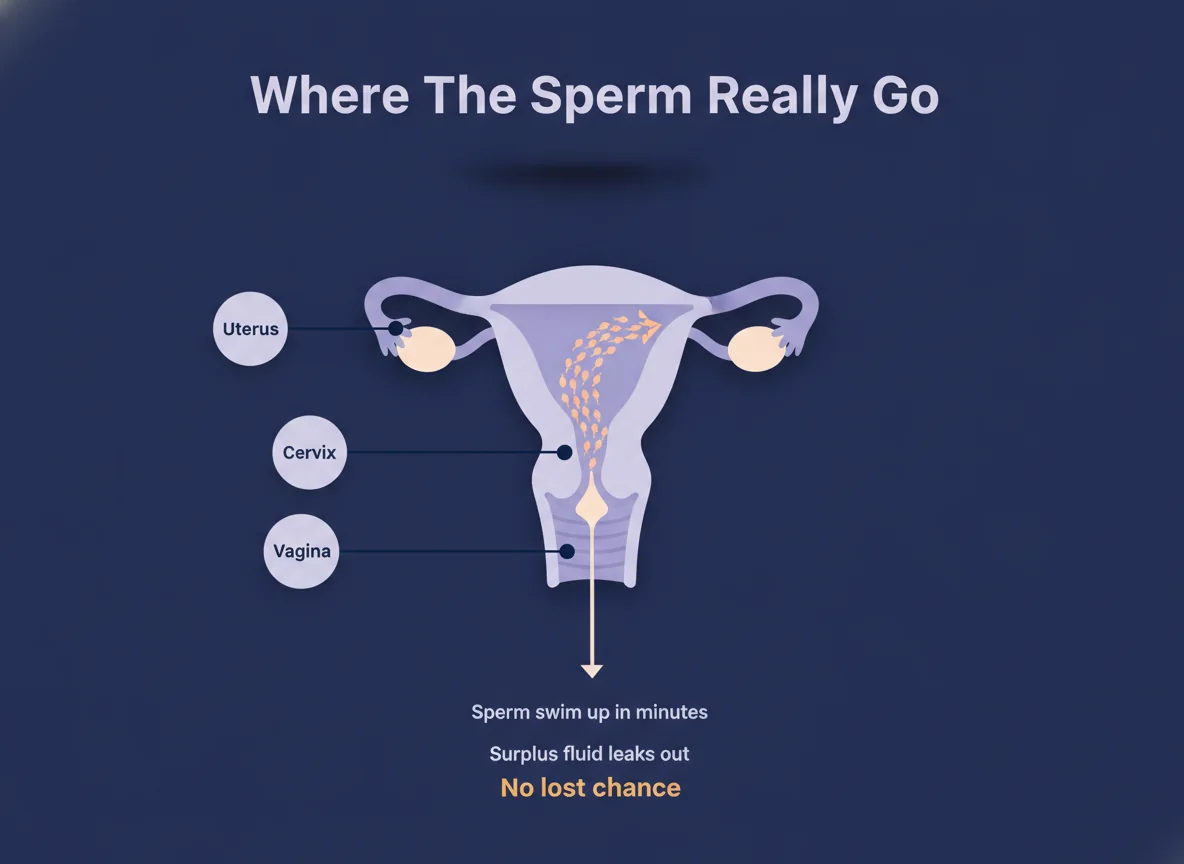
- The sperm that count are already gone before the fluid leaks. Powerful uterine contractions transport sperm up into the womb and tubes within minutes of ejaculation (Kunz, 1997), so the surplus that runs back out is not your chance at conceiving.
- Timing matters far more than leakage. Conception is driven by having sex inside the fertile window, not by how much fluid stays in (Wilcox, 1995; Gibbons, 2023).
- Lying down afterwards is unproven for natural conception. The pooled clinic evidence — from immobilising women after fertility treatment — could not confirm any real benefit (Cordary, 2017), so a pillow under the hips is reassurance, not medicine.
- Some lubricants harm sperm. Many common lubricants reduce sperm movement in the lab (Mowat, 2014), so a couple trying to conceive should choose a fertility-friendly one or skip it.
Is it normal for semen to leak out after intercourse?
Yes — completely. Let me be as plain as I can: in every couple, on every occasion, a portion of the ejaculate flows back out of the vagina over the minutes and hours after sex. This is not a sign of weakness, a leak in a faulty system, or sperm “escaping.” It is the body doing exactly what it is built to do.
Here is why it happens. A normal ejaculate is only a couple of millilitres of fluid, deposited high in the vagina near the cervix. The vagina is not a sealed container — it is a muscular passage open at one end — so gravity and ordinary movement carry the surplus fluid back out. The medical literature has called this effluvium seminis for over a century. So when you stand up, walk to the bathroom, or simply lie there afterwards and feel that warm trickle, you are feeling the leftover fluid leave. Nothing is going wrong.
I say this to patients constantly: you are meant to leak. The men who worry their semen “comes out too easily,” and the women who worry the semen “won’t stay in,” are both describing the same normal event from two sides of the bed.
Can I still get pregnant if the sperm leaks out?
This is the real question underneath all the others, so let me answer it without any hedging: yes, you can absolutely still get pregnant even though sperm leaks out. In fact, you would leak whether or not you conceived — the two have almost nothing to do with each other.
The reason is timing and biology. Within a minute or two of ejaculation, the fluid liquefies and the strongest, most motile sperm swim straight into the cervical mucus, where the vagina’s acidity can no longer touch them. The uterus then helps actively: rhythmic, wave-like contractions — what researchers call the uterine peristaltic pump — draw sperm up through the womb and toward the tubes within minutes (Kunz, 1997). The sperm that are going to fertilise an egg have left the building long before the surplus fluid appears at the entrance.
And the numbers are wildly in your favour. A single ejaculate contains tens to hundreds of millions of sperm, but only a few hundred ever reach the egg. So losing a visible trickle of fluid — even a teaspoon of it — does not meaningfully change a process that was only ever going to use a microscopic fraction of what was deposited. What decides whether you conceive is whether you had sex in the fertile window, the five or six days up to and including ovulation (Wilcox, 1995) — not how much fluid you saw afterwards.
How to actually help conception — the honest steps
Search “how to prevent sperm leakage after intercourse” and you will find the same list everywhere: lie down for thirty minutes, prop a pillow under your hips, don’t go to the toilet, don’t wash. As a doctor who reads the actual studies, I owe you an honest grading of that list — because most of it is comfort, not science, and chasing it only feeds the anxiety.
What genuinely helps
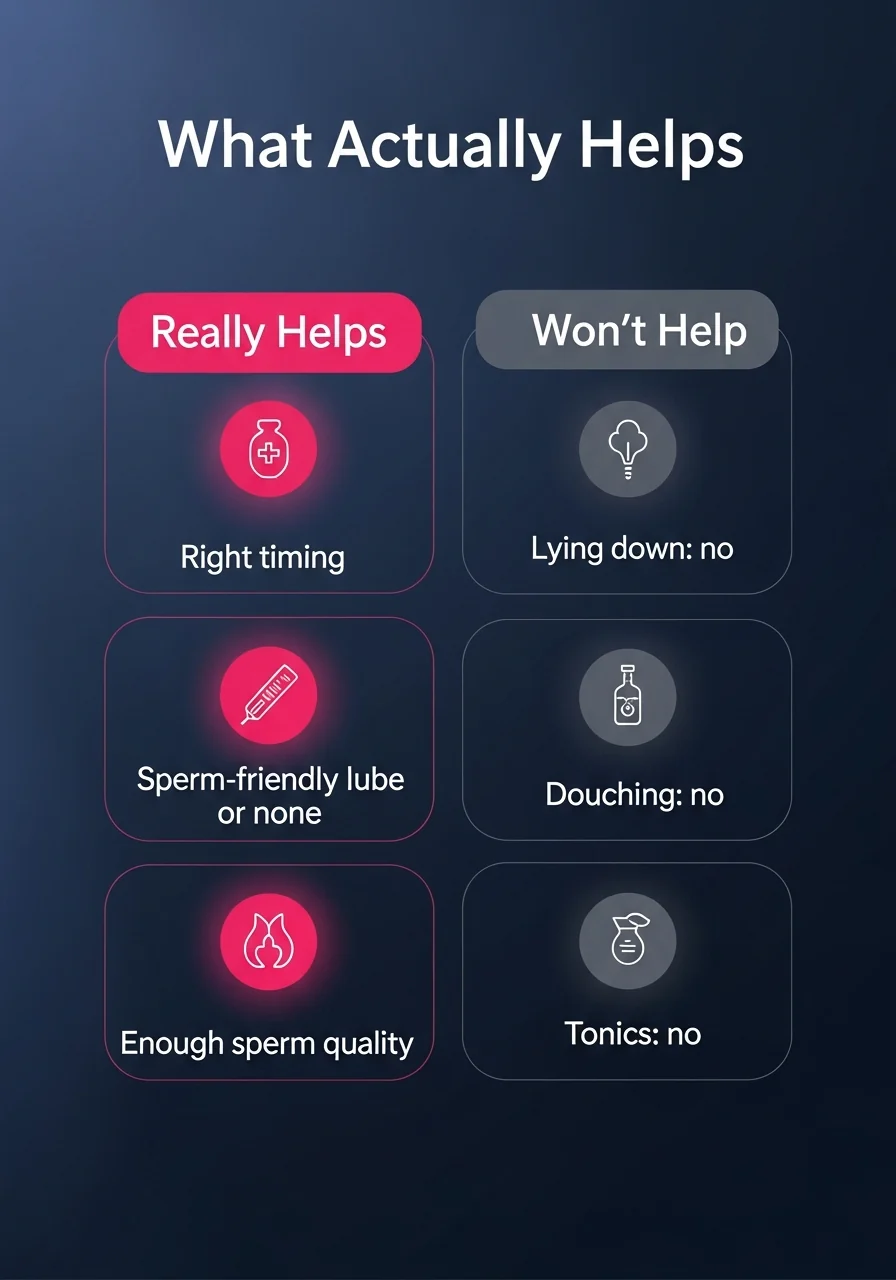
These are the levers that actually move the odds — do these:
- Time sex to the fertile window. This is by far the most powerful lever you have. Conception probability rises sharply in the days leading up to ovulation (Wilcox, 1995), and tracking fertile cervical mucus predicts it even better than calendar timing alone (Bigelow, 2004). Having sex every one to two days across that window is the single best thing you can do (Gibbons, 2023).
- Choose a sperm-friendly lubricant, or none. Many popular lubricants — and even saliva — sharply reduce sperm motility in laboratory testing (Mowat, 2014), and reviews advise trying-to-conceive couples to avoid them or use a fertility-rated product (Mesen, 2015). This matters far more than any amount of fluid staying in.
- Look after the sperm themselves. If you are trying to conceive, the quality of the sperm matters more than retention. I walk through the practical, evidence-based ways to improve sperm quality and quantity in a separate guide — and if a semen test has flagged weak forward movement, my guide to low sperm motility explains what genuinely improves it.
What barely helps
Don’t stress about these — the evidence behind them is weak or beside the point:
- Lying down or a pillow under the hips. The closest hard evidence comes from fertility clinics, where women are immobilised after intrauterine insemination — and even there it is mixed. One small randomised trial did find a benefit from ten minutes of bed rest (Saleh, 2000), but once the trials were pooled, a systematic review and meta-analysis could not confirm any real difference in pregnancy rates (Cordary, 2017); a later trial found that even fifteen versus thirty minutes of immobilisation made no difference (Mengye, 2023). And none of this IUI evidence governs ordinary intercourse, where getting the fertile-window timing right matters far more than whether you lie down afterwards. If lying still for ten minutes relaxes you, do it — but do not believe it is the difference between a baby and no baby.
- Not passing urine afterwards. Urine leaves through a completely separate opening in women, so it cannot wash sperm out of the vagina. Go to the toilet whenever you need to.
- Douching or washing inside. This does nothing helpful and can disturb the vaginal environment, so I advise against it.
| The common “step” | Does it really help? | What I tell my patients |
|---|---|---|
| Right timing | Yes — the biggest factor | Sex every 1–2 days around the fertile window (Wilcox, 1995) |
| Sperm-friendly lube or none | Yes | Use a fertility-friendly lubricant or none (Mowat, 2014) |
| Enough sperm quality | Yes | Healthy sperm count and motility matter more than how much fluid stays in; a semen analysis settles it |
| Lying down: no | Barely — weak evidence | Fine if it relaxes you; not the deciding factor (Cordary, 2017) |
| Douching: no | No — can harm | Skip it; it disturbs the natural balance |
| Tonics: no | No — avoid | A normal event needs no medicine; these are scams |
In my clinic, I would say nine out of ten couples who come in worried about “sperm leakage after intercourse” are perfectly fertile and simply mistiming the cycle or chasing folklore that adds stress without adding babies. The wife is often quietly blaming herself for the fluid she sees, and the husband is quietly buying some “leakage tonic” off the internet. I take both worries off the table in one consultation: the leaking is normal, the medicines are useless, and the fix — when one is even needed — is almost always better timing and a basic semen check, not anything you do in the ten minutes after sex.

Private 1-on-1 consultation
Worried leakage is stopping you conceiving? Let’s settle it
One private consultation: I confirm the leaking is normal, check the timing and the basics, and tell you the few things that genuinely help.
Book a Confidential Consultation
When sperm leakage IS worth a check
For the overwhelming majority, leakage after sex needs nothing but reassurance. But I am honest with my patients about the small number of situations where I do want to take a closer look — because here a “leak” is a clue, not just surplus fluid.
- A dry orgasm with little or no semen out front. If a man climaxes but almost nothing comes out — and instead his urine looks cloudy afterwards — the semen may be going backward into the bladder. That is retrograde ejaculation, driven by diabetes, certain prostate medicines, or past surgery, and it is treatable (Jefferys, 2012). I explain this fully, including the male “sperm comes out in my urine” worry, in my companion guide to sperm leakage in the urine, where sperm also genuinely turns up in the post-ejaculatory urine of normal men (Sigman, 2008).
- Trouble conceiving after a year of trying. If leakage comes alongside difficulty getting pregnant, the leakage is almost never the cause — but it is a good reason to get a semen analysis and a proper fertility work-up for both partners.
- Known diabetes or new ejaculatory changes. Long-standing diabetes can disturb ejaculation and is worth managing properly (Desai, 2023).
- Abnormal discharge — odour, itching, burning, or pain. That points to a possible infection rather than harmless leakage, and it deserves a swab and a urine test.
“Sperm leakage medicine” — please don’t fall for it
I want to say this clearly, because the old version of this page already did and it remains true: there is no legitimate medicine to “prevent sperm leakage after intercourse,” because normal leakage is not a disease. The tonics, capsules and “shukra” formulas sold online to “stop semen loss” and “lock the sperm in” are exploiting anxiety, not treating anything.
This belief — that losing semen drains your strength or your fertility — has a name and a long cultural history in our part of the world, and it causes real suffering even though the premise is false. If that fear of “losing semen” is weighing on you, I explain the whole picture in my piece on Dhat syndrome and feeling sexually weak. The short version: your body remakes sperm continuously, a normal leak takes nothing from you, and the only thing these medicines reliably empty is your wallet.

You can stop worrying about this
If you have been lying awake after sex wondering whether the semen running out has cost you a baby, let me lift that weight: it has not, and it cannot. Leakage is normal, universal, and irrelevant to whether the sperm that count reached the egg. Put your energy into the things that truly matter — getting the timing right, looking after the sperm, and asking for help early if a year of trying has passed — and let the rest go.
Get an honest answer about sperm leakage
A private consultation with Dr Shah tells you whether anything is wrong — almost always, nothing is — and what actually helps you conceive.
Free guide · no spam · unsubscribe anytime.
Frequently Asked Questions
Is it normal for sperm to leak out after intercourse?
Completely normal — it happens to every couple, every time. A normal ejaculate is only a small amount of fluid placed in an open passage, so the surplus simply flows back out. It even has an old medical name, effluvium seminis. The sperm that matter have already swum up toward the womb within minutes (Kunz, 1997), so what you see leaving is the leftover fluid, not your fertility.
Can I still get pregnant if the sperm leaks out?
Yes. You would leak whether or not you conceived, so leakage tells you nothing about your chances. Within a minute or two the strongest sperm enter the cervical mucus and are carried up into the uterus, beyond the reach of anything that leaks back out. What decides conception is whether you had sex in your fertile window (Wilcox, 1995), not how much fluid stayed in.
How do I make sure more sperm stays inside?
Honestly, you do not need to — enough sperm are already inside within minutes. If you want to do something useful, time sex to the fertile window and have it every one to two days (Gibbons, 2023), and avoid sperm-hostile lubricants (Mowat, 2014). Lying down for a few minutes afterwards is harmless if it relaxes you, but the pooled evidence could not confirm it makes any real difference (Cordary, 2017).
How long does sperm leak out after sex?
Usually for a few minutes to a couple of hours, as the surplus fluid drains under gravity and movement. The amount and timing vary from couple to couple and tell you nothing about fertility. It is the fluid leaving, not sperm being lost.
Why does my partner’s semen drip out of me?
Because the vagina is an open, muscular passage, not a sealed pouch — so once the sperm have headed up toward the cervix, the leftover seminal fluid trickles back out with gravity and movement. It is normal physiology in every healthy couple, and it does not mean anything is wrong with him, with you, or with your chances of a baby.
Is it good or bad for sperm to leak out?
Neither — it is simply normal. Leakage is not a sign that something is working well or badly; it is just surplus fluid leaving an open passage. There is nothing to prevent and nothing to fix.
Can I get pregnant if my husband’s semen is watery?
Watery-looking semen is often just a normal variation, a short abstinence gap, or a one-off — and many men with thin-looking semen father children without trouble. It is only worth checking if it is persistent, in which case a simple semen analysis settles it. The leakage you notice afterwards is separate and harmless either way.
Is there a medicine to stop sperm leakage after intercourse?
No — and you should be wary of anyone selling one. Normal post-sex leakage is not a disease, so there is nothing for a medicine to treat. “Semen-loss” tonics and capsules prey on anxiety and do nothing useful. The only situations that need real treatment are a dry orgasm (possible retrograde ejaculation) or leakage with infection — and those need a doctor, not a tonic.
References
- Wilcox AJ, Weinberg CR, Baird DD (1995). Timing of sexual intercourse in relation to ovulation. Effects on the probability of conception, survival of the pregnancy, and sex of the baby. The New England Journal of Medicine. PMID 7477165
- Kunz G, Beil D, Deininger H, et al. (1997). The uterine peristaltic pump. Normal and impeded sperm transport within the female genital tract. Advances in Experimental Medicine and Biology. PMID 9361805
- Bigelow JL, Dunson DB, Stanford JB, et al. (2004). Mucus observations in the fertile window: a better predictor of conception than timing of intercourse. Human Reproduction. PMID 14990542
- Saleh A, Tan SL, Biljan MM, et al. (2000). A randomized study of the effect of 10 minutes of bed rest after intrauterine insemination. Fertility and Sterility. PMID 10973647
- Mowat A, Newton C, Boothroyd C, et al. (2014). The effects of vaginal lubricants on sperm function: an in vitro analysis. Journal of Assisted Reproduction and Genetics. PMID 24390681
- Mesen TB, Steiner AZ (2015). Effect of vaginal lubricants on natural fertility. Current Opinion in Obstetrics & Gynecology. PMID 24717914
- Cordary D, Braconier A, Guillet-May F, et al. (2017). Immobilization versus immediate mobilization after intrauterine insemination: A systematic review and meta-analysis. Journal of Gynecology Obstetrics and Human Reproduction. PMID 28964965
- Mengye Y, Yan T, Jiarong Q, et al. (2023). 15 and 30 min of immobilization after IUI: a randomized control trial. Human Fertility. PMID 36942496
- Gibbons T, Reavey J, Georgiou EX, et al. (2023). Timed intercourse for couples trying to conceive. Cochrane Database of Systematic Reviews. PMID 37709293
- Jefferys A, Siassakos D, Wardle P (2012). The management of retrograde ejaculation: a systematic review and update. Fertility and Sterility. PMID 22177462
- Sigman M, Boyle K, Jarow JP (2008). Prevalence of sperm in the post-ejaculatory urine of fertile and subfertile men. Urology. PMID 18242376
- Desai A, Chen R, Cayetano A, et al. (2023). Understanding and treating ejaculatory dysfunction in men with diabetes mellitus. Andrology. PMID 35933708
A private, judgment-free space to talk through fertility and men’s sexual health. Walk in, or book ahead by phone.
📍No 21, Sree Kalki Apartments, Ground Floor, Bazullah Road, T-Nagar, Chennai 600017