
Here’s the honest answer, straight away: Dhat syndrome is a real, recognised medical condition — not a myth, and not “all in your head.” It is a culture-bound syndrome in which deep anxiety about losing semen drives genuine fatigue, weakness, low mood and sexual symptoms. The fear is misplaced, but the suffering is real — and it is very treatable.
As a practising andrologist in Chennai, I see this almost every week: a young man, often in his early twenties, convinced that semen lost through masturbation, a nightfall, or a few drops passed in urine is draining his strength, his manhood and his future. Let me explain what is actually happening, because once you understand it, the fear loosens its grip — and the treatment is genuinely good.
Quick Facts
- Dhat syndrome is real and classified. It sits in the ICD-10 under neurotic/culture-specific disorders, is retained in ICD-11, and is listed in DSM-5 among the cultural concepts of distress (Kar, 2021).
- The symptoms are genuine — the folk mechanism is not. Semen loss does not physically drain testosterone or destroy fertility — the evidence on that is set out in semen retention benefits; the symptoms are driven by an anxiety–depression and compulsive-behaviour loop (Prakash, 2014).
- It mainly affects South Asian and East Asian men — India, Pakistan, Bangladesh, Sri Lanka, Nepal and China — typically young, unmarried men aged 16–25 (Udina, 2013).
- Anxiety and depression travel with it. In a nationwide Indian study, most men with Dhat syndrome had a co-existing depressive or anxiety disorder (Grover, 2015).
- It is very treatable — reassurance and correcting the semen myth, CBT, treating the anxiety or depression, and breaking the masturbation/porn loop turn it around (Strong, 2022).
What is Dhat syndrome?
Dhat syndrome — Dhat rog, dhatu loss, “semen-loss anxiety” in plain English — is a clinical condition in which a man becomes preoccupied and distressed about losing semen, and attributes a whole cluster of bodily and sexual symptoms to that loss. The word comes from the Sanskrit dhatu, meaning a vital bodily essence; in classical belief, semen was held to be the most precious of these essences, distilled from blood and food over many days.
It was first described in the medical literature decades ago as “a culture-bound sex neurosis of the orient” (Malhotra & Wig, 1991), and it has been studied steadily ever since. So let me say plainly what so few articles do: this is not a made-up complaint and you are not weak for having it. It is a recognised diagnosis with a real symptom picture, a known psychology, and a clear treatment path.
I want to be precise about one thing, because the whole site links back to this page for it. The condition is real; the explanation men inherit for it is wrong. Your tiredness, your low mood, your erection trouble — those are real and worth treating. The idea that each drop of semen is physically bleeding away your vitality is the part that is medically untrue. Hold both of those at once and you already understand Dhat syndrome better than most.
Is Dhat syndrome real, or a myth? The crucial distinction
This is the question I am asked most, and getting it right matters. The honest, evidence-based position is this: the syndrome is real, the distress is real, the diagnosis is real — but the crude folk mechanics are false.
Semen is not a finite reservoir of “life force.” Losing it through masturbation, through a nightfall during sleep, or as a few drops passed in urine does not lower your testosterone, shrink your organ, or wreck your fertility. Your body remakes sperm continuously; I explain the daily reality of that in my piece on what happens if you release sperm every day. So the men who tell me their strength is “leaking out” are describing a true experience built on a false premise.
Where do the symptoms come from, then? From the anxiety itself. Worry, guilt and hyper-vigilance about semen loss produce very physical effects — fatigue, poor sleep, muscle tension, low mood, and performance anxiety that blocks erections. The semen never harmed you; the fear did. That is not a dismissal — it is the doorway to treatment, because anxiety and depression are things I can actually treat.
Dhat syndrome symptoms: the real cluster
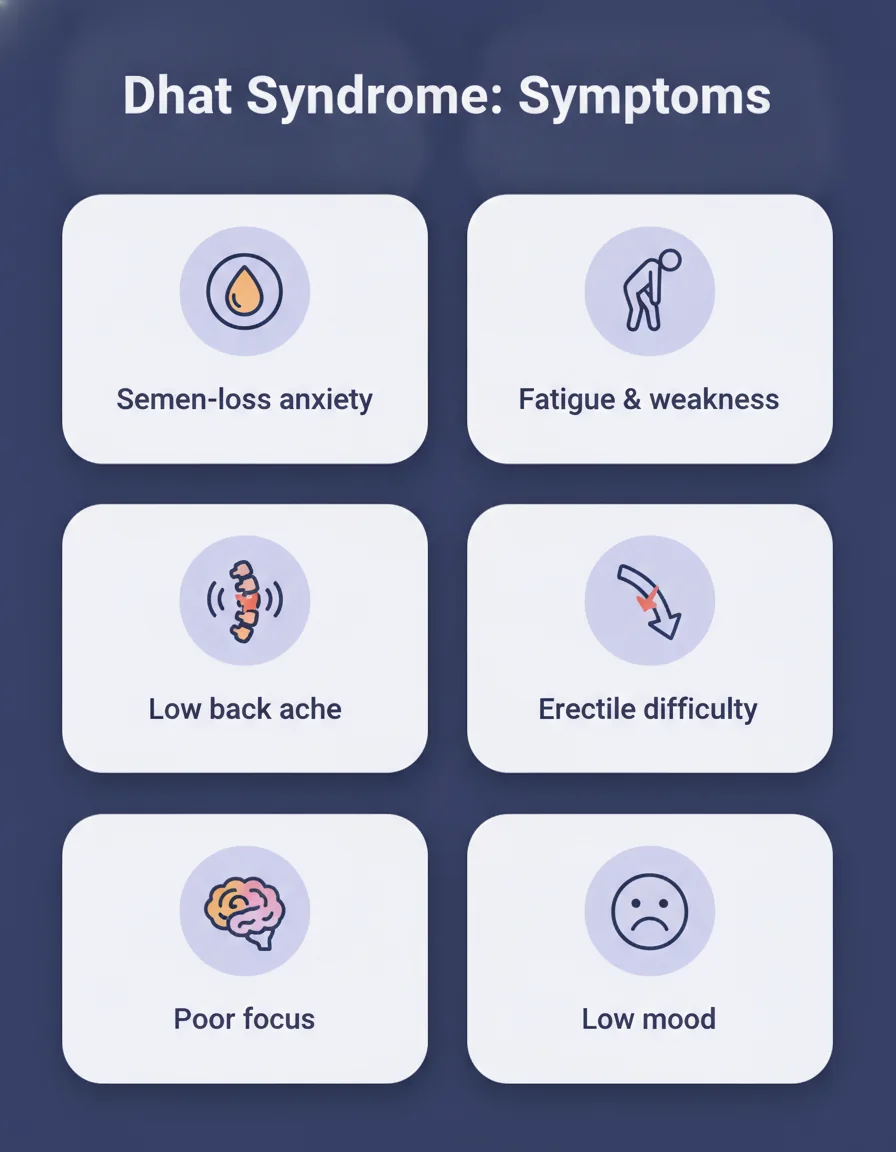
Men with Dhat syndrome do not complain of one thing — they bring a recognisable cluster, and naming it is itself reassuring. The core complaints I hear, supported by the published reviews (Kar, 2021; Strong, 2022), are:
The core symptoms men describe
- Preoccupation and anxiety about semen loss — through masturbation, nightfall (nocturnal emission), or passing “dhat” in urine. This is the central, defining feature.
- A pervasive sense of weakness and fatigue — feeling drained, low on energy, “not the man I was.”
- Lower-back ache — a classic and very common complaint in this group.
- Self-perceived shrinking of the penis or testes — the conviction that the organ is reducing in size. In my clinic this very often crosses over into small penis syndrome — a perceived shrinkage, not an anatomical one.
- Erectile dysfunction and premature ejaculation — and in this group the erectile dysfunction is frequently severe, not mild; comorbid sexual dysfunction is a documented, distinctive feature of Dhat syndrome (Rajkumar, 2016; Vivekanandan, 2019).
- Poor concentration, low motivation, and depressed mood — sometimes deep enough to meet criteria for clinical depression (Mumford, 1996).
The symptoms are real and measurable in their impact: the longer Dhat syndrome goes untreated, the more it erodes coping, quality of life and day-to-day function (Ashwin, 2026). That is exactly why I never wave it away — and why catching it early matters.
| What men fear (the myth) | What is actually true (the medicine) |
|---|---|
| Each drop of semen drains my “vital fluid” and strength | Semen is replaced continuously; losing it does not deplete the body |
| Semen loss lowers my testosterone | Ordinary ejaculation does not lower testosterone |
| Masturbation or nightfall is destroying my fertility | Neither destroys fertility; sperm is made afresh every day |
| My tiredness and weakness come from lost semen | They come from anxiety, low mood and disturbed sleep |
| It is shameful and untreatable | It is a recognised diagnosis and very treatable |
What Dhat syndrome does to a man’s life
The textbook lists symptoms; let me tell you what I actually see walk through my door, because it goes well beyond a tick-list. These are my first-hand clinical observations over years of consultations, and they show how heavy this condition becomes when it is left unnamed.
The real-life toll: ED, body image and marriage
The erectile dysfunction is often severe. Men arrive not with an occasional soft erection but with a near-total loss of function with a partner, even though everything works in private. The fear and the porn-driven conditioning together produce a deep psychogenic erectile dysfunction, and comorbid sexual dysfunction is a recognised, distinctive feature of Dhat syndrome rather than a coincidence (Rajkumar, 2016).
Many report visible muscle-mass loss and weight loss. This one is striking and I hear it constantly: the man feels he is physically wasting — thinner arms, a softer body, lost strength — and he attributes it to “low testosterone from losing semen” or to the exhausting masturbation-and-porn loop he is caught in. The weight change is real to him and often real on the scale; the explanation he carries for it is the part I have to gently correct.
They become convinced their organ has shrunk. A “significant reduction in size” is one of the most common things men tell me, and it tips many of them into full small penis syndrome — a perceived shrinkage with entirely normal anatomy on examination. This perceived-shrinkage complaint in otherwise normal men is well described, and it sits on the same culture-bound spectrum as koro, with which Dhat can co-exist (Marra, 2020; Ghosh & Chowdhury, 2020).
Some quietly give up on marriage. This is the saddest pattern I see. Convinced they can never satisfy a wife, men actively avoid marriage proposals and bride-seeking, sometimes for years, withdrawing from a normal life over a fear that is treatable in weeks. No one should lose their twenties to this.
Who gets Dhat syndrome?
Dhat syndrome is strongly culture-bound. It is reported overwhelmingly in South Asia — India, Pakistan, Bangladesh, Sri Lanka and Nepal — and across China and South-East Asia, wherever the folk belief in semen as a finite vital essence runs deep (Udina, 2013). A classic comparative study found the same “semen-loss” picture in both Sri Lankan and Japanese men, confirming it is not unique to one country but tracks the shared cultural idea (Dewaraja & Sasaki, 1991).
The typical patient is a young man, often unmarried, between his late teens and mid-twenties, frequently from a background where sex education was scarce and orthodox beliefs about semen were strong (Grover, 2016). But I want to be clear from the clinic: I also see married men in their thirties and forties carrying this quietly for years. It is far more common than the textbooks suggest — many estimates run into a large minority of men in the regions where it occurs — and most never tell anyone.
What causes Dhat syndrome?
There is no single cause; Dhat syndrome grows where a cultural belief meets an anxious mind. The threads I see again and again are:
- The semen-as-vitality belief plus a gap in sex education. When no one ever explained that nightfall and ejaculation are normal physiology, a young man fills that gap with fear (Prakash, 2014).
- Underlying anxiety and depression. This is the engine. In the nationwide Indian data, the majority of men with Dhat syndrome had a co-existing depressive or anxiety disorder (Grover, 2015). Often the Dhat worry is how an underlying depression first announces itself (Mumford, 1996).
- Compulsive masturbation and pornography. This is where I differ from the breezy Western take. A daily, guilt-laden masturbation habit — or heavy pornography use — feeds the cycle on both ends: it manufactures the “semen loss” the man then panics about, and the dopamine-and-novelty loop of compulsive porn use is itself linked to anxiety and sexual dysfunction (Rajashekar, 2026; Zacharopoulos, 2026). I am not in the camp that cheerfully encourages more masturbation; in this condition it usually pours fuel on the fire.
The anxiety cycle that keeps it going
Whatever lights the first spark, Dhat syndrome sustains itself through a loop, and seeing the loop is half the cure.
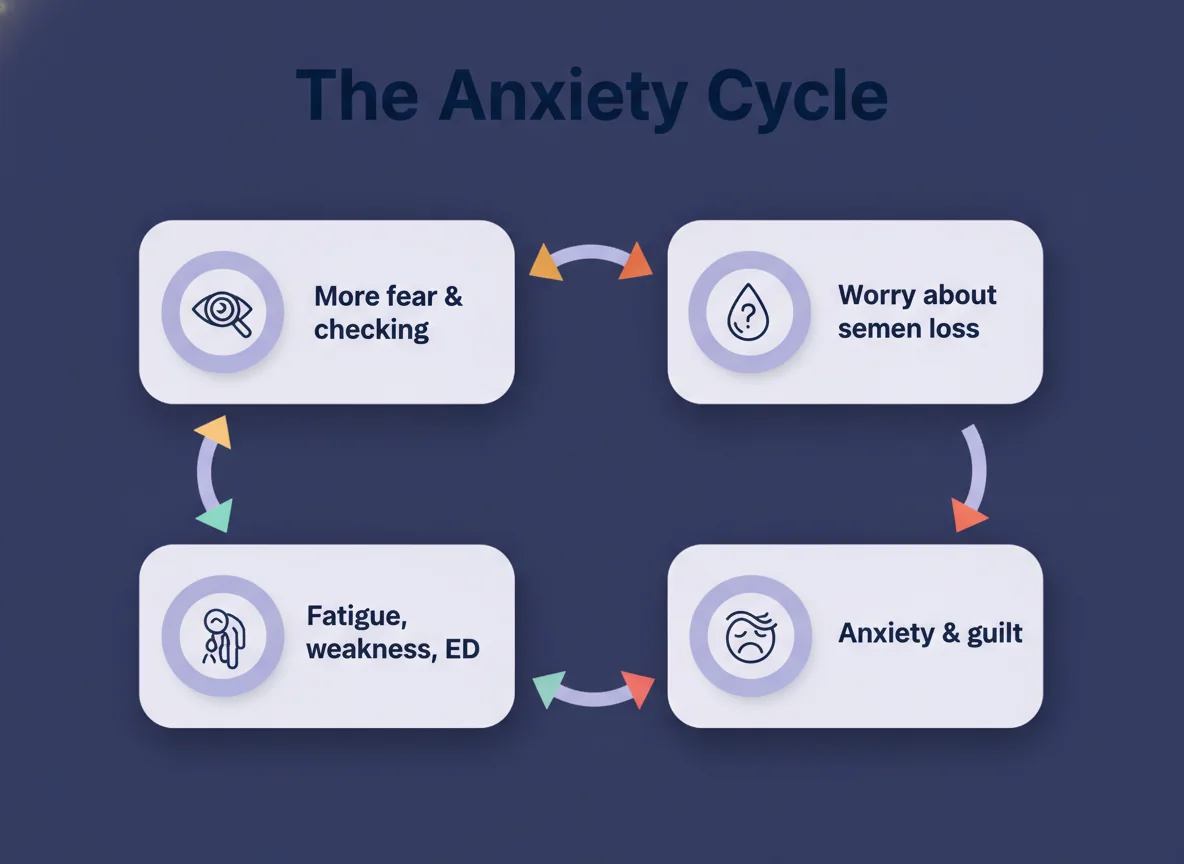
A man worries about losing semen. The worry creates real anxiety symptoms — tiredness, tension, an unreliable erection. He reads those symptoms as proof that the semen loss is harming him, which deepens the worry. Round and round it goes. Break any link in that chain and the whole thing starts to unwind.
My working clinical hypothesis: the dopamine-withdrawal model
I want to be transparent here, because honesty is the whole point of this page. What follows is my working clinical hypothesis — a model built from what I see repeatedly in practice, not an established or proven fact. It deserves formal study, and I offer it as a clinician’s pattern, not a textbook law.
My working hypothesis is that, in a large share of the men I treat, what kicks off Dhat syndrome is not the semen loss at all but a dopamine-withdrawal effect from the pornography-and-masturbation loop. Heavy, novelty-driven porn use floods the brain’s reward system; when the man tries to stop, or simply between binges, that reward system crashes. In the withdrawal trough his mood flips, his emotional stability gives way, and the familiar Dhat symptoms — fatigue, low mood, anxiety, poor focus — settle in. The semen-loss belief is the story his culture hands him to explain a withdrawal state he has no other name for. What is firmly established in the literature is the link between problematic pornography use, anxiety and sexual dysfunction (Zacharopoulos, 2026; Rajashekar, 2026), and between Dhat and underlying depression (Mumford, 1996; Kalimuthu, 2024); the dopamine-withdrawal framing of how they connect is my hypothesis.
When the low mood turns dangerous
This matters because the mood collapse can go deep. In the more severe men I see, the low mood tips into suicidal thinking — and that is not a feature to soften. Comorbid depression and anxiety are documented in the majority of Dhat patients (Grover, 2015), and depression of that depth carries real risk.
If the low mood has reached the point where you feel you cannot go on, I want you to hear this clearly: you are not a burden, this state is temporary, and it is treatable. Please don’t carry it in silence — reach out and call me at the clinic on +91 97907 83856, or book a consultation, and we will help you through it. Dhat syndrome and the depression behind it get better with the right support — let that one phone call be the first step you take, today, before anything else.
A plausible pathway I see again and again
Pulling it together, here is the sequence I repeatedly observe — offered as a clinical model to be formally studied, not as proven causation:
Almost every man who walks in with “Dhat” is carrying two things he has never said aloud: a daily masturbation or porn habit he feels guilty about, and a quiet, untreated low mood. He blames the semen because that is the story he was given. Most of the time his fertility is intact and his examination is normal — but here is the honest twist I cannot ignore: a real subset of these men do show genuinely low testosterone on bloodwork, often alongside the muscle and weight loss they describe.
I do not believe the lost semen caused that — semen loss does not deplete the body — and the exact mechanism is honestly unknown; my suspicion is the sedentary, poorly-fed, chronically-stressed, dopamine-depleted state the loop drags them into. What I can tell you is what helps: correcting the diet, getting them walking daily, and treating the mood and the erections together. The semen was never the problem. The fear — and the loop behind it — was.
How Dhat syndrome is diagnosed
Dhat syndrome is a clinical diagnosis — there is no blood test for it. My job is two-fold: confirm the typical picture, and rule out the organic conditions that can mimic it so the man leaves with genuine reassurance, not a brush-off.
So a proper assessment looks like this:
I take a careful history of the symptoms and the beliefs behind them, examine the patient, and run targeted tests — testosterone, blood sugar, thyroid, and a urine check if there is genuine discharge or leakage — to exclude diabetes, infection or a hormonal problem. I also screen for the erectile dysfunction and premature ejaculation that ride along with it, and — crucially — for the anxiety or depression underneath. When the reports come back normal, that is not a dead end; it is the evidence that lets me say, with confidence, that no fluid is draining your strength.

Private 1-on-1 consultation
Dhat syndrome is treatable — let’s lift this weight
One private, judgment-free consultation: I confirm the diagnosis, show you the body is healthy, and start a treatment that genuinely works.
Book a Confidential Consultation
Dhat syndrome treatment: what actually works
Here is the genuinely hopeful part — Dhat syndrome treatment works, and it usually works well (Strong, 2022; Kar, 2021). I do not hand out tonics or “shukra” pills to “replace lost semen”; that only validates the myth. The treatment targets the real machinery — the belief and the mood.
The cornerstones of treatment
- Psychoeducation and reassurance — the cornerstone. I explain, with the man’s own normal reports in hand, that semen loss does not deplete the body. For many men, correctly understanding the physiology is itself a large part of the cure.
- Cognitive behavioural therapy (CBT). Structured CBT breaks the worry-symptom-checking loop and retrains how the man interprets his body. It is the best-studied psychological treatment here and works quickly for many (Strong, 2022).
- Treating the underlying anxiety or depression. Where there is a clear depressive or anxiety disorder, treating it — including an SSRI antidepressant where clinically indicated — lifts the Dhat symptoms with it (Grover, 2015; Mumford, 1996).
- Breaking the masturbation and porn loop. Easing off compulsive, guilt-driven masturbation and heavy porn use removes both the trigger and the daily “evidence” the fear feeds on. The goal is not shame — it is redirecting toward real intimacy.
- Treating the sexual symptoms directly. Where erectile dysfunction or premature ejaculation persist, I treat them on their own merits so confidence can return and normal intimacy can resume.
A combination of these, tailored to the man in front of me, usually turns things around within weeks to a few months. I will often combine medical therapy — to treat the erectile dysfunction, the depression and the anxiety — alongside the lifestyle work below, because lifting the mood and restoring confident erections in parallel is what breaks the despair fastest. The single biggest enemy is delay — and the silence and stigma that cause it.
Testosterone, diet and daily walking — my clinical approach
For the subset of men who turn out to have genuinely low testosterone (and the muscle and weight loss that often comes with it), I add a practical, food-and-movement plan — and in my experience it helps considerably. This is my clinical approach, offered as what I see work, not as a guaranteed cure:
- Eat to support testosterone. I move men toward more healthy fat, moderate protein and lower carbohydrate. This is not folklore: in a systematic review and meta-analysis, low-fat diets were associated with significantly lower serum testosterone in men, so pushing healthy fats back up is a sensible lever (Whittaker & Wu, 2021).
- Walk every day. A daily walk is the simplest, most reliable thing I prescribe — it lifts mood, improves sleep, supports weight and fits any life. I would rather a man walk daily for months than chase a supplement.
- Treat the rest in parallel. Diet and walking sit on top of the core treatment — psychoeducation, CBT, treating the anxiety or depression, and easing the porn loop — not instead of it.
To be clear about the stance behind all of this: I do not believe losing semen lowered anyone’s testosterone. Where the testosterone is genuinely low, I treat the man’s whole state — diet, activity, mood, sleep, and the dopamine loop — rather than blaming a fluid that the body simply remakes.

Prognosis: this gets better
Let me end the worry where it belongs. The outlook in Dhat syndrome is good. It is not a degenerative disease, it does not damage your fertility, and it does not shorten your life. With the right explanation and treatment, the fatigue lifts, the mood improves, the sexual confidence returns, and the preoccupation fades. The men who do worst are simply the ones who suffer in silence for years before anyone names it for them (Ashwin, 2026) — which is the one outcome I most want this page to prevent.
If any of this sounds like you, you are not broken, you are not alone, and you are certainly not beyond help. A single honest conversation with a sexologist in Chennai — or wherever you are — can start to lift a weight you may have carried for years.
Get an honest answer about Dhat syndrome
A private consultation with Dr Shah tells you what is really going on — and how quickly it can get better.
Free guide · no spam · unsubscribe anytime.
Frequently Asked Questions
What is the Dhat problem in men?
The “Dhat problem” is Dhat syndrome — a recognised condition in which a man becomes intensely anxious about losing semen (through masturbation, nightfall, or in urine) and blames a cluster of real symptoms — fatigue, weakness, low-back ache, erectile difficulty, low mood — on that loss. The symptoms are genuine; the idea that semen loss is physically draining him is the part that is mistaken, and the whole thing is treatable.
Is Dhat syndrome real?
Yes. Dhat syndrome is a real, recognised clinical condition. It is listed in the ICD-10 (and retained in ICD-11) and appears in the DSM-5 among the cultural concepts of distress (Kar, 2021). The distress and the symptoms are real — what is not true is the folk belief that losing semen physically depletes the body.
What are the symptoms of Dhat syndrome?
The core symptoms are preoccupation and anxiety about semen loss, a pervasive sense of weakness and fatigue, lower-back ache, a self-perceived shrinking of the organ, erectile dysfunction and premature ejaculation, poor concentration, low motivation, and depressed mood (Kar, 2021; Strong, 2022).
Can Dhat syndrome cause severe erectile dysfunction?
Yes. In my clinical experience the erectile dysfunction in Dhat syndrome is frequently severe — a near-complete loss of function with a partner despite normal private erections — driven by fear and porn-related conditioning. Comorbid sexual dysfunction is a documented, distinctive feature of the condition, not a coincidence (Rajkumar, 2016), and it responds well when the ED, the mood and the porn loop are treated together.
Does Dhat syndrome lower testosterone or cause weight loss?
Losing semen does not lower testosterone — the body remakes sperm continuously. That said, in my clinic a real subset of these men do show genuinely low testosterone on bloodwork, often with the muscle and weight loss they describe; the exact mechanism is unknown and warrants study, but it more likely reflects the sedentary, poorly-nourished, chronically-stressed state the masturbation-porn loop drives, not the semen itself. Diet (more healthy fat, moderate protein, lower carbohydrate) and daily walking help in my experience (Whittaker & Wu, 2021).
Does Dhat syndrome make the penis smaller?
No — but the feeling that it has shrunk is one of the commonest complaints, and it often develops into small penis syndrome: a perceived reduction in a man with completely normal anatomy (Marra, 2020). It sits on the same culture-bound spectrum as koro, and the size worry eases as the underlying anxiety is treated.
How is Dhat syndrome diagnosed?
It is a clinical diagnosis — there is no single test. A doctor confirms the typical pattern of symptoms and beliefs, examines the patient, and runs targeted tests (testosterone, blood sugar, thyroid, urine where relevant) to rule out diabetes, infection or hormonal causes, then screens for the underlying anxiety or depression.
Why does Dhat syndrome happen?
It develops where a cultural belief in semen as a finite “vital fluid” meets an anxious or low mood and, often, a guilt-laden compulsive masturbation or pornography habit (Grover, 2015; Rajashekar, 2026). A lack of clear sex education leaves the fear unchallenged, and an anxiety loop then keeps it going.
What are the treatment options for Dhat rog?
Treatment is psychoeducation and reassurance (correcting the semen myth), cognitive behavioural therapy, treating any underlying anxiety or depression (including an SSRI where indicated), and easing the compulsive masturbation/porn habit — plus treating any erectile or ejaculatory symptoms directly. There is no need for “semen-replacing” tonics, and they do not help.
Is Dhat syndrome related to anxiety?
Very much so. Anxiety (and depression) is the engine of Dhat syndrome — in nationwide Indian data most patients had a co-existing anxiety or depressive disorder (Grover, 2015). The bodily symptoms men blame on semen loss are largely the physical effects of that anxiety.
What are the symptoms of “Dhat” in urine?
Men often describe passing a whitish fluid in urine and call it “dhat.” Usually this is harmless — a little prostatic fluid or leftover semen washing out — and not a loss of “vital fluid.” It only needs a check if it is persistent or comes with burning or discharge; I explain this fully in my guide to sperm and semen leakage in urine.
What is “Dhat” in girls or women?
The classic Dhat syndrome is described in men, around semen. An analogous condition is reported in some women who attribute weakness and similar symptoms to a perceived loss of vaginal or “white” discharge. The principle is the same: the distress is real, but the loss is not depleting the body, and it responds to the same reassurance-and-treatment approach.
Private 1-on-1 consultation
Dhat syndrome is treatable — let’s lift this weight
One private, judgment-free consultation: I confirm the diagnosis, show you the body is healthy, and start a treatment that genuinely works.
Book a Confidential Consultation
You do not have to carry this alone
If you have spent months or years convinced that semen loss is draining your life away, take a breath: in nearly every man I examine, the body is healthy and the fear is the treatable problem. Dhat syndrome is real, it is recognised, and it gets better — but only once it is named and treated instead of hidden. You do not have to guess, and you do not have to suffer in silence.
References
- Malhotra HK, Wig NN (1975). Dhat syndrome: a culture-bound sex neurosis of the orient. Archives of Sexual Behavior. PMID 1191004
- Dewaraja R, Sasaki Y (1991). Semen-loss syndrome: a comparison between Sri Lanka and Japan. American Journal of Psychotherapy. PMID 2018192
- Mumford DB (1996). The ‘Dhat syndrome’: a culturally determined symptom of depression? Acta Psychiatrica Scandinavica. PMID 8891081
- Udina M, Foulon H, Valdés M, Bhattacharyya S, Martín-Santos R (2013). Dhat syndrome: a systematic review. Psychosomatics. PMID 23352282
- Prakash O, Kar SK, Sathyanarayana Rao TS (2014). Indian story on semen loss and related Dhat syndrome. Indian Journal of Psychiatry. PMID 25568479
- Grover S, Avasthi A, Aneja J, et al. (2015). Comorbidity in patients with Dhat syndrome: a nationwide multicentric study. Journal of Sexual Medicine. PMID 25904237
- Grover S, Avasthi A, Gupta S, et al. (2016). Phenomenology and beliefs of patients with Dhat syndrome: A nationwide multicentric study. International Journal of Social Psychiatry. PMID 26142412
- Rajkumar RP (2016). Distinctive clinical features of Dhat syndrome with comorbid sexual dysfunction. Indian Journal of Psychological Medicine. PMID 26957326
- Vivekanandan KS, Thangadurai P, Prasad J, Jacob KS (2019). Sexual Dysfunction among Men in Rural Tamil Nadu: Nature, Prevalence, Clinical Features, and Explanatory Models. Indian Journal of Psychological Medicine. PMID 30783313
- Ghosh S, Chowdhury AN (2020). A case of two culture-bound syndromes (Koro and Dhat syndrome) coexisting with obsessive-compulsive disorder. Indian Journal of Psychological Medicine. PMID 32382189
- Marra G, Drury A, Tran L, Veale D, Muir GH (2020). Systematic Review of Surgical and Nonsurgical Interventions in Normal Men Complaining of Small Penis Size. Sexual Medicine Reviews. PMID 31027932
- Whittaker J, Wu K (2021). Low-fat diets and testosterone in men: Systematic review and meta-analysis of intervention studies. The Journal of Steroid Biochemistry and Molecular Biology. PMID 33741447
- Kar SK, Menon V, Arafat SMY, Singh A (2021). Dhat syndrome: Systematic review of epidemiology, nosology, clinical features, and management strategies. Asian Journal of Psychiatry. PMID 34563955
- Strong YN, Li A, Pierre JM (2022). Dhat Syndrome: Epidemiology, Risk Factors, Comorbidities, Diagnosis, Treatment, and Management. Cureus. PMID 36425228
- Kalimuthu A, Kaki A, Jetty RR, T M (2024). Dhat Syndrome Presenting as Secondary Depression in a Patient With Mild Intellectual Disability. Cureus. PMID 39229414
- Zacharopoulos Z, Georgiou C, Critselis E, et al. (2026). Pornography Consumption and Male Sexual Dysfunction: A Systematic Review. Advances in Experimental Medicine and Biology. PMID 41273571
- Rajashekar M, Sharma MK, Amudhan S (2026). Problematic Pornography Use Among Indian Adults: Patterns, Preferences, Motives, Psychosocial Impacts, and Support Strategies. International Journal of Sexual Health. PMID 42205327
- Ashwin JV, Shahi MK, Tripathi A, Singh A, Kar S (2026). Association of duration of untreated Dhat Syndrome on coping mechanism, quality of life and disability in Dhat Syndrome: A cross-sectional study. Indian Journal of Psychiatry. PMID 42158515
A private, judgment-free space to talk through fertility and men’s sexual health. Walk in, or book ahead by phone.
📍No 21, Sree Kalki Apartments, Ground Floor, Bazullah Road, T-Nagar, Chennai 600017