
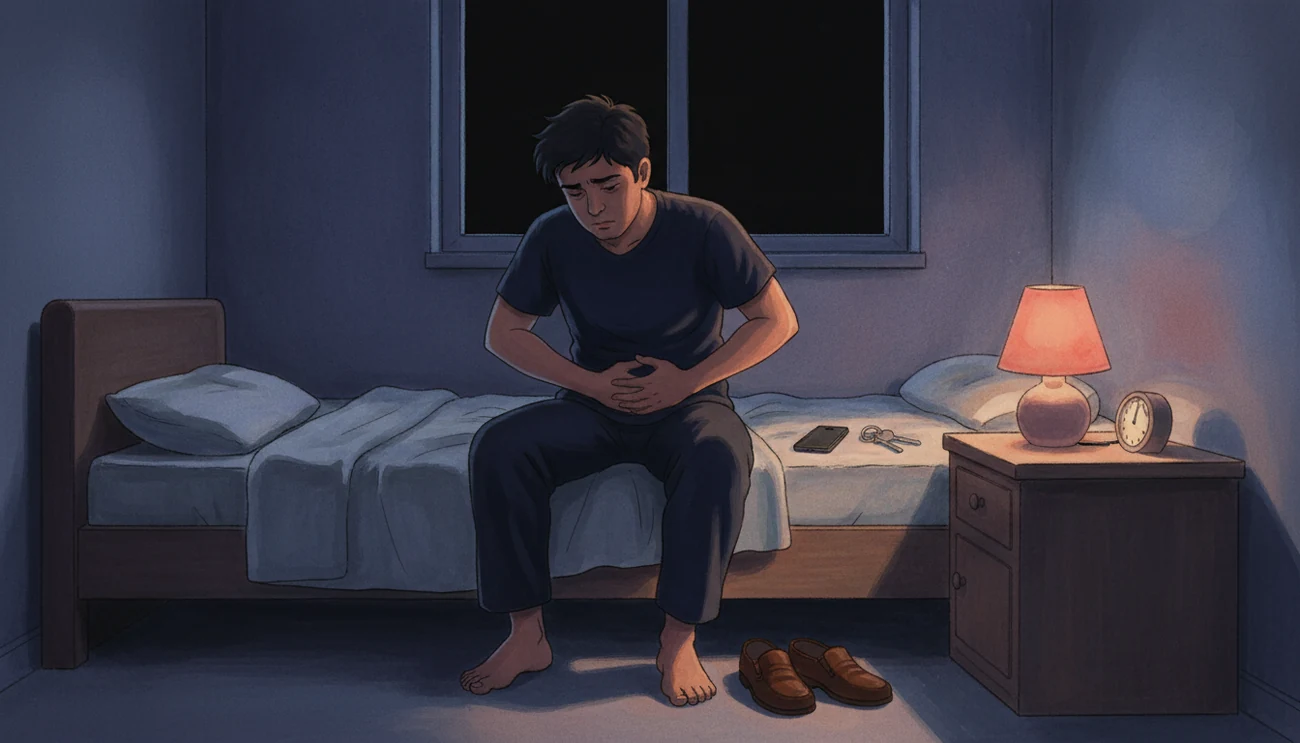
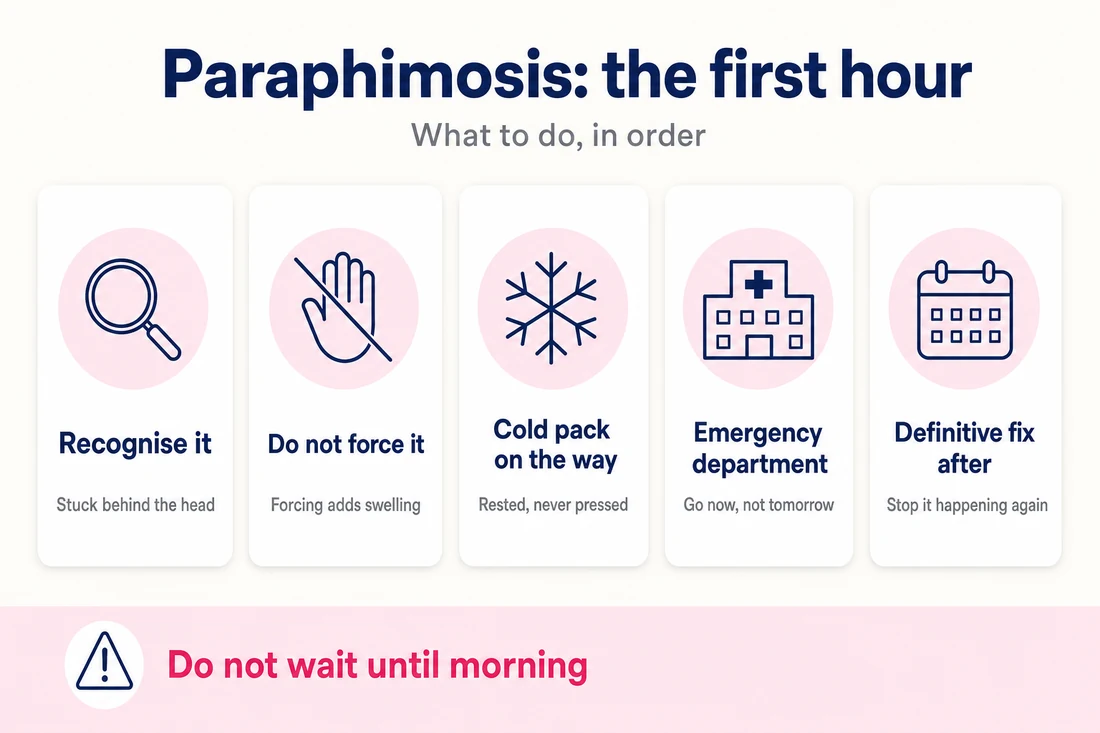
If your foreskin is pulled back behind the head of the penis and will not come forward again, do not try to fix this at home and do not wait until morning. This is paraphimosis, a true emergency. Go to the nearest emergency department now.
Let me answer the exact question first, because it is the one you came here for. There is no home fix for this. There is no position, no cream, no stretch and no amount of patience that will undo it, and every hour you spend looking for one makes the problem harder to solve.
I want to be blunt at the top, because the single most dangerous thing about this condition is how reasonable it feels to wait. The pain is bad but bearable at first. The swelling looks like something that might settle on its own. It does not settle. It gets worse every hour, and the mechanism that makes it worse is the same one that will eventually kill the tissue.
And I know why you are still reading instead of moving. The men who come to me with this are not reckless — they are embarrassed, and embarrassment costs them hours. So let me settle that now: nobody in an emergency department will think you are foolish, we see this constantly, and you will not be the strangest thing anyone there deals with tonight.
Here is the short version. Read the six points, then go. The detail underneath is there for afterwards.
Read this first
In a nutshell
It is an emergency
Paraphimosis is one of a small handful of true urological emergencies, and delay causes permanent damage (Kessler, 2009).
You cannot fix it at home
Forcing the skin makes the swelling worse and tightens the ring further.
It affects anyone with a foreskin
Men and boys, including partially or incompletely circumcised males (Pham, 2017). A foreskin that will not retract at all is phimosis — a different problem, and not an emergency.
It is often caused during medical care
Foreskin pulled back for washing, an examination or a catheter, and never pulled forward again (Choe, 2000).
It is treated, not endured
In hospital it is numbed properly first, then reduced. Surgery is the exception, not the rule.
Untreated, it can end in gangrene
Trapped fluid becomes trapped blood, and the tissue dies (Yiğiter, 2008).
Quick facts
- Paraphimosis is the foreskin trapped behind the head of the penis and unable to be returned forward. Phimosis is the opposite: a foreskin that will not pull back at all.
- It happens in males who are uncircumcised, or only partially or incompletely circumcised (Pham, 2017; Fuenfer, 1994).
- The trapped ring of skin acts like a tourniquet, blocking drainage and then blood supply (Williams, 1995).
- It is often iatrogenic — that is, caused during medical care (Choe, 2000). An indwelling catheter is a recognised setting (Tremayne, 2020).
- Untreated paraphimosis can progress to gangrene and auto-amputation within days to weeks (Yiğiter, 2008).
What paraphimosis actually is
The foreskin is a sleeve. When you pull it back over the widest part of the head — the corona — the narrowest part of that sleeve sits in the groove behind the head. In most men it slides forward again without a thought. In some men the opening of the foreskin is a little tight to begin with, and once it is parked in that groove, it behaves like a rubber band that has been rolled off a jar lid and cannot be rolled back on.
That trapped band is the whole disease. Paraphimosis is defined by exactly this: the prepuce retracted behind the corona, forming a tight band of constricting tissue that cannot be reduced — and it happens in the uncircumcised or the partially circumcised alike (Choe, 2000; Pham, 2017). Everything painful that follows is downstream of that one ring of skin.
A naturally tight foreskin is the usual setup, which is why men with a history of tight foreskin or phimosis are the ones this tends to happen to. But it is not a prerequisite. I have reduced paraphimosis in men whose foreskin had never given them a moment’s trouble before that night.
Why it gets worse every hour
This is the part I most want you to understand, because it explains why waiting is not neutral.
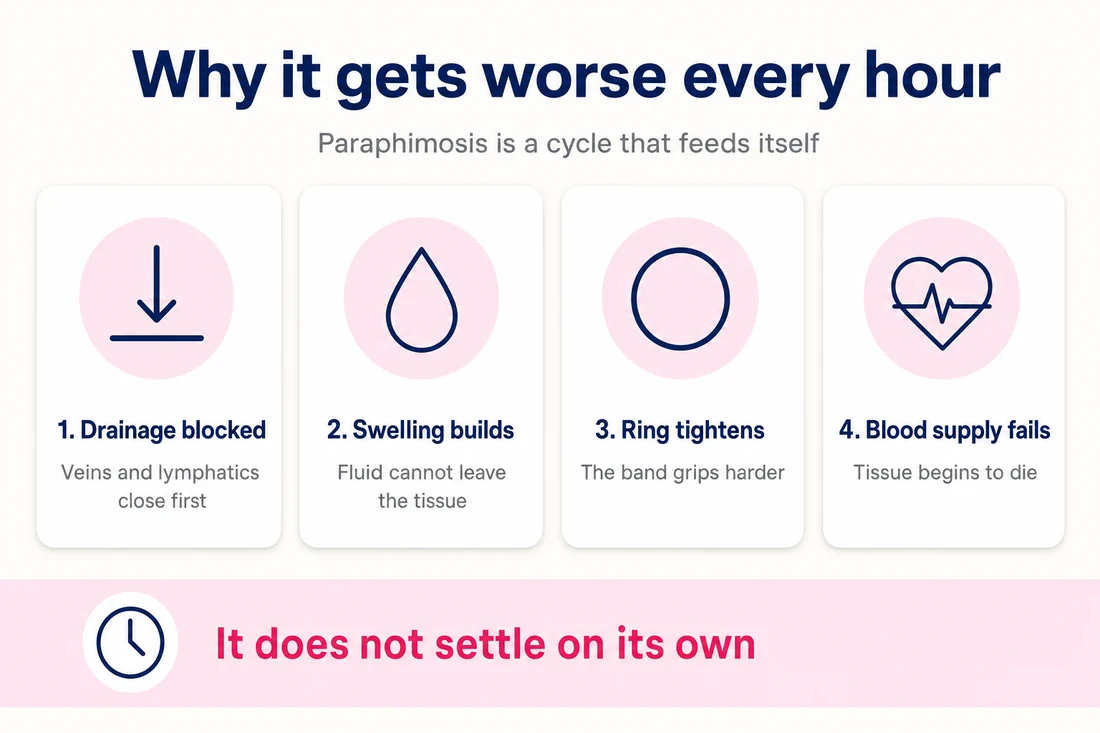
The constricting ring does not cut off the arteries first. It cuts off the low-pressure channels first — the veins and the lymphatics, which is why the trapped tissue develops venous and lymphatic congestion before anything else (Pham, 2017). Blood keeps arriving through the arteries, but it cannot leave. Fluid accumulates in the glans and in the trapped foreskin, and the swelling itself makes the ring tighter, which obstructs drainage further, which causes more swelling (Yiğiter, 2008). It is a loop that feeds itself, and it does not have a natural stopping point.
Only later, once the pressure inside the tissue rises high enough, does arterial supply fail. That is when the colour goes from red to purple to dusky blue, and that is when tissue begins to die. The tight preputial ring constricts the distal penis and causes vascular occlusion, much like a tourniquet (Williams, 1995). Delayed treatment produces genuinely devastating outcomes, including necrosis of the glans (Sato, 2019).
So the honest answer to “how long do I have?” is: nobody can tell you, the clock is already running, and the injury is cumulative. Paraphimosis is one of a small group of true urological emergencies in which delays in treatment lead to permanent damage (Kessler, 2009).
The colour of the glans is the single most useful thing you can report when you arrive. Red and swollen is early. Purple, blue, grey or black is late, and it changes what we do first — so say the colour out loud at the desk, even if nobody asks you.
Paraphimosis or phimosis? They are opposites
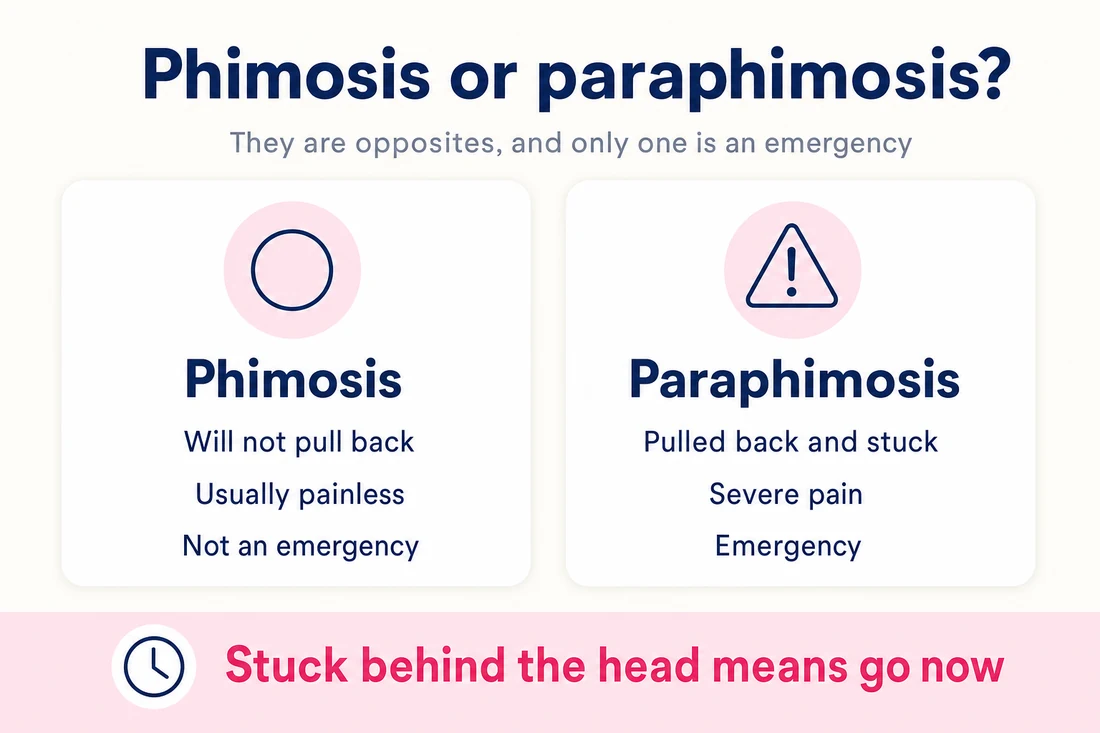
These two words get confused constantly, including by people writing health content, and the confusion is not harmless — the standard advice for one is actively wrong for the other.
| Phimosis | Paraphimosis | |
|---|---|---|
| What is happening | Foreskin will not pull back over the head | Foreskin is pulled back and will not come forward |
| Pain | Usually painless | Severe, and escalating |
| Emergency? | No | Yes — immediate |
| Normal at any age? | Yes — physiological in young boys, common up to about age three and often persisting into older age groups (Hayashi, 2011) | Never normal |
| If left alone | When severe: trouble passing urine, discomfort during sex, sometimes blood in the urine | Swelling, colour change, tissue death |
| Typical treatment | Steroid cream, gentle stretching over weeks, sometimes circumcision | Immediate reduction; surgery if that fails |
| Timescale | Managed over weeks to months | Managed the same day |
If you take one thing from this table: stretching exercises, warm showers and petroleum jelly are phimosis advice. They belong to a slow, non-urgent problem managed over weeks. Applying them to paraphimosis wastes the hours that matter. If it turns out you have the other one — a foreskin that will not pull back at all and never has — then nothing here is urgent, and I have written separately about how a tight foreskin is actually fixed.
The distinction matters more than it sounds. A man who has read about phimosis, recognises the word “foreskin” in his own situation and starts doing what those articles suggest is not being careless — he is following the wrong instructions carefully.
What you must not do
This is where the health blogs — and, right now, Google’s own automated answer — do real damage. I am listing these specifically because they are what people actually do, and because some of them are being served to you as advice.
Do not “gently squeeze the head of the penis for a few minutes.” You will find this instruction online, and I want to deal with it directly, because it is the most plausible-sounding of all the bad advice. Yes, sustained compression is part of what we do in hospital. No, it is not the same procedure when you do it at home. In hospital it comes after an examination that rules out dead tissue, and after the penis has been properly anaesthetised — because the compression that works has to be firm and held, and an unanaesthetised man cannot tolerate it for long enough to work. What happens at home is a series of short, painful, half-hearted attempts, each of which adds swelling. You are not performing the hospital manoeuvre. You are performing the thing that makes the hospital manoeuvre harder.
Do not try to stretch it in a warm shower. This is the most common piece of misapplied advice on the internet for this condition. It is written for phimosis. In paraphimosis the foreskin is already retracted — stretching the opening is not the problem you are solving, and the time spent trying is time the tissue does not have.
Do not smear on petroleum jelly and keep pulling. Lubricant does not address trapped oedema. Repeated forceful attempts traumatise already-congested tissue and increase the swelling, which tightens the ring.
Do not force it, repeatedly, harder. Every failed forceful attempt adds oedema. You are making the next attempt — including ours — more difficult.
Do not cut anything. I should not have to write this, and yet.
Do not wait to “see if it settles by morning.” It will not.
There is one reasonable thing to do while you are on your way, and I am fencing it deliberately: a cold pack wrapped in a cloth, rested — not pressed — against the area. Cooling may take the edge off the swelling while you travel. It is not a treatment, it is not a reason to spend another ten minutes at home, and if it hurts, stop and just go.
What to do right now
Go to an emergency department or urgent care. Not a pharmacy, not a teleconsultation, not tomorrow’s outpatient appointment. If it is the middle of the night, the emergency department is still the correct destination — a specialist review can follow in the morning, but the reduction should not wait for it.
Tell the triage nurse the words “the foreskin is stuck behind the head and I cannot pull it forward.” That sentence gets you seen quickly. And if you cannot pass urine, say that too — urinary obstruction is one of the specific reasons this is treated as urgent rather than routine (Fuenfer, 1994).

Private 1-on-1 consultation
Not sure whether this is an emergency?
If the foreskin is retracted, the head is swelling and it will not come forward, treat it as one and go now. For everything after that — a foreskin that keeps causing trouble, recurrent episodes, or a decision about definitive treatment — that is what a consultation is for.
Book a Confidential Consultation
What we actually do in hospital
Knowing this in advance takes some of the fear out of going, so let me walk you through it the way it actually happens.
First, I look before I touch. I do not attempt to reduce anything blindly. If the tissue is already dead, or you cannot pass urine, that changes the plan entirely and the answer becomes surgical. I also have to satisfy myself that this is what it looks like, because not everything that swells like this is paraphimosis. This assessment is the step that home advice skips, and it is the whole reason home advice is dangerous.
Then I take the pain away. Almost nothing else works if you cannot bear to be touched. Depending on the situation that means a topical anaesthetic, a dorsal penile nerve block or a ring block. In children there is a genuine choice between a topical anaesthetic and procedural sedation, and the topical route compares well (Burstein, 2017). Nebulised ketamine has been used in emergency departments for exactly this procedure (Barberan Parraga, 2022).
Then I get the fluid out. The core manoeuvre is unglamorous. I take the head and the trapped foreskin in the palm of a gloved hand, often over a saline-soaked swab, and squeeze — snugly, evenly, without letting go — typically for five to ten minutes or more, driving the oedema back across the constricting ring. Then my thumbs push the glans back through the ring while my fingers draw the foreskin forward over it. It is a technique that works with the underlying pathophysiology rather than against it (Raveenthiran, 1996), and people are still refining it (Pohlman, 2013). Elastic compression wraps of the Coban type do the same job.
That is the same word — squeeze — you will have read online. Note what surrounds it here: an examination first, an anaesthetic second, and five to ten unbroken minutes of even pressure that nobody could tolerate awake. Take any one of those away and you are not doing this procedure. You are just injuring yourself.
If compression is not enough, I draw the fluid out osmotically. Granulated sugar packed against the swollen tissue for an hour or two pulls water out down an osmotic gradient; in one small series of three men, every one was reduced this way after compression alone had failed (González Fernández, 2001). Mannitol has been used on the same principle (Anand, 2013), as have high-concentration dextrose and glycerol. Hyaluronidase injected into the swollen prepuce disperses the extracellular oedema and permits easy reduction (DeVries, 1996). Ice packs and other oedema-reducing measures have long been part of this step (Fuenfer, 1994), and the relative merits of ice, multiple puncture and sugar have been formally compared against one another (Mackway-Jones, 2004).
If that fails, small punctures. Multiple fine needle punctures — the technique often called the Dundee method — let trapped fluid drain, after which the tissue compresses down and reduces. Puncture and aspiration sit alongside manual and osmotic methods in the standard ladder of options (Little, 2005).
Surgery is the last rung, not the first. A dorsal slit — a small incision through the constricting band — releases the pressure immediately, and sharp incision is the recognised endpoint when conservative measures fail (Little, 2005). Occasionally the answer is circumcision, either then or electively later (Hayashi, 2011). There are also traction techniques using fine forceps on the band itself, which pull the ring open rather than shrinking what is inside it (Turner, 1999).
I am describing all of this deliberately, because knowing what is coming makes people more likely to come in. None of it is as bad as the night you spend not coming in.
What causes it
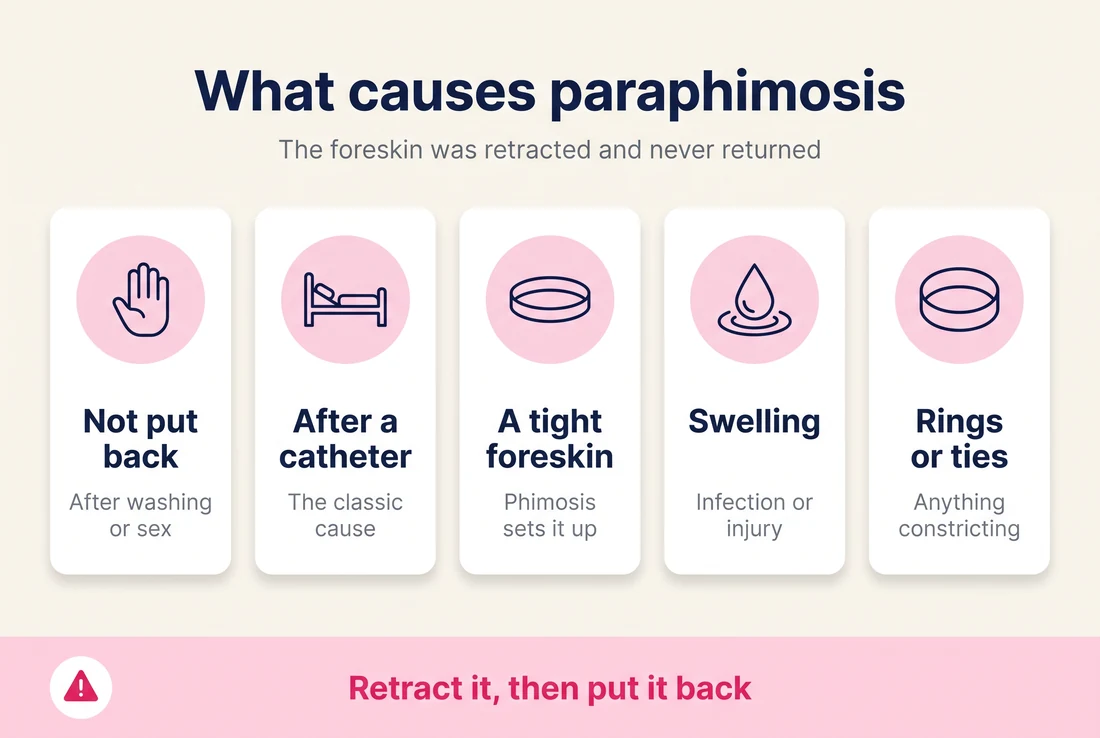
Forgetting to pull the foreskin forward. It is depressingly simple. After washing, after sex, after passing urine, after an examination. Paraphimosis is often iatrogenically induced — that is, caused in the course of medical care — and is prevented by returning the prepuce over the glans after any penile manipulation (Choe, 2000). It is also why ordinary foreskin hygiene should never involve leaving the skin pulled back once you are done.
Catheters. This is the version I want clinicians and carers reading this to sit with. A urinary catheter is passed, the foreskin is retracted to clean and position, the catheter is secured, and nobody rolls the foreskin forward. The patient is often elderly, often confused, sometimes cannot report the pain. Paraphimosis sits among the recognised complications of indwelling urinary catheters (Tremayne, 2020), and catheter-related penile pain deserves a proper look rather than another dose of analgesia (Wilson, 2008). The diagnosis is a clinical one, made by examining the patient — it is not something to wait for a scan to reveal, and imaging findings have barely been described at all (Davis, 2022). Which is precisely why someone has to look.
Diabetes, which impairs healing and predisposes to the foreskin inflammation that sets this up, and older age — paraphimosis in elderly men is a described entity in its own right (Williams, 1995).
Rough sex or injury, and swelling from infection. An inflamed, oedematous foreskin is a swollen one, and swelling is the whole mechanism here — balanitis and balanoposthitis are common, occurring in something like 4 to 11 per cent of uncircumcised boys (Hayashi, 2011).
Constricting objects. Rings, ties and piercings placed around the penis. One case involved four key rings placed circumferentially, worn to manage referred pain from prostate cancer (Wimsey, 2006). Unusual causes are genuinely varied — hemangioma of the glans (Yiğiter, 2008), and a case caused by monkeypox infection (Milano, 2022).
Forceful retraction of a child’s foreskin. I have put this last so it stands alone, because it is the most preventable cause on the entire list. I treat adults, not children, so this is not a case I take on myself — but it is the one I most want parents reading this to never cause, and it is the reason the section below exists.
Dr Shahs notes (from my clinical observation)
My practice is adult andrology — I do not treat children, and a boy with a trapped foreskin belongs with a paediatric surgeon the same day. But two things are worth saying plainly.
The first is for parents, because the advice that causes this is still being handed out. A boy’s foreskin is supposed to be non-retractile in early childhood — it is physiological, and it sorts itself out over years (Hayashi, 2011). Somebody, usually well-meaning, tells a parent to pull it back daily “to clean properly.” It is forced, it goes behind the corona, and it does not come back. Please do not retract a young child’s foreskin forcibly. There is nothing under there that needs cleaning that badly.
The second is what I do see, in adults: late presentation, and it is an Indian problem more than a Western one. I see men who have had this for days, sometimes longer, by which point the swelling has organised and the tissue is chronically changed. There is a described chronic variant of paraphimosis in which patients present many days after the initial injury, and it has been characterised as predominantly a developing-world presentation (Rangarajan, 2008). Some of these late cases are not even especially painful any more, which is precisely why they get ignored — one man presented so late that the appearance was mistaken for a second scrotum (Mishra, 2019). Painless does not mean safe. If the foreskin is stuck behind the head, it needs reducing, whether it hurts today or not.
After it is reduced — will it happen again?
Once the foreskin is back where it belongs, the immediate danger is over. Superficial abrasions are cleaned and dressed, and you will usually be told to leave the foreskin alone for a period while the tissue settles.
Then comes the real question, which is whether the underlying foreskin is going to keep doing this. If the episode was a one-off after a catheter, and your foreskin was otherwise normal, the answer is usually no — provided the rule below is followed. If the foreskin was tight to begin with, recurrence is likely, and it should be dealt with definitively rather than left until the next emergency. Circumcision is the definitive prevention. Preputioplasty — a smaller operation that widens the foreskin instead of removing it — is the foreskin-sparing alternative, and if keeping your foreskin matters to you, that is the operation to ask for by name.
Recurrent trouble under the foreskin is worth taking seriously in its own right rather than treating episode by episode, and it sits alongside the rest of men’s sexual health as something to sort out properly once. If you are getting repeated inflammation under the foreskin between episodes, that needs treating too, because an inflamed foreskin swells and gets stuck more easily.
The one prevention rule, for the rest of your life: after you retract the foreskin, for any reason, put it back. That is it. That single habit prevents the large majority of cases (Choe, 2000). It applies to you, to anyone examining you, and to anyone caring for you — and if you are supporting someone who cannot manage their own hygiene, this is a specific thing to check every time (Wilson, 2009).
When it has already gone too far
I would rather you did not need this section.
If the constriction persists, the glans becomes ischaemic and tissue begins to die. Increasing oedema from vascular and lymphatic obstruction leads to penile gangrene and, over days to weeks, auto-amputation (Yiğiter, 2008). Infection follows dead tissue. Urinary obstruction can occur before any of that, and in children the risk of necrosis and obstruction is precisely why reduction is treated as urgent (Fuenfer, 1994).
My own position, as the doctor you are asking, is plain: I am not telling you this to frighten you into paralysis. Even where the glans has already died, careful treatment can save a great deal — in one long-term follow-up, a young man with established glans necrosis was managed conservatively rather than with amputation, and two years later the glans had healed over with healthy skin, kept its natural shape, and passed urine and got erections normally (Sato, 2019). None of this is common, none of it is where you are headed if you go in today, and all of it is what the emergency is guarding against.
Frequently asked questions
Can I fix paraphimosis myself at home?
No. This is the one question I will not soften. Home attempts almost always involve forcing the skin, which increases the oedema and tightens the constricting ring — the exact opposite of what needs to happen. Reduction needs adequate pain relief and sustained, correct compression, and often needs osmotic agents or puncture techniques you do not have access to (Little, 2005). Cold on the way to hospital is the only home step worth taking.
Is paraphimosis or phimosis worse?
Paraphimosis, without question. Phimosis is usually painless, is normal in young boys, and is managed over weeks (Hayashi, 2011). Paraphimosis is painful, progressive, and belongs to the small group of urological emergencies where delay causes permanent damage (Kessler, 2009).
How long can paraphimosis go untreated?
There is no safe window, and anyone who gives you a specific number is inventing it. The injury accumulates continuously from the moment the ring forms. Gangrene and auto-amputation are described over days to weeks (Yiğiter, 2008), but damage begins long before that, and reduction gets harder every hour as oedema builds.
Can paraphimosis go back to normal?
Yes — that is the usual outcome when it is treated promptly. Once the constricting ring is released and the foreskin is back in position, the trapped fluid drains, the swelling settles over the following days and the appearance returns to normal. What determines the outcome is not how bad it looks on arrival but how long it has been going on. Treated early, this resolves cleanly. Left for many days, the trapped foreskin can become fibrous and bunched behind the head, and that stage usually needs the scarred tissue excised surgically rather than simply pushed back (Rangarajan, 2008).
Does paraphimosis always need surgery?
No, and this is the reassuring part. Most cases are managed without an operation, using pain relief, sustained compression and — where needed — osmotic agents or fine punctures. Sharp incision is the recognised endpoint when those fail, not the starting point (Little, 2005).
Can paraphimosis happen to a circumcised man?
Not if the circumcision was complete, because there must be enough foreskin to retract and become trapped. But it absolutely can happen to a partially or incompletely circumcised male — this is described in both adults and children (Pham, 2017; Fuenfer, 1994). Do not rule yourself out because you have had something done.
How do you sleep with paraphimosis?
You do not, and you should not try. This is one of the most-asked questions on this topic and the honest answer is that going to sleep on it is the single most common way a manageable problem becomes a surgical one. If it is the middle of the night, that is what emergency departments are for.
Why does it happen after a catheter?
Because the foreskin is retracted to clean and position the catheter, and then not returned. It is one of the recognised complications of indwelling catheters (Tremayne, 2020), and it is why “replace the foreskin” belongs on every catheter checklist. Older men are a well-described group for this (Williams, 1995).
Should I pull my son’s foreskin back to clean it?
No. A young boy’s foreskin is naturally non-retractile — physiological phimosis is normal up to about age three and often persists well beyond that (Hayashi, 2011). It separates on its own. Forcing it back is how a foreskin ends up trapped behind the head, and it is the single most avoidable cause of this condition in boys. My own practice is adult andrology, so if this has already happened to your son, take him to a paediatric surgeon or an emergency department today rather than to me. Wash the outside, leave the rest alone, and if you are worried about what is collecting under there, read what smegma actually is before you start scrubbing.
Can I get this treated over a video consultation?
You can get advice that way, and remote guidance has been used to help with reduction where access to care was genuinely impossible, such as during the COVID-19 pandemic in elderly patients (Sharma, 2021). That is a compromise made under constraint, not a standard of care. If you can physically reach a hospital, reach one.
What does paraphimosis look like?
A swollen, often shiny head of the penis, with a visible tight band of skin squeezed in behind it and a doughnut of swollen foreskin beyond that. Colour ranges from red early to purple, blue or black late. The head and the trapped foreskin are both swollen — that combination is the giveaway.
You are not wasting anyone’s time
The men who do badly with this are almost never the ones who came in too early. They are the ones who felt stupid, hoped it would resolve, and arrived on day three.
If the foreskin is behind the head and will not come forward, that is the whole diagnosis. You do not need to be certain, you do not need to have tried everything first, and you do not need to explain yourself. Go now, and let someone look at it.
Once the emergency is dealt with, come and talk about why it happened and whether it is likely to happen again — that conversation is worth having properly, and it is the one that stops you being back in an emergency department next year. If the foreskin has been a recurring problem, or you simply want a straight answer about whether you need anything done, book a consultation and we will look at it calmly, in daylight, with no emergency attached.
References
- Stangl FP, Thalmann GN (2020). [Urologic Emergencies: Paraphimosis]. Therapeutische Umschau. Revue therapeutique. PMID 32870094
- Davis JR, Baaklini GT, Schwope RB (2022). The “Wet Collar” Sign: A Case of Paraphimosis on CT. Cureus. PMID 35607539
- Tremayne P (2020). Managing complications associated with the use of indwelling urinary catheters. Nursing standard (Royal College of Nursing (Great Britain) : 1987). PMID 33073550
- Wilson M (2008). Causes and management of indwelling urinary catheter-related pain. British journal of nursing (Mark Allen Publishing). PMID 18414267
- Yiğiter M, Arda IS, Hiçsönmez A (2008). An unusual cause of paraphimosis: hemangioma of the glans penis. Journal of pediatric surgery. PMID 18280267
- Raveenthiran V (1996). Reduction of paraphimosis: a technique based on pathophysiology. The British journal of surgery. PMID 8983618
- Anand A, Kapoor S (2013). Mannitol for paraphimosis reduction. Urologia internationalis. PMID 23257575
- Little B, White M (2005). Treatment options for paraphimosis. International journal of clinical practice. PMID 15857356
- Mackway-Jones K, Teece S (2004). Best evidence topic reports. Ice, pins, or sugar to reduce paraphimosis. Emergency medicine journal : EMJ. PMID 14734388
- González Fernández M, Sousa Escandón MA, Parra Muntaner L, López Pacios JC (2001). [Sugar: treatment of choice in irreducible paraphimosis]. Actas urologicas espanolas. PMID 11512267
- Choe JM (2000). Paraphimosis: current treatment options. American family physician. PMID 11142469
- DeVries CR, Miller AK, Packer MG (1996). Reduction of paraphimosis with hyaluronidase. Urology. PMID 8804504
- Fuenfer MM, Najmaldin A (1994). Emergency reduction of paraphimosis. European journal of pediatric surgery : official journal of Austrian Association of Pediatric Surgery … [et al] = Zeitschrift fur Kinderchirurgie. PMID 7748840
- Wilson NJ, Cumella S, Parmenter TR, Stancliffe RJ, Shuttleworth RP (2009). Penile hygiene: puberty, paraphimosis and personal care for men and boys with an intellectual disability. Journal of intellectual disability research : JIDR. PMID 19054270
- Grutman AJ, Gabrielson AT (2025). Paraphimosis: An Epidemiological Perspective From a Large Multicenter Research Network. Urology practice. PMID 40272231
- Kessler CS, Bauml J (2009). Non-traumatic urologic emergencies in men: a clinical review. The western journal of emergency medicine. PMID 20046251
- Silverberg B, Partin M, Clark R, Newman R (2025). Male Sexual Disorders: Penile Disorders. FP essentials. PMID 40377951
- Rangarajan M, Jayakar SM (2008). Paraphimosis revisited: is chronic paraphimosis a predominantly third world condition? Tropical doctor. PMID 18302866
- Barberan Parraga C, Peng Y, Cen E, Dove D, Fassassi C, Davis A, Drapkin J, Hossain R, Mahl E, Motov S (2022). Paraphimosis Pain Treatment with Nebulized Ketamine in the Emergency Department. The Journal of emergency medicine. PMID 35094900
- Milano E, Belati A, De Santis L, Tanese F, Vavallo A, Dachille G, Loconsole D, Bavaro DF, Di Gennaro F, Chironna M, Ditonno P, Saracino A (2022). First Case of Paraphimosis as a Severe Complication of Monkeypox. Vaccines. PMID 36679908
- Sharma AP, Tyagi S, Chaudhary K, Singh SK (2021). Teleconsultation for paraphimosis reduction in the geriatric population: Lessons from the COVID-19 pandemic. Indian journal of urology : IJU : journal of the Urological Society of India. PMID 33850361
- Sato Y, Takagi S, Uchida K, Shima M, Tobe M, Haga K, Honama I, Hirobe M (2019). Long-term follow-up of penile glans necrosis due to paraphimosis. IJU case reports. PMID 32743402
- Mishra DK, Rajenthiran V, Vinod Kumar Reddy T, Agarwal MS (2019). Double scrotum? A rare ignored paraphimosis – Case report. Urology case reports. PMID 31367524
- Burstein B, Paquin R (2017). Comparison of outcomes for pediatric paraphimosis reduction using topical anesthetic versus intravenous procedural sedation. The American journal of emergency medicine. PMID 28416265
- Pham C, Zehring J, Berry-Caban CS (2017). Invasive Reduction of Paraphimosis in an Adolescent Male While in a Deployed Austere Environment. Journal of special operations medicine : a peer reviewed journal for SOF medical professionals. PMID 28285474
- Pohlman GD, Phillips JM, Wilcox DT (2013). Simple method of paraphimosis reduction revisited: point of technique and review of the literature. Journal of pediatric urology. PMID 22827972
- Hayashi Y, Kojima Y, Mizuno K, Kohri K (2011). Prepuce: phimosis, paraphimosis, and circumcision. TheScientificWorldJournal. PMID 21298220
- Wimsey S, Thiruchelvam N, Keoghane SR (2006). A key cause of paraphimosis. International urology and nephrology. PMID 16502063
- Turner CD, Kim HL, Cromie WJ (1999). Dorsal band traction for reduction of paraphimosis. Urology. PMID 10565759
- Williams JC, Morrison PM, Richardson JR (1995). Paraphimosis in elderly men. The American journal of emergency medicine. PMID 7755835
A private, judgment-free space to talk through fertility and men’s sexual health. Walk in, or book ahead by phone.
📍No 21, Sree Kalki Apartments, Ground Floor, Bazullah Road, T-Nagar, Chennai 600017