

If you are wondering how to know whether your husband is infertile, here is the honest answer: you usually cannot tell that your husband is infertile just by looking at him, or by how he performs in bed. Most infertile men have completely normal erections, a normal sex drive and a normal-looking ejaculate — and feel perfectly well. Infertility is almost always silent. The one test that actually looks at his sperm is a semen analysis, a simple, inexpensive check — a normal result is very reassuring, though never an absolute guarantee. If you have been trying to conceive for a year without success (or six months if you are 35 or older), that is the signal to get both of you checked — together, without blame.
I am Dr Shah Dupesh, a practising andrologist in Chennai, and “how do I know if my husband is infertile?” is one of the most common questions I am asked — very often by the wife, not the husband. So let me speak to you directly, because the honest, reassuring truth is not what most couples expect: male infertility rarely announces itself. A man can look strong, have a healthy sex life, ejaculate normally, and still have a sperm problem that only a lab test will reveal. This page walks you through the few signs that are worth noticing, the many things that do not tell you anything, and exactly what to do next.
What every worried partner should know
The essentials I give couples in my clinic — what male infertility does and does not look like, and the calm next step.
It is usually silent
Most infertile men have no symptoms at all — normal erections, normal sex drive, normal ejaculate. You cannot spot it from the outside.
The main clue is time
Not getting pregnant after 12 months of regular, unprotected sex (6 months if the woman is 35 or older) is the real sign that a check is due.
A few signs matter
Testicular pain, swelling or a lump, very low semen volume, low sex drive with reduced body hair, or a past mumps/surgery/injury deserve attention.
Manliness is not fertility
Strong erections, a big build, plenty of body hair or a large ejaculate say nothing about sperm. Fertile-looking and fertile are not the same.
A test settles it
A semen analysis is the only way to actually know. It is quick, low-cost, and gives a clear answer in a day or two.
It is a couple’s issue
A male factor is involved in about half of all infertile couples. Getting checked together — never blaming one partner — is the fastest route to a baby.
Can you tell if your husband is infertile just by looking? (Almost never)
This is the single most important thing I want you to take away, because it dissolves a lot of unfair worry and blame: there are no reliable outward signs of unhealthy sperm. A man’s fertility lives in the microscopic quality and number of his sperm cells, and you cannot see, feel or sense that from the outside. In my clinic I regularly meet men with a completely normal physique, a healthy libido and firm erections whose semen analysis shows a very low count — and I meet quieter, less “macho” men whose sperm are perfect. Appearance and performance simply do not track fertility.
This is not just my clinical impression — it is why the AUA and ASRM guidelines make the semen analysis the cornerstone of the male work-up: a man can have entirely normal sexual function and still have an abnormal semen analysis, and the only way to actually assess his sperm is to test it. So if you have been quietly studying your husband for “signs,” please stop — you are looking in the wrong place, and it is not your fault that the signs are invisible.
The signs of male infertility that are actually worth noticing
While infertility is usually silent, a handful of clues do raise the odds of a male-factor problem and are worth acting on. None of these prove infertility — they simply mean a check is sensible.
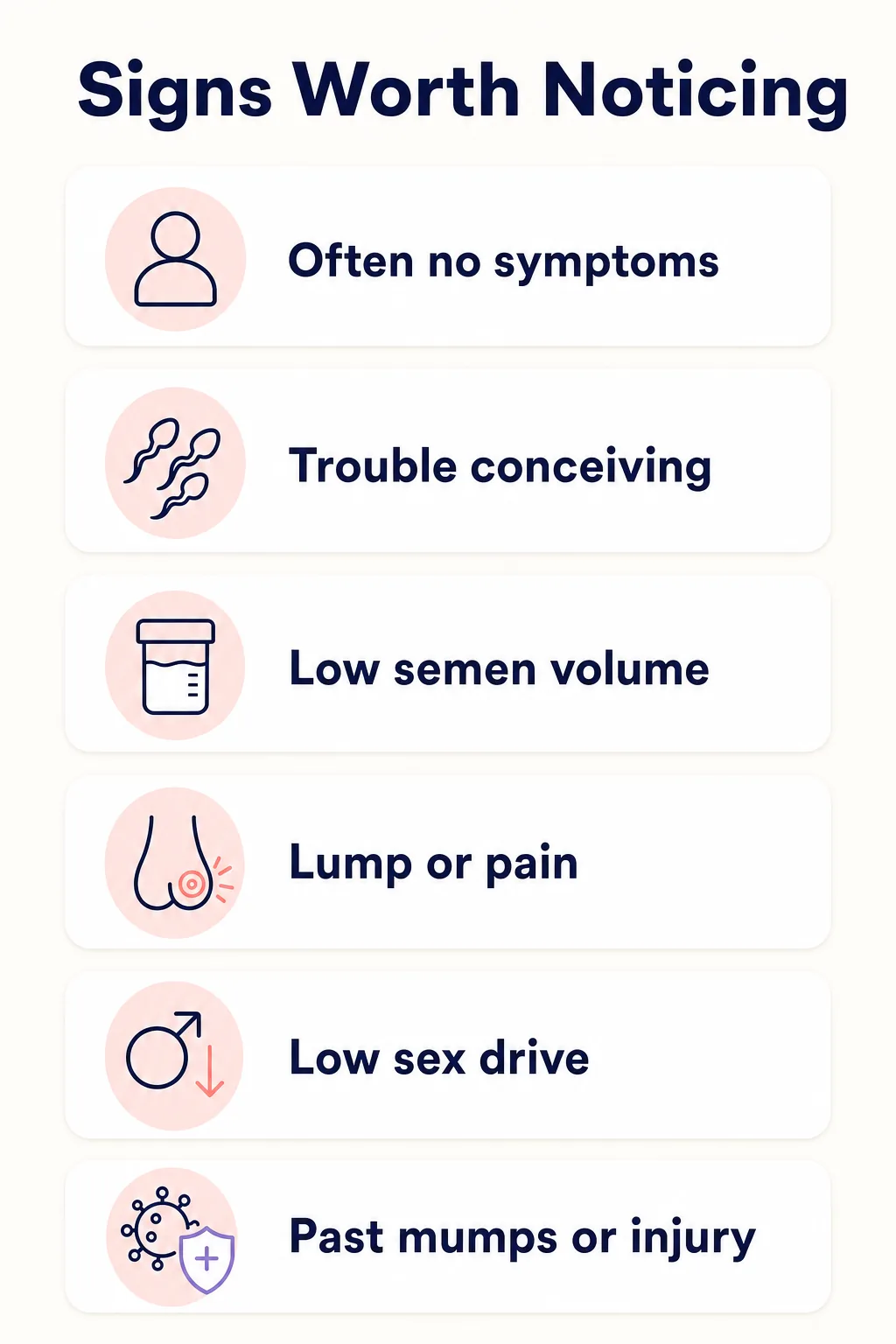
1. Trouble conceiving after a year of trying
This is the big one, and often the only “symptom” there is. If a couple has regular, unprotected sex for 12 months and pregnancy has not happened — or 6 months if the woman is 35 or older — that is the recognised point to get evaluated (WHO; NICE; ASRM). It says nothing yet about whose factor it is; it simply means it is time to test.
2. Changes in ejaculation or semen
Difficulty ejaculating, ejaculating very little fluid, or a change in the semen can point to a blockage in the tubes that carry sperm, a hormone problem or nerve damage. Note the nuance, though: a normal-looking ejaculate does not mean the sperm inside it are normal, and a smaller volume is not the same as a low sperm count. If you want to understand what the numbers on a report mean, our guide to reading a semen analysis explains it in plain language.
3. Testicular pain, swelling or a lump
The testicles are where sperm are made, so anything wrong there matters. Pain, swelling, a heaviness, or a lump — or a bag-of-worms feeling above a testicle, which can be a varicocele (enlarged veins, one of the commonest findings in male infertility) — should be examined. A small, soft or undescended testicle is also relevant.
4. Low sex drive with other low-testosterone clues
A genuinely low libido, together with reduced facial or body hair, low energy, breast-tissue development or mood changes, can point to low testosterone, which can affect sperm production. On its own a slightly lower sex drive means little — it is the cluster that counts.
5. A medical history that raises the odds
Some past events genuinely increase risk: mumps after puberty, an undescended testicle in childhood, testicular injury or surgery, a hernia repair, chemotherapy or radiotherapy, anabolic-steroid or heavy testosterone use (which shuts down natural sperm production), long-standing diabetes, and heavy smoking, alcohol or recreational drug use. If any of these are in his history, mention them early — they help us know where to look.
| What you notice | What it can point to | Sensible next step |
|---|---|---|
| No pregnancy after 12 months (6 if she is 35+) | A male and/or female factor — the trigger to test | Semen analysis for him, basic check for her |
| Low ejaculate volume or trouble ejaculating | Blockage, retrograde ejaculation or low testosterone | Semen analysis + hormone review |
| Testicular pain, swelling or a lump | Varicocele, infection or another testicular problem | Examination + scrotal ultrasound |
| Low sex drive with reduced body hair | Possible low testosterone | Testosterone and hormone blood tests |
| Mumps, undescended testis, injury, steroids, chemo | Higher baseline risk to sperm production | Early andrology evaluation |
What does not tell you he is infertile
Just as important as the real signs are the false ones — the things couples worry about that say nothing about fertility. In the Indian setting especially, a lot of shame and blame is built on these myths, so let me clear them:
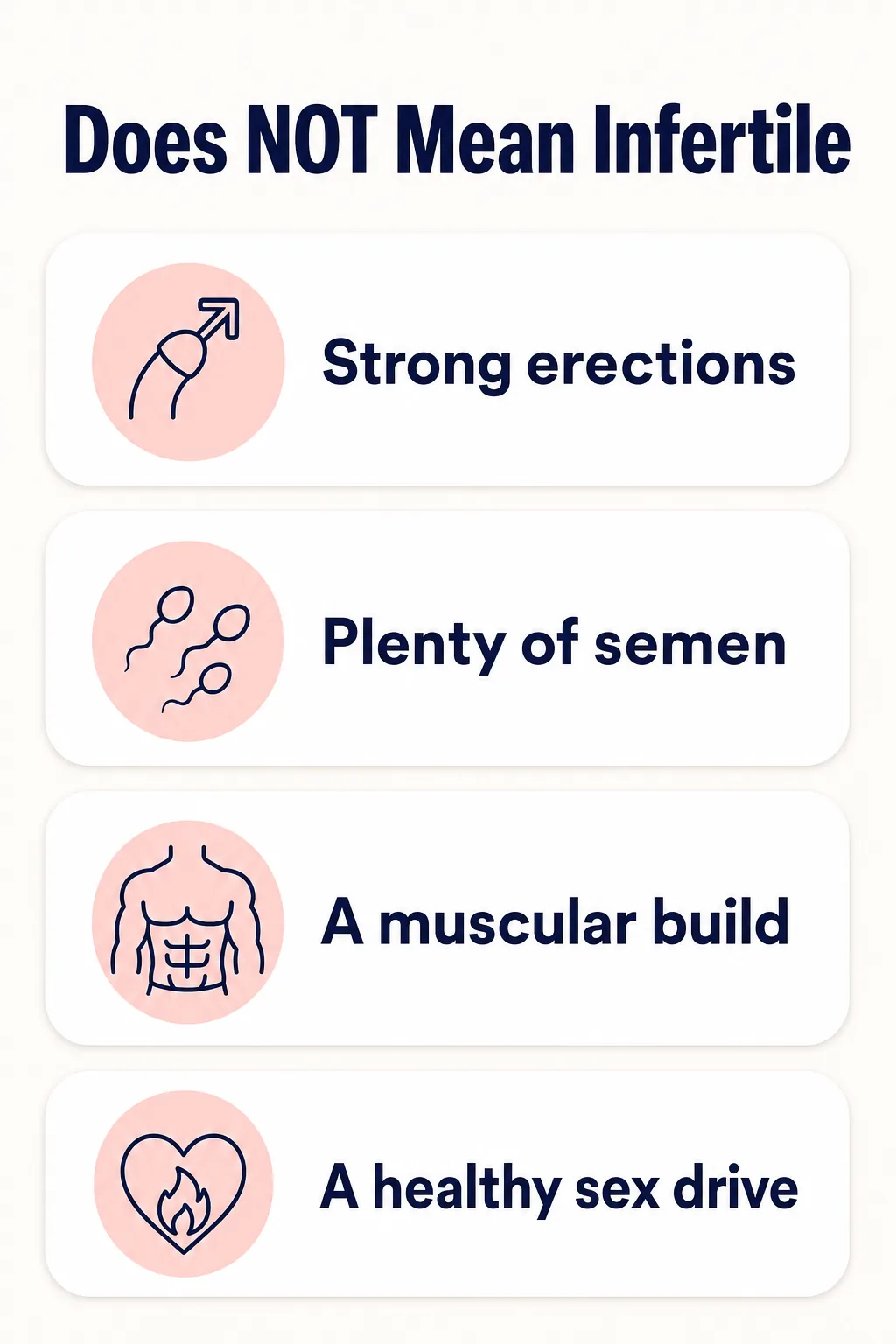
Strong erections
Erections and fertility are separate systems. A man with firm erections can have very few sperm; a man with erectile difficulty can be perfectly fertile.
A big ejaculate
The volume of fluid is mostly from the prostate and seminal vesicles. A generous ejaculate can carry almost no sperm; a small one can be loaded with them.
A muscular, hairy, “manly” build
Body type, muscle and body hair are about testosterone and genetics, not sperm count. Fertile-looking is not the same as fertile.
A healthy sex drive
Plenty of desire and a good sex life are wonderful — but the testicles can still be underproducing sperm behind the scenes.
In my Chennai practice, the couples who reach me have very often spent a year quietly blaming each other — and in our culture the woman is usually blamed first. Yet when we actually test, a male factor is involved in roughly half of these couples, and the husband is almost always astonished, because he “feels completely normal.” That reaction is the whole point of this page. Male infertility is not a failure of manhood and it is rarely visible; it is a common, frequently treatable medical finding. The kindest and fastest thing a worried wife can do is not to search for signs, but to gently get the two of you tested together.
The test that actually checks his sperm: a semen analysis
Everything above only tells us whether to look. The actual answer comes from a semen analysis — a simple laboratory test where the man provides a semen sample and the lab measures how many sperm there are, how well they swim (motility), and how normally they are shaped. It is quick, low-cost, and available across Chennai. If the count comes back low, our page on the signs of a low sperm count explains what that means; if no sperm are seen at all, that is azoospermia, which has its own, often treatable, causes.
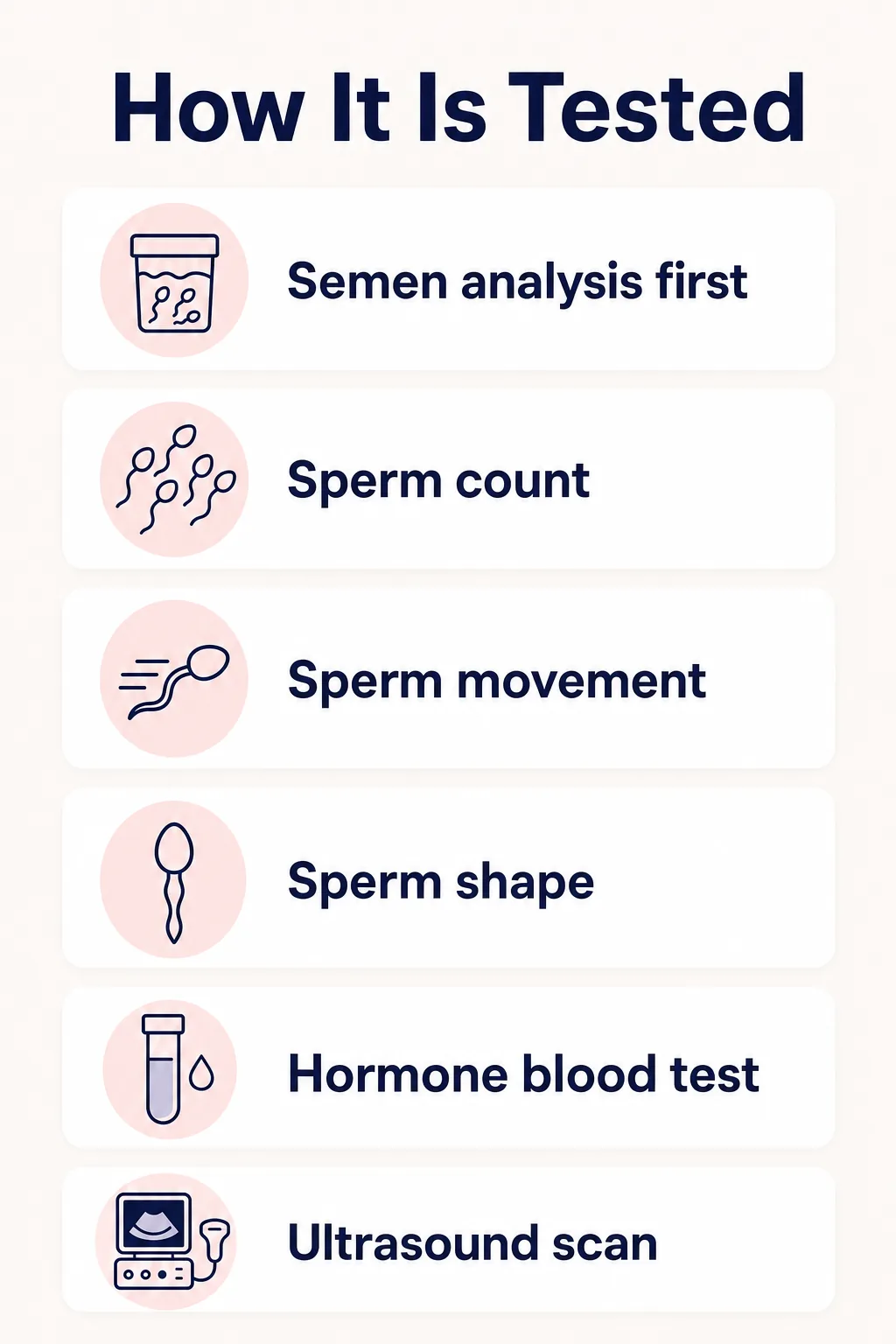
One test is not always the final word — sperm counts vary, so a borderline or abnormal result is usually repeated after a few weeks before any conclusion is drawn. A normal result is very reassuring but not an absolute guarantee, and a good andrologist reads the report alongside an examination and history, not in isolation.
Is male infertility treatable? (Often, yes)
The reason I push couples to test early rather than worry is simple: a great many male-factor problems respond to treatment, and even the difficult ones have real options. Here is the honest picture.
| Cause | Treatable? | What helps |
|---|---|---|
| Varicocele (enlarged scrotal veins) | Common finding | Managed conservatively; surgery is not advised as a fertility treatment (NICE/NHS) |
| Hormonal imbalance / low testosterone | Frequently | Treating the underlying cause — not testosterone injections, which worsen fertility |
| Genital infection or inflammation | Yes | Antibiotic / anti-inflammatory treatment |
| Lifestyle (heat, smoking, alcohol, obesity) | Yes | Targeted changes over a 2–3 month sperm cycle |
| Blockage in the sperm tubes | Sometimes | Microsurgery, or retrieving sperm directly |
| Very low count or no sperm (azoospermia) | Options remain | Sperm retrieval with IVF / ICSI can still achieve pregnancy |

Private 1-on-1 consultation
Wondering about your husband’s fertility? Let’s check it properly — together.
A calm, judgement-free evaluation for both partners: semen analysis, examination and an honest plan. Most male-factor problems are common and treatable — the first step is simply knowing.
Book a Confidential Consultation
If you are the worried partner: what to do (without blame)
You searched this because you love him and you want a family — so here is the practical, kind path forward.
Treat it as a couple’s investigation, not his fault
Fertility is a two-person equation, and about half the time a male factor is part of it — often alongside a female factor. Framing it as “let’s both get checked so we know how to move forward” removes the shame that stops so many men from testing.
Get the simple tests first
For him, that is a semen analysis; for you, a basic gynaecological and hormone check. These inexpensive first steps resolve most of the uncertainty. If you are not yet married or are planning a family, a premarital fertility check answers the question early and privately.
See the right specialist
Male fertility is the field of an andrologist. A good one will test, examine, explain the report in plain terms, and — importantly — tell you honestly whether the problem is likely treatable. Many male-factor problems (a varicocele, a hormone imbalance, an infection, lifestyle factors) genuinely improve with treatment.
When to see a doctor
See an andrologist if you have been trying to conceive for 12 months without success (6 months if the woman is 35 or older), or sooner if he has any testicular pain, swelling or lump, a very low ejaculate volume, a low sex drive with other low-testosterone signs, or a history of mumps, undescended testicle, injury, surgery, chemotherapy or steroid use. There is no advantage in waiting — early testing simply gives you more options.
Male fertility evaluation in Chennai
At Dr Shah’s Clinic in T. Nagar, both partners are welcome, the visit is private and judgement-free, and we keep it practical: a semen analysis and examination, a clear reading of the results, and an honest plan — treatment where it helps, and referral for advanced options where needed. You can also consult a sexologist in Chennai directly if sexual concerns are part of the picture.
Get a clear answer — together
Stop searching for invisible signs. A simple semen analysis tells you where you stand, and most male-factor problems have a solution.
Frequently asked questions
Can a man be infertile and still ejaculate normally?
Yes — this is the commonest situation. Ejaculation and sperm production are separate. A man can ejaculate a completely normal-looking amount of semen that contains very few sperm, or even none. Only a semen analysis can tell.
How can you tell if a man is sterile?
You cannot tell from the outside. “Sterile” (no sperm at all, or azoospermia) is diagnosed only by a semen analysis showing no sperm, confirmed on a repeat test. Many such men look and function entirely normally.
Can a man be infertile with a normal sex drive and good erections?
Absolutely. Libido and erections depend largely on testosterone and blood flow, while fertility depends on sperm made in the testicles. The two often do not match — strong performance does not guarantee healthy sperm.
Does male infertility have any symptoms?
Usually none. When symptoms do appear they are subtle — testicular pain or swelling, a lump, low semen volume, or low-testosterone signs like reduced libido and body hair. Most men have no symptoms and find out only when a couple struggles to conceive.
How is male infertility tested and is it treatable?
The first test is a semen analysis, sometimes with hormone blood tests and a scrotal ultrasound. Many causes — a varicocele, hormonal problems, infections, and lifestyle factors — are genuinely treatable, and even when sperm counts are very low, assisted-reproduction techniques can often still achieve a pregnancy.
Whose fault is it if we cannot conceive?
Neither partner’s — it is a shared medical situation, not a fault. A male factor is involved in roughly half of infertile couples, frequently alongside a female factor. Testing together, without blame, is the fastest way to a baby.
References
- World Health Organization. Infertility — fact sheet and WHO laboratory manual for the examination and processing of human semen (6th ed., 2021).
- National Institute for Health and Care Excellence (NICE). Fertility problems: assessment and treatment (CG156).
- American Society for Reproductive Medicine (ASRM) / American Urological Association (AUA). Diagnosis and management of male infertility.
- Cleveland Clinic. Male Infertility: causes, symptoms, tests & treatment.
- European Association of Urology (EAU). Guidelines on sexual and reproductive health — male infertility.
This article is for education and does not replace an in-person consultation. If you and your partner have been trying to conceive without success, get evaluated together. Call +919790783856 to book a confidential appointment with Dr Shah Dupesh in Chennai.
A private, judgement-free space to talk through fertility and men’s sexual health. Both partners welcome. Walk in, or book ahead by phone.
📍No 21, Sree Kalki Apartments, Ground Floor, Bazullah Road, T-Nagar, Chennai 600017
I think my husband is infertile I can’t get pregnant
Please drop me a call at 9789843856