

The signs of a low sperm count are almost always invisible — it usually causes no symptoms you can see or feel. It does not change your sex drive, your erections, how much you ejaculate, or how your semen looks — almost every man with a low count feels completely normal. The only way to truly know is a semen analysis, a simple, low-cost lab test. A handful of clues (trouble conceiving after a year, testicular changes, or low-testosterone signs) can hint that a check is due — but they are hints, not proof.
I am Dr Shah Dupesh, a practising andrologist in Chennai, and “how do I know if my sperm count is low?” is one of the questions men ask me most quietly — usually after searching for it late at night. So let me speak to you directly, because the honest answer is reassuring and probably not what you are bracing for: a low sperm count is almost always invisible. You cannot judge it by how sex feels, how firm your erections are, or how your semen looks. This page walks you through the few clues that are genuinely worth noticing, the many things that tell you nothing, what the actual numbers mean, and the one test that gives a clear answer.
What every man wondering about his count should know
The essentials I give men in my clinic — what a low sperm count does and does not feel like, and the calm next step.
It is usually silent
Most men with a low count have no symptoms at all — normal erections, normal desire, a normal-looking ejaculate. You cannot feel it.
Sex and semen fool you
How sex feels and how your semen looks say almost nothing about the sperm inside it. A watery or a thick ejaculate can each carry a perfectly normal count.
A few clues do matter
Trouble conceiving after a year, testicular pain or a lump, very low semen volume, or low sex drive with reduced body hair are worth acting on.
Know the real number
Below 16 million sperm per millilitre is “low” (WHO 2021). Many popular sites still quote the older 15 million figure.
Only a test tells you
A semen analysis is the only way to actually know — quick, inexpensive, and usually repeated once to be sure.
Often improvable
A low count is frequently not permanent. Lifestyle changes over a 2–3 month sperm cycle, and treating the cause, often lift the numbers.
Can you feel or tell if your sperm count is low? (Almost never)
This is the single most important thing to take away, because it saves a lot of needless worry: a low sperm count has no reliable outward signs. Your fertility lives in the microscopic number and quality of sperm cells, and you simply cannot see, feel or sense that from the outside. In my clinic I regularly meet men with a strong physique, a healthy libido and firm erections whose semen analysis shows a very low count — and quieter men, worried sick, whose counts are perfect. How you look and how you perform in bed do not track your sperm count.
This is not just my clinical impression. It is exactly why the major guidelines — the AUA/ASRM male-infertility guideline, and clinics like Mayo and Cleveland — build the entire male work-up around the semen analysis: a man can have completely normal sexual function and still have an abnormal count, and the only way to assess sperm is to test them (Schlegel et al., AUA/ASRM, 2021). So if you have been quietly studying yourself for “symptoms,” you are looking in the wrong place — finding no “symptoms” proves nothing either way.
First, what actually counts as a “low” sperm count?
Before we talk signs, it helps to know the number, because “low” has a precise meaning. The World Health Organization’s 6th-edition manual (2021) sets the lower reference limit for sperm concentration at 16 million sperm per millilitre. Below that is called oligozoospermia — a low sperm count. You will still see many popular health pages quoting 15 million; that is the older 2010 figure, now superseded. These numbers are not a pass/fail line for having a baby — they are the 5th-percentile values measured in recently-fertile men — but they are the yardstick every lab uses.
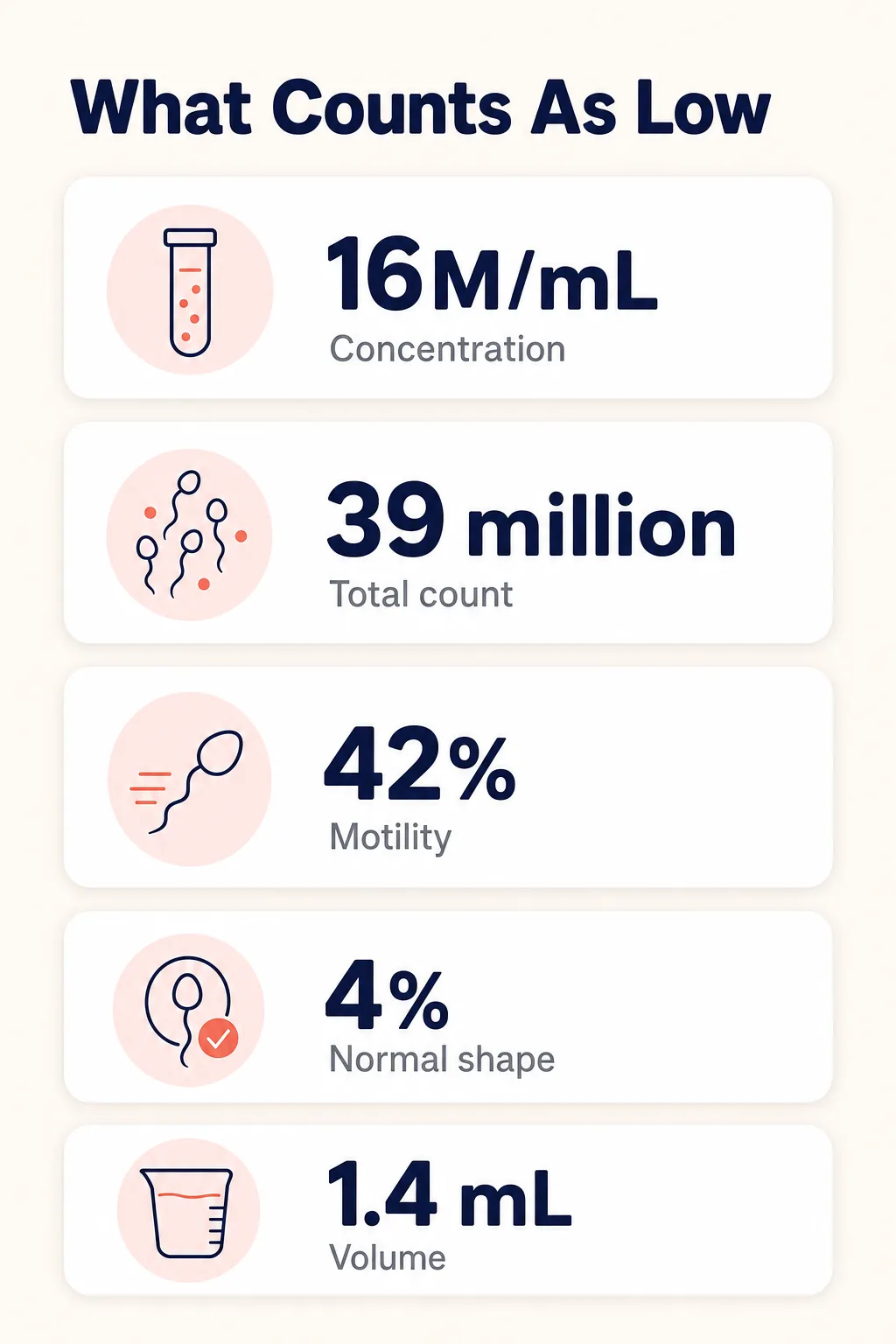
| What the lab measures | WHO 2021 (6th ed.) lower limit | Older 2010 figure |
|---|---|---|
| Sperm concentration | 16 million / mL | 15 million / mL |
| Total sperm per ejaculate | 39 million | 39 million |
| Total motility (moving sperm) | 42% | 40% |
| Progressive motility | 30% | 32% |
| Vitality (live sperm) | 54% | 58% |
| Normal shape (morphology) | 4% | 4% |
| Semen volume | 1.4 mL | 1.5 mL |
A few related terms are worth knowing, because a report can read as more than just “low”: severe oligozoospermia means fewer than 5 million/mL; cryptozoospermia means almost none — sperm are found only after the lab spins the sample down; and azoospermia means no sperm at all in the ejaculate. If your report throws up any of these, our plain-English guide to reading a semen analysis explains exactly what each number means, and azoospermia has its own, often treatable, causes.
Low count, low motility, or low morphology? They are not the same thing
Here is a distinction that trips up almost everyone who reads their own report. “Sperm count” is only one of three things a semen analysis measures, and the three can fail independently:
- Count (concentration) — how many sperm there are. A low count is oligozoospermia.
- Motility — how well they swim. Poor movement is low sperm motility (asthenozoospermia), and it can be abnormal even when the count is completely normal.
- Morphology — what shape they are. Too few normally-shaped sperm is poor morphology (teratozoospermia).
A man can have a healthy count but sluggish swimmers, or plenty of brisk sperm that are mostly oddly shaped — which is exactly why “my count is fine” does not automatically mean “my semen analysis is fine.” The three read together, and the single number that best reflects natural fertility is the total motile count (concentration × volume × the fraction swimming forward) — easily worked out from your report.
The signs of a low sperm count worth noticing — clues to an underlying cause
While a low count is usually silent, a handful of clues do raise the odds and are worth acting on. None of these prove a low count — they simply mean a semen analysis is sensible. It helps to group them by the kind of problem they point to.
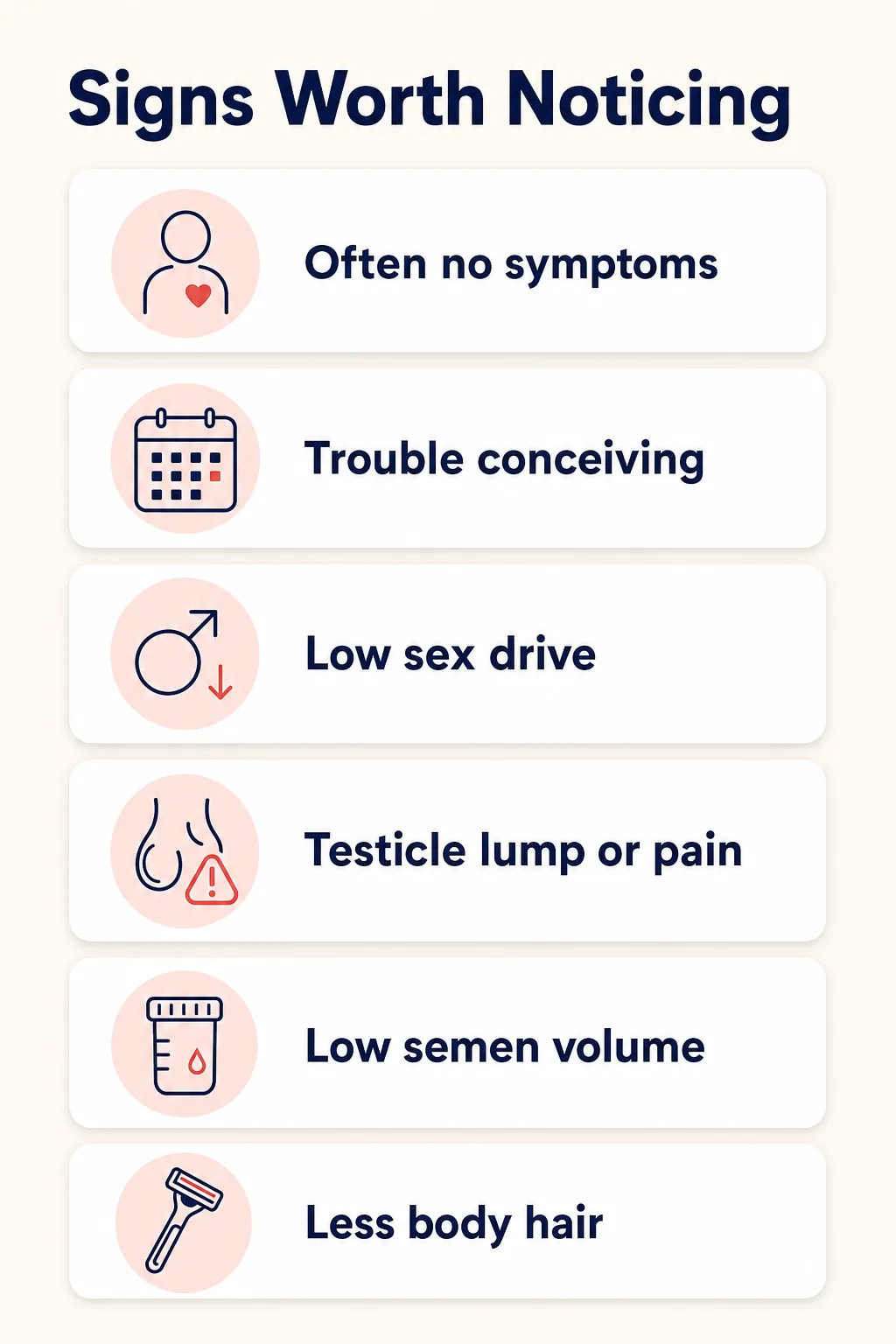
1. Hormonal clues (low testosterone)
Sperm production runs on testosterone, so a genuine testosterone deficiency can quietly lower your count and show itself in other ways: a real drop in sex drive, erectile difficulty, reduced facial or body hair and less frequent shaving, some breast-tissue development (gynaecomastia), low energy and low mood (Bhasin et al., Endocrine Society, 2018). On its own a slightly lower sex drive means little — it is the cluster that counts.
2. Anatomical clues (the testicles)
The testicles are where sperm are made, so anything wrong there matters: pain, swelling, a heaviness, a lump, or small, soft testicles. A common finding is a varicocele — enlarged scrotal veins that can feel like a “bag of worms” above a testicle. It is the single most commonly found abnormality in men with a low count. But finding one does not mean you need an operation: in line with NICE and NHS guidance, varicocele surgery is not recommended as a fertility treatment because it does not reliably improve the chance of a pregnancy — a point I will come back to, because it matters.
3. Ejaculatory clues (the semen itself)
Sometimes the ejaculate offers a hint: a very low volume of fluid, difficulty ejaculating, or cloudy urine after orgasm — which can signal retrograde ejaculation, where semen travels backward into the bladder. Be careful with one popular myth, though: watery or thin-looking semen is not a reliable sign of a low count. Semen’s look changes with how long since you last ejaculated and how hydrated you are; the sperm inside it can only be judged under a microscope.
From my own clinic, two patterns are worth flagging here. First, when a man notices his ejaculate has become sparse and his erections have softened or turned partial, the low volume and the erectile change often travel together — both can point back to a hormonal or vascular cause that a simple work-up will uncover, so I take an erection problem alongside a low volume as a real reason to test. Second, a truly “dry” orgasm — the full sensation of climax but with little or no semen coming out — is the classic clue to retrograde ejaculation, where semen is pushed backwards into the bladder instead of forwards. It is easily confirmed by checking a urine sample passed right after orgasm for sperm, and it is an important, often treatable, reason a report can read as a very low count.
4. The fertility signal (the big one)
For most men, this is the only “symptom” there ever is. If you and your partner have had regular, unprotected sex for 12 months without a pregnancy — or 6 months if she is 35 or older — that is the recognised point to get a semen analysis (ASRM, 2023). It says nothing yet about whose factor it is; it simply means it is time to test. If your partner is anxious about this too, our companion guide on how to tell if a husband is infertile is written for her.
| What you notice | What it can point to | Sensible next step |
|---|---|---|
| No pregnancy after 12 months (6 if she is 35+) | The trigger to test — a male and/or female factor | Semen analysis for him, basic check for her |
| Low sex drive with reduced body hair, low energy | Possible low testosterone | Semen analysis + hormone blood tests |
| Testicular pain, swelling, a lump or small testes | Varicocele, infection or another testicular problem | Examination + scrotal ultrasound |
| Very low semen volume or cloudy urine after sex | Blockage or retrograde ejaculation | Semen analysis + post-orgasm urine test |
What does not mean your sperm count is low
Just as important as the real clues are the false ones — the things men torture themselves over that say nothing about sperm count. In the Indian setting especially, a lot of quiet anxiety is built on these myths, so let me clear them.
Strong erections and high libido
Erections and desire run largely on blood flow and testosterone; the sperm count is made separately in the testicles. Firm performance does not guarantee a healthy count.
Thin or watery semen
Semen appearance shifts with frequency and hydration. Watery-looking semen is not a dependable sign of a low count — only a microscope can tell.
Masturbation or “wasting” semen
Normal masturbation does not cause a permanently low count. It can briefly lower the volume of the next ejaculate, but the testicles keep making sperm continuously.
Feeling perfectly healthy
A fit, muscular, energetic man can still have a low count, and an anxious, tired one can be perfectly fertile. Feeling well is not a fertility test.
If your worry is tangled up with guilt about masturbation, night-time emissions or “loss of vitality” — a very common concern I treat — remember that it is almost always the anxiety, not your sperm count, that is the real problem, and it responds well to reassurance and treatment.
Two things I see almost every week. First, the men who arrive certain that something is “physically wrong” — because their semen looks thin, or because they masturbate — almost always have a normal count; their real problem is anxiety, not andrology. Second, when a varicocele does turn up, I do not reach for surgery. In over twelve years of practice I have not performed a single varicocele operation, and I do not, because — as NICE and the NHS state plainly — varicocele surgery does not reliably improve pregnancy rates. A low count is a number to understand and usually to improve, not a verdict on your manhood. Test first, panic never.
The only way to truly know: a semen analysis
Everything above only tells us whether to look. The actual answer comes from a semen analysis — a simple lab test where you give a semen sample and the lab measures how many sperm there are, how well they swim (motility), and how normally they are shaped. It is quick, low-cost, and available across Chennai. Because sperm counts naturally swing from week to week, one low result is rarely the final word: a borderline or abnormal count is usually repeated after about three months — one full sperm-production cycle — before any conclusion is drawn. If you already have a report in hand, our free semen analysis calculator shows you in seconds how each of your values compares against the WHO 2021 limits.
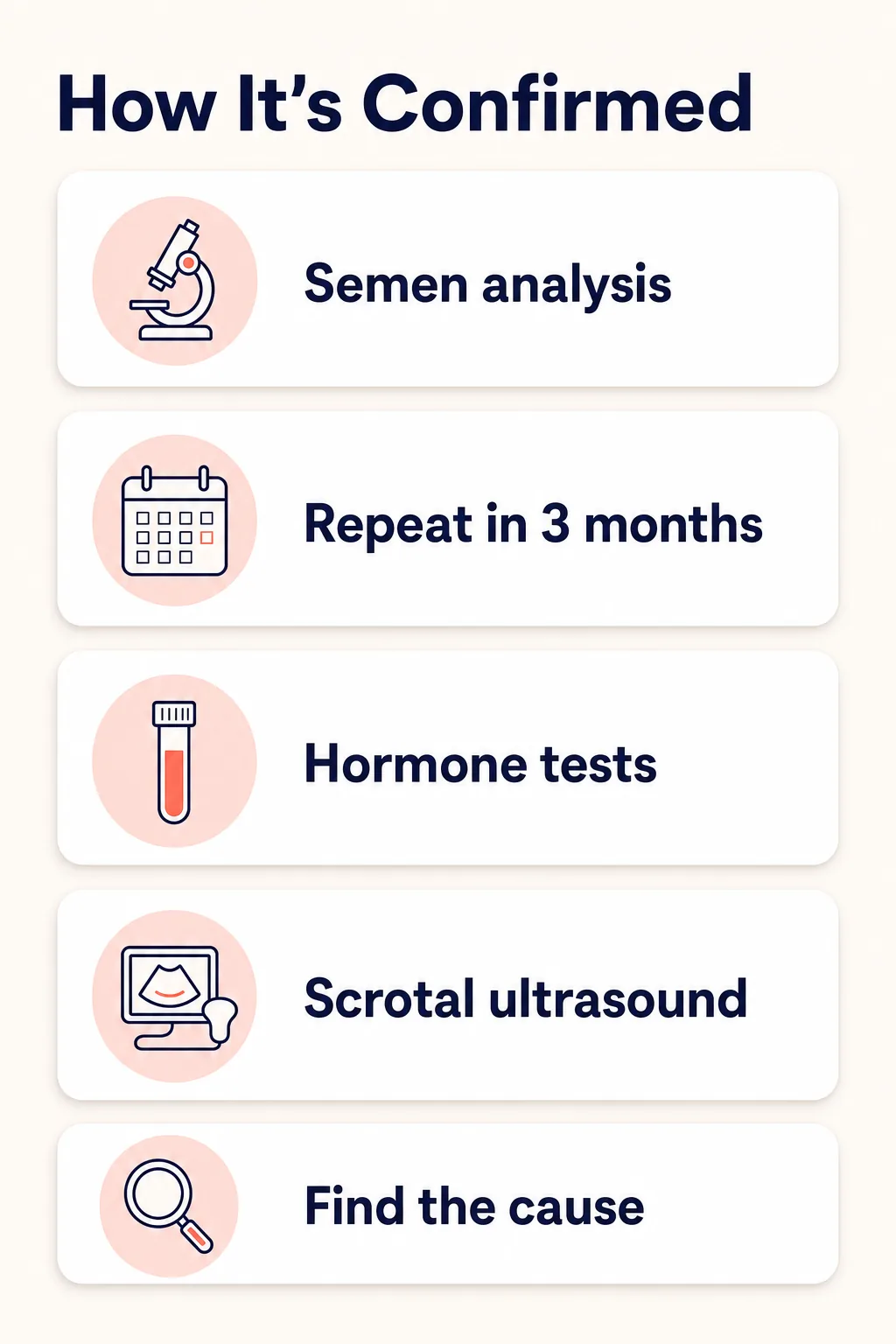
If the count is genuinely low, a good andrologist reads the report alongside an examination and history, and adds a few targeted tests only where they are needed: hormone blood tests (FSH and testosterone), a scrotal ultrasound, and — for very low counts — genetic testing or a post-orgasm urine test. The point is to find why the count is low, because that is what decides whether it can be improved.
How to prepare for your semen analysis
A little preparation makes the result trustworthy, so it is worth getting right:
- Abstain for 2–7 days beforehand — not less, not more. Too short a gap lowers the volume and count; too long reduces motility (WHO 2021).
- Give the whole sample — ideally by masturbation into a sterile container, and if collected at home, kept near body temperature and at the lab within about an hour. Missing the first, sperm-rich portion drags the count down falsely.
- Steer clear of a fever, heavy alcohol or a recent illness in the days before — a high temperature or infection can temporarily crash the count.
- Never judge everything on one test. Counts swing naturally, so a low or borderline result is repeated after about three months before it is taken as real.
In Chennai the test is quick, inexpensive and widely available; at our clinic the report is read exactly the way this page describes — against the WHO 2021 limits, alongside an examination — so you leave understanding what your own numbers mean.

Private 1-on-1 consultation
Wondering if your sperm count is low? Let’s check it properly — and honestly.
A calm, judgement-free evaluation: a semen analysis, an examination, and a clear reading of what the numbers mean. Most low counts are common and improvable — the first step is simply knowing yours.
Book a Confidential Consultation
What causes a low sperm count?
Once we know the count is low, the useful question is why. The common causes fall into a short list, and most are either treatable or improvable.
| Cause | What it is | Can it be helped? |
|---|---|---|
| Varicocele | Enlarged scrotal veins — the commonest finding | Managed conservatively; surgery not advised as fertility treatment (NICE/NHS) |
| Hormonal / low testosterone | The signal to make sperm is weak | Often — by treating the cause, not testosterone injections |
| Infection or inflammation | Of the genital tract | Yes — antibiotics / anti-inflammatories |
| Retrograde ejaculation / blockage | Semen misrouted or the tubes blocked | Sometimes — medication or minor surgery |
| Lifestyle (heat, smoking, alcohol, obesity) | Everyday exposures that suppress sperm | Yes — changes over a 2–3 month cycle |
| Genetic (e.g. Klinefelter), undescended testis | Present from birth or childhood | Options remain, including sperm retrieval with IVF/ICSI |
One warning I repeat often: do not take testosterone injections or gels to “boost” fertility. They do the opposite — external testosterone switches off the body’s own signal to make sperm and can drive the count to zero. If low testosterone is the problem, it is treated in a way that protects sperm production, not with a shortcut that destroys it.
Can a low sperm count be improved? (Often, yes)
The reason I push men to test early rather than worry is simple: a great many low counts respond to treatment or to honest lifestyle change, and even the difficult ones have real options. The levers with the strongest evidence are unglamorous but effective. Stopping smoking matters — a large meta-analysis of nearly 6,000 men linked smoking to a meaningfully lower sperm count (Sharma et al., 2016). Losing excess weight helps too, with overweight and obesity clearly linked to lower counts (Sermondade et al., 2013). Add keeping the testicles cool (loose underwear, no laptops on the lap, fewer hot baths), cutting alcohol, and giving it time — because sperm take about two to three months to mature, changes made today show up on a repeat test a season later, not next week.
And here is the reassurance men most need to hear: a low count is not the same as being infertile. Plenty of men with counts below the reference limit conceive naturally, especially once a treatable cause is addressed — and where the count is very low, assisted-reproduction techniques such as IVF and ICSI can achieve a pregnancy with only a handful of healthy sperm. If that is your situation, our guide to treating a low sperm count explains the options.
How common is a low sperm count — and are counts really falling?
If you are worried, the first thing to know is that you are in very common company. A male factor contributes to about half of all infertile couples (Agarwal et al., 2015), and a low sperm count is the commonest male finding of all — I see it every week in men who are otherwise fit and well. It is a medical result, not a personal failing.
You may also have read that sperm counts are falling, and that part is true: the largest analysis of its kind found average sperm concentration in Western men fell by about 52% between 1973 and 2011 (Levine et al., 2017), and the 2022 global update extended that decline to men on every continent — roughly a 50% drop since 1973, and at an accelerating pace since the year 2000 (Levine et al., 2022). The takeaway for you is not to panic about a global trend, but the reverse: a lower count is now common, usually has an identifiable cause, and is often improvable — which is exactly why testing and acting early pays off.
Could a low count ever point to something more serious?
Almost always, a low sperm count is a fertility matter and nothing more. But two situations deserve a mention, because catching them early genuinely matters:
- A new testicular lump. Any new lump, swelling or firmness in a testicle should be examined promptly — not because it is usually cancer, but because men with fertility problems carry a modestly higher risk of testicular cancer (around threefold; Walsh et al., 2009), and it is one of the most curable cancers when caught early.
- A very low or zero count. When the count is extremely low or no sperm are found at all, a genetic cause such as Klinefelter syndrome — the commonest chromosomal reason for very low sperm production (Groth et al., 2013) — is worth ruling out with a simple blood test, because it changes what treatment can realistically achieve.
Neither is common, and neither is a reason to panic — but both are reasons not to shrug off a lump or a strikingly low report, and to see an andrologist rather than wait and wonder.
When should you see a doctor?
See an andrologist if you and your partner have been trying to conceive for 12 months without success (6 months if she is 35 or older), or sooner if any of these are true: you have erectile difficulty or a genuinely low sex drive; testicular pain, swelling, a lump or small testes; a very low semen volume or cloudy urine after orgasm; or a history of an undescended testicle, mumps after puberty, testicular injury or surgery, chemotherapy, or steroid use. There is no advantage in waiting — early testing simply gives you more options. If you are planning marriage or a family, a private premarital fertility check answers the question calmly, before it becomes a worry.
Low sperm count evaluation in Chennai
At Dr Shah’s Clinic in T. Nagar, the visit is private and judgement-free, and we keep it practical: a semen analysis and examination, a clear reading of your numbers against the WHO limits, and an honest plan — lifestyle and medical treatment where it helps, and referral for advanced options where needed. If sexual concerns such as low desire or erectile difficulty are part of the picture, you can also consult a sexologist in Chennai directly.
Get a clear answer about your count
Stop guessing from symptoms that do not exist. A simple semen analysis tells you exactly where you stand — and most low counts have a solution.
Frequently asked questions
Can you have a low sperm count and still ejaculate normally?
Yes — this is the usual situation with a low sperm count. The volume and look of your ejaculate come mostly from the prostate and seminal vesicles, not from the sperm, so a completely normal-looking ejaculate can still carry very few sperm — or none. Only a semen analysis can tell.
Does a low sperm count have any physical symptoms — can you feel it?
Usually none. Most men feel entirely normal and find out only after a couple struggles to conceive. When there are clues, they point to an underlying cause — testicular pain or a lump, very low semen volume, or low-testosterone signs like reduced libido and body hair — not to the low count itself.
Is watery or thin semen a sign of a low sperm count?
Not reliably. Semen naturally looks thinner or more watery when you have ejaculated recently or are dehydrated, and thicker after a longer gap. The look of semen does not tell you the sperm count — that can only be measured under a microscope in a semen analysis.
Does masturbation cause a low sperm count?
No. Normal masturbation does not cause a permanently low count. It can temporarily reduce the volume of the very next ejaculate, but the testicles produce sperm continuously and the count recovers within a day or two. There is no evidence that ordinary masturbation harms fertility.
What sperm count is considered low?
Below the WHO 2021 lower limit of 16 million sperm per millilitre is called a low sperm count (oligozoospermia). Fewer than 5 million/mL is severe, and no sperm at all is azoospermia. Many older pages still quote 15 million/mL, which is the superseded 2010 figure.
Is a low sperm count the same as being infertile?
No. A low count reduces the odds of conceiving in any given month, but many men below the reference limit still father children naturally — especially once a treatable cause is addressed. Infertility means not conceiving after a year of trying; a low count is one possible reason, not a diagnosis of sterility.
What is the difference between oligospermia and azoospermia?
Oligospermia (oligozoospermia) means a low but present sperm count — below 16 million/mL. Azoospermia means no sperm are found in the ejaculate at all, even after the sample is spun down in the lab. Azoospermia has its own, frequently treatable, causes and needs a specialist work-up.
Can a low sperm count be improved naturally?
Often, yes. Stopping smoking, losing excess weight, cutting alcohol, and keeping the testicles cool all have real evidence behind them, and treating an underlying cause helps further. Because sperm take two to three months to mature, give any change a full cycle before re-testing.
References
Guidelines and reference standards
- World Health Organization. WHO laboratory manual for the examination and processing of human semen (6th ed., 2021). ISBN 978-92-4-003078-7.
- American Society for Reproductive Medicine (ASRM), Practice Committee. Definition of infertility: a committee opinion (2023). Fertil Steril.
- Schlegel PN, Sigman M, Collura B, et al. Diagnosis and Treatment of Infertility in Men: AUA/ASRM Guideline. Fertil Steril. 2021 (amended 2024).
- National Institute for Health and Care Excellence (NICE). Fertility problems: assessment and treatment (CG156) — including the recommendation that men should not be offered varicocele surgery as fertility treatment because it does not improve pregnancy rates.
- Bhasin S, Brito JP, Cunningham GR, et al. Testosterone Therapy in Men With Hypogonadism: An Endocrine Society Clinical Practice Guideline. J Clin Endocrinol Metab. 2018;103(5):1715–1744.
Studies and reviews cited
- Sharma R, Harlev A, Agarwal A, Esteves SC. Cigarette Smoking and Semen Quality: A New Meta-analysis. Eur Urol. 2016;70(4):635–645.
- Sermondade N, Faure C, Fezeu L, et al. BMI in relation to sperm count: an updated systematic review and collaborative meta-analysis. Hum Reprod Update. 2013;19(3):221–231.
- Alsaikhan B, Alrabeeah K, Delouya G, Zini A. Epidemiology of varicocele. Asian J Androl. 2016;18(2):179–181.
- Levine H, Jørgensen N, Martino-Andrade A, et al. Temporal trends in sperm count: a systematic review and meta-regression analysis. Hum Reprod Update. 2017;23(6):646–659.
- Levine H, Jørgensen N, Martino-Andrade A, et al. Temporal trends in sperm count: samples collected globally in the 20th and 21st centuries. Hum Reprod Update. 2023;29(2):157–176.
- Agarwal A, Mulgund A, Hamada A, Chyatte MR. A unique view on male infertility around the globe. Reprod Biol Endocrinol. 2015;13:37.
- Walsh TJ, Croughan MS, Schembri M, Chan JM, Turek PJ. Increased risk of testicular germ cell cancer among infertile men. Arch Intern Med. 2009;169(4):351–356.
- Groth KA, Skakkebæk A, Høst C, Gravholt CH, Bojesen A. Klinefelter syndrome — a clinical update. J Clin Endocrinol Metab. 2013;98(1):20–30.
This article is for education and does not replace an in-person consultation. If you are concerned about your fertility or have been trying to conceive without success, get a semen analysis. Call +919790783856 to book a confidential appointment with Dr Shah Dupesh in Chennai.
A private, judgement-free space to talk through your sperm count, fertility and men’s sexual health. Walk in, or book ahead by phone.
📍No 21, Sree Kalki Apartments, Ground Floor, Bazullah Road, T-Nagar, Chennai 600017
what is your consultation fees?
Just get a semen analysis done, in a well-certified andrology laboratory