
No — masturbation does not meaningfully or lastingly reduce your testosterone. Normal masturbation and ejaculation have no clinically significant effect on your baseline testosterone level. The “drained” feeling you may have heard about is a myth, not a measurement.
I am Dr Shah Dupesh, an andrologist in Chennai, and almost every week a young man walks into my clinic convinced that masturbation has “finished” his testosterone — that it has made him weak, thin, tired, less of a man. He has usually read this on some forum or watched a reel that quoted “a study.” So let me settle this clearly, with real evidence, the way I would across the table from you.
Quick Facts
- Masturbation does not lower your baseline testosterone. There is no lasting drop.
- Testosterone may dip or rise by a few percent for minutes to hours around orgasm, then returns to normal on its own.
- The famous “testosterone peaks on day 7 of no ejaculation” study was retracted in 2021 — it is not valid evidence.
- NoFap and “semen retention” do not raise your testosterone in any meaningful, lasting way.
- The real testosterone-killers are obesity, poor sleep, chronic stress, certain medicines, and ageing — not your hand.
Does masturbation lower testosterone? The honest, direct answer
No. Let me say it without hedging, because hedging is exactly what has kept this myth alive.
When researchers actually measured what happens to the hormone, they found that the act of orgasm itself does not change your testosterone in any way that matters. In a controlled study of healthy men, Exton and colleagues measured blood hormones continuously through arousal and masturbation-induced orgasm. Orgasm pushed up heart rate, blood pressure, adrenaline and prolactin — but plasma testosterone was unaltered by orgasm (Exton, 2001). It did not crash. It did not drain away.
Think of it this way. Your testes are not a fuel tank that empties a little with every ejaculation. Testosterone is made continuously, regulated by a feedback loop between your brain (the hypothalamus and pituitary) and your testes. A single ejaculation does not switch that factory off. The semen you release is mostly fluid from the prostate and seminal vesicles — it is not “stored testosterone” leaving your body.
If you want a fuller picture of healthy frequency and why “limits” are mostly cultural rather than medical, I have written about exactly that in how many times masturbation can be done in a day.
The endocrine physiology: why one ejaculation can’t dent your baseline
Let me show you the actual machinery, because once you understand it, the fear simply dissolves.
Your testosterone is governed by what we call the HPG axis — the hypothalamus, the pituitary, and the gonads (your testes). Picture it as a thermostat in a well-run house. The hypothalamus, deep in your brain, releases a signalling hormone (GnRH) in steady pulses. That tells the pituitary to send out LH (luteinising hormone). LH travels down to the Leydig cells in your testes and tells them: make testosterone. When testosterone in the blood rises high enough, the brain senses it and eases off the signal. When it drops, the brain pushes the signal back up. The system is constantly self-correcting, minute by minute, all day and all night.
Now, where does ejaculation fit into this? It doesn’t, really. Ejaculation is a mechanical, neural event — a reflex coordinated by your spinal cord. The fluid expelled comes from the prostate and seminal vesicles, with sperm a tiny fraction of the volume. None of it is “testosterone in storage.” Testosterone is a hormone dissolved in your blood, made on demand by the testes — not packaged into semen and shipped out the door.
So the thermostat does not even register an ejaculation as a meaningful event. There is no sudden drop for it to correct. This is precisely why the cleanest study found plasma testosterone unaltered by orgasm (Exton, 2001): the HPG axis simply keeps doing its job.
Here is the metaphor I use with my patients: your testosterone is like the water level in a large reservoir, kept topped up by a stream that never stops flowing. Ejaculation is like scooping out a single cup. The stream refills it before you have even noticed it was gone. You cannot empty a reservoir with a teacup, and you cannot empty your testosterone with your hand.
Does ejaculation reduce testosterone? What actually happens in your blood
Here is the precise, honest science — because this is where the myths are born.
Around sexual activity, testosterone does fluctuate a little. Some studies show a small rise during arousal and right at ejaculation; others show it settling back within minutes. The Exton study is the cleanest answer: orgasm itself left testosterone unaltered (Exton, 2001). These are tiny, short-lived blips, and they return to baseline on their own within minutes to a few hours. Your body is built to do this without you doing anything.
So when someone tells you ejaculation “wastes” your testosterone, they are confusing a small wave on the surface of the sea with the sea itself draining away. The wave passes. The sea level does not change.
This is also why men who masturbate regularly do not develop low testosterone from it. Regular, normal sexual activity simply does not deplete the hormone. If anything, a healthy sex life is a marker of good hormonal and vascular health, not a drain on it.
Does NoFap increase testosterone? Debunking the “semen retention” myth
This is the big one, so let me be definitive: No — NoFap and semen retention do not raise your testosterone in any lasting, beneficial way. I go through the whole claim, including the retracted study behind the day-7 figure, in semen retention benefits.
The entire NoFap “testosterone boost” belief rests on essentially one study. In 2003, Jiang and colleagues reported that in a small group of men, serum testosterone climbed to about 145% of baseline on the 7th day of abstinence after an ejaculation, then settled (Jiang, 2003). The internet took that single day-7 number, stripped it of all context, and turned it into “don’t ejaculate and your testosterone will skyrocket.”
Two problems with that story.
First — and this is decisive — that 2003 study was officially RETRACTED in 2021. The journal withdrew it (Retraction Note, Journal of Zhejiang University-Science A, 2021). A retracted paper is not weak evidence; it is withdrawn evidence. You cannot build a lifestyle on a study the scientific record itself has pulled.
Second, even taken at face value, that finding was a single transient spike on one day in a tiny sample — not a sustained rise, and never a basis for the strength, confidence and “superpower” claims NoFap communities attach to it. A brief blip on day 7 does not become permanently higher testosterone, and it does not translate into the benefits people imagine.
We do have a cleaner, intact study on abstinence: when healthy men abstained for 3 weeks, there was a modest elevation in testosterone — but, importantly, orgasm itself still did not change the hormone, and these were measured group differences, not life-changing surges (Exton, 2001). Modest, transient, and not the engine of any NoFap miracle.
Avoiding masturbation will not raise your baseline testosterone. If your testosterone is genuinely low, abstinence is not the cure — and chasing it can feed real anxiety. Compulsive porn use does have downsides worth addressing (I cover those elsewhere in this site), but testosterone depletion is simply not the mechanism. And while we are clearing out masturbation myths, the same goes for the panic around “blue balls” — that aching heaviness is a brief, harmless congestion, not a sign of damage, as I explain in the truth about blue balls.

Does abstinence raise testosterone? The transient blip, honestly explained
Short, careful answer: a brief period without ejaculation may be associated with a small, temporary uptick in testosterone — but it is transient, not a staircase that keeps climbing the longer you hold out. After any early blip, levels plateau back to your individual normal. There is no evidence that weeks or months of “retention” keep pushing testosterone higher. The body simply does not work like a savings account.
So if the question behind your question is “should I stop masturbating to fix my testosterone?” — the answer is no. You would be treating a number that masturbation never broke in the first place.
Why does the “masturbation lowers testosterone” myth spread?
It is worth understanding why this belief is so sticky, because once you see the machinery, the fear loses its grip.
First, there is the one out-of-context number — the retracted day-7 study’s “145%.” A single, dramatic, screenshot-friendly figure travels far faster on the internet than the boring, accurate truth (“levels barely change, and they return to normal”). The retraction notice never goes viral. A number like that is built for a thumbnail; the correction is built for a footnote, and nobody shares footnotes.
Second, there is a real biological feeling that gets misinterpreted. After orgasm, the hormone prolactin rises and dopamine settles — that is what produces the natural, drowsy “post-orgasm” calm or low mood some men notice. That is prolactin and dopamine doing their normal job for a short while; it is not your testosterone collapsing. People feel something real and then reach for the wrong explanation. The sensation is genuine; the diagnosis they give it is wrong.
Third, in our cultural context especially, moral guilt looks for a medical costume. If a behaviour feels shameful, the mind is quick to believe it must also be physically harmful. “It drained my testosterone” feels more concrete than “I feel guilty.” But a blood test does not measure guilt, and that is precisely why testing reassures so powerfully.
There is also a fourth engine worth naming: a whole economy now profits from the fear. Supplements, “testosterone-boosting” programmes, retention coaches and reels all need you to believe your hormone is leaking away so they can sell you the plug. Once you realise nothing is leaking, there is nothing to buy. Understand those engines and you have understood the entire myth.
In my Chennai practice, I see a very specific kind of distress that the textbooks abroad rarely capture. A young man — often unmarried, often anxious — is convinced that masturbation has “leaked out” his strength, his testosterone, his future fertility. He may complain of weakness, brain fog, thinning body. This is closely related to what we call Dhat-syndrome-adjacent distress in the Indian context. Here is what I have learned: when I actually check his serum testosterone, it is almost always perfectly normal. The problem was never his hormone — it was the fear. The symptoms were anxiety wearing a hormonal mask. Reassurance backed by a real blood test, not abstinence, is what heals these men. I tell them plainly: your hand did not take your testosterone. Let us look at what actually could — and usually find there is nothing wrong at all.
What actually lowers testosterone (redirect your worry here)
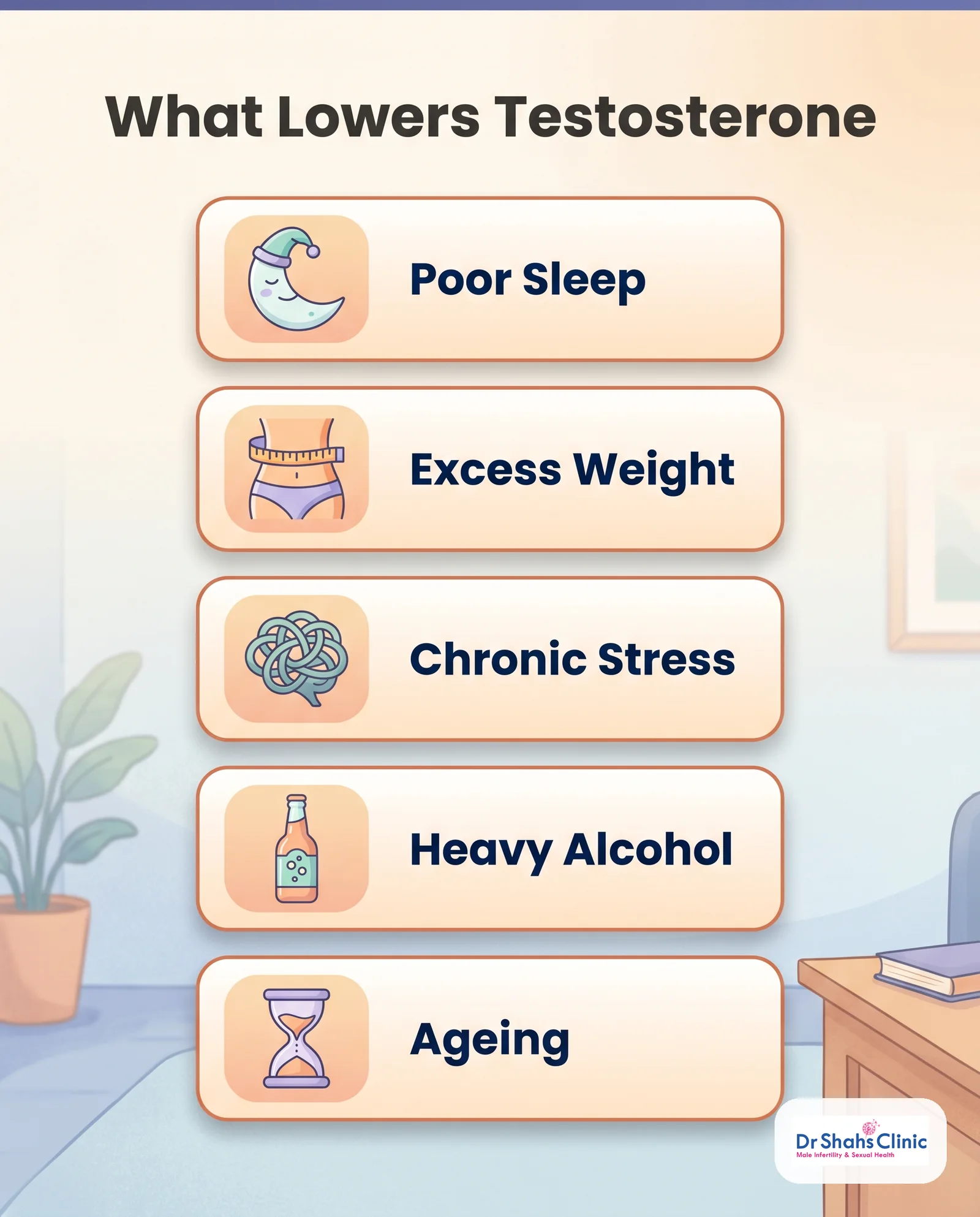
If you are genuinely worried about low testosterone, point your attention at the real causes — these have far more impact than anything your sex life is doing. Here is what I look at, in order, when a man comes to me with genuinely low energy and a genuinely low test result.
- Obesity and excess belly fat. Fat tissue converts testosterone into estrogen and disrupts the brain-testes signal, so the more central fat you carry, the lower your testosterone tends to run. In my practice this is the single most common reversible cause in young men — and the good news is it runs both ways: losing weight often lifts testosterone back up without a single tablet.
- Poor sleep and sleep apnea. Sleep loss and short sleep duration are associated with lower morning, afternoon and 24-hour testosterone (Liu, 2022). Most of your testosterone is made while you sleep — rob the sleep, you rob the hormone. If you snore heavily, wake unrefreshed, or your partner notices you stop breathing at night, get screened for obstructive sleep apnea; treating it can meaningfully change your numbers.
- Chronic stress. Persistently high cortisol suppresses testosterone; they sit on opposite ends of a seesaw. Sustained work pressure, poor sleep and anxiety together can quietly hold your testosterone down for months.
- Alcohol, opioids and certain medicines. Heavy alcohol, opioid painkillers, some anabolic steroids and a handful of prescription drugs genuinely lower testosterone — opioids in particular are a frequently missed cause. Always tell your doctor every medicine and substance you use.
- Ageing. A slow, natural decline of roughly 1% a year happens with age — gradual, expected, and not caused by anything you did. It is not a switch that flips; it is a gentle slope.
- Medical hypogonadism. A real, diagnosable condition involving the testes (primary) or the pituitary and hypothalamus (secondary), which a proper evaluation and blood test will catch. This is the genuine version of “low testosterone” — and it has nothing to do with masturbation.
Notice what is not on that list: masturbation. If you tick several boxes above and feel persistently low, here is the practical step: get a morning serum testosterone test (ideally drawn between 7 and 11 am, when levels are highest, and repeated on a second morning if it comes back low). That single blood test will tell you far more than any “retention challenge” ever could. Do not start abstaining to fix a number you have not even measured.
This is also why I gently redirect men who blame masturbation for unrelated problems. If you are worried about erections, the cause is rarely your hand — see does masturbation cause erection problems. If your worry is fertility, the honest answer is in does masturbation cause infertility. And if your concern is a compulsive or painful habit, how to stop prone masturbation is a more useful place to put your energy than chasing a testosterone myth.
What actually changes your testosterone — and what doesn’t
Here is the whole picture in one glance. Keep this table in mind the next time a reel tells you your hand is draining your hormone.
| Factor | Effect on testosterone | Lasting? |
|---|---|---|
| Masturbation / ejaculation | No meaningful effect; orgasm leaves it essentially unchanged | No effect to last |
| NoFap / abstinence | At most a tiny, transient blip early on | No — plateaus back to your normal |
| Poor sleep / sleep apnea | Lowers it (most testosterone is made during sleep) | Yes, while the sleep problem persists |
| Obesity / excess belly fat | Lowers it (fat converts testosterone to estrogen) | Yes, until weight is reduced |
| Chronic stress / high cortisol | Lowers it (cortisol and testosterone seesaw) | Yes, while stress is sustained |
| Heavy alcohol / opioids | Lowers it | Yes, while use continues |
| Ageing | Slow natural decline (~1% per year) | Yes — gradual and permanent, but normal |
“But my testosterone is normal and I still feel weak” — this is where Dhat syndrome comes in
Now let me speak to the man this article is really for — because for him the story does not end at a normal blood report.
He comes to me drained: low mood, constant tiredness, poor erections, a nagging sense that even his size has shrunk. He has masturbated daily, often several times a day, frequently to porn, for years. And his testosterone report comes back perfectly normal. He stares at it and refuses to believe it, because the suffering is so real.
Here is the honest truth I give him: your symptoms are genuine, but they are not coming from a low hormone. In these men the driver is Dhat syndrome — the culturally rooted cycle of guilt, anxiety and constant self-monitoring that compulsive, daily masturbation and porn keep feeding. Testosterone can read completely normal while the man still truly experiences weakness, fatigue, erectile difficulty and a feeling of being diminished — because these symptoms are generated by an anxious, exhausted mind and the distress cycle, not by a hormone deficiency. I have written about this in detail in feeling sexually weak and Dhat syndrome, and it is the key that unlocks most of these cases.
The prolactin piece fits here, honestly. Every orgasm is followed by a rise in prolactin and a dip in dopamine — the normal post-orgasm flatness. A man releasing several times a day lives in that low-dopamine, prolactin-shadowed trough far too often, and starts to read that chronic flatness as “my testosterone is finished.” His hormone is fine; it is the rhythm of his reward system and his anxiety that have been knocked out of balance. So testosterone is the wrong thing to blame, and testing it a second and third time only deepens the worry — the real work is to calm the cycle.
This is why a normal report is good news, not a contradiction of your suffering. When we treat the Dhat cycle — the porn, the compulsive frequency, the guilt and the anxiety — the energy, the confidence and the erections return, even though the hormone never moved.
Masturbation as a walking stick, not a daily crutch
Let me leave you with how I frame it for my own patients. Masturbation is best thought of as a walking stick — something to lean on occasionally — not a daily crutch you cannot stand without. An occasional release is harmless and completely normal. But serial, compulsive, daily masturbation, especially porn-driven, is exactly where the Dhat cycle and the “weakness” take root. The honest long-term goal is not lifelong abstinence chased for a testosterone number — it is to need it less and less, to break the compulsive loop, and to move toward real intimacy with a partner, which is where genuine, satisfying sexual health actually lives. If the habit already feels compulsive, how to stop prone masturbation is a practical place to start.

Private 1-on-1 consultation
Worried your testosterone is low? Don’t guess — test.
A simple morning blood test settles it in a day. Talk to Dr Shah for an honest, judgment-free assessment — and the real causes worth checking.
Book a Confidential Consultation
Get a simple testosterone test
A morning serum testosterone test is quick and confidential. Talk to Dr Shah and treat the real cause, not a myth.
Free guide · no spam · unsubscribe anytime.
FAQ
Does masturbation lower testosterone?
No. Masturbation does not lower your baseline testosterone. Orgasm itself leaves plasma testosterone unaltered (Exton, 2001), and regular masturbation does not deplete the hormone over time. The feeling of being “drained” is psychological, not hormonal.
Does NoFap increase testosterone?
No, not in any lasting way. The belief comes from a 2003 study reporting a day-7 spike — but that study was retracted in 2021 and was never evidence of a sustained rise. Avoiding masturbation will not raise your baseline testosterone or deliver the benefits NoFap communities claim.
Why do I feel weak, tired or have erection problems if my testosterone is normal?
Because in most of these men the symptoms come from Dhat syndrome — an anxiety-driven distress cycle fed by compulsive, daily masturbation and porn — not from a low hormone. Testosterone can read perfectly normal while you still genuinely feel weak, low and struggle with erections. Treating the cycle, not chasing the hormone, is what restores it. See our guide to feeling sexually weak and Dhat syndrome.
Does ejaculation reduce testosterone?
No. Ejaculation may cause tiny, short-lived hormonal fluctuations that return to normal within minutes to hours. Semen is mostly prostate and seminal-vesicle fluid, not stored testosterone, so releasing it does not drain your hormone.
Does abstinence raise testosterone?
Only a small, transient blip at most. A brief abstinence may associate with a minor temporary uptick (Exton, 2001), but it plateaus back to your normal. There is no evidence that longer retention keeps pushing testosterone higher.
How long does testosterone take to recover after ejaculation?
There is essentially nothing to recover, because ejaculation does not meaningfully drop your testosterone in the first place. Any minor fluctuation around orgasm normalises on its own within minutes to a few hours.
Does masturbation reduce testosterone in teenagers or young men?
No. A young man’s HPG axis is producing testosterone continuously and abundantly; masturbation does not interrupt that. The weakness, fatigue or “brain fog” that anxious teenagers attribute to it almost always traces back to sleep, study stress or the anxiety itself — not to a hormone loss.
How often is too often — can frequent masturbation lower testosterone?
Frequency does not lower your baseline testosterone, whether that is once a week or several times a day. There is no medical “limit” beyond what feels comfortable and does not interfere with your life. The only real downside of very high frequency is if it becomes compulsive or replaces other parts of living, which is a behavioural matter, not a hormonal one.
Does masturbation reduce testosterone enough to cause hair loss or weakness?
No. Male-pattern hair loss is driven by genetics and your sensitivity to DHT, not by masturbation, and the “weakness” people describe is not a measurable hormone deficiency. When I test these men, their testosterone is almost always normal.
Will my testosterone go back to normal if I have been masturbating a lot?
There is nothing to return from, because frequent masturbation did not lower it in the first place. If you genuinely feel low, the honest move is a morning blood test and an honest look at your sleep, weight and stress — not a guilt-driven abstinence streak.
Can masturbation make me weak or low in testosterone permanently?
No. In years of practice I have not seen masturbation cause low testosterone. When anxious men get tested, their levels are almost always normal. If you feel persistently weak, the answer is a blood test and a look at sleep, weight and stress — not stopping masturbation.
References
- Exton MS, Krüger TH, Bursch N, et al. Endocrine response to masturbation-induced orgasm in healthy men following a 3-week sexual abstinence. World Journal of Urology. 2001;19(5):377-382. PMID 11760788
- Jiang M, Jiang X, Zou Q, Shen J-W. A research on the relationship between ejaculation and serum testosterone level in men. Journal of Zhejiang University-Science A. 2003;4(2):236-240. [Retracted 2021] PMID 12659241
- Liu PY, et al. Sleep, testosterone and cortisol balance, and ageing men. Reviews in Endocrine and Metabolic Disorders. 2022;23(6):1323-1339. PMID 36152143
A private, judgment-free space to talk through fertility and men’s sexual health. Walk in, or book ahead by phone.
📍No 21, Sree Kalki Apartments, Ground Floor, Bazullah Road, T-Nagar, Chennai 600017