
Here’s the honest answer, straight away: masturbating before sex can make a second round last a little longer, because the refractory period after one climax blunts the next. But it does not truly increase your sex time. It is a crutch, not a cure, and for many men it trades a fast finish for a softer erection.
I am an andrologist in Chennai, and in my clinic, I see this every week — usually from a man who has read a dozen forum threads telling him to “just finish once beforehand.” Let me explain what’s actually happening in your body, why the trick is unreliable, and what genuinely lengthens the time you last.
Quick Facts
- Masturbating before sex can stretch the second round slightly — the refractory period dampens the next climax — but it does nothing for the fast reflex underneath.
- For many men the pre-emptive climax softens the second erection, swapping a quick finish for a weaker one.
- It is a workaround, not a treatment: it retrains nothing, so the moment you stop, the early finish returns.
- Premature ejaculation is defined by a short ejaculatory latency, poor control, and distress — and the ISSM names behavioural retraining, not pre-sex masturbation, as first-line care (Serefoglu, 2014; Althof, 2014).
- Real, lasting control comes from reconditioning the ejaculatory reflex — stop-start, the squeeze, pelvic-floor work — not from tiring it out first (Cooper, 2015; de Oliveira, 2026).
Does masturbating before sex actually increase sex time?
Partly, and only in a narrow way. After a man ejaculates, the body enters a refractory period — a recovery window in which arousal is lower and the next climax is harder to reach. So masturbating an hour or two before sex may make the next orgasm during intercourse arrive later. On paper, that looks like “lasting longer.”
But notice what has actually changed. You have gained no control over your ejaculatory reflex — you have simply spent your first, sharpest climax alone and turned the real event into a duller second round. The fast trigger is still there; you have just muffled it for one occasion. That is why I tell my patients the gain is borrowed, not earned.
What really decides how long sex lasts (IELT and the ejaculatory reflex)
To fix a problem you have to name it correctly. The clinical measure of “how long sex lasts” is the intravaginal ejaculatory latency time (IELT) — the time from penetration to ejaculation. How short that time runs is governed by your ejaculatory reflex, a spinal reflex with a threshold that is set largely by serotonin signalling in the brain and cord (de Jong, 2006).
Think of it as a sensitivity setting: a low threshold fires early, a higher one takes longer. premature ejaculation (PE) is the formal diagnosis when three things line up: a consistently short IELT (a minute or less in lifelong PE), the feeling that you cannot delay it, and real distress about it (Serefoglu, 2014). It comes in two forms — lifelong PE, present from the first sexual experiences, and acquired PE, which arrives later and is usually driven by performance anxiety, relationship strain, or erectile difficulty (McMahon, 2016).
Masturbating beforehand does not touch any of this. It does not raise the serotonin set-point, it does not calm performance anxiety, and it does not retrain the reflex. It only hides the symptom for one round.
Lifelong or acquired PE, and why the trick fits neither
It is worth knowing which kind of early finish you have, because the right fix differs. Lifelong PE is present from your very first sexual experiences and runs on a naturally low ejaculatory threshold. Acquired PE arrives later, usually pushed by performance anxiety, relationship strain, or a weakening erection (McMahon, 2016).
A 2025 lifespan analysis of men with lifelong PE examined exactly these questions — how the pattern shifts with age, foreplay, and even masturbation (Cote-Leger, 2025). The practical takeaway is blunt: neither subtype is treated by emptying the tank beforehand. Lifelong PE needs the threshold raised; acquired PE needs the anxiety and the erection addressed. A pre-sex climax does neither.
Before you decide you finish “too fast”, it helps to know how long sex normally lasts for most couples — the honest average is only a few minutes, not the marathon the internet implies.
The refractory period: why the second round runs slower
The whole “trick” lives or dies on the refractory period, so it is worth understanding it properly.
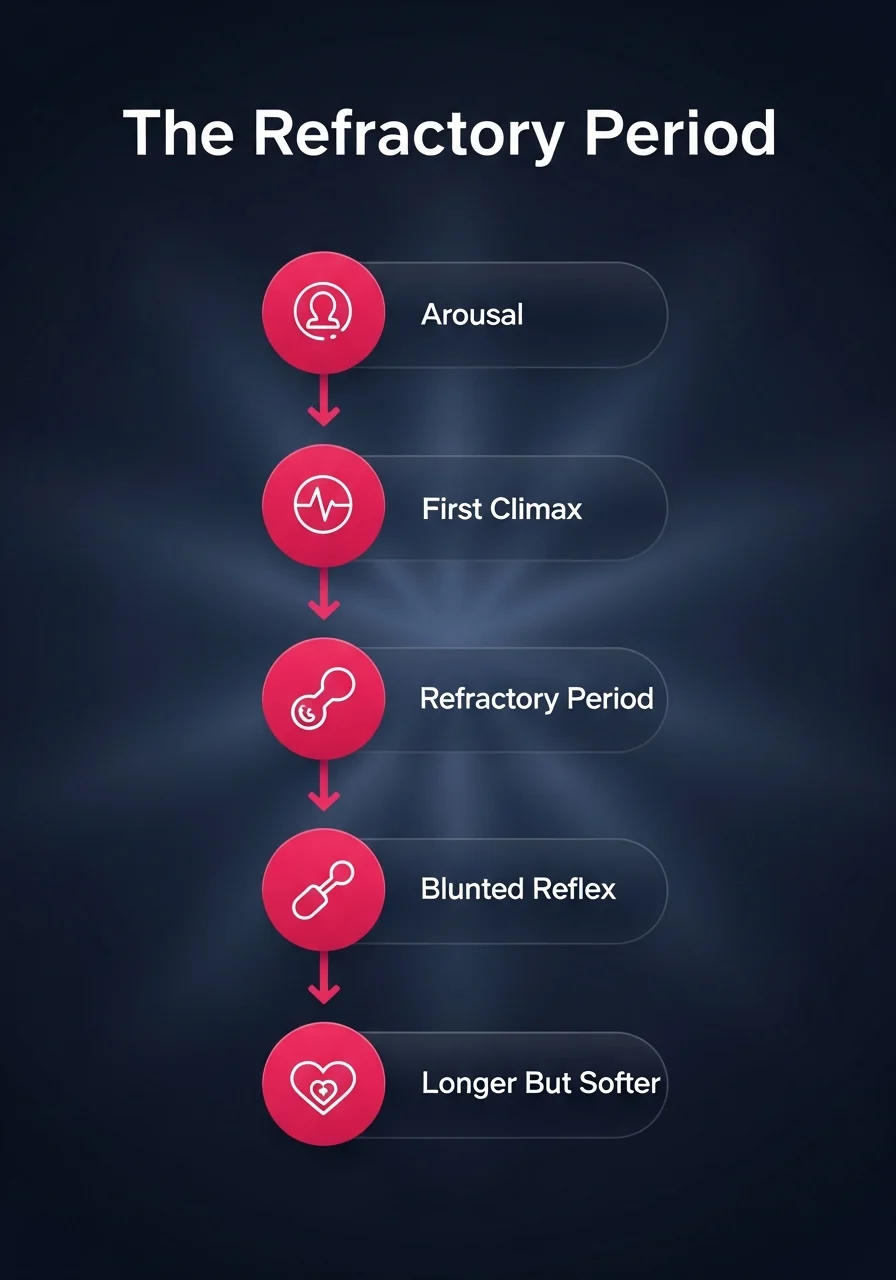
When you climax, arousal drops sharply and the body shifts into recovery. During this window the ejaculatory reflex is harder to trigger — exactly why a second round can run longer. In younger men the window may be twenty minutes; in older men it can stretch to hours or a full day. This is normal physiology, not a defect.
There is real biology under this. When you orgasm, a surge of the hormone prolactin follows, and it is thought to act as a feedback brake that sustains the refractory period, damping desire while the next climax stays out of reach (Haake, 2002). Dopamine, the drive chemical, dips at the same time. So the “trick” is really you borrowing a hormonal recovery state — not building any skill your body gets to keep.
Here is the catch I see in my consulting room. That same recovery state that delays the second climax also weakens the second erection. Lower arousal means a less reliable erection — so the man who masturbated to “last longer” often ends up struggling to stay hard. He has bought a slower finish at the price of a softer one. For most, it is a poor trade.
Does masturbating before sex help premature ejaculation? The honest answer
No — not as a treatment. When I search the medical literature for evidence that pre-sex masturbation treats premature ejaculation, there is none. What the evidence supports is that PE responds to methods that retrain the reflex or raise its threshold: structured behavioural techniques, pelvic-floor training, and, where needed, clinician-supervised medication (Althof, 2014; Cooper, 2015).
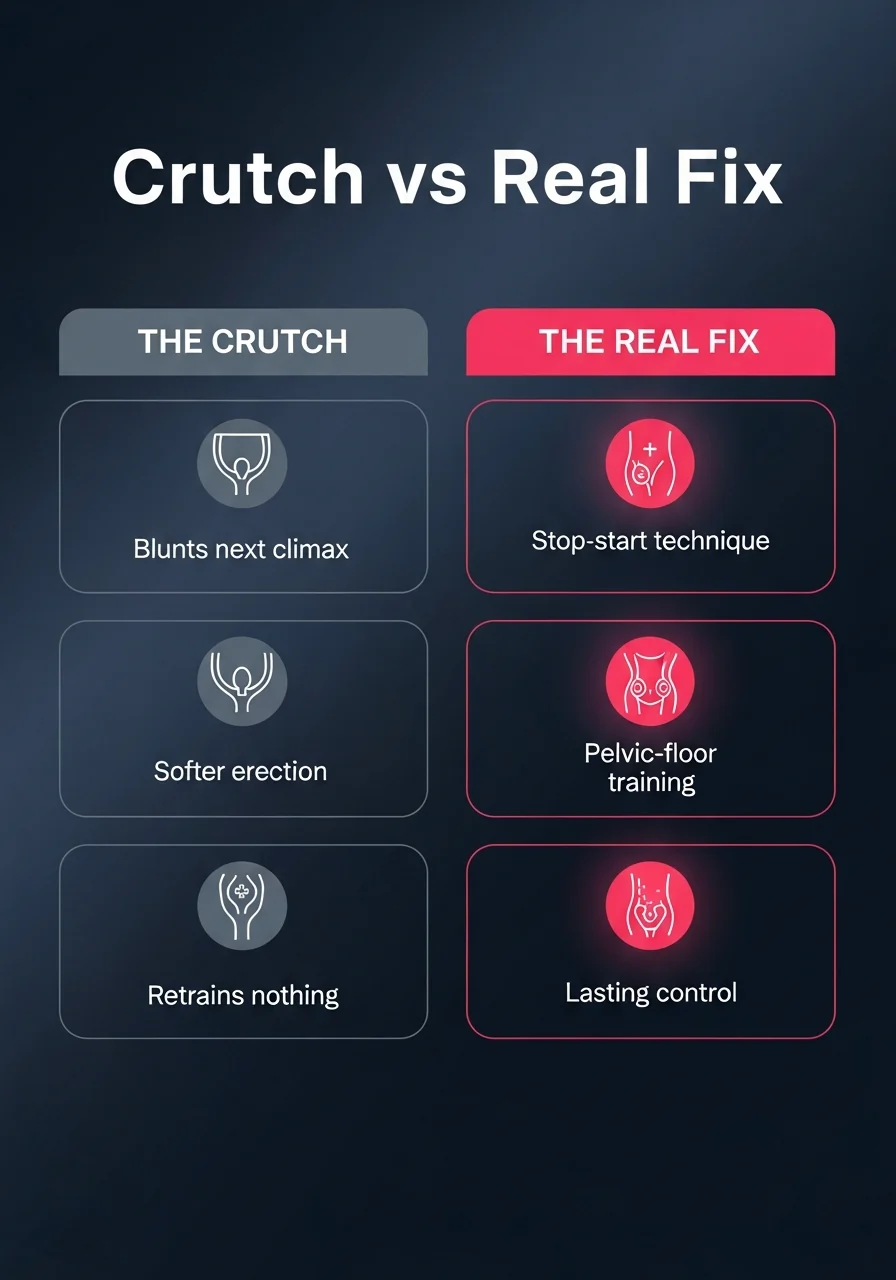
The reason it fails is simple: it removes the practice you actually need. Lasting control is the skill of recognising high arousal and riding it without tipping over. I tell my patients: finish alone first, and you skip the rep — so the reflex never learns. Compare the two honestly:
| The workaround: masturbate before sex | The real fix: retrain the reflex |
|---|---|
| Blunts the next climax for one night | Raises your control across every encounter |
| Often softens the second erection | Keeps the erection firm and reliable |
| Retrains nothing — the fast trigger stays | Reconditions the ejaculatory reflex over weeks |
| Can deepen a finish-fast habit and dependence | Builds genuine, lasting confidence |
| No evidence as a treatment | Evidence-based first-line care (ISSM) |
Why I do not recommend it as a strategy
I want to be plain with you, because the rest of the internet is not. As a clinician, I do not encourage masturbating before sex as a way to last longer. It is not dangerous in itself, but as a strategy it quietly works against you.
First, it conditions the wrong reflex — you rehearse finishing quickly and lean on a recovery window instead of learning control. In fact, a rushed, watch-and-finish routine is one of the ways men train themselves toward a fast trigger in the first place. Second, the softer second erection it tends to cause can seed performance anxiety, itself a main driver of acquired PE (McMahon, 2016).
Third, I watch a “do it every time” habit escalate into compulsive masturbation, often paired with heavy pornography use that pulls arousal away from real intimacy and feeds a wider worry about sexual exhaustion. You set out to fix one worry and feed two. You deserve a method that makes you better over time, not one you must repeat forever to keep working.

Private 1-on-1 consultation
Last longer for good — without the pre-sex workaround
One private, judgment-free consultation: I find why you finish fast and start a retraining plan that actually holds — no nightly ritual required.
Book a Confidential Consultation
What actually works to last longer (retraining the reflex)
This is the part the content mills skip. Lasting longer is a trainable skill, and the evidence-backed tools are straightforward. The core loop behind all of them is the same:
The tools that actually retrain the reflex
Here are the levers I reach for with my own patients, roughly in the order I introduce them:
- Stop-start and the squeeze technique. During arousal you pause (or gently squeeze below the head) just before the point of no return, let the urge subside, then continue. Done consistently, these methods lengthen ejaculatory latency and rebuild control — they are first-line in the ISSM guidance (Cooper, 2015; Althof, 2014).
- Pelvic-floor training. Strengthening the muscles that govern ejaculation gives you a physical “brake.” A 2026 systematic review and meta-analysis of randomised trials evaluated pelvic-floor muscle training as a non-drug way to improve ejaculatory latency in men with PE (de Oliveira, 2026).
- Build the wider engine. Fitness and stress control matter too: a 2026 study found that a three-month structured exercise programme improved ejaculatory latency in previously sedentary young men (Zhou, 2026). It is no magic bullet, but it stacks on top of the retraining above.
- Treat the anxiety, not just the timing. Because acquired PE is so often anxiety-led, I find that slowing arousal, talking openly with your partner, and facing the performance fear does more than any pre-sex trick (McMahon, 2016).
- Medical therapy, when it is needed and supervised. For persistent cases, clinician-prescribed options — certain SSRIs, on-demand agents, topical desensitisers — are well supported by an umbrella review (Raisi, 2025). In my clinic these belong in a consultation, never self-prescribed from a website.

The thread running through all of these is the same: they retrain the reflex. That is the difference between lasting longer for one night and lasting longer for good.
The medication question, answered honestly
Patients always ask which pill makes them last longer, so let me map it plainly. Dapoxetine is the only SSRI purpose-built and licensed for on-demand use in PE, taken a few hours before sex to lift the ejaculatory threshold (Russo, 2016). Everyday SSRIs such as paroxetine, topical anaesthetic creams and sprays, and a few other agents are used off-label.
When researchers rank these head to head, network meta-analyses that pool the randomised trials find genuine IELT gains across the classes, with topical desensitisers and SSRIs among the strongest performers (Jian, 2018; Raisi, 2025). But every option carries trade-offs, side effects and interactions — which is exactly why they belong in a consultation, not a self-ordered parcel. Topical delay sprays, for instance, help some men and simply numb the encounter for others.
Dr Shahs notes (from my clinical observation)
Dr Shahs notes (from my clinical observation): In my Chennai practice, the men who come in convinced that masturbating before sex is “the fix” are almost always the ones whose erections have quietly grown less reliable. They solved the wrong problem. When we instead spend a few weeks reconditioning the reflex — stop-start, pelvic-floor work, and calming the performance fear — the change holds without any pre-sex ritual. The large majority of my acquired-PE patients improve with retraining alone. That is my clinical observation, not a trial figure — but it is consistent enough that I no longer recommend the workaround to anyone.
You do not need a workaround
If you have been relying on this trick, you are not broken, not alone, and not beyond help. A short, early finish is one of the most treatable concerns I manage. The path forward is not a clever hack before each encounter — it is a few focused weeks of retraining, until lasting longer is simply how your body works.
Get an honest answer about lasting longer
A private consultation with Dr Shah tells you what is really driving the early finish — and the few focused weeks of retraining that fix it for good.
Free guide · no spam · unsubscribe anytime.
Frequently Asked Questions
Does masturbating before sex make you last longer?
Only for a second round, and only that once. The refractory period after climax blunts the next orgasm, so intercourse afterwards may run longer — but your underlying control is unchanged, and the second erection is often softer. It is a temporary trick, not real stamina.
How long before sex should I masturbate to last longer?
Men are usually told one to two hours beforehand, to dull arousal without losing the erection entirely. I do not recommend timing it at all, because the method is unreliable and trains nothing. Put those weeks into reconditioning the reflex instead — the result is permanent, not a one-night gamble.
Does masturbating before sex help premature ejaculation?
No. There is no evidence that pre-sex masturbation treats premature ejaculation. It can mask a quick finish once, but PE responds to behavioural retraining, pelvic-floor work, and supervised medical therapy — methods that actually raise ejaculatory control (Althof, 2014; Cooper, 2015).
Will I lose my erection if I masturbate before sex?
Often, yes — or at least firmness. The same low-arousal recovery state that delays the next climax also weakens the next erection, so many men who try this end up fighting to stay hard, which only seeds fresh performance anxiety.
Is it good to masturbate before sex?
As an occasional act, masturbation is normal and harmless. As a deliberate strategy to last longer, no: it conditions the wrong reflex, can soften your erection, and may deepen a compulsive habit.
What is the refractory period?
It is the recovery window after ejaculation when arousal drops and another climax is harder to reach — minutes in younger men, hours in older men. It is the entire reason a second round can run longer, and the entire reason the “masturbate first” trick exists.
Can getting fitter help me last longer?
Yes, as part of the picture. A 2026 study found a structured three-month exercise programme lengthened ejaculatory latency in sedentary young men (Zhou, 2026). Fitness sharpens blood flow, mood and pelvic strength, so it supports the stop-start and pelvic-floor work rather than replacing it.
What is the best medication to make me last longer?
There is no single “best.” Dapoxetine is the only on-demand SSRI licensed for PE (Russo, 2016), while daily SSRIs and topical anaesthetics also raise ejaculatory latency in the trials (Jian, 2018). The right choice depends on your pattern and health, so it must be prescribed and supervised, never self-ordered.
Does the refractory period get longer as I age, and does that help?
It does lengthen with age — from minutes in your twenties to hours later on. But a longer recovery window is not control; it usually just means a softer, slower second erection. Age does not fix an early finish. Retraining does.
How can I actually last longer in bed naturally?
Retrain the ejaculatory reflex: stop-start and the squeeze technique, pelvic-floor work, and calming performance anxiety. These build control that lasts across every encounter, unlike any pre-sex workaround (Cooper, 2015; de Oliveira, 2026). For stubborn cases, a tailored plan from a sexologist closes the gap.
Questions from the clinic
I now cannot last without masturbating first. Is that a problem?
Yes, and I see it often. You have taught your body to lean on the refractory period instead of real control, so the early finish returns the moment you skip the ritual. What I do with these patients is simple: a few focused weeks of stop-start and pelvic-floor retraining to fix the reflex itself — and then, I promise, you will not need the trick at all.
My partner and I only ever manage one round. Does the trick even make sense for us?
Honestly, no. If a second round is not on the table, spending your one strong erection alone beforehand leaves you with a duller, softer main event and nothing gained. You are far better served by retraining the reflex so the first — and only — round lasts. That is exactly the work I do with these patients.
References
- Serefoglu EC, McMahon CG, Waldinger MD, Althof SE (2014). An evidence-based unified definition of lifelong and acquired premature ejaculation: report of the second International Society for Sexual Medicine Ad Hoc Committee for the Definition of Premature Ejaculation. The journal of sexual medicine. PMID 24848805
- Althof SE, McMahon CG, Waldinger MD, Serefoglu EC (2014). An update of the International Society of Sexual Medicine’s guidelines for the diagnosis and treatment of premature ejaculation (PE). The journal of sexual medicine. PMID 24848686
- de Jong TR, Veening JG, Waldinger MD, Cools AR (2006). Serotonin and the neurobiology of the ejaculatory threshold. Neuroscience and biobehavioral reviews. PMID 16529815
- Cooper K, Martyn-St James M, Kaltenthaler E, Dickinson K (2015). Behavioral Therapies for Management of Premature Ejaculation: A Systematic Review. Sexual medicine. PMID 26468381
- McMahon CG, Jannini EA, Serefoglu EC, Hellstrom WJ (2016). The pathophysiology of acquired premature ejaculation. Translational andrology and urology. PMID 27652216
- de Oliveira FA, Lima LB, da Costa MO, Uchôa SMM (2026). Efficacy of pelvic floor muscle training in the management of premature ejaculation: a systematic review and meta-analysis of randomized controlled trials. The journal of sexual medicine. PMID 42132359
- Raisi F, Soleimani R, Ahmadzadeh A, Sadati SN (2025). Efficacy and safety of pharmacological treatments in patients with premature ejaculation: an umbrella review of meta-analyses of randomized controlled trials. The journal of sexual medicine. PMID 40326158
- Russo A, Capogrosso P, Ventimiglia E, La Croce G (2016). Efficacy and safety of dapoxetine in treatment of premature ejaculation: an evidence-based review. International journal of clinical practice. PMID 27456527
- Jian Z, Wei X, Ye D, Li H (2018). Pharmacotherapy of premature ejaculation: a systematic review and network meta-analysis. International urology and nephrology. PMID 30225547
- Zhou J, Liu M, Hu S, Ouyang Y (2026). Effects of regular physical exercise on ejaculatory control: a comparative and interventional study among male university students. Frontiers in public health. PMID 42368913
- Cote-Leger P, Althof SE, Rowland DL (2025). A lifespan perspective on lifelong premature ejaculation: unresolved issues and new insights. The journal of sexual medicine. PMID 40801170
- Haake P, Exton MS, Haverkamp J, Krämer M (2002). Absence of orgasm-induced prolactin secretion in a healthy multi-orgasmic male subject. International journal of impotence research. PMID 11979330
A private, judgment-free space to talk through fertility and men’s sexual health. Walk in, or book ahead by phone.
📍No 21, Sree Kalki Apartments, Ground Floor, Bazullah Road, T-Nagar, Chennai 600017