

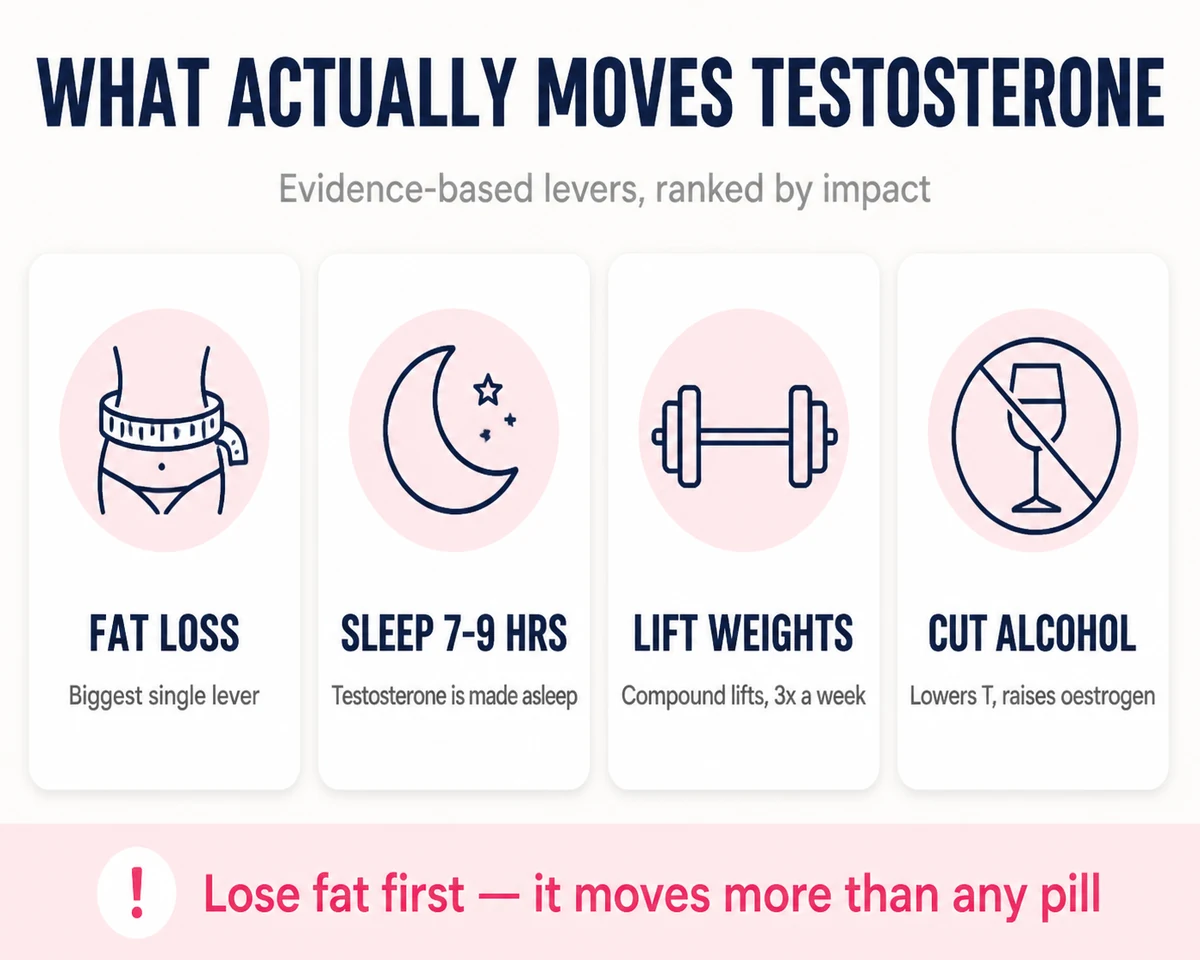
Here’s the honest answer, straight away: how to increase testosterone naturally comes down to four things — losing excess body fat, sleeping seven to nine hours, lifting weights, and cutting alcohol, in that order of importance. Everything else on the internet is a rounding error, and most supplements sold as boosters do nothing at all.
I am Dr Shah Dupesh, a Consultant Andrologist in Chennai. In my clinic, I see this every week: a man in his thirties who has read four listicles, bought three supplements, and never once had his testosterone measured properly. He is treating a number he does not know, with products that were never tested, while the two things that would actually move it — his waistline and his sleep — go untouched.
So this page does what the supplement pages will not. It tells you how much each change is genuinely worth, in the units your lab report uses, with the studies behind it — and when natural measures will not be enough.
In a nutshell
Fat loss is the single biggest natural lever
In a meta-analysis of 24 studies in men with obesity, a low-calorie diet raised total testosterone by about 2.87 nmol/L, and the amount of weight lost was the best predictor of the rise (Corona, 2013).
Erection problems are a cardiac warning
Consensus guidance is to treat a man with erectile dysfunction as being at risk of a cardiac event until proven otherwise (Köhler, 2024).
Good general health is worth 10 to 15 percent
In the Massachusetts Male Aging Study, men with no chronic illness, no regular medication, no obesity and no heavy drinking carried androgen levels 10 to 15 percent higher than the rest (Feldman, 2002).
Low is a number plus symptoms, not a feeling
European criteria define late-onset hypogonadism as at least three sexual symptoms with total testosterone below 11 nmol/L, roughly 320 ng/dL (Wu, 2010).
Alcohol lowers testosterone and raises oestradiol
Pooled across 30 trials in more than 10,000 men (Santi, 2024).
Most boosters fail; a few do not
Most of 27 marketed products produced no rise (Morgado, 2024). Ashwagandha and mucuna are the two I use (Santos, 2019); tribulus and maca are unsupported.
Long-term opioids are a hidden cause
They cause androgen deficiency in 20 to 80 percent of men, and it is routinely missed (Kafel, 2025).
Test in the morning, twice
Fasting, morning, and confirmed on a repeat sample before anyone calls it low (Bhasin, 2018).
First — is your testosterone actually low?
Before you change a single habit, get a number. Most men who come to me convinced they have low testosterone have never been tested. A good share of them turn out to be perfectly normal men who are exhausted, overweight, or unhappy at work.
The test has rules, and I am strict about them. Testosterone follows a daily rhythm and peaks in the morning. So I ask for blood drawn fasting, in the morning, and I confirm any low result on a second sample before I call it low (Bhasin, 2018). A single afternoon reading is not a diagnosis. If your total testosterone sits near the lower limit, or you carry a condition that alters sex hormone-binding globulin, I calculate free testosterone as well.
Now the part that confuses almost everybody: the units. Indian labs report testosterone in either ng/dL or nmol/L. The two numbers look wildly different for the same blood, and I have seen men panic over a perfectly normal result because they read it in the wrong scale.
| nmol/L | ng/dL (approx.) | How to read it |
|---|---|---|
| Below 8 | Below 230 | Clearly low. Needs proper andrological assessment, not a supplement. |
| 8 – 11 | 230 – 320 | The grey zone. Symptoms decide what this means (Wu, 2010). |
| 11 – 30 | 320 – 865 | Within the usual adult male range. |
| Above 30 | Above 865 | High. If you are not on treatment, this needs explaining. |
To convert, multiply nmol/L by about 28.8 to get ng/dL. So the man who searches “is 9.5 testosterone low” is holding a reading of roughly 274 ng/dL — under the 11 nmol/L threshold, and worth taking seriously, but only meaningful alongside symptoms and a confirmatory morning sample.
Which symptoms count? Not the ones the adverts list. When European researchers surveyed 3,369 men aged 40 to 79, only three clustered reliably with genuinely low testosterone: poor morning erections, low sexual desire, and erectile dysfunction (Wu, 2010). Fatigue, low mood and poor concentration were far less specific — they track with almost everything, which is why they sell so many supplements. If erections and desire are your problem, understand first why masturbation does not lower your testosterone — that myth sends me more men than any real hormonal problem does.
How much testosterone actually falls with age — and the part you control
This is the study I quote to patients more than any other, so let me tell you what it actually did. Researchers enrolled 1,709 men aged 40 to 70 in the late 1980s. They then followed 1,156 of them for seven to ten years, measuring the same men repeatedly rather than comparing different men of different ages (Feldman, 2002).
The headline number: total testosterone fell by about 1.6 percent per year within individual men. Bioavailable testosterone fell faster, at 2 to 3 percent per year. Sex hormone-binding globulin rose steadily, which is why free testosterone drops faster than total — more of what you have gets locked up and cannot act.
But the finding that should change your behaviour is a quieter one. Men in “apparent good health” — defined as no chronic illness, no prescription medication, no obesity and no excessive drinking — carried androgen levels 10 to 15 percent higher than the rest of the cohort (Feldman, 2002). The authors also found the decline within individuals was steeper than the decline across age groups, and suggested that incident poor health may accelerate the fall. Read that carefully: it is an association between health and androgen levels, not a guarantee of what you will get back.
Let me explain what’s actually happening, because I think this is the most useful idea on the page. Ageing sets a slow downward slope you cannot negotiate with. Your health decides how far above or below that slope you sit. Roughly a tenth of your testosterone has nothing to do with your birthday. It is a function of your weight, your drinking, your sleep and your illnesses. That tenth is the entire natural-testosterone project, and it is genuinely yours to claim.
There is a second, stranger finding worth knowing. Comparing men of the same age across different decades, researchers found an age-independent population-level decline in testosterone in American men — men today running lower than men of the same age a generation earlier, and not explained by changes in smoking or obesity (Travison, 2007). Nobody has fully accounted for it. It is a reason to take the modifiable factors seriously, not a reason to despair.
How to increase testosterone naturally after 40
The plan does not change after 40 — the stakes do. From the fifth decade you are working against that 1.6 percent annual slope (Feldman, 2002), so the same habits buy you maintenance as much as gain. My honest framing for a man of 45: you will not reach the testosterone you had at 25, but you are very likely to reclaim the 10 to 15 percent poor health is taking from you today. In my experience that is the part he could actually feel missing.
Talk to an andrologist about your testosterone
Lose the fat first — it is the biggest lever you have
If you do one thing on this page, do this one. Two things happen as fat accumulates. Fat tissue contains aromatase, which converts testosterone into oestrogen, so the more excess fat you carry the more of your own testosterone you convert away. Obesity also lowers sex hormone-binding globulin, the protein that carries testosterone in the blood — and that fall in the carrier is largely what drives the low total testosterone seen on the report, a state best described as the pseudo-hypogonadism of obesity (Muir, 2025). I describe it to my patients as a loop that feeds itself, and weight loss is what breaks it.
How much fat loss raises testosterone naturally
The evidence here is unusually clean. A systematic review and meta-analysis of 24 studies found that both dieting and bariatric surgery significantly raised total testosterone: a low-calorie diet by about 2.87 nmol/L, and bariatric surgery by about 8.73 nmol/L (Corona, 2013). Critically, the degree of weight loss was the single best determinant of how much testosterone rose, and the gains were largest in younger, non-diabetic men with more weight to lose.
| Approach | Studied in | Rise in total testosterone |
|---|---|---|
| Low-calorie diet | Men with obesity | ~2.87 nmol/L · ~83 ng/dL (Corona, 2013) |
| Bariatric surgery | Men with obesity | ~5.5–8.7 nmol/L · ~158–252 ng/dL (Zhu, 2026; Corona, 2013) |
| Ashwagandha, 8 weeks | Healthy young men, also weight-training | ~2.7 nmol/L · ~78 ng/dL placebo-adjusted (Wankhede, 2015) |
| Tribulus, maca, most “boosters” | Mixed | No reliable change (Morgado, 2024; Santos, 2019) |
Put that beside the supplement aisle for a moment. A sustained diet moves your testosterone by more than almost anything on that shelf, and it costs you nothing. Where obesity is severe, bariatric surgery reliably raises testosterone (Zhu, 2026), and the newer weight-loss drugs are being studied for the same effect (Corona, 2026). For most men I see, the answer is ordinary: a deficit, enough protein, and patience.
One caution. Do not crash-diet. Severe restriction alongside heavy training suppresses the very axis you are trying to support.
Train — but train the way that actually signals
Exercise helps, and the type matters far more than the hours. In my practice, resistance training using large muscle groups is the form I see linked most consistently to better testosterone status, and sitting all day is separately bad for your metabolic health. So my prescription is simple.
Here is what I tell my patients to do:
- Lift three times a week. Squat, deadlift, press, row, pull-up. Large muscles, real load.
- Keep sessions to 45 to 60 minutes. Longer is not better in my experience.
- Walk daily and break up long sitting. This is for your insulin sensitivity and your waistline — the route back to your testosterone.
- Do not train to exhaustion every session. Overreaching alongside poor sleep and under-eating works against you.
Let me be realistic with you about the mechanism. Exercise does not raise your testosterone directly and permanently, whatever the fitness industry implies. It works mostly by changing your body composition and your insulin sensitivity. In men with obesity and sleep apnoea, an interdisciplinary weight-loss and lifestyle programme raised testosterone by 77.6 ng/dL more than usual care at eight weeks (Herrera-Quintana, 2026). I think of the barbell as a tool for the fat-loss job.
Sleep — the fastest way to lower your own testosterone
Testosterone follows a daily rhythm, rising through the night and peaking in the morning, so a short night cuts into the window when most of it is made. Experimental sleep restriction in young healthy men lowers daytime testosterone (Leproult, 2011) — and in my clinic this is the most under-treated cause I see in men under 40.
There is a specific trap for Indian men. Obstructive sleep apnoea — loud snoring, daytime exhaustion, a partner who says you stop breathing — fragments sleep and clusters with the abdominal obesity already lowering your testosterone. Insomnia and apnoea together are associated with erectile dysfunction (Andersen, 2025). Treating apnoea is not a testosterone treatment, but leaving it untreated makes everything else here harder.
Non-negotiable if you are serious:
- Seven to nine hours, at consistent times, including weekends.
- Get diagnosed if you snore heavily, wake unrefreshed, or your partner reports pauses in breathing.
- Phone out of the bedroom. Late-night screen use is why my younger patients are getting five hours, and it often travels with the porn habit separately damaging their erections.
What to eat to increase testosterone naturally
Here is where most articles lose the plot. Search results are full of foods that “boost testosterone” — bananas, oysters, pomegranate, ginger. I will be blunt: no food meaningfully raises testosterone in a well-nourished man. Food works on your body fat and micronutrient status, and those work on your testosterone. Two things are worth getting right.
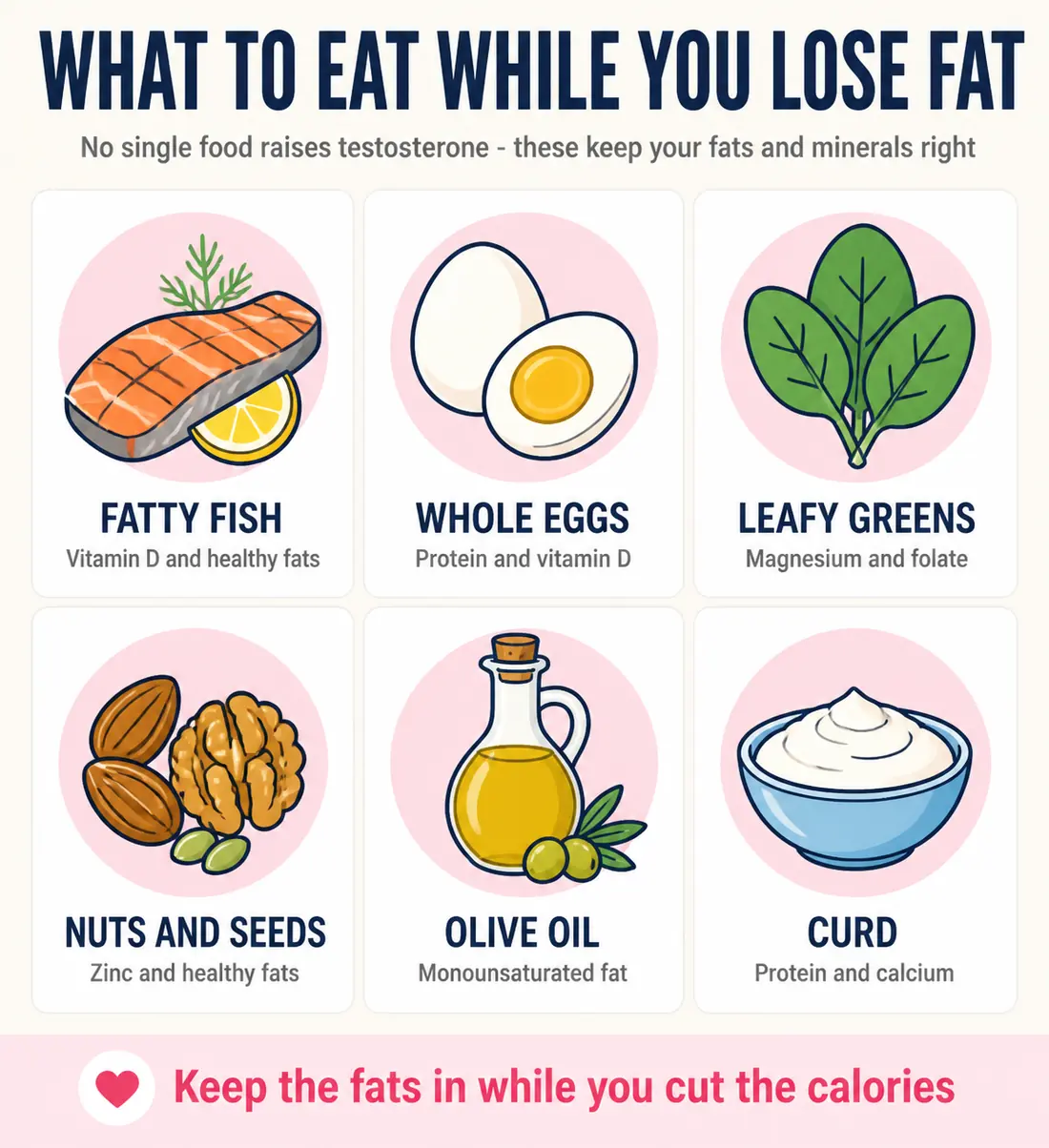
Do not fear dietary fat. This one is my clinical practice rather than a trial result: the men I see attempting weight loss almost always cut fat hardest, and I have not found that it serves them. Keep fish, nuts, eggs and olive oil in your diet while you run your calorie deficit. Lose the weight through your overall intake, not by stripping the fat out.
Correct deficiencies; do not chase boosts. This is the distinction the supplement industry depends on you not making. Vitamin D is my clearest example. In overweight men who were deficient at baseline, a year of 3,332 IU daily saw total testosterone go from 10.7 to 13.4 nmol/L while placebo did not move (Pilz, 2011). Notice three things before you order a bottle: those men were deficient to start with, they were also losing weight, and the trial was small enough that its authors called the finding hypothesis-generating rather than proven. So my reading is careful. Fixing a real deficiency helps you; topping up a normal level has no mechanism to.
Zinc and magnesium blends were among the products that failed to raise testosterone (Morgado, 2024). Get your levels checked, correct what is genuinely low, and stop there.
Alcohol, stress, painkillers and steroids — what to subtract
Adding things is the fun part. Subtracting is where I see the results.
Alcohol. A meta-analysis of 30 trials in 10,199 men found chronic drinking was associated with lower total and free testosterone and higher oestradiol — a pattern seen in healthy men drinking chronically, rather than after a single night or in diagnosed alcohol use disorder (Santi, 2024). That combination is precisely wrong for you. I am not asking you to become teetotal — I am telling you the four-nights-a-week habit quietly undoes the rest of your effort.
Painkillers and steroids that lower testosterone naturally without you knowing
Opioid painkillers. This one is badly under-recognised, and I want it on the record. Long-term opioid use suppresses the signal from the brain to the testes, and 20 to 80 percent of men on chronic opioids develop androgen deficiency (Kafel, 2025). If you take long-term tramadol for back pain and your testosterone is low, I would look there first.
Anabolic steroids. The bitter irony of my field. Men take testosterone to look better and shut down their own production doing it. If you have run a cycle, tell me when you get tested — it changes my whole reading of your result.
Chronic stress. In my experience cortisol works against testosterone, but it is the vaguest lever here and the hardest to measure. I treat it by fixing your sleep and training load, not with a supplement.
What does not raise your testosterone
Most “testosterone boosters”
Across 52 studies of 27 products, most produced no rise at all (Morgado, 2024). Ashwagandha and mucuna are the exceptions.
Tribulus and maca
India’s two most marketed ingredients, both explicitly unsupported for raising testosterone (Santos, 2019).
Any single “superfood”
No food meaningfully raises testosterone in a well-nourished man. Food works through body fat and deficiency.
Vitamins you are not short of
Correcting a real deficiency helps (Pilz, 2011). Topping up a normal level has nothing to work through.
Abstaining from masturbation
No lasting gain from not ejaculating — see the myths about masturbation’s side effects.
Training yourself into the ground
Overreaching with poor sleep and under-eating lowers testosterone instead.
Do “testosterone boosters” work? The honest verdict
Most do not — and I want to be precise, because the two reviews I rely on disagree with each other.
Reviewers examined two decades of data on 27 proposed boosters across 52 studies. Most failed to raise total testosterone at all (Morgado, 2024). That review’s own exceptions were β-hydroxy β-methylbutyrate and betaine in athletes, plus Eurycoma longifolia — and it assessed ashwagandha without listing it as an exception.
A separate phytotherapy review reached a more favourable conclusion. It found moderate evidence that long jack (Eurycoma longifolia), mucuna, ashwagandha, fenugreek and black seed raise total testosterone and improve semen parameters, while stating plainly that tribulus and maca are not supported (Santos, 2019).
So the honest position is that the evidence is genuinely mixed, and five herbs carry that moderate grade — not two. Of those five, mucuna and ashwagandha are the two I use in my own practice, because they have the clearest dose data and because they are what I have watched work in my clinic. That narrowing is my clinical judgement, not a restriction either review imposes.
Ashwagandha (Withania somnifera)
The best trial ran for exactly eight weeks. Fifty-seven healthy young men new to resistance training took 300 mg of root extract twice daily or placebo, and both groups trained throughout. The ashwagandha arm gained 96.2 ng/dL of testosterone against 18.0 on placebo (p = 0.004), plus more strength and more muscle (Wankhede, 2015). Two caveats I want you to hold: the placebo-adjusted difference is 78 ng/dL, and the ashwagandha arm also lost more body fat (3.5% vs 1.5%) — so by this article’s own mechanism, part of that rise is the fat loss, not the herb.
A separate figure is often quoted alongside it: about 143 ng/dL over 12 weeks in men with low sperm counts. That came from 5,000 mg a day of powdered root, not the 600 mg of concentrated extract above (Santos, 2019). Different preparation, roughly eight times the mass — do not attach one number to the other dose.
One more honest note. In overweight, mildly fatigued men aged 40 to 70, a standardised extract raised salivary testosterone 14.7 percent more than placebo but made no significant difference to fatigue, vigour or sexual well-being (Lopresti, 2019). Salivary is not the same analyte as the serum figures above. So: a real hormonal signal in small trials, and no promise you will immediately feel transformed.
Mucuna pruriens (Lyon bean, kapikachhu)
Mucuna is the one most Western articles miss, and it has a genuine mechanism rather than marketing behind it. In infertile Indian men it significantly raised testosterone and LH, restored dopamine and noradrenaline, lowered the elevated FSH and prolactin, and recovered sperm count and motility (Shukla, 2009). The authors concluded it regulates steroidogenesis through the hypothalamic-pituitary-gonadal axis — a far more coherent story than any proprietary blend offers.
On dose, the trials used 5,000 mg per day of powdered seed, which added about 151 ng/dL over 12 weeks in men with oligozoospermia, with sperm concentration up 83.3 million/mL (Santos, 2019).
In my own clinic I prescribe 500 mg a day of Lyon bean extract, and at that dose I consistently see testosterone improve. Note the difference carefully: an extract is concentrated, so 500 mg of extract is not 500 mg of the raw powdered seed used in the trials, and the two figures are not interchangeable. This dose is my clinical observation, not a trial result, and I want it labelled as such.
Let me be straight about the limits. The largest published numbers come from men who were infertile or oligozoospermic, starting from a suppressed baseline with the most room to recover. A healthy man should not expect 151 ng/dL. None of it outranks losing the fat — I use these as an adjunct, never a replacement.
Before you take either of these — the safety part nobody prints
These are pharmacologically active plants, not vitamins, and the shop will not tell you any of this.
Mucuna works through dopamine, which is precisely why it also carries dopaminergic side effects. Its active constituent is L-DOPA — the same molecule used in Parkinson’s disease — so at the 5 g seed doses used in trials it can cause nausea, vomiting, drops in blood pressure on standing, involuntary movements and, uncommonly, agitation or psychosis. Do not take it at all if you are on levodopa, an antipsychotic, an MAO inhibitor, or blood-pressure medication, without your doctor’s agreement.
Ashwagandha carries a documented signal for liver injury — rare, but real and regulator-flagged — so stop it immediately and get tested if you develop nausea, itching, dark urine or yellowing of the eyes. It can also raise thyroid hormone levels, which matters if you are already on thyroxine or have thyroid disease, and it is immunomodulatory, so I avoid it in autoimmune conditions. It is sedating and adds to sleeping tablets and alcohol.
And never take the cheap unprocessed version of either. Raw mucuna seed is not the same thing as a properly processed extract — traditional preparation exists precisely because the unprocessed seed is harsh, and the L-DOPA content of unstandardised powder swings from batch to batch, so you cannot know what dose you are actually taking. The cheap unbranded herbal powders sold loose here are also the ones most often found adulterated or contaminated with heavy metals. Buy a standardised extract from a manufacturer that publishes its assay, or do not buy it at all.
Tell whoever prescribes for you that you are taking either one, and stop both at least two weeks before any surgery. If you were spending money on one shelf, these two are where I would send you — but with your doctor knowing, not instead of them.
Your 8-week plan to increase testosterone naturally
This is the block I give my patients. Eight weeks is long enough to fix your sleep, cut your drinking, establish training and start losing fat — not long enough to finish a large weight loss. Since the testosterone gain tracks the weight you lose (Corona, 2013), treat it as the first block of a longer project, not a cure.
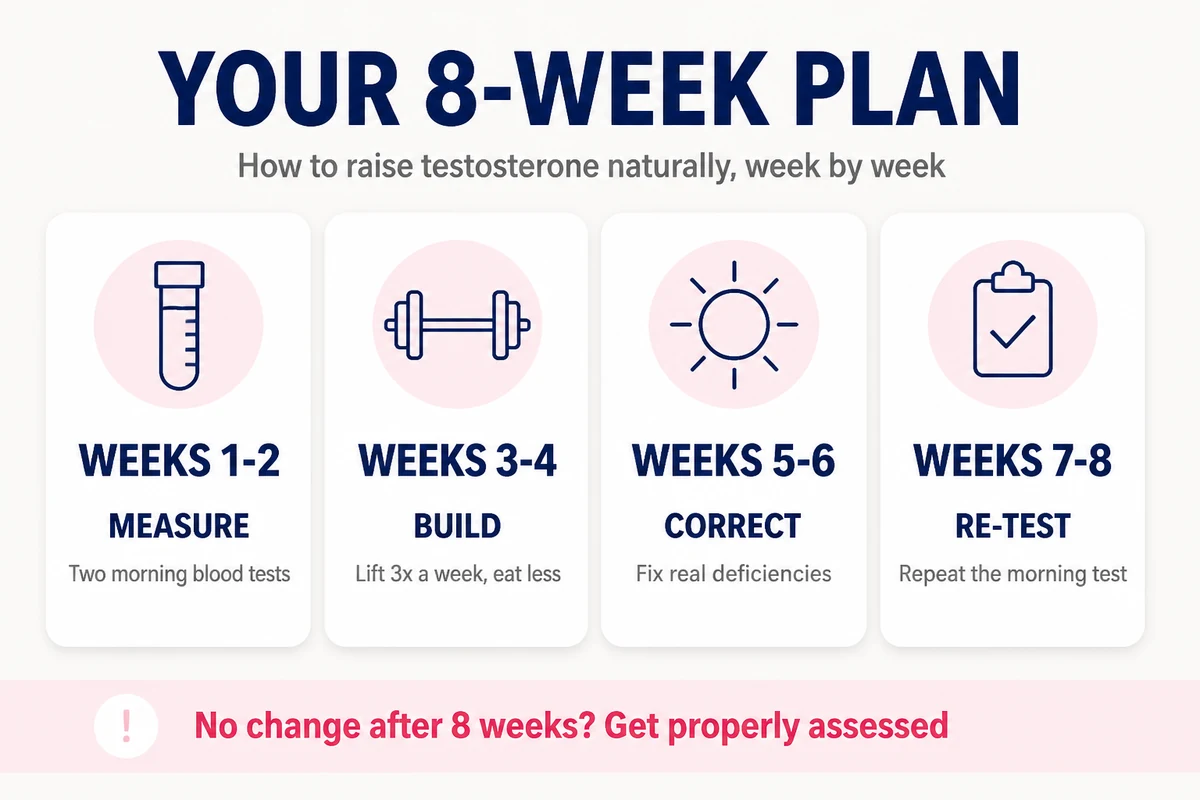
| Weeks | What you change | Why it works |
|---|---|---|
| 1–2 Measure |
Two fasting morning testosterone tests on separate days, plus vitamin D, HbA1c, lipids and thyroid. If either testosterone comes back low, add LH, FSH, prolactin and SHBG before you go further — and if it is very low, stop this plan and get assessed now. Start a fixed 7–9 hour sleep window and cut alcohol. | You cannot judge progress without a real baseline, and a low result needs its cause identified rather than assumed (Bhasin, 2018). LH and FSH separate a testicular cause from a pituitary one; prolactin finds the tumour you must not miss. |
| 3–4 Build |
Resistance training three times weekly, compound lifts. A moderate calorie deficit with protein around 1.6 g per kg. Keep healthy fats in. | Fat loss is the largest natural lever, and the amount lost predicts the gain (Corona, 2013). |
| 5–6 Correct |
Act on the results — replace vitamin D only if genuinely deficient. Get assessed for sleep apnoea if you snore. Review any long-term opioid with your prescriber. | Correcting real deficiency works; topping up normal levels does not (Pilz, 2011). Opioids are a commonly missed cause (Kafel, 2025). |
| 7–8 Re-test |
Repeat the fasting morning testosterone. Record weight, waist, and how erections and desire have changed. | Symptoms plus a number is the only meaningful measure (Wu, 2010). |
The decision at the end of week eight is the important one, and it is simple:
If the number has not moved and the symptoms are unchanged, that is not a failure of effort — it is information. It means the cause is unlikely to be lifestyle alone, and it is time for a proper andrological assessment rather than another eight weeks of the same.
The men who succeed are rarely the ones who arrive with a supplement stack. They accept my least glamorous instruction: lose the belly and sleep properly. I have watched men in their forties recover their morning erections on nothing but fifteen kilograms and a fixed bedtime — and watched others spend more on boosters in three months than a full workup would have cost. Take the order of operations: test first, subtract second, add third.
Erection problems, low testosterone and your heart
This is the part of the page I most want you to read, and it is why I take a low testosterone result seriously rather than as a lifestyle complaint.
Erectile dysfunction is a symptom of functional hypogonadism, and it is also an early marker of cardiovascular disease (Alwani, 2021). The artery that fails first is the small one. The vessels supplying the penis are narrower than the coronary arteries, so the same furring-up process that will eventually threaten your heart shows itself in your erections years before it shows itself in your chest.
The specialists have made this explicit. Princeton IV consensus guidance is to treat a man with erectile dysfunction as being at risk of a cardiac event until proven otherwise, and it now recommends coronary artery calcium scoring to stratify that risk (Köhler, 2024). Most men presenting with ED have never had that acted on.
Why low testosterone and heart risk travel together
Low testosterone sits inside the same picture. Low endogenous testosterone is itself associated with cardiovascular risk (Corona, 2018), and British Society for Sexual Medicine guidance records an association with incident type 2 diabetes and increased all-cause mortality (Hackett, 2023). In men with existing cardiovascular disease and hypogonadism, long-term testosterone treatment improved erectile function alongside falls in weight, HbA1c and blood pressure — in an uncontrolled cohort of 77 men, not a randomised trial (Alwani, 2021).
So here is what I want you to do with that. If you are in your forties with new erection problems, you do not have a sexual problem — you have a vascular problem that has announced itself early. Get your blood pressure, lipids, HbA1c and testosterone checked, all of them, now. Treating the erection itself matters too, and the difference between sildenafil and tadalafil is worth understanding before you start anything. I would far rather find your risk on a form than in an emergency department.
Get seen urgently — do not spend eight weeks on this
Everything on this page assumes you have time. Some presentations do not. See a doctor straight away, not in eight weeks, if you have any of these:
- A lump, swelling or firmness in a testicle. Testicular cancer is the commonest solid cancer in young men and it is highly curable when caught early. It can also present with breast tissue development.
- Headaches, loss of side vision, or milky discharge from the nipples. These point to a pituitary tumour, which is a treatable cause of low testosterone and needs imaging, not squats.
- Chest pain or breathlessness on exertion, especially alongside new erection problems.
- A total testosterone below about 6 nmol/L (170 ng/dL), or low testosterone with low or normal LH and FSH — that combination needs prolactin and pituitary imaging before anything else.
- Loss of smell alongside delayed or absent puberty.
When natural measures will not be enough
I would be doing you a disservice if I ended on encouragement alone. For a proportion of the men I see, lifestyle change will not fix this, and pretending otherwise wastes years of their life.
Natural measures work on functional testosterone deficiency — the kind driven by obesity, poor sleep, alcohol, medication and illness (Zitzmann, 2026; Muir, 2025). They do not repair a testis damaged by mumps orchitis, undescended testes, chemotherapy or injury, nor a genetic condition such as Klinefelter syndrome, nor a pituitary that has stopped signalling. Those causes need my diagnosis, not your discipline.
Come and get assessed properly, rather than continuing alone, if any of these apply to you:
- Total testosterone consistently below 8 nmol/L, or below 11 nmol/L with the sexual symptoms described earlier (Wu, 2010).
- Small or soft testes, absent morning erections, loss of body hair, or breast tissue development.
- Infertility, or a partner pregnancy that is not happening.
- A history of testicular injury, undescended testis, mumps after puberty, chemotherapy or radiotherapy.
- Long-term opioid use, or previous anabolic steroid cycles.
If two or three of those describe you, stop optimising alone. One consultation with the right bloods tells you in a fortnight what six more months of guesswork will not.

Private 1-on-1 consultation
Think your testosterone is low? Let’s measure it properly.
A short, private consultation gets you the right morning bloods, an honest reading of the result, and a plan that is not a supplement. No shame, no jargon.
Book a Confidential Consultation
Where treatment is genuinely indicated, I prescribe testosterone only for men with both symptoms and consistently low levels on properly taken samples (Bhasin, 2018). Its cardiovascular safety was the open question for years, and a randomised trial in 5,246 men aged 45 to 80 at high cardiovascular risk found testosterone gel non-inferior to placebo for major cardiac events — but the same trial recorded more atrial fibrillation, more acute kidney injury and more pulmonary embolism in the testosterone group (Lincoff, 2023). That is reassurance about the headline risk, not a clean bill of health.
There are also men who should not have it at all. Testosterone is contraindicated in breast or prostate cancer, a PSA above 4, raised haematocrit, untreated severe sleep apnoea — which, given what I said earlier, may well be you — severe urinary symptoms, uncontrolled heart failure, and a heart attack or stroke in the last six months (Bhasin, 2018). Taken without indication it suppresses your own production and your fertility, raises your haematocrit enough to need venesection, creates a clot-prone state, and can leave you dependent on it (Muir, 2025). This is why I test properly before I ever prescribe.
Does not ejaculating for 30 days increase testosterone?
No — not in any lasting way. Brief fluctuations occur around abstinence, but I have never seen a NoFap streak produce the transformation it is credited with. We set out the evidence in full on masturbation and testosterone. The short version: if your testosterone is genuinely low, abstinence will not fix it, and if it is normal, you have nothing to fix. Men who believe semen loss is draining their vitality are describing something real in Dhat syndrome — but the mechanism is anxiety, not androgen.
Whatever you decide, decide it from a number rather than a feeling.
Book a confidential consultation
Talk to Dr Shah about testosterone, energy and men’s health — honest, evidence-based and judgment-free.
Frequently Asked Questions
Is 9.5 testosterone low?
A total testosterone of 9.5 nmol/L is about 274 ng/dL. That sits below the 11 nmol/L threshold used to define late-onset hypogonadism, so I would act on it. It only becomes a diagnosis once I confirm it on a second fasting morning sample and you also have poor morning erections, low desire or erectile dysfunction (Wu, 2010; Bhasin, 2018).
Which foods increase testosterone the most?
None of them, in a man who eats adequately. Food works through your body fat and through correcting genuine deficiencies — no single ingredient does it.
What is the most powerful natural testosterone booster?
Losing excess body fat. In pooled trial data a low-calorie diet raised total testosterone by about 2.87 nmol/L, and bariatric surgery by about 8.73 nmol/L (Corona, 2013). Of the herbal options, only ashwagandha and mucuna have real support (Santos, 2019) — most marketed boosters produce no rise at all (Morgado, 2024).
Does exercise increase testosterone?
Yes, but mostly indirectly. Resistance training with compound lifts is the form I find most useful. The main route is better body composition and insulin sensitivity — in men with obesity and sleep apnoea, a combined weight-loss and lifestyle programme added 77.6 ng/dL over usual care in eight weeks (Herrera-Quintana, 2026). That is why training without fixing diet and sleep disappoints so many of my patients.
Does ashwagandha really work?
Yes, for testosterone specifically, though less dramatically than the marketing claims. In an 8-week randomised trial in healthy young men who were also weight-training, 300 mg of root extract twice daily raised testosterone by 96.2 ng/dL against 18.0 on placebo — a placebo-adjusted difference of about 78 ng/dL (Wankhede, 2015). A much larger dose, 5,000 mg a day of powdered root, added roughly 143 ng/dL over 12 weeks in men with low sperm counts (Santos, 2019). A separate trial in older, fatigued men moved salivary testosterone but not their energy or sexual well-being (Lopresti, 2019). Check the safety notes above before starting it.
Does Mucuna pruriens (Lyon bean) increase testosterone?
Yes, and it has a real mechanism. In infertile men, mucuna significantly raised testosterone and LH, restored dopamine and noradrenaline, lowered elevated FSH and prolactin, and improved sperm count and motility — though that was an uncontrolled before-and-after study with no placebo arm (Shukla, 2009). Trials used 5,000 mg a day of powdered seed, adding about 151 ng/dL over 12 weeks in men with oligozoospermia (Santos, 2019). In my own clinic I use 500 mg a day of the concentrated extract — a different preparation, and my clinical observation rather than a trial dose. Because it works through L-DOPA, read the safety notes above before you take it.
Can low testosterone be cured?
Functional low testosterone often improves substantially once the cause is removed (Zitzmann, 2026). That is the kind caused by obesity, poor sleep, alcohol, opioids or illness. Deficiency caused by damage to the testes or the pituitary will not resolve with lifestyle change, and I treat that medically.
References
- Feldman HA, Longcope C, Derby CA, Johannes CB, Araujo AB, Coviello AD, Bremner WJ, McKinlay JB (2002). Age trends in the level of serum testosterone and other hormones in middle-aged men: longitudinal results from the Massachusetts male aging study. The Journal of clinical endocrinology and metabolism. PMID 11836290
- Travison TG, Araujo AB, O’Donnell AB, Kupelian V, McKinlay JB (2007). A population-level decline in serum testosterone levels in American men. The Journal of clinical endocrinology and metabolism. PMID 17062768
- Corona G, Rastrelli G, Monami M, Saad F, Luconi M, Lucchese M, Facchiano E, Sforza A, Forti G, Mannucci E, Maggi M (2013). Body weight loss reverts obesity-associated hypogonadotropic hypogonadism: a systematic review and meta-analysis. European journal of endocrinology. PMID 23482592
- Leproult R, Van Cauter E (2011). Effect of 1 week of sleep restriction on testosterone levels in young healthy men. JAMA. PMID 21632481
- Wu FC, Tajar A, Beynon JM, Pye SR, Silman AJ, Finn JD, O’Neill TW, Bartfai G, Casanueva FF, Forti G, Giwercman A, Han TS, Kula K, Lean ME, Pendleton N, Punab M, Boonen S, Vanderschueren D, Labrie F, Huhtaniemi IT (2010). Identification of late-onset hypogonadism in middle-aged and elderly men. The New England journal of medicine. PMID 20554979
- Pilz S, Frisch S, Koertke H, Kuhn J, Dreier J, Obermayer-Pietsch B, Wehr E, Zittermann A (2011). Effect of vitamin D supplementation on testosterone levels in men. Hormone and metabolic research = Hormon- und Stoffwechselforschung = Hormones et metabolisme. PMID 21154195
- Bhasin S, Brito JP, Cunningham GR, Hayes FJ, Hodis HN, Matsumoto AM, Snyder PJ, Swerdloff RS, Wu FC, Yialamas MA (2018). Testosterone Therapy in Men With Hypogonadism: An Endocrine Society Clinical Practice Guideline. The Journal of clinical endocrinology and metabolism. PMID 29562364
- Lincoff AM, Bhasin S, Flevaris P, Mitchell LM, Basaria S, Boden WE, Cunningham GR, Granger CB, Khera M, Thompson IM, Wang Q, Wolski K, Davey D, Kalahasti V, Khan N, Miller MG, Snabes MC, Chan A, Dubcenco E, Li X, Yi T, Huang B, Pencina KM, Travison TG, Nissen SE (2023). Cardiovascular Safety of Testosterone-Replacement Therapy. The New England journal of medicine. PMID 37326322
- Corona G, Rastrelli G, Di Pasquale G, Sforza A, Mannucci E, Maggi M (2018). Endogenous Testosterone Levels and Cardiovascular Risk: Meta-Analysis of Observational Studies. The journal of sexual medicine. PMID 30145097
- Corona G, Sparano C, Romeo M, Rastrelli G, Vignozzi L, Maggi M (2026). Emerging Effects of Glucagon-Like Peptide-1 Receptor Agonists and Sodium-Glucose Cotransporter 2 Inhibitors on Male Sexual Hormones and Behaviors: Systematic Review and Meta-Analysis. Andrology. PMID 42011503
- Herrera-Quintana L, Vázquez-Lorente H, Ruiz JR, Amaro-Gahete FJ, Carneiro-Barrera A (2026). Impact of an interdisciplinary weight loss and lifestyle intervention on testosterone and scores for sexual activity on the FOSQ in men with obesity and obstructive sleep apnea: secondary analyses of data from the INTERAPNEA randomized trial. Maturitas. PMID 42456328
- Zhu R, Li L (2026). Metabolic and bariatric surgery and male endocrine and reproductive health: a GRADE-assessed meta-analysis. Frontiers in nutrition. PMID 41919084
- Peng W, Qu W, Lu D, Sun J, Li D (2026). The Effects of Individualized Low- and Moderate-Load Circuit Training on Physical Performance, Hormonal Responses, And Hematological Adaptations in Resistance-Trained Men. Journal of sports science & medicine. PMID 41710440
- Muir CA, Wittert GA, Handelsman DJ (2025). Approach to the Patient: Low Testosterone Concentrations in Men With Obesity. The Journal of clinical endocrinology and metabolism. PMID 40052430
- Andersen ML, Gozal D, Tufik S (2025). Exploring the link between comorbid insomnia and sleep apnea (COMISA) and erectile dysfunction: implications for male sexual health. Sexual medicine reviews. PMID 39440362
- Morgado A, Tsampoukas G, Sokolakis I, Schoentgen N, Urkmez A, Sarikaya S (2024). Do “testosterone boosters” really increase serum total testosterone? A systematic review. International journal of impotence research. PMID 37697053
- Lopresti AL, Drummond PD, Smith SJ (2019). A Randomized, Double-Blind, Placebo-Controlled, Crossover Study Examining the Hormonal and Vitality Effects of Ashwagandha ( Withania somnifera) in Aging, Overweight Males. American journal of men’s health. PMID 30854916
- Zitzmann M, Soave A, Bier S (2026). Functional testosterone deficiency in aging men: Clinical impact, diagnostic pathways, and treatment strategies. Maturitas. PMID 41655564
- Kafel H, Braga-Basaria M, Basaria S (2025). Opioid-induced androgen deficiency in men: Prevalence, pathophysiology, and efficacy of testosterone therapy. Andrology. PMID 39982737
- Santi D, Cignarelli A, Baldi M, Sansone A, Spaggiari G, Simoni M, Corona G (2024). The chronic alcohol consumption influences the gonadal axis in men: Results from a meta-analysis. Andrology. PMID 37705506
- Shukla KK, Mahdi AA, Ahmad MK, Shankhwar SN, Rajender S, Jaiswar SP (2009). Mucuna pruriens improves male fertility by its action on the hypothalamus-pituitary-gonadal axis. Fertility and sterility. PMID 18973898
- Wankhede S, Langade D, Joshi K, Sinha SR, Bhattacharyya S (2015). Examining the effect of Withania somnifera supplementation on muscle strength and recovery: a randomized controlled trial. Journal of the International Society of Sports Nutrition. PMID 26609282
- Santos HO, Howell S, Teixeira FJ (2019). Beyond tribulus (Tribulus terrestris L.): The effects of phytotherapics on testosterone, sperm and prostate parameters. Journal of ethnopharmacology. PMID 30790614
- Alwani M, Yassin A, Talib R, Al-Qudimat A, Aboumarzouk O, Al-Zoubi RM, Saad F, Haider KS, Al Ansari A (2021). Cardiovascular Disease, Hypogonadism and Erectile Dysfunction: Early Detection, Prevention and the Positive Effects of Long-Term Testosterone Treatment: Prospective Observational, Real-Life Data. Vascular health and risk management. PMID 34465997
- Köhler TS, Kloner RA, Rosen RC, Burnett AL, Blaha MJ, Ganz P, Goldstein I, Kim NN, Lue T, McVary KT, Mulhall JP, Parish SJ, Sadeghi-Nejad H, Sadovsky R, Sharlip ID, Miner M (2024). The Princeton IV Consensus Recommendations for the Management of Erectile Dysfunction and Cardiovascular Disease. Mayo Clinic proceedings. PMID 39115509
- Hackett G, Kirby M, Rees RW, Jones TH, Muneer A, Livingston M, Ossei-Gerning N, David J, Foster J, Kalra PA, Ramachandran S (2023). The British Society for Sexual Medicine Guidelines on Male Adult Testosterone Deficiency, with Statements for Practice. The world journal of men’s health. PMID 36876744
A private, judgment-free space to talk through fertility and men’s sexual health. Walk in, or book ahead by phone.
📍No 21, Sree Kalki Apartments, Ground Floor, Bazullah Road, T-Nagar, Chennai 600017