

PrEP for HIV is a daily tablet that HIV-negative people take to stay HIV-negative. Daily use cuts the risk from sex by about 99% on drug-level modelling, and WHO, the US CDC and India’s NACO recommend it for ongoing risk.
I do not prescribe PrEP. For rare, unplanned exposures I give PEP to carry, started within hours of a condom failure. This guide explains both honestly, so you can decide.
Hello! Vanakkam and Namaste. This is Dr Shah Dupesh, consultant andrologist and sexologist in Chennai.
Men ask me about PrEP in two ways. The first man has read about it online, and he asks, “Doctor, is there a tablet I can take before I travel?”
The second man has already needed PEP once. He asks, “Is there something so I never go through that 28-day course again?”
Both questions deserve a straight answer. This guide gives you the full picture of PrEP first. What it is, and how well it works.
Who the guidelines say should take it. What it costs your body and your wallet, and how to get it in India.
Then I tell you plainly why I do not prescribe it, and what I do instead. My approach has a name in the medical literature.
It is called PEP in pocket. I will show you the studies behind it, and I will also show you where it does not belong.
Read it all before you decide. Then call me if you want to talk it through. 97907 83856 or WhatsApp.
Read this first
PrEP and PEP in 60 seconds
PrEP is protection before
One tablet a day, taken before any exposure. Four or more tablets a week meant zero new HIV infections in the iPrEx follow-up (Grant, 2014).
PEP is the emergency brake
A 28-day course started within 72 hours of one exposure. The sooner it starts, the better it works, so hours matter.
Guidelines recommend PrEP for ongoing risk
WHO, CDC and India’s NACO guidelines point people with regular, repeated risk to PrEP, and I say so plainly.
I do not prescribe PrEP
My reason is simple. My judgement is that a tablet which removes the fear of HIV changes how men behave. It also does nothing for syphilis, gonorrhoea or chlamydia.
PEP in pocket is what I give instead
A man with rare, unplanned exposures carries a PEP course with him. In Toronto, 111 people carried it for nearly 179 patient-years with no HIV infections, in a group chosen because their exposures were rare (Billick, 2023).
Doxy-PEP comes second, tests come first
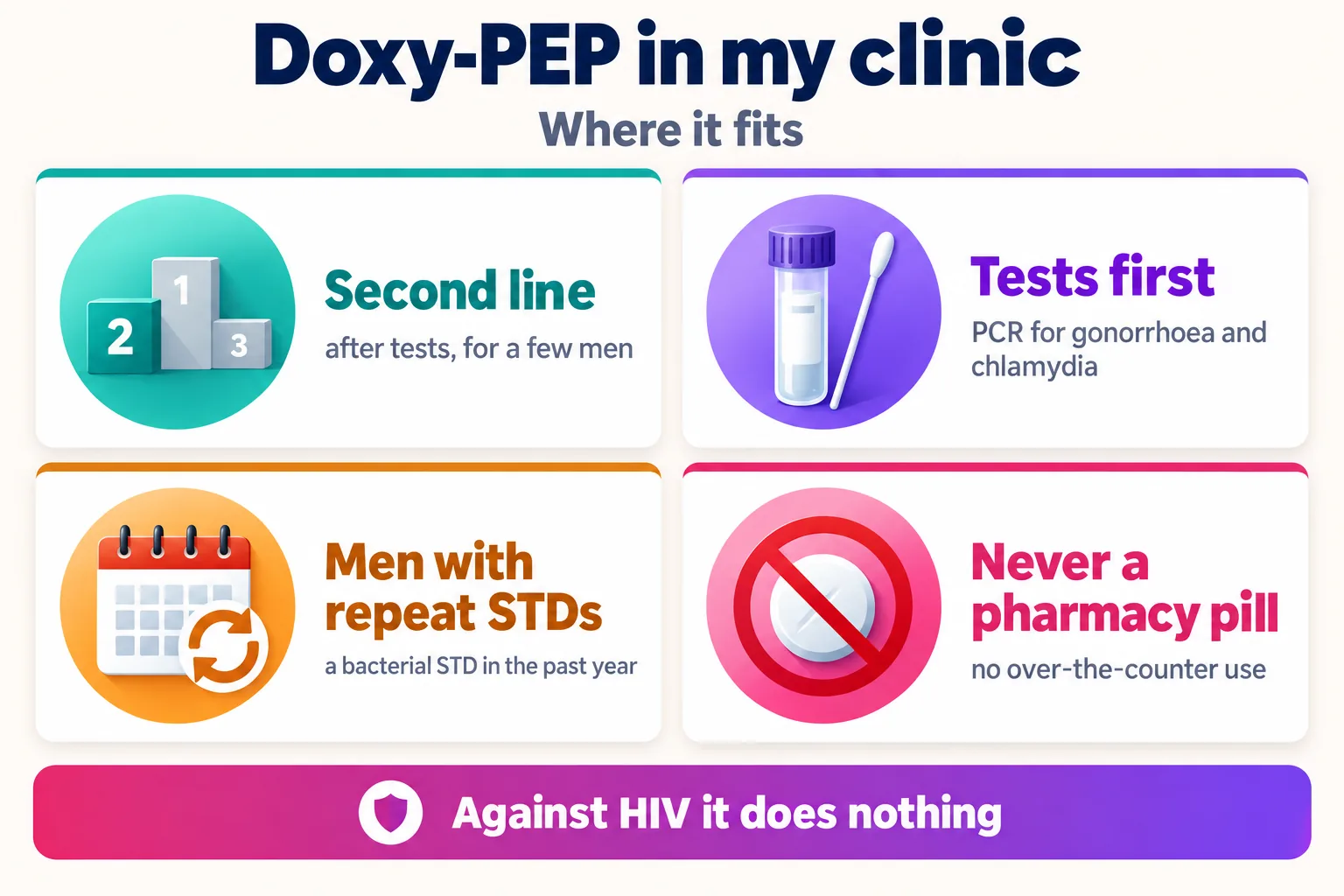
After an exposure, I test for gonorrhoea and chlamydia by PCR first. Doxycycline after sex is a second-line tool for a few men, and never a pharmacy pill.
Jump straight to your question:
💊 1. What is PrEP for HIV?
PrEP for HIV stands for pre-exposure prophylaxis. Pre-exposure means before the risk. Prophylaxis means prevention.
PrEP is medicine taken by a person who does not have HIV. It stops HIV from taking hold if the virus gets in, through sex or a shared needle.
Two medicines in one tablet
The standard PrEP tablet holds two antiretroviral medicines: tenofovir disoproxil fumarate and emtricitabine. These are the same medicines that people living with HIV take as part of their treatment. In PrEP they are used before infection instead of after.
A newer tablet uses tenofovir alafenamide with emtricitabine. A large trial compared it with the older tablet in men who have sex with men and transgender women.
It protected just as well (Mayer, 2020). The older tablet is the one licensed and sold in India.
How PrEP blocks the virus
HIV needs to copy itself inside your cells within hours of entering the body. Tenofovir and emtricitabine block the enzyme the virus uses to copy. If the medicine is already in your cells when the virus arrives, the virus cannot establish itself.
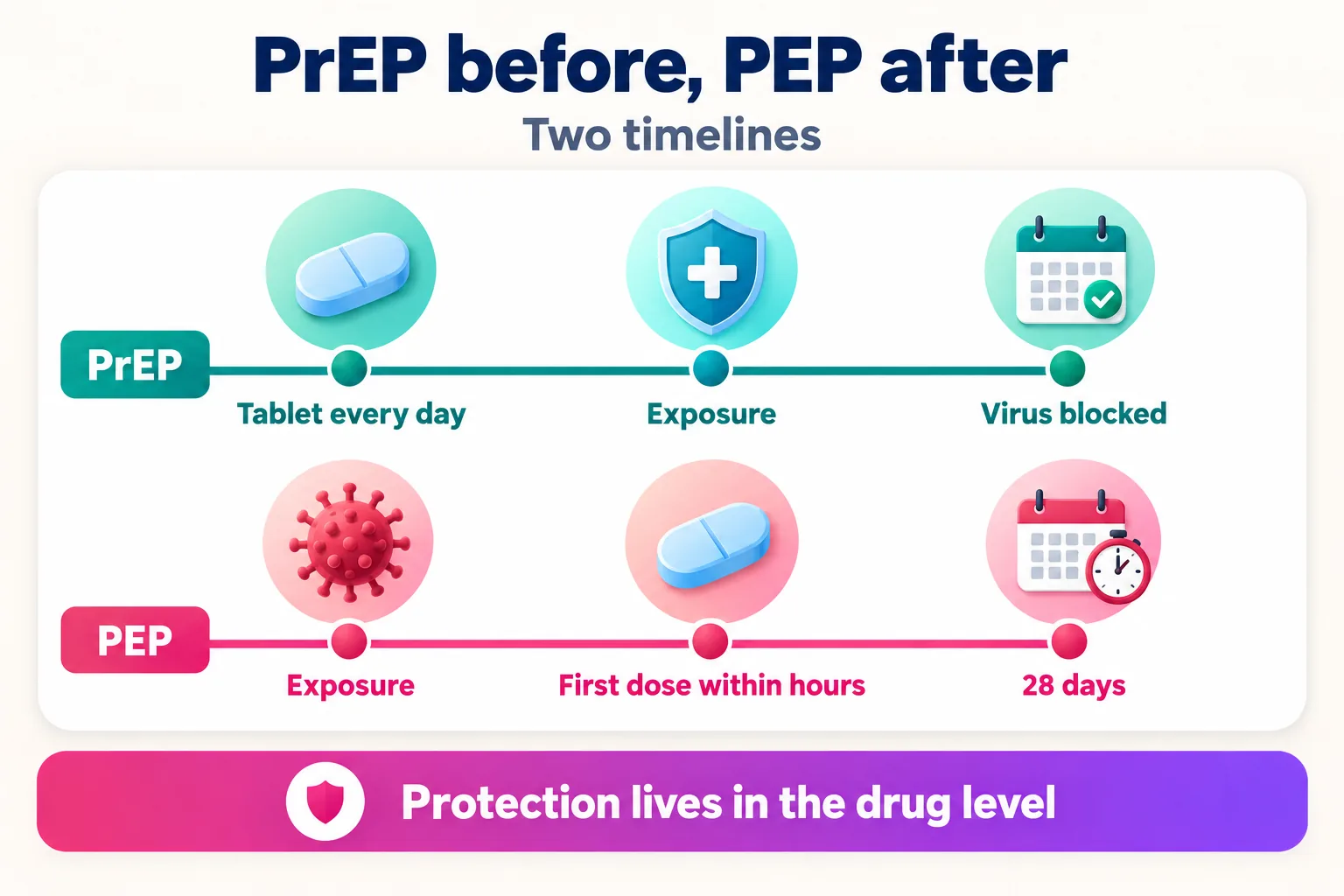
That is why the tablet must be taken before the exposure, and why it must be taken every day. The protection lives in the drug level inside your cells.
A study of the iPrEx trial measured those levels. At 16 femtomoles per million cells, the risk of HIV fell by 90% (Anderson, 2012).
PrEP is not a vaccine, and not a cure
A vaccine teaches your body to fight a germ for years. PrEP does nothing of the kind.
The protection lasts only while the drug is in your blood and cells. Stop the tablets and the protection fades within days.
PrEP also does not treat HIV. A person who already has HIV needs full HIV treatment.
On these two medicines alone, that person can breed a resistant virus. This is the reason for the HIV test before the first tablet, which I explain in section 10.
Licensed in India, but hard to find
The tenofovir and emtricitabine tablet has been licensed in India for HIV prevention since the middle of the last decade, and Indian companies make it on prescription, as of this page’s last review. The tablet exists here. What is missing is the doctor, the testing and the follow-up, as section 13 explains.
⚖️ 2. PrEP vs PEP: what is the difference?
They sound alike and they use related medicines. But they do opposite jobs.
PrEP is taken before, every day. PEP is taken after, once, for 28 days.
The one-line difference
PrEP is taken before any exposure, every day, for as long as the risk continues. PEP is taken after one exposure, for 28 days, and it must start within 72 hours. I explain PEP in full on my PEP treatment page.
PrEP and PEP side by side
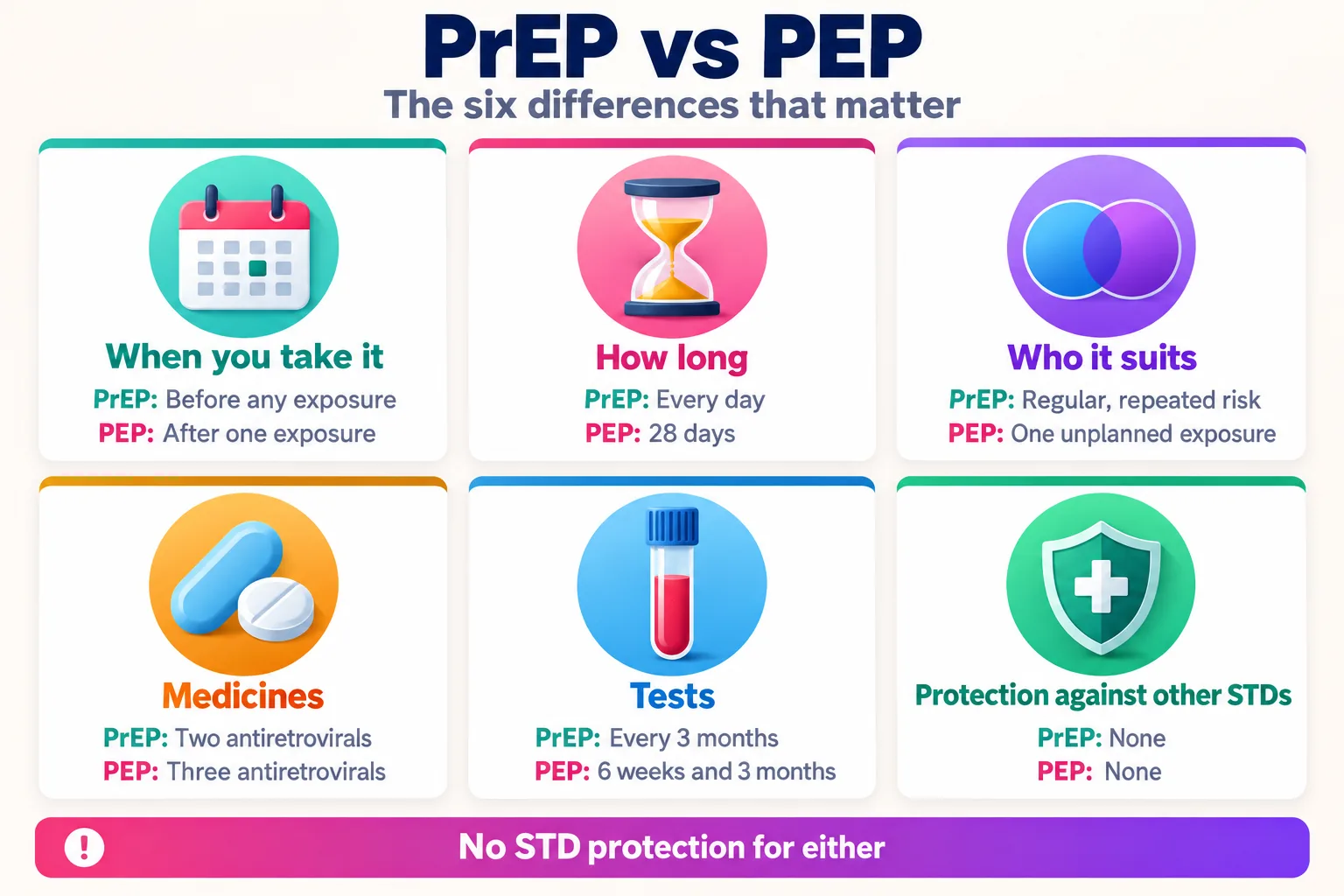
At a glance: PrEP vs PEP (On a phone, swipe the table sideways.)
| PrEP | PEP | |
|---|---|---|
| When you take it | Before any exposure, every day | After one exposure, within 72 hours |
| How long | As long as the risk continues | 28 days |
| Medicines | Two antiretrovirals in one tablet | Three antiretrovirals, usually one or two tablets a day |
| Who it suits | Regular, repeated risk | One unplanned exposure |
| Tests | HIV test every 3 months while on it | HIV test at the start, then at 6 weeks and 3 months after the exposure |
| Protection against other STDs | None | None |
| My clinic | I do not prescribe it | I prescribe it, and I give it to carry |
One row especially deserves a second look. Neither tablet protects you from syphilis, gonorrhoea, chlamydia or herpes.
Men forget this. PrEP does nothing to stop the first signs of an STD in men, and the men on it in the open-label studies caught more, not fewer (section 5).
Why PEP is not a weaker PrEP
PEP is not a diluted version of PrEP. It is a different strategy with its own evidence.
In the first study to put a number on it, health workers who had taken zidovudine after a needlestick had about 81% lower odds of seroconverting than those who had not (Cardo, 1997). It was a case-control study, not a trial, but it is why PEP exists at all.
Timing is everything with PEP. In monkeys exposed to the virus, a 28-day course of tenofovir started at 12 or 36 hours prevented infection, and a course started at 72 hours failed (Otten, 2000).
This is where the 72-hour rule comes from, and why I say “within hours”, not “within three days”.
Where PEP alone falls short
PEP has a limit, and I want you to see it before I make my case. In the British PROUD trial, men at very high ongoing risk were randomised. Half started PrEP at once, while half started a year later.
The men who waited still had PEP available, and took 174 courses of it. They still caught HIV at 9.0 per 100 person-years, against 1.2 in the men on PrEP (McCormack, 2016).
PEP after each exposure does not replace PrEP for a man with weekly risk. That finding shapes who I offer PEP in pocket to, and who I do not. Section 7 is about exactly that.
📊 3. How well does PrEP for HIV work?
PrEP works very well when a man takes it every day, and poorly when he does not. Every PrEP trial tells the same story. The main ones follow.
The trials, one by one
iPrEx was the first large trial, in men and transgender women who have sex with men. Daily tenofovir and emtricitabine cut new HIV infections by 44% overall (Grant, 2010).
But the drug was found in the blood of only 51% of the participants who stayed negative, and in just 9% of those who became infected (Grant, 2010). The tablet was not weak. Many people simply did not take it.
Partners PrEP studied heterosexual couples where one partner had HIV. The combined tablet cut infections by 75% (Baeten, 2012). I cover how such couples protect each other, and have children, in section 19.
In Botswana, a trial studied heterosexual men and women. It found 1.2 infections per 100 person-years on PrEP against 3.1 on placebo (Thigpen, 2012).
PROUD in Britain showed what happens in real clinics. Immediate PrEP cut HIV by 86%. Thirteen men needed a year of PrEP to prevent one infection (McCormack, 2016).
Adherence is everything
The iPrEx investigators later ran an open-label extension, following people from iPrEx and two sister trials who chose to keep taking PrEP. Among those with no drug detected in their blood, HIV incidence was 4.7 per 100 person-years.
Fewer than two tablets a week gave 2.3, and two to three tablets a week gave 0.6. Four or more tablets a week gave zero (Grant, 2014).
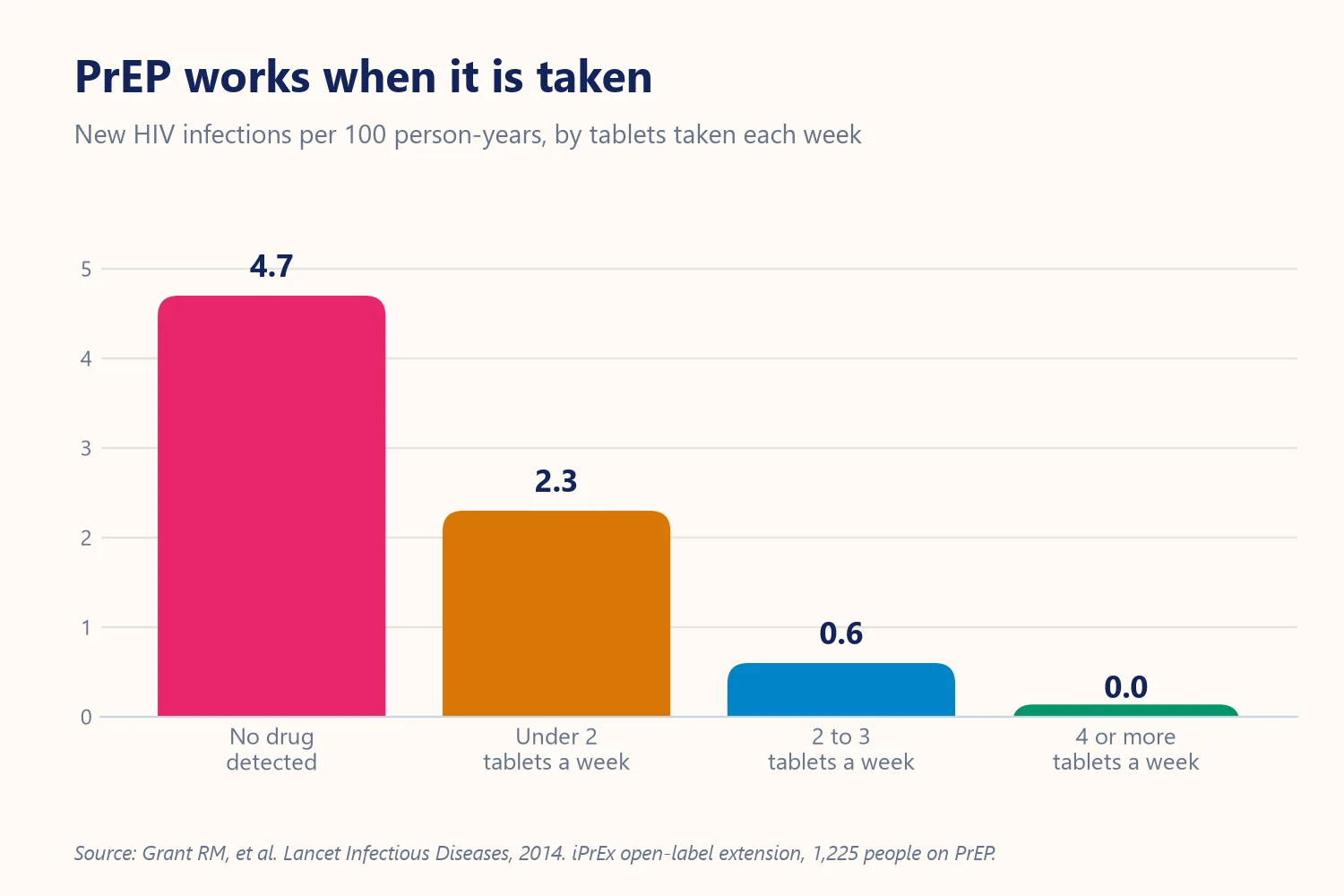
This is the chart I would show every man who thinks of PrEP as a casual tablet. A review of 18 studies found the same pattern.
Trials where more than 70% of people took their tablets cut HIV by about 70%. Trials where use was low showed no statistically significant protection (Fonner, 2016).
A later review for the US Preventive Services Task Force pooled 11 trials. Oral PrEP roughly halved HIV infections overall, and higher adherence meant higher protection (Chou, 2023).
The medicine works. Missed doses are where it fails.
What “99%” really means
You will read that PrEP is 99% effective. That figure describes daily, uninterrupted use.
One review puts the efficacy of daily dosing above 90%, tightly tied to how many doses are taken, and only 2% of users stop for side effects (Riddell, 2018). The familiar 99% comes from drug-level modelling: seven doses a week corresponded to a 99% risk reduction, four doses a week to 96%, and two doses a week to 76% (Anderson, 2012).
The honest statement is this. PrEP taken every day comes close to 99%, and four doses a week still came to 96% in that modelling. Below two doses a week the protection falls away towards nothing.
The slide from every day to a few days is the gap I worry about, because nobody plans it.
On-demand PrEP works for anal sex
French researchers tested a different schedule in men and transgender women who have sex with men. Two tablets before sex, one the next day and one the day after.
In the follow-on study, HIV incidence was 0.19 per 100 person-years, a 97% reduction. Participants used a median of 18 tablets a month, far fewer than daily (Molina, 2017).
A later cohort of more than 3,000 men let each man choose daily or on-demand. Half chose each.
The HIV incidence was the same in both groups, about 1 per 1,000 person-years (Molina, 2022). I return to the limits of this schedule in section 8.
🧭 4. Who do the guidelines say PrEP is for?
I promised you the full picture, so here it is. The World Health Organization, the US CDC and India’s National AIDS Control Organisation agree on this.
All three recommend oral PrEP for people at substantial, ongoing risk of HIV. India’s national technical guidelines for PrEP were published in 2022.
The guideline list
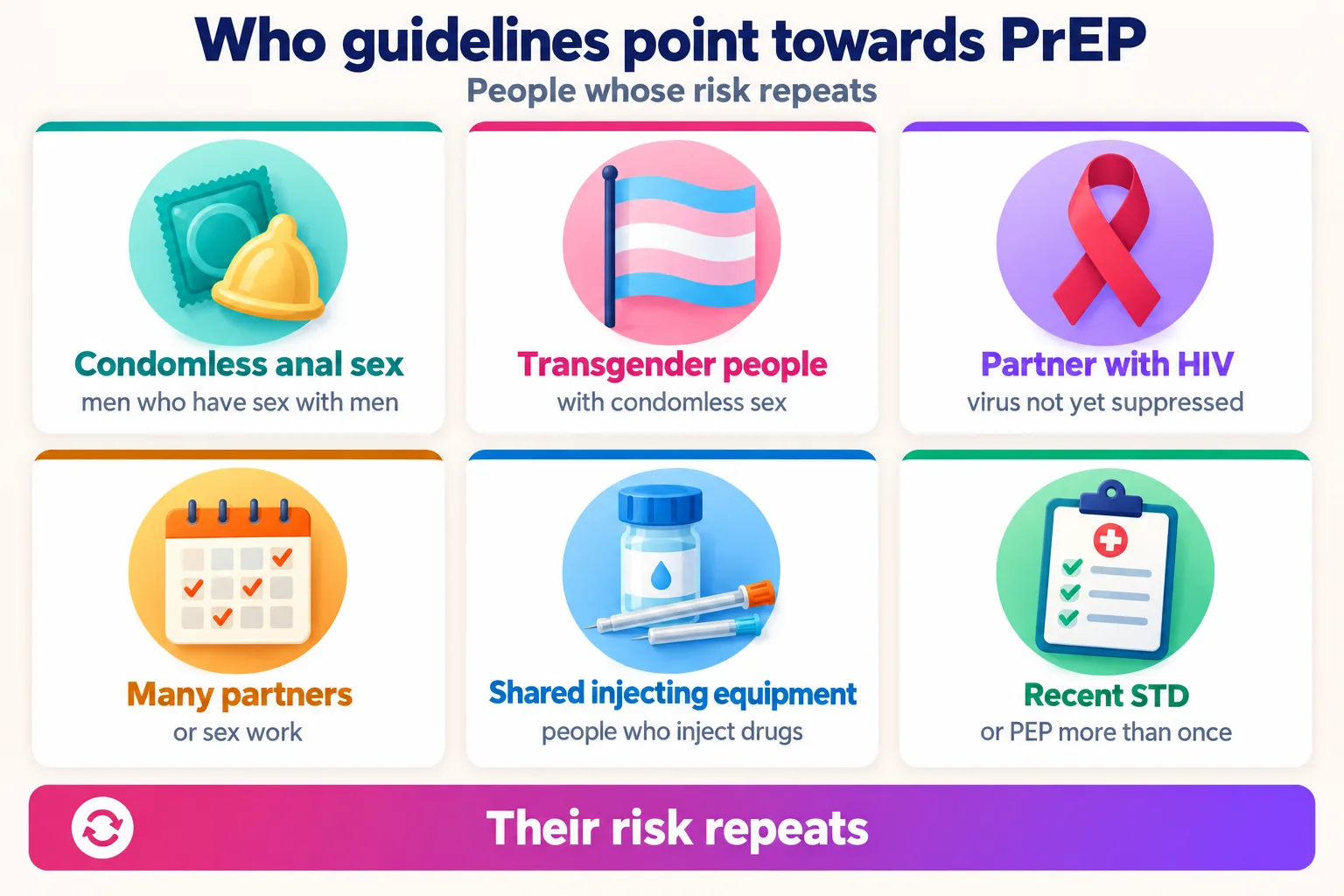
Across these guidelines, the people pointed towards PrEP share one feature. Their risk repeats. The list usually includes:
- Men who have sex with men with condomless anal sex.
- Transgender people with condomless sex.
- A partner living with HIV whose virus is not yet suppressed on treatment.
- People who sell sex, or who have many partners of unknown status.
- People who inject drugs and share equipment.
- Anyone with a recent bacterial STD, or who has needed PEP more than once.
The 2024 recommendations of the International Antiviral Society-USA say the same in one sentence. Oral PrEP, daily or intermittent, is an effective prevention option for people at increased likelihood of HIV. So are the long-acting injections (Gandhi, 2025).
India’s own picture
India has done something remarkable. New HIV infections have fallen by 66% since the year 2000. Yet HIV among men who have sex with men and transgender women is still not under control (Sahay, 2023).
Awareness is the first gap. In focus groups in Chennai and Mumbai, not one man who has sex with men had heard of PrEP. Once the researchers explained PrEP, most said they would use it.
Some saw it as a back-up plan. Others saw it as a replacement for condoms (Chakrapani, 2015). In Delhi, 14.5% of men who have sex with men and transgender people knew of PrEP, yet 63.3% were willing to use it (Sethi, 2023).
Where PrEP has been tried properly in India, it has worked. In a community-led project among sex workers in Mysore and Mandya, 647 women took daily PrEP for 16 months.
There were no new HIV infections, and condom use stayed stable. Self-reported daily intake was 98% in the final month, and blood tests confirmed steady dosing in 80 to 90% of the women sampled (Reza-Paul, 2020).
What the guidelines do not say
No guideline recommends PrEP for a single, unplanned exposure, because that is what PEP is for. No guideline says PrEP replaces condoms either, since PrEP has no effect on any other STD. Keep both points in mind as you read my position in the next section.
🚫 5. Why I do not prescribe PrEP
I have told you what the guidelines say. Now I owe you my own position, and my reasons.
Many good doctors prescribe PrEP. I do not, and I will not pretend otherwise.
My position, plainly
My judgement is that a daily tablet changes behaviour. A man who feels protected from HIV takes more chances.
He uses condoms less, and he takes partners he would otherwise have refused. PrEP removes one fear, and that fear was doing quiet work.
PrEP also protects against exactly one infection. Syphilis, gonorrhoea, chlamydia, herpes, hepatitis B and HPV walk straight past it. Every one of them comes through my STD clinic, and PrEP would have stopped none of them.
What the evidence says, both ways
I will not hide the evidence that disagrees with me. The randomised trials found no link between PrEP and riskier sex (Fonner, 2016). PROUD recorded no difference in STDs between men on PrEP and men waiting for it (McCormack, 2016).
But randomised trials are not daily life. A review of 17 open-label studies of PrEP users found significantly more rectal chlamydia, with 59% higher odds. It also found more diagnoses of any STD, though that second figure did not reach statistical significance, at 24% higher odds with a confidence interval of 0.99 to 1.54.
Most of those studies showed more condomless sex among users (Traeger, 2018). In the French on-demand cohort, condomless receptive anal sex rose over 18 months, from 77% of participants to 86% (Molina, 2017).
The STD numbers on PrEP are striking. In one Australian cohort of nearly 3,000 PrEP users, STDs were diagnosed at 91.9 per 100 person-years. A quarter of the men accounted for three-quarters of all infections (Traeger, 2019).
Across 88 studies worldwide, 24% of people already had chlamydia, gonorrhoea or early syphilis when they started PrEP. On PrEP, the incidence was 72 per 100 person-years (Ong, 2019).
Read both sides and decide for yourself. I have read them, and my judgement sits with the second set.
The tablet people stop taking
PrEP works only while it is taken every day. Yet many people stop. A cohort of young Black men who have sex with men in Atlanta showed how many.
Of those who started PrEP, 69% stopped it at least once and 40% stopped for good. The median time to the first stop was 159 days (Serota, 2020). In the French cohort, people left the study at 17.6 per 100 person-years (Molina, 2022).
A man who stops PrEP often keeps the habits he formed on it. He ends up worse off than before he started.
The literature calls the first half of that risk compensation. I call the whole of it the reason I do not start men on PrEP.
PrEP in India adds another layer
PrEP needs an HIV test every three months, a kidney test, and a doctor who follows you. In India, a man can buy the tablet across a pharmacy counter and never see a doctor at all. That is not PrEP.
That is PrEP without the one test that stops a small, avoidable risk from becoming yours. Section 10 puts a number on it.
What this means for you
If your risk is weekly, not yearly, the guidelines point you to PrEP. I have said so, and I will not talk you out of it.
It is simply not what I offer. What I offer is in the next section: condoms as the plan, PEP in your pocket as the backup, testing every three months, and treatment of whatever we find.
If your risk is rare and unplanned, read on. You are the man this approach was built for.
🎒 6. What I give instead: PEP in pocket (PEP-in-pocket)
Here is what I do instead. A man whose exposures are rare and unplanned leaves my clinic with a PEP course to carry. Not to take, but to carry.
He uses it only if a condom fails or an exposure happens. In my clinic we call it the safety card.
The literature calls it PEP in pocket
I did not invent this. Doctors in Toronto have studied it for years under the name PEP in pocket, written PEP-in-pocket or PIP. They identify people with rare but real exposures and give them PEP to self-start.
Their results are worth knowing, and worth reading carefully. Across 111 patients and nearly 179 patient-years, PEP was self-started 69 times by 35 people. There were no HIV infections.
The group was chosen precisely because their exposures were rare, and PEP-in-pocket has never been compared against PrEP in a trial. Some patients later moved to PrEP. About as many moved the other way, from PrEP to PEP-in-pocket (Billick, 2023).
Do people use it correctly? Among 43 patients carrying PIP in a second study, it was self-started 27 times by 15 people. Of those starts, 24, or 89%, were appropriate, meaning a genuine high-risk exposure and a start within 72 hours.
Two were unnecessary and one could not be classified. Nobody who should have started failed to start (Clifford Rashotte, 2024).
How the safety card works in my clinic
The card has rules, and the rules are not optional. Here is the sequence I give every man who carries one.
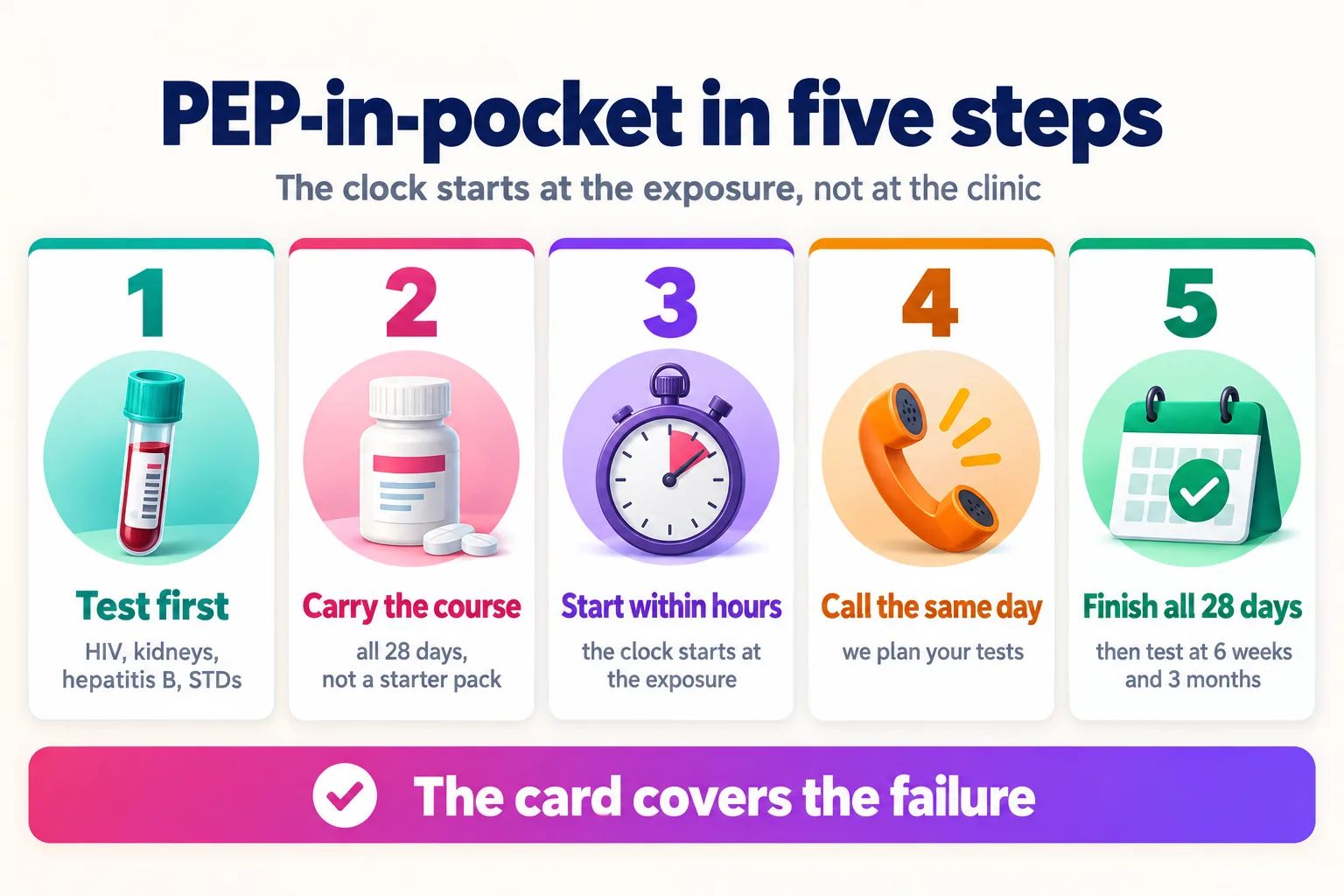
First, I test you. An HIV test, kidney function and hepatitis B, plus a screen for other STDs. You cannot carry PEP with an unknown HIV status.
Second, you carry the full course. A full 28 days, not a starter pack. A man in a hotel in another country cannot find the rest of his course at midnight.
Third, if a condom fails, you start at once. Not the next morning. The clock starts at the exposure.
The monkey study I quoted earlier is the whole argument. Twelve hours worked. Seventy-two hours did not (Otten, 2000).
Fourth, you call me the same day. We talk through what happened.
Where possible, I arrange a baseline HIV test within the first 72 hours. Then I plan your follow-up tests.
Fifth, you finish the course. All 28 days. Then we test at six weeks and again at three months after the exposure.
The card also has a shelf life. Before each trip, or every six months, we repeat the HIV test, and you check the expiry date on the pack. A course that has been started is replaced, not topped up.
The traveller
Picture the man I see most often. He travels for work. He is in Bali, in Bangkok, in Goa or in another Indian city.
One evening he visits a massage centre. He uses a condom, as he should. Then it breaks.
Without the card, he spends the night searching for a doctor in a strange city. He may be sold the wrong medicines, or he may give up. With the card, he takes the first dose within the hour.
He messages me. He finishes his trip and his course.
I have written separately about the STD risks of massage parlours. Read it before you travel.
Why condoms stay in the plan
The card is not a licence. Consistent condom use cuts HIV transmission by about 80% in heterosexual couples (Weller, 2001). The card covers the failure, but it does not replace the condom.
Some men want the card so that they can stop using condoms. They do not get the card.
✅ 7. Who is a good fit for PEP-in-pocket, and who is not
This approach has a sharp edge. In the wrong man it is worse than PrEP would have been. I apply a frequency rule, and I apply it strictly.
A good fit
- An adult who is HIV-negative on a recent test.
- Rare, unplanned exposures, a few times a year at most, usually linked to travel.
- A man who uses condoms and wants cover for the failure.
- Normal kidney function and no untreated hepatitis B.
- A man who will call me, and who will finish 28 days.
Not a fit
- Weekly or frequent condomless sex with partners of unknown status.
- A man who has already needed PEP twice in a year. Something else is going on, and we talk about that first.
- A man who wants the card instead of condoms.
- Anyone under 18.
The PROUD trial is my reason for the frequency rule. Men at very high ongoing risk had PEP available but no PrEP.
They still caught HIV at 9.0 per 100 person-years (McCormack, 2016). PEP in the pocket of such a man is a false comfort, and I will tell him so.
PEP-in-pocket or something else? (On a phone, swipe the table sideways.)
| Your situation | What I offer | Why |
|---|---|---|
| Rare, unplanned exposure, a few times a year | PEP-in-pocket, condoms, tests | No HIV infections across 179 patient-years in the Toronto cohort, a selected low-exposure group never compared with PrEP in a trial (Billick, 2023) |
| Needed PEP twice in a year | A frank conversation, tests, treatment of what we find | Repeat PEP means the plan is failing, not the tablet |
| Weekly condomless sex, unknown partners | The guidelines point you to PrEP. Not my offer | PEP alone did not protect men at this level of risk (McCormack, 2016) |
| Partner living with HIV | Treatment of the partner to undetectable, timed intercourse, and sperm washing where needed | No linked transmissions once the virus is suppressed (Rodger, 2016) |
| One exposure, already happened | PEP now, today | Earlier is better; at 72 hours the animal data show failure (Otten, 2000) |
If your partner has HIV
A couple where one partner lives with HIV is a different situation again. The strongest protection there is the positive partner’s treatment, not a tablet for the negative one. I explain the numbers, and how such couples have children, in section 19.
The honest line for men with frequent risk
I will repeat it, because it matters. If your exposures are frequent, the evidence favours PrEP and the guidelines recommend it. PEP-in-pocket is not an equal substitute for you.
I do not prescribe PrEP, so if you choose my clinic you choose condoms every time, an STD and HIV screen every three months, and treatment of whatever we find. PEP is for a genuine one-off failure, not a monthly routine.
If you cannot hold to condoms, take the guideline advice and get PrEP from a doctor who does the tests. Choose with open eyes.

Private 1-on-1 consultation
Carrying a risk you did not plan for? Let us plan the protection.
A private consultation in T Nagar, Chennai. I take a full history and run the tests that matter. Then you leave with a plan you can carry, not a tablet you have to remember.
Book a Confidential Consultation
🗓️ 8. The three ways PrEP is taken
PrEP is not one thing. There are three schedules, and each has its own evidence and its own limits. If you choose PrEP with another doctor, you should know all three.
Daily tablets
One tablet, every day, for as long as the risk continues. This is the schedule in iPrEx, Partners PrEP and PROUD, and among the oral schedules it is the only one tested in heterosexual men and women (Baeten, 2012). On-demand dosing has been studied only in men who have sex with men (Molina, 2017).
In practice, protection for anal sex builds over about seven daily doses. For vaginal sex it takes about three weeks. Those are CDC guideline figures, not trial findings.
On-demand, or 2-1-1
Two tablets between two and 24 hours before sex. One tablet 24 hours after the first dose. One more 24 hours after that.
In the French follow-on study, this schedule cut HIV by 97% (Molina, 2017). The people studied were men and transgender women who have sex with men.
The limits matter. On-demand dosing has been studied only for anal sex. It is not for vaginal sex, because the drug builds up more slowly in that tissue.
Men with hepatitis B should not use it, and it has not been tested with the newer tenofovir alafenamide tablet. Those limits come from CDC and WHO guidance, and I pass them on as such.
Injections
Cabotegravir is an injection given every two months after two starter doses a month apart. In men who have sex with men and transgender women it beat daily tablets.
There were 0.41 infections per 100 person-years against 1.22 (Landovitz, 2021). In women it did better still, 0.2 against 1.85 (Delany-Moretlwe, 2022).
Lenacapavir is an injection given twice a year. In women there were zero infections on lenacapavir, against 2.02 per 100 person-years on daily emtricitabine and tenofovir alafenamide and 1.69 on the older daily tablet (Bekker, 2024).
In men and gender-diverse people it was 0.10 against 0.93 (Kelley, 2025). Section 9 covers what this means in India today.
Three ways to take PrEP (On a phone, swipe the table sideways.)
| Schedule | How | Evidence | Limits |
|---|---|---|---|
| Daily | One tablet every day | 44% to 86% fewer infections in trials; zero at four or more tablets a week (Grant, 2010; McCormack, 2016; Grant, 2014) | Works only if taken; many people stop within months |
| On-demand (2-1-1) | Two tablets 2 to 24 hours before sex, then one at 24 and one at 48 hours | 97% reduction in men who have sex with men (Molina, 2017) | Anal sex only; not for hepatitis B; not with the newer tablet |
| Injection | Cabotegravir every 2 months, or lenacapavir every 6 months | Beat daily tablets in every trial (Landovitz, 2021; Bekker, 2024) | Not yet available in India; injection-site reactions |
Whichever schedule a man chooses with his doctor, the testing rules in section 10 do not change. In my own clinic I offer none of the three. I include them because an honest guide must.
💉 9. Injectable PrEP for HIV in India: cabotegravir and lenacapavir
The injections remove the problem that sinks daily PrEP, which is forgetting. This is where they stand, and where India stands.
Cabotegravir every two months
HPTN 083 was stopped early for efficacy, because the injection was clearly better than tablets (Landovitz, 2021). Injection-site reactions were common: 81% in the cabotegravir group, against 31% in the tablet group, which also received dummy injections. In the women’s trial they led to no discontinuations at all (Landovitz, 2021; Delany-Moretlwe, 2022).
In that women’s trial, only 42% of blood samples from the tablet group showed daily use (Delany-Moretlwe, 2022). That is why an injection exists.
There is a catch. Thirteen participants caught HIV while on cabotegravir.
Among them, resistance to that class of medicine and late detection of the infection were both seen (Landovitz, 2021). An injection that hides an infection for months is a serious thing.
Getting cabotegravir to lower-income countries needs market-shaping, regulatory and supply work that is under way but far from finished (Jenkins, 2023). As of November 2026, cabotegravir for prevention is not available in India.
Lenacapavir twice a year
A Cochrane review pooled the two lenacapavir trials. Lenacapavir cut new HIV infections by about 93% compared with daily tablets.
There were slightly fewer serious adverse events and more injection-site reactions (Ebrahim, 2026). In the men’s trial, 1.2% stopped because of injection reactions (Kelley, 2025).
The price is the fight. Lenacapavir is cheap to make and, in high-income countries, is projected to sell for roughly a thousand times its production cost.
The maker has licensed six generic companies to supply 120 low-income countries (Adepoju, 2025). Indian regulators were reviewing a generic through 2025 and 2026, and press reporting in that period put the first generic supplies in 2027.
As of November 2026, lenacapavir is not something you can get in India. I will update this page when that changes.
What this means for an Indian man today
Today, PrEP in India means the daily tablet. If an injection arrives, the tests around it stay the same, and so does my position.
A twice-yearly injection removes the forgetting. It does not remove syphilis, gonorrhoea or chlamydia, and it does not change behaviour for the better.
I cover HIV treatment itself, including the long-acting treatment injections, on my HIV treatment page.
🧪 10. Tests before PrEP, and why they matter
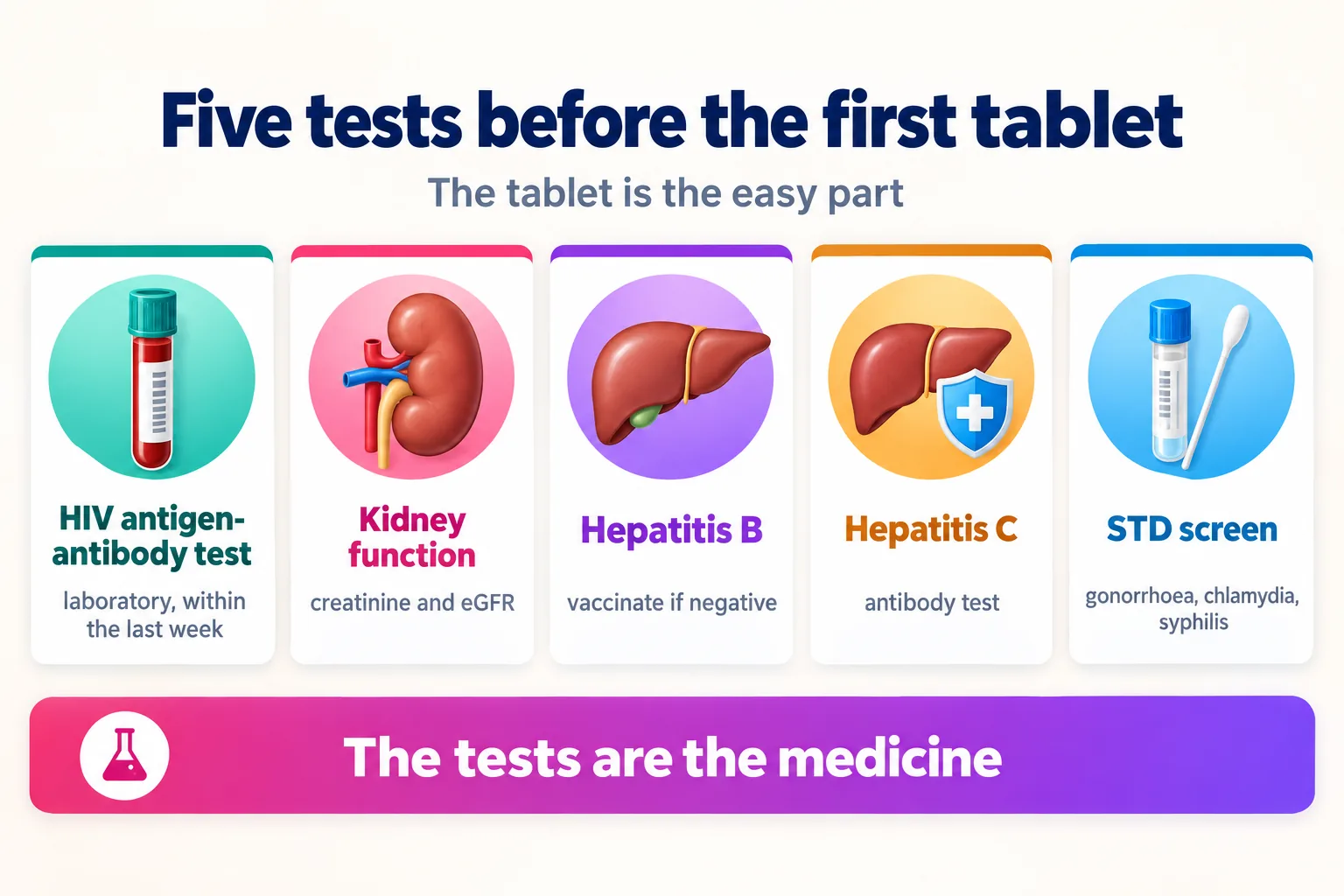
Whether you start PrEP elsewhere or carry PEP from my clinic, the tests come first. The tablet is the easy part. The tests are the medicine.
An HIV test, before the first tablet
This is the test that cannot be skipped. Two antiretrovirals are enough to prevent HIV.
They are not enough to treat it. A man who starts PrEP while already infected, even without knowing it, can breed a resistant virus.
The trials saw this. In Botswana, one participant developed resistance mutations. That participant had an unrecognised acute HIV infection at enrolment (Thigpen, 2012).
In iPrEx, resistance was rare in people who caught HIV on PrEP. But those who started PrEP during an acute infection did develop emtricitabine resistance, which faded within 24 weeks of stopping (Liegler, 2014).
Across 12 studies, resistance mutations were found in about 6.5% of people who became infected on PrEP. Specific tenofovir or emtricitabine mutations were found in 1.5%. There was no increase compared with placebo (Rachman, 2024).
The risk is small. But it is entirely avoidable with one blood test.
The window period
A test can miss a very recent infection. Laboratory tests detect both the HIV antigen and the antibody. They reach their 99th-percentile window at 44 days (Delaney, 2017).
If you had an exposure in the past six weeks, the test is repeated. Fever, rash or a sore throat after an exposure can be acute HIV. I treat it as such, and test for the virus itself.
Rapid finger-prick tests have mixed performance in early infection. Point-of-care tests for the virus itself are not yet routine (Rutstein, 2025).
This is why I use a laboratory test. My page on the HIV window period explains every test and its timing.
Kidney function
Tenofovir is cleared by the kidneys and can strain them slightly. In iPrEx, creatinine clearance fell by about 2.4 ml/min in the first month against 1.1 ml/min on placebo, and did not get worse. It returned to normal after stopping (Solomon, 2014).
In a larger trial the small decline reversed within four weeks of stopping (Mugwanya, 2016). A baseline creatinine tells us you can take the medicine safely. A repeat every six to twelve months keeps it that way.
Hepatitis B
Tenofovir and emtricitabine also act against hepatitis B. In iPrEx, the six participants with chronic hepatitis B who took PrEP came to no harm, and no liver flares were seen after they stopped (Solomon, 2016). That is reassuring, but six people is a small base.
The wider rule from hepatology still applies. In anyone with hepatitis B, stopping a medicine that also suppresses that virus needs a plan, because withdrawal can provoke a flare.
I test for hepatitis B before, and the men who are negative get the vaccine. My page on hepatitis B treatment explains it.
A screen for other STDs
Nearly a quarter of people already have chlamydia, gonorrhoea or early syphilis when they start PrEP (Ong, 2019). Most of these infections have no symptoms.
I screen before, with urine and swab tests, and I treat what I find. The same is true before a man carries PEP.
Tests before PrEP or PEP-in-pocket, and how often they repeat (On a phone, swipe the table sideways.)
| Test | Before | On PrEP | With PEP-in-pocket |
|---|---|---|---|
| HIV antigen-antibody (laboratory) | Yes, within the last week | Every 3 months | At the start, then 6 weeks and 3 months after any exposure |
| Creatinine and eGFR | Yes | Every 6 to 12 months | At the start |
| Hepatitis B surface antigen | Yes, vaccinate if negative | Once | Once |
| Hepatitis C antibody | Yes | Yearly if at risk | At the start |
| Gonorrhoea and chlamydia PCR, syphilis blood test | Yes | Every 3 to 6 months | Two weeks after any exposure, syphilis at 6 and 12 weeks |
⚠️ 11. PrEP side effects: kidney, bone and the first month
PrEP is a safe medicine, and I do not prescribe it. My objection is to behaviour, not to the body. Here are the side effects, in proportion.
The first month
Nausea is the common one. In iPrEx it was more frequent in the first four weeks on the tablet than on placebo. Then it settled (Grant, 2010).
In Botswana, 18.5% of people on PrEP reported nausea against 7.1% on placebo, with more vomiting and dizziness too (Thigpen, 2012). Serious adverse events were no more common than on placebo in either trial.
Taking the tablet with food, at night, gets most men through the first month. Only about 2% of users stop PrEP because of side effects (Riddell, 2018).
Kidneys
The kidney effect is real, small and reversible. Creatinine clearance dropped by about 2.4 ml/min in the first month in iPrEx, against 1.1 on placebo, and then held steady (Solomon, 2014). After stopping, kidney function returned towards baseline within weeks.
More than 96% of people had recovered at least three-quarters of that small drop within eight weeks of stopping, and the group averages were back to the placebo level by four weeks (Mugwanya, 2016). Men with existing kidney disease are the exception, and they should not take tenofovir-based PrEP.
Bones
Bone density falls a little on tenofovir. In adherent iPrEx users the hip lost about 1% and the spine about 1.8% of density. After stopping, both recovered to baseline within 12 to 18 months (Glidden, 2017).
The Botswana trial also recorded a significant decline on PrEP (Thigpen, 2012). For a young man this is a footnote. For a man with weak bones already, it is a conversation.
What PrEP does not do
Men ask me whether PrEP causes erection problems or lowers testosterone. None of the trials I have cited recorded either as a side effect, and none measured sperm counts. I claim no effect in either direction, and I would not use PrEP as an explanation for either problem.
🦠 12. Does PrEP protect against other STDs?
No. Not one.
PrEP blocks HIV and nothing else. This single fact sits behind most of my position, so it deserves its own section.
The numbers on PrEP
Across 88 studies, people on PrEP caught chlamydia, gonorrhoea or early syphilis at 72 per 100 person-years (Ong, 2019). In the Australian PrEP cohort the figure was 92 per 100 person-years, and a quarter of the men carried three-quarters of the infections (Traeger, 2019). Rectal chlamydia in particular was 59% more likely among PrEP users (Traeger, 2018).
Many of these infections are silent. In a trial of men who have sex with men on PrEP, 71% of the STDs found caused no symptoms at all (Molina, 2018). A man on PrEP who feels well is not necessarily well.
The infections PrEP ignores
- Syphilis, which is rising in men who have sex with men worldwide.
- Gonorrhoea, which is becoming resistant to the antibiotics we have.
- Chlamydia, the commonest and the quietest.
- Genital herpes, which stays for life.
- Trichomoniasis, a parasite most men carry without a single symptom.
- HPV and genital warts, which can also reach a wife as cervical cancer.
- Hepatitis B, which the PrEP medicines happen to suppress. Get the vaccine; do not rely on a prevention tablet.
A man on PrEP needs the same condoms and the same testing as a man without it. My judgement is that the men who forget this are a large part of why the STD numbers above look the way they do, though the Australian cohort itself found partner numbers and group sex, not condom use, predicted who caught what (Traeger, 2019).
🇮🇳 13. PrEP in India: cost and where to get it
Two questions bring most Indian men to this page. What does PrEP cost, and where do I get it? Here is the honest answer to both, without a price list, because prices change and this page does not.
What PrEP costs
The Indian tablet is a generic, so it costs far less than most men expect, and much less than the branded tablet abroad. The real cost of PrEP is the three-monthly testing, and that cost is non-negotiable. A man who pays for the tablet and skips the tests has bought the cheap half of PrEP.
Where PrEP is available in India
India’s national guidelines for PrEP were written in 2022. In March 2026, IndiaSpend reported that the public programme had still not rolled PrEP out.
With no public programme, the men who take it get it through private doctors or NGO-run community clinics. In practice, PrEP in India means a private prescription with private follow-up.
That is not a bad thing, if the doctor does the tests. But it becomes dangerous when the tablet is bought across a pharmacy counter, with no HIV test, no kidney test and nobody following up. Section 10 told you why.
Awareness is the real barrier
In Chennai and Mumbai, men who have sex with men had not heard of PrEP. Once the researchers described it, many of those men wanted it, but they feared being labelled HIV-positive or promiscuous if anyone found the tablets (Chakrapani, 2015).
Stigma is the first barrier, and cost is the second. The same study called free or subsidised supply necessary before PrEP could work for poorer men.
The same stigma also keeps men away from testing. My confidential STD clinic exists for exactly this reason. Nobody at the counter decides your care, and nobody outside the room knows you were there.
If you choose PrEP, choose the tests too
Find a doctor who will do the tests in section 10 and repeat the HIV test every three months. The same doctor should see you when something goes wrong.
An infectious-disease physician, a sexual-health physician or an andrologist who prescribes PrEP all qualify. A pharmacy does not.
And if you would rather carry PEP than take PrEP, call me. 97907 83856.
🛡️ 14. Condoms: the plan that PEP backs up
Every strategy on this page sits on top of condoms. PrEP users need them for every other STD.
PEP-in-pocket users need them because the card covers the failure, not the choice. The real numbers on condoms, failures included, are these.
What consistent use achieves
In heterosexual couples, people who always used condoms caught HIV at 1.14 per 100 person-years. Those who never used them caught it at 5.75. That is about an 80% reduction (Weller, 2001).
Among men who have sex with men, consistent condom use was 70% effective against HIV. The line that matters is this: men who used condoms “sometimes” had no significant protection at all compared with men who never used them. Only 16% of men managed consistent use (Smith, 2015).
Why “sometimes” is not protection
HIV does not average your behaviour. One receptive anal exposure carries about 138 infections per 10,000 exposures, the highest of any sexual act.
Oral sex carries a very low risk (Patel, 2014). The one time you skip the condom is the one time that counts.
Condoms plus treatment of a positive partner cut the risk of sexual HIV acquisition by 99.2% (Patel, 2014). That number is why I treat the condom as the plan, not the backup.
When the condom fails
Condoms break, slip and tear, and that is the moment the safety card exists for. My step-by-step page on what to do when a condom breaks walks you through the first 72 hours. The next section is the short version.
⏱️ 15. The PEP clock: the first 72 hours
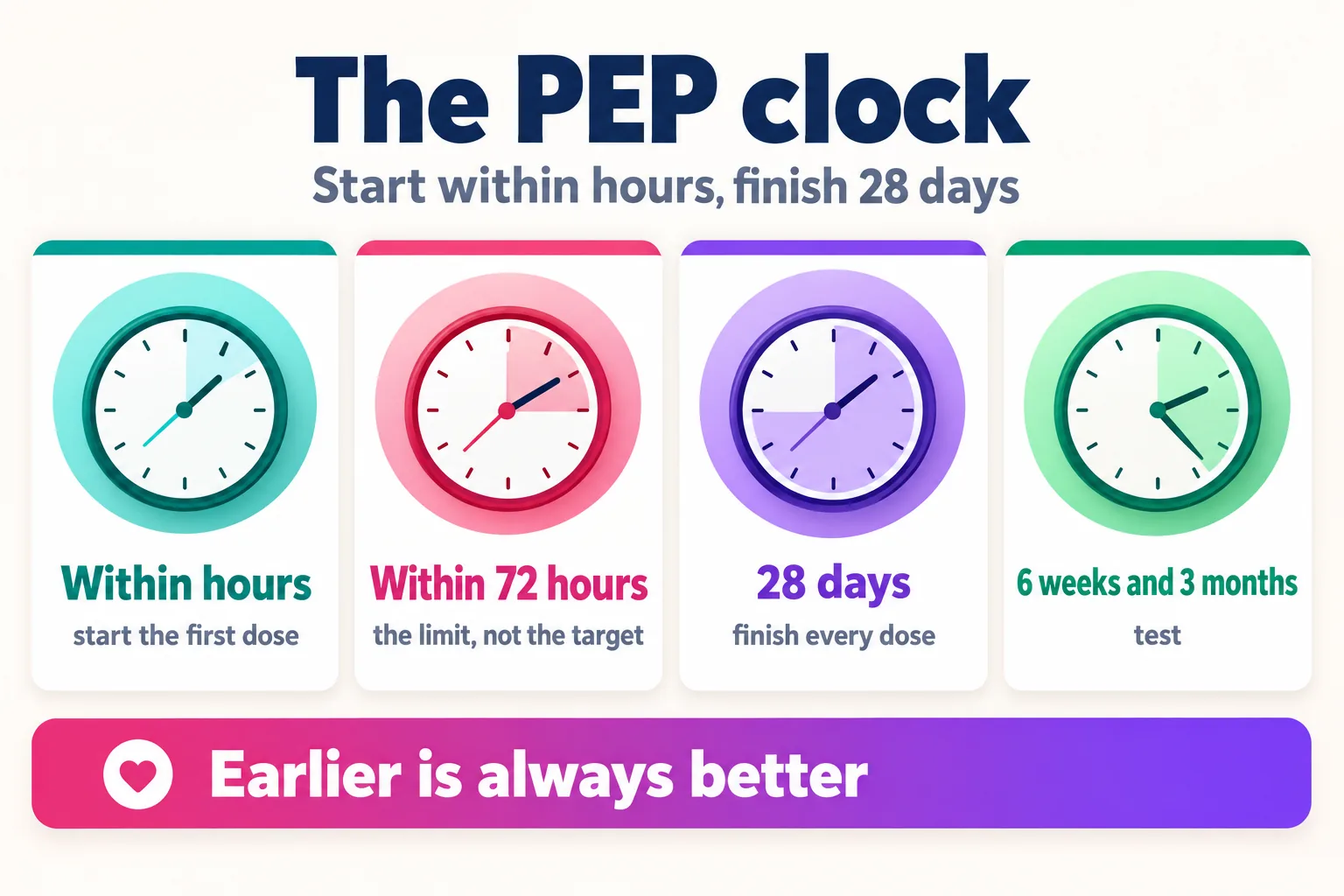
You may carry PEP from my clinic, or you may be reading this after an exposure tonight. Either way, the rules are the same. The clock started at the exposure, and everything else follows from that.
Hours, not days
The 72-hour limit is a limit, not a target. In the macaque study, tenofovir started at 12 or 36 hours after exposure prevented infection, while the animals treated at 72 hours became infected (Otten, 2000).
In health workers, zidovudine after a needlestick cut the odds of infection by about 81% (Cardo, 1997). Every guideline says the same thing about timing: sooner is better.
Twenty-eight days, every dose
PEP is a 28-day course of three antiretroviral medicines. In my clinic the usual course is tenofovir disoproxil, emtricitabine and dolutegravir, once a day. Finishing matters more than anything after the first dose.
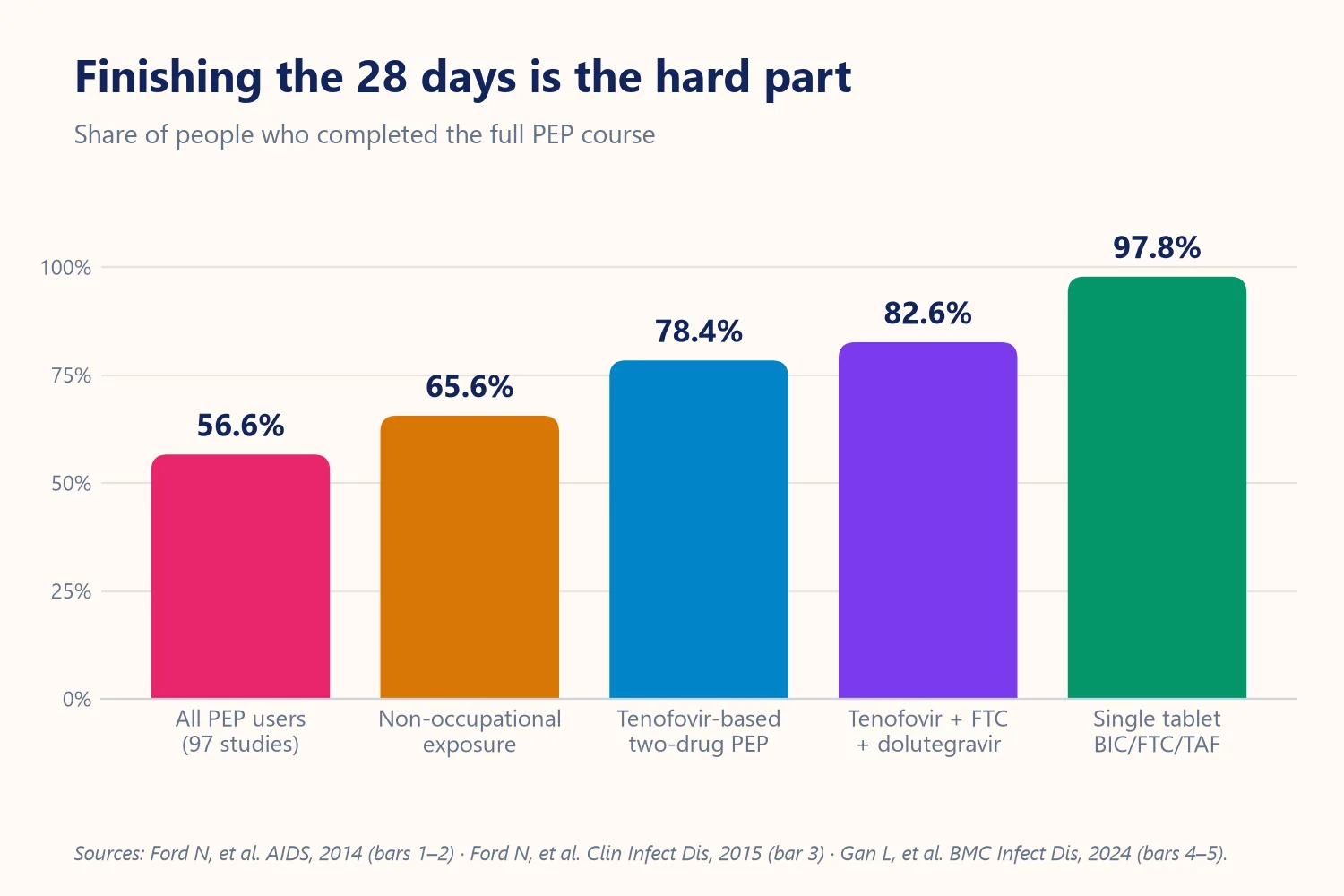
Finishing is where PEP fails in the real world. Across 97 studies, only 56.6% of people completed the 28 days.
After non-occupational exposure, mostly consensual sex, the figure was 65.6%, and among men who have sex with men 67.2%. After sexual assault it fell to 40.2% (Ford, 2014).
The medicines matter for completion. Tenofovir-based courses were completed by 78.4% of people, against 58.8% for the older zidovudine courses, and far fewer stopped for side effects (Ford, 2015).
In a Chinese cohort, a single-tablet course was completed by 97.8%. The figure was 82.6% for tenofovir-emtricitabine taken with a separate dolutegravir tablet (Gan, 2024).
When I hand a man his pocket course, I choose the simplest regimen I can, because a half-finished course protects nobody.
What to do tonight
Take the first dose now, if you carry the course. Then message me. If you do not carry it, do not wait for morning.
Call the clinic number straight away, at any hour, and we start you on a course as early as the morning allows. Do not decide to wait on your own, and do not wait for a test result before the first dose. My PEP page has the full plan; the section before this one covers the condom.
🔬 16. Testing after an exposure: PCR first
After an exposure, the question is not only “did I catch HIV?”. It is “what did I catch?”.
My order of operations is test first, treat what we find, and only then talk about extra antibiotics. PCR comes before doxycycline in my clinic, every time.
Why I test before I treat
Most STDs are silent. In a trial of men who have sex with men on PrEP, 71% of the infections found caused no symptoms at all (Molina, 2018). There is no reason a single exposure behaves differently.
A man who waits for a discharge or a sore will miss most of what he has caught. I test on a schedule, whether or not he feels anything.
The schedule I use
Testing after an exposure: what, and when (On a phone, swipe the table sideways.)
| Infection | Test | When |
|---|---|---|
| Gonorrhoea and chlamydia | PCR on urine, and throat or rectal swabs where relevant | About 2 weeks after the exposure |
| HIV | Laboratory antigen-antibody test | At the start, at 6 weeks and at 3 months after the exposure |
| Syphilis | Blood test | At 6 weeks and again at 12 weeks |
| Hepatitis B and C | Blood tests | At the start; hepatitis B again at 3 months unless you are vaccinated, hepatitis C again at 3 months |
| Herpes | Swab of any sore | Only if a sore appears |
The HIV timing follows the window period. Laboratory antigen-antibody tests reach their 99th-percentile window at 44 days (Delaney, 2017). The test at six weeks catches almost everything, and because 44 days sits right at six weeks I repeat it if there is any doubt.
The three-month test settles it. If you took PEP, the dates still count from the exposure, not from the last tablet.
The six-week test falls about two weeks after the course ends. My HIV window period page explains the reasons.
Burning but normal tests
Some men return with burning on passing urine and a negative gonorrhoea and chlamydia test. That is usually non-gonococcal urethritis, often from Mycoplasma genitalium or Ureaplasma.
It needs its own tests and its own antibiotics. I have written a full page on urethritis in men.
Then, and only then, doxy-PEP
Once the tests are done and anything found is treated, we can talk. The question then is whether a man should carry doxycycline for the next time. For most men the answer is no.
For a few, it is yes. That is the next section.
💊 17. Doxy-PEP: what it is, and where it fits in my clinic
Doxy-PEP is a single 200 mg dose of the antibiotic doxycycline. It is taken within 24 hours after sex, and no later than 72 hours, to prevent bacterial STDs.
It is new, it works for some infections, and it carries a cost that India cannot ignore. I use it only as a second-line tool, in a few men.
What the trials showed
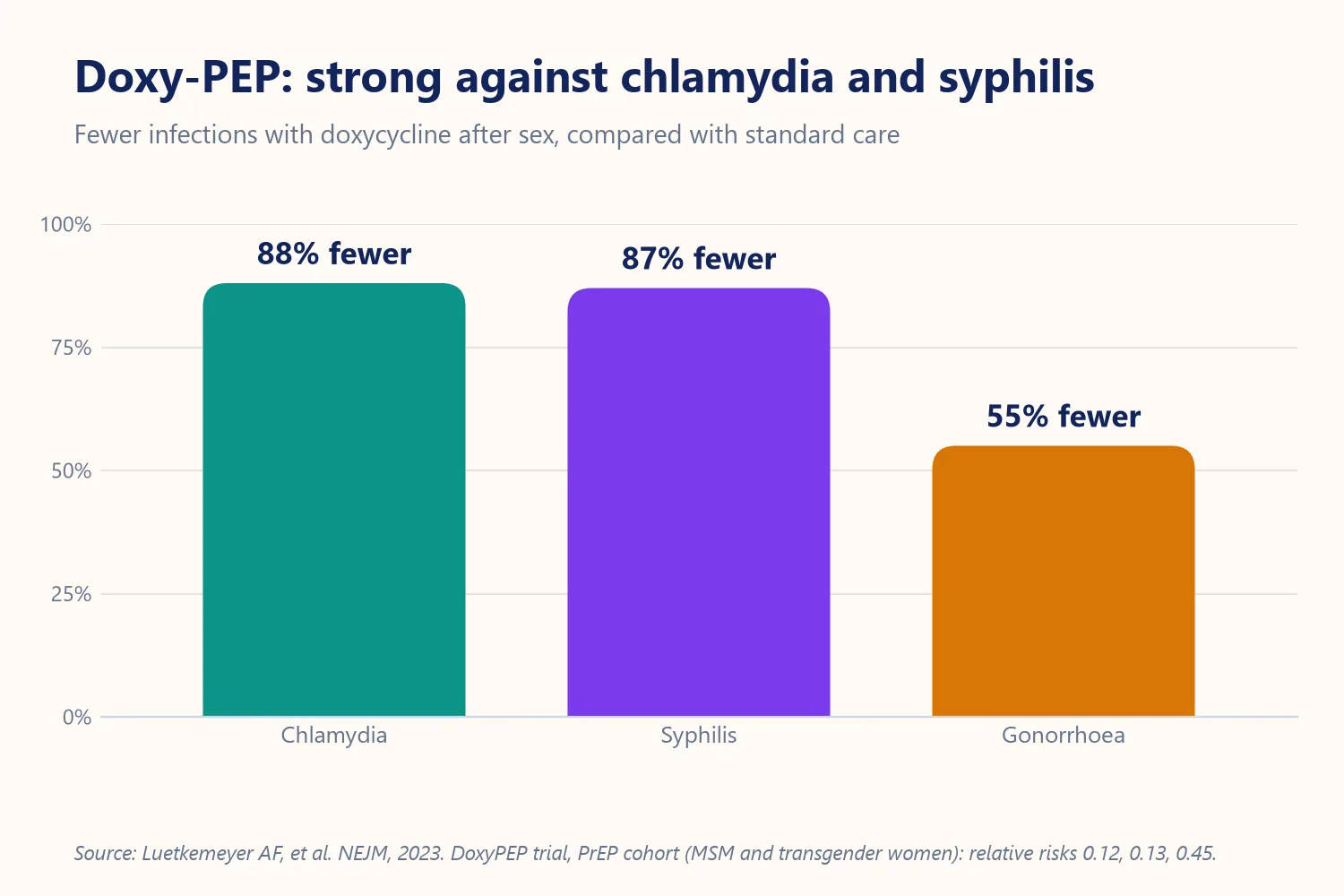
The American DoxyPEP trial enrolled men who have sex with men and transgender women who had had a bacterial STD in the past year, some on HIV PrEP and some living with HIV. In the PrEP group, an STD was diagnosed at 10.7% of their quarterly visits, against 31.9% with standard care, a two-thirds reduction. Chlamydia fell by 88%, syphilis by 87% and gonorrhoea by 55% (Luetkemeyer, 2023).
A French substudy found the same shape. The risk of a first STD roughly halved, and chlamydia and syphilis fell by about 70%. Gonorrhoea did not change significantly (Molina, 2018).
A second French trial recorded chlamydia or syphilis at 8.8 per 100 person-years with doxycycline. Without it, the figure was 53.2 (Molina, 2024).
The two meta-analyses agree on chlamydia and syphilis and differ on gonorrhoea. One found doxy-PEP cut any bacterial STD by 46%, chlamydia by 65% and syphilis by 77%, with no significant effect on gonorrhoea (Sokoll, 2025). The other, across randomised trials in men who have sex with men and transgender women, found chlamydia down 81%, syphilis down 77% and gonorrhoea down 45%, and its authors stress that the gonorrhoea result depends on local tetracycline resistance (Szondy, 2024).
In the DoxyPEP trial itself, gonorrhoea fell by 55% (Luetkemeyer, 2023). Where resistance is low, doxycycline helps against gonorrhoea. Where it is high, as in India, assume the weaker answer.
On this evidence the US CDC now recommends doxy-PEP for a defined group. That group is men who have sex with men and transgender women with a bacterial STD in the past 12 months. The offer follows a shared decision with their doctor (Bachmann, 2024).
Where the evidence runs out
In the one trial in women, 449 Kenyan women, doxy-PEP did not significantly reduce STDs. But doxycycline was detectable in only 29% of hair samples, so the trial cannot tell us whether it works when it is actually taken, and every gonorrhoea isolate was already resistant to it (Stewart, 2023).
The evidence is for men who have sex with men and transgender women. I do not stretch it further.
The resistance problem, and why India must care
Doxycycline is an antibiotic, and bacteria learn. In King County, Washington, tetracycline-resistant gonorrhoea sat at about 27% of isolates until early 2023 and then climbed to 70% by mid-2024, after the county issued doxy-PEP guidance. High-level resistance had already been rising since 2021, and in that study it was taking more than three doses a month, not doxy-PEP use as such, that tracked with resistance.
Users also carried more tetracycline-resistant staph and group A strep in the nose and throat (Soge, 2025). Doxy-PEP also changes the pool of resistance genes in the gut (Langelier, 2024).
Protection against gonorrhoea depends on local tetracycline resistance, and frequent use drives that resistance up (Fernandez-Ibanez, 2026). In a Delhi series, tetracycline-resistant gonorrhoea was commoner among STD-clinic attendees than at peripheral centres (Bala, 2008). A 15-year series of 183 isolates from one North Indian STI clinic found high resistance to tetracycline, alongside penicillin and ciprofloxacin, while the two drugs India actually treats gonorrhoea with, cefixime and azithromycin, showed no rise in resistance over the same period (Sood, 2025).
That is the point for doxy-PEP here. The tetracycline door is already shut, and the drugs that still work must be protected.
In India, doxy-PEP is a syphilis and chlamydia tool. Against gonorrhoea, expect little.
Health workers share this worry. In a survey at two Dublin sexual health services, 46 of 52 health workers, or 89%, had concerns about doxy-PEP, mostly about resistance, even though 62% also thought it would reduce STDs (Keane, 2026). I share both halves of that.
How I use doxy-PEP
Second line, and only after tests. A few men qualify. They carry PEP-in-pocket because their exposures are rare, a few trips a year, and they have had chlamydia or syphilis in the past twelve months.
If such a man understands the resistance trade-off, he may carry doxycycline next to his PEP course. A man whose exposures are weekly is not in this group, and was not in the PEP-in-pocket group either.
The dose is 200 mg within 24 hours of sex, and no later than 72 hours. Never more than one dose in 24 hours.
Never as a pharmacy pill. Doxycycline bought over the counter and taken after every encounter is how a city loses an antibiotic. The man who wants it that way does not get it from me.
Side effects and the small print
Doxycycline can cause nausea, heartburn and sun sensitivity. Take it with a full glass of water and stay upright for half an hour. Keep dairy, antacids and iron tablets two hours away from the dose.
I do not give it to women at all, pregnant or not, because the one trial in women showed no benefit (Stewart, 2023). It is not for anyone allergic to tetracyclines. It does nothing against HIV, and it is never a substitute for HIV PEP.
✈️ 18. Travel, massage centres and the risk you carry home
Most of the men who carry my safety card are travellers. The risk is real, and it does not stay abroad, so this section is for travellers.
Who takes risks abroad
A review of the sex-tourism literature found when casual sex abroad is more likely. Longer trips, travelling alone or with friends, alcohol or drugs, and being younger and single all raise it.
The authors concluded that travellers should be told the local STD risks before they leave (Lu, 2020). Consider this section that briefing.
The numbers behind a massage centre
Worldwide, about one in ten female sex workers lives with HIV. That figure has barely moved in years (Shannon, 2018). The risk per act is highest for receptive anal sex.
It is lower for vaginal sex and low for oral sex (Patel, 2014). A condom used every time cuts the HIV risk by about 80% in heterosexual couples (Weller, 2001).
A condom used only sometimes gave no significant protection in the men who have sex with men who were studied (Smith, 2015). Inconsistency will not behave differently in a massage centre.
Massage centres in Bali, Bangkok or an Indian city follow the same arithmetic, even if the local figure is not the global one. Section 6 points you to my page on massage parlours.
I have also written about whether oral sex can give you an STD. Read both before you pack.
The risk you carry home
This is the part men do not want to hear. A husband’s partners outside marriage raise his wife’s risk of cervical cancer. In a Spanish study, men with 21 or more partners carried an 11-fold risk to their wives, compared with a husband who had only ever had one partner.
Men with 10 or more prostitutes as partners carried an 8-fold risk, compared with none. HPV found on the husband’s penis gave his wife a fivefold risk of cervical cancer (Bosch, 1996).
There is no PrEP and no PEP for HPV or for herpes. There is a vaccine for HPV, and one for hepatitis B, and both are worth asking me about.
The pocket course protects you from HIV. It does not protect your wife from what else you bring home. The condom does that, and so does not going.
Packing the safety card
If you qualify for PEP-in-pocket, we do the tests before you travel. You carry the full 28-day course with a note from me, and you carry condoms.
Then you follow the rule. Start within hours, message me the same day, finish the course, and test at six weeks and three months after the exposure.
Sometimes the fear does not leave you after a negative test. That is its own problem, with its own treatment. My page on HIV phobia is for the man who keeps testing long after the risk has passed.
👫 19. If one partner has HIV: U=U, PrEP and having a baby
Sometimes a man asks about PrEP because his wife or partner lives with HIV. It is also the situation where the best protection is not a tablet for the negative partner at all. It is treatment for the positive one.
Undetectable equals untransmittable
When the positive partner’s treatment keeps the virus undetectable, the risk of passing HIV during sex is effectively zero. In the PARTNER study, 888 heterosexual and gay couples had condomless sex about 58,000 times. There were no linked transmissions within the couples (Rodger, 2016).
In the follow-on study of gay couples, 76,088 condomless anal sex acts produced no linked transmissions (Rodger, 2019). Some negative partners did acquire HIV in both studies, from partners outside the couple.
The trial that started it all looked at early treatment of the positive partner. Transmission within couples fell by 96% (Cohen, 2011). Few results in medicine are as clear.
The first six months
Protection takes time. In the first six months of treatment, HIV was still detectable in semen in 21% of samples. Infections still occurred in those months.
After six months on treatment, none were seen in the 167 person-years followed (Mujugira, 2016). During those months, condoms are not optional.
PrEP for the negative partner is what the authors of that study recommend for that window (Mujugira, 2016), and the guidelines say the same. I offer condoms and testing instead.
If your partner is not on treatment, or the virus is not coming down, your risk is ongoing, not rare. That is the case the guidelines built PrEP for. What I can do is treat your partner, test you both every three months, and keep condoms in every encounter until the virus is undetectable.
Having a baby when the husband has HIV
This is where my work as an andrologist comes in. Sperm washing separates sperm from the semen that carries the virus. A review of 40 single-arm studies, with no randomised trial behind it, covered 11,585 cycles of assisted reproduction among 3,994 women.
There was not one HIV transmission. That includes nearly 3,000 cycles where the man was not yet virally suppressed (Zafer, 2016).
Some couples want natural conception. Swiss doctors offered 53 couples treatment of the positive partner, timed intercourse at ovulation and PrEP for the negative partner. Pregnancy rates reached 75% after six cycles (Vernazza, 2011).
I do not offer the PrEP part of that approach. I offer treatment of the positive partner to undetectable, intercourse timed to the fertile window, and sperm washing where it is needed.
Having a baby when the wife has HIV
When the wife is the positive partner, her treatment to undetectable protects her husband. Treatment of any STD, sex limited to the fertile days and a well-timed plan reduce the risk further (Matthews, 2012).
Every such couple needs a doctor who manages both partners, and both halves of the fertility picture. That is what I do.
If you are in such a couple, call me. 97907 83856 or WhatsApp.
Myths, cleared
🧠 20. Seven myths about PrEP and PEP
Myth: PrEP is a cure
It prevents HIV in a negative person, but it treats nothing.
Myth: PrEP is a vaccine
No. The protection ends days after the last tablet.
Myth: PrEP covers all STDs
It covers one, so syphilis, gonorrhoea and chlamydia walk straight past it.
Myth: PEP is a morning-after pill
No. It is 28 days of medicine, started within hours.
Myth: three days is fine for PEP
72 hours is the limit, not the target, because hours matter.
Myth: a pharmacy can start me
Without an HIV test first, you risk a resistant virus.
Myth: doxy-PEP is harmless
It drives antibiotic resistance in gonorrhoea where it is used heavily.
I hear these seven misunderstandings every week. Here is the evidence behind each card, because each one can cost a man dearly.
The PrEP myths, with the evidence
“PrEP is a cure, or a vaccine.” Neither. PrEP prevents HIV in a person who does not have it, and only while the medicine is in the body. A person who already has HIV needs full treatment, not PrEP.
“PrEP protects me from everything.” It protects you from HIV. Nothing else. Section 12 gave you the numbers.
The PEP myths, with the evidence
“PEP is a morning-after pill.” PEP is 28 days of medicine, and the first dose should be taken within hours. Single-tablet courses do exist, and they are finished more often (Gan, 2024). But one tablet on one day is never PEP.
“I have three days to start PEP.” You have 72 hours at the very most, and guidelines are unanimous that the sooner the first dose is taken the better it works. Treat 72 hours as the edge of a cliff, not a deadline. My page on a broken condom walks you through the first night.
“The pharmacy can start me on PrEP or PEP.” Without an HIV test before PrEP, you risk breeding a resistant virus. Without a doctor behind PEP, you miss the follow-up tests that tell you whether it worked.
The doxy-PEP and partner myths
“Doxy-PEP is a harmless precaution.” In one American county, tetracycline resistance in gonorrhoea rose from 27% to 70% of isolates between early 2023 and mid-2024, after doxy-PEP guidance was issued, and resistance tracked with heavy use, more than three doses a month (Soge, 2025). Harmless is not the word.
“If my partner has HIV, I must be on PrEP.” If your partner’s treatment keeps the virus undetectable, the transmission risk during sex is effectively zero (Rodger, 2019). The first six months of treatment are the exception, and condoms carry you through them.
Before the questions men ask most, a few lines from my own practice.
I have never prescribed PrEP. I have prescribed a great deal of PEP, and I have watched it work.
Men who travel for work ask me for a tablet they can carry. I give them PEP, not PrEP.
A condom is the plan. PEP is what happens when the plan fails.
If a man has needed PEP twice in a year, we do not talk about a third course. We talk about why.
❓ PrEP and PEP: your questions answered
Short answers to the questions men search for most. The detail, and the evidence, is in the sections above.
What is PrEP for HIV?
PrEP is a daily tablet of two antiretroviral medicines, taken by an HIV-negative person before any exposure. With daily use it cuts the risk of catching HIV from sex by about 99%, on drug-level modelling (Anderson, 2012).
Is PrEP available in India?
Yes, on prescription. The tenofovir and emtricitabine tablet has been licensed for HIV prevention in India since the middle of the last decade, and Indian companies make it. Pharmacies stock it; the doctor and the tests are the scarce part.
How much does PrEP cost in India?
India’s tablet is a cheap generic. The three-monthly blood tests are the real cost, and they are not optional. Prices change, so I do not print them, and never skip the tests to save money.
How much does PEP cost?
I do not print prices here. A generic 28-day course costs less than most men expect, and the tests around it cost more than the tablets. Call and ask; the figure is given on the phone, not the page.
What is the difference between PrEP and PEP?
PrEP is taken before any exposure, every day, for as long as the risk lasts. PEP is taken after one exposure, for 28 days, and must start within 72 hours.
Can I take PEP instead of PrEP?
For rare, unplanned exposures, yes: that is PEP-in-pocket, and it is what I offer. For weekly ongoing risk, no. PEP alone did not protect men at that level in the PROUD trial (McCormack, 2016).
What is PEP in pocket?
A PEP course you carry and start yourself within hours of a high-risk exposure, then report to your doctor. In Toronto, 111 patients chosen for rare exposures used it for 179 patient-years with no HIV infections (Billick, 2023).
Can I use PEP and PrEP at the same time?
No. PEP is a 28-day course after one exposure. A man finishing PEP who wants PrEP is tested first, then started by a doctor who prescribes it; I offer PEP in pocket for rare exposures instead.
How effective is PEP?
No randomised trial exists, because none can be done. After needlestick injuries, zidovudine cut the odds of infection by about 81% (Cardo, 1997). In monkeys, tenofovir started within 36 hours prevented infection and at 72 hours it failed (Otten, 2000).
What medicines are in PEP?
Three antiretrovirals for 28 days. In my clinic the usual course is tenofovir disoproxil, emtricitabine and dolutegravir, once a day. Tenofovir-based courses are finished by far more people than the older zidovudine courses (Ford, 2015).
How is PEP taken?
By mouth, one dose a day for 28 days, started within hours of the exposure, with an HIV test at the start and again at 6 weeks and 3 months after the exposure. An unfinished course protects nobody.
What are the guidelines for prescribing PEP?
Start within 72 hours of a genuine exposure, the sooner the better, with three antiretrovirals for 28 days. A baseline HIV test, then tests at 6 weeks and 3 months. Counselling on condoms, and a plan for the next exposure.
Is PEP 100% safe?
No medicine is, but tenofovir-based PEP is rarely stopped for side effects: 0.3% on two-drug courses and about 1 to 2% on three-drug courses (Ford, 2015; Gan, 2024). Nausea, tiredness and headache settle. The danger is not finishing.
Is PrEP 100% effective?
No tablet is. With four or more doses a week, HIV incidence was zero in the iPrEx follow-up (Grant, 2014). Missed doses are where PrEP fails.
When should I take PrEP?
Every day, at the same time, starting about a week before any anal exposure and about three weeks before vaginal exposure, on CDC guidance. Protection lasts only while the tablets continue, so PrEP is never a 30-day course.
Is 4 days of PrEP enough?
No. For anal sex PrEP needs about seven daily doses before it protects, and about 21 for vaginal sex. Once protected, people who took four or more tablets a week had zero infections (Grant, 2014). Fewer tablets, less protection.
Can I take PrEP for 3 months?
PrEP is taken for as long as the risk lasts, not for a fixed three months. Three months is one testing cycle. Stopping needs an HIV test, and daily tablets for 28 days after the last exposure.
How long does PrEP take to work?
Guidelines allow about seven daily doses for protection during anal sex and about three weeks for vaginal sex. On-demand dosing protects anal sex from the double dose, taken 2 to 24 hours before.
Can I use ARVs as PrEP?
Only the specific two-drug combination tested for prevention, prescribed after an HIV test. Never take someone’s HIV treatment tablets as PrEP: wrong drugs, wrong dose, and a real risk of resistance.
Is PrEP sold over the counter in India?
Pharmacies do sell it, and that is the problem. PrEP without an HIV test first and every three months after can breed a resistant virus. Buy it only on a doctor’s prescription, with the tests.
What are the side effects of PrEP?
Nausea, headache, loose stools and dizziness in the first weeks, which settle. Small, reversible changes in kidney function and bone density. About 2% of users stop because of side effects (Riddell, 2018).
Does PrEP damage the kidneys?
It causes a small, non-progressive fall in kidney function that reverses within weeks of stopping (Solomon, 2014; Mugwanya, 2016). Men with existing kidney disease should not take it.
Does PrEP protect against other STDs?
No. It protects against HIV only. People on PrEP caught chlamydia, gonorrhoea or syphilis at 72 per 100 person-years across 88 studies (Ong, 2019). Condoms and testing stay essential.
What tests do I need before PrEP?
A laboratory HIV antigen-antibody test and creatinine for the kidneys. Then hepatitis B and C tests, and a screen for gonorrhoea, chlamydia and syphilis. The HIV test is the one that cannot be skipped.
How often do I need an HIV test on PrEP?
Every three months, before every refill. Starting or continuing PrEP with an undiagnosed infection risks a resistant virus.
What is on-demand or 2-1-1 PrEP?
Two tablets 2 to 24 hours before sex, one 24 hours later and one 24 hours after that. It cut HIV by 97% in men who have sex with men (Molina, 2017). It is for anal sex only.
Which version of PrEP is best?
For most people, the daily tablet, because it is the schedule with evidence in men and women. On-demand 2-1-1 suits men who have anal sex and can plan. Injections beat tablets in trials but are not available in India.
Is injectable PrEP available in India?
Not as of November 2026. Cabotegravir is not marketed in India for prevention. Generic lenacapavir was still under regulatory review, with press reports pointing to 2027 for supply.
What is lenacapavir?
A twice-yearly injection for HIV prevention. In trials it cut new infections by about 93% compared with daily tablets (Ebrahim, 2026). It is not yet available in India.
Is PrEP safe if I have hepatitis B?
Probably, if there is no cirrhosis and liver tests are normal, though the trial evidence is only six patients (Solomon, 2016). Stopping needs a plan, because hepatitis B can flare when the medicine is withdrawn.
Can I buy PrEP online in India without a prescription?
You can, and you should not. Without an HIV test first and a test every three months, you risk breeding a resistant virus. PrEP without a doctor is not PrEP.
What is doxy-PEP?
A single 200 mg dose of doxycycline taken within 24 hours of sex, never later than 72 hours, to prevent bacterial STDs. It cut chlamydia by 88% and syphilis by 87% in men who have sex with men (Luetkemeyer, 2023).
What is doxycycline mainly used for?
An antibiotic for chlamydia, syphilis, acne, some chest infections and malaria prevention. Doxy-PEP is a different use: one 200 mg dose within 24 hours of sex, never later than 72, to prevent bacterial STDs. It does nothing against HIV.
How do I take doxy-PEP?
200 mg, ideally within 24 hours and no later than 72 hours after sex, never more than one dose in 24 hours, with water and food. Keep dairy and antacids two hours away, and expect sun sensitivity. Prescription only.
Does doxycycline after sex prevent all STDs?
No. It has no effect on HIV, herpes, HPV or hepatitis B, and little on gonorrhoea where tetracycline resistance is high, as in India (Sood, 2025). It is a chlamydia and syphilis tool, nothing wider.
What is the effective post-exposure prophylaxis for syphilis?
One 200 mg dose of doxycycline within 24 hours of sex, no later than 72, cut syphilis by 77 to 87%, mostly in men who have sex with men (Luetkemeyer, 2023; Sokoll, 2025). Second line for me, after tests.
Can doxycycline be used to prevent gonorrhoea and chlamydia?
Chlamydia, yes: 65 to 88% fewer infections (Sokoll, 2025; Luetkemeyer, 2023). Gonorrhoea only weakly, and poorly where tetracycline resistance is common (Fernandez-Ibanez, 2026), which the North Indian isolates show it is here (Sood, 2025).
Is there resistance to doxycycline in chlamydia?
Not as a clinical problem so far. Chlamydia has stayed sensitive to doxycycline, which is why doxy-PEP cuts it by 65 to 88% (Sokoll, 2025). The resistance problem is gonorrhoea, where tetracycline resistance in India is already high (Sood, 2025).
Can women use doxy-PEP?
The only trial in women showed no significant benefit, and adherence in it was low (Stewart, 2023). Until there is better evidence, I do not prescribe it to women.
What should I do if a condom breaks?
Start PEP within hours if you carry it, and call me the same day. Without a course, call me tonight; 72 hours is the limit, not the target. My condom-broke page has every step, including the tests.
When should I test after unprotected sex?
PCR for gonorrhoea and chlamydia at about two weeks, then a laboratory HIV test at six weeks and three months after the exposure. Syphilis blood tests at six and twelve weeks. My window period page explains why.
If my partner has HIV, do I need PrEP?
Guidelines say yes until your partner’s virus is undetectable, and I say so. Once treatment keeps it undetectable the risk is effectively zero (Rodger, 2016). I offer condoms and three-monthly tests instead of PrEP, and I treat your partner.
Can we have a baby if my husband is HIV-positive?
Yes. Sperm washing with IUI or IVF produced no HIV transmissions in 11,585 cycles among 3,994 women (Zafer, 2016). Treatment to undetectable and timed intercourse are the other route.
Does PrEP affect sperm count or testosterone?
The trials did not report lower testosterone or erection problems. The studies I cite carry no data on sperm counts either way. So I make no claim in either direction.
Why do you not prescribe PrEP?
My judgement is that a daily tablet changes behaviour, and PrEP protects against one infection only. Guidelines recommend it for ongoing risk; that stands. For rare exposures I give PEP to carry instead.
Who can take PrEP?
Guidelines point PrEP at HIV-negative adults whose risk repeats: condomless sex with partners of unknown status, a partner with HIV not yet suppressed, sex work, shared injecting equipment, a recent STD or repeat PEP. Section 4 has the full list.
Can you sleep with someone while on PrEP?
Yes, once protection has built, and PrEP protects against HIV only. Every other STD gets through, so condoms still stand between you and syphilis, gonorrhoea and chlamydia (Ong, 2019).
Can I get HIV from sleeping with an HIV-positive person?
Yes, if the virus is untreated or not yet suppressed. Once treatment keeps it undetectable, the risk of passing HIV during sex is effectively zero (Rodger, 2019). Condoms until then, and testing for both of you.
Who qualifies for PEP treatment?
Anyone HIV-negative with a genuine exposure in the last 72 hours: a condom failure or condomless sex with a partner of unknown or positive status, a shared needle, or an assault. The earlier the first dose, the better.
How long does it take for PEP to start working?
It works from the first dose, by blocking the virus as it tries to copy itself. Protection depends on finishing all 28 days, and in animals a course started at 72 hours failed (Otten, 2000).
What happens if you take PEP without exposure?
Usually nothing serious. A healthy, HIV-negative man gets the side effects without the benefit: nausea, tiredness, a wasted course. That is why a pocket course is started only for a real exposure, and why you call the same day.
Can I drink alcohol while taking doxy-PEP?
Alcohol does not cancel doxycycline, so a drink does not undo the dose. Heavy drinking adds nausea to a tablet that already causes it. Take the dose with water and food, and stop at one drink.
Why is PEP given for 28 days?
Because the 28-day course is what prevented infection in the animal studies that defined PEP (Otten, 2000), and every guideline since has kept it. A shorter course leaves the virus time to establish itself.
Is PrEP free in India?
Not in practice. India wrote PrEP guidelines in 2022, but reporting in 2026 found the public programme had not rolled it out, so PrEP in India means a private prescription with private tests. NGO-run community clinics in some cities help.
What does DoxyPEP stand for?
Doxycycline post-exposure prophylaxis. Doxy is the antibiotic, PEP means a dose taken after the exposure rather than before. It shares the letters with HIV PEP and nothing else: HIV PEP is 28 days of antiretrovirals, doxy-PEP is one antibiotic dose.
How quickly does doxyPEP work?
It is one dose for one exposure, taken within 24 hours of sex and never later than 72, the window the trials used (Luetkemeyer, 2023). It does not build up; the next encounter needs its own dose and a prescription.
How many doxycycline pills do I take for doxyPEP?
Two 100 mg tablets, 200 mg in all, as one dose within 24 hours of sex and never later than 72 hours. Never more than one dose in 24 hours, and never without a prescription.
Is doxyPEP really effective?
For chlamydia and syphilis, yes: 65 to 88% fewer infections across the trials (Luetkemeyer, 2023; Sokoll, 2025). For gonorrhoea the answer follows local tetracycline resistance, and in India expect little. Against HIV it does nothing.
Is doxycycline a penicillin?
No. Doxycycline belongs to the tetracycline family, so a penicillin allergy does not rule it out. A tetracycline allergy does, and I do not prescribe doxy-PEP to women at all.
🎯 The bottom line
PrEP works. Daily tablets stop HIV almost completely. The guidelines are right to recommend it for people whose risk repeats.
I have shown you the trials, the side effects, the tests and the Indian reality. I have softened none of it.
Even so, I do not prescribe it. My judgement is that it changes behaviour, and it protects against one infection out of many. In India it is too often swallowed without a single test.
For the man whose exposures are rare and unplanned, I offer PEP in pocket instead. Condoms as the plan, PEP in the bag for the failure, and a doctor who tests and treats.
If your exposures are frequent, the honest answer is that PrEP suits you better than my approach does. Take it from a doctor who does the tests. If your partner has HIV, their treatment protects you more than any tablet of yours.
And if you are reading this within 72 hours of an exposure, stop reading and call. 97907 83856 or WhatsApp.
Private consultation
Honest HIV prevention, from a practising andrologist
Tests you can trust, PEP you can carry, and treatment of whatever we find. Confidential, in Chennai.
References
PrEP trials and effectiveness
- Grant RM, et al., 2010: Preexposure chemoprophylaxis for HIV prevention in men who have sex with men (PMID 21091279).
- Grant RM, et al., 2014: Uptake of pre-exposure prophylaxis, sexual practices, and HIV incidence in men and transgender women who have sex with men: a cohort study (PMID 25065857).
- Anderson PL, et al., 2012: Emtricitabine-tenofovir concentrations and pre-exposure prophylaxis efficacy in men who have sex with men (PMID 22972843).
- Baeten JM, et al., 2012: Antiretroviral prophylaxis for HIV prevention in heterosexual men and women (PMID 22784037).
- Thigpen MC, et al., 2012: Antiretroviral preexposure prophylaxis for heterosexual HIV transmission in Botswana (PMID 22784038).
- McCormack S, et al., 2016: Pre-exposure prophylaxis to prevent the acquisition of HIV-1 infection (PROUD): effectiveness results from the pilot phase of a pragmatic open-label randomised trial (PMID 26364263).
- Molina JM, et al., 2017: Efficacy, safety, and effect on sexual behaviour of on-demand pre-exposure prophylaxis for HIV in men who have sex with men: an observational cohort study (PMID 28747274).
- Molina JM, et al., 2022: Daily and on-demand HIV pre-exposure prophylaxis with emtricitabine and tenofovir disoproxil (ANRS PREVENIR): a prospective observational cohort study (PMID 35772417).
- Mayer KH, et al., 2020: Emtricitabine and tenofovir alafenamide vs emtricitabine and tenofovir disoproxil fumarate for HIV pre-exposure prophylaxis (DISCOVER): primary results from a randomised, double-blind, multicentre, active-controlled, phase 3, non-inferiority trial (PMID 32711800).
PrEP reviews, guidelines and persistence
- Fonner VA, et al., 2016: Effectiveness and safety of oral HIV preexposure prophylaxis for all populations (PMID 27149090).
- Chou R, et al., 2023: Preexposure Prophylaxis for the Prevention of HIV: Updated Evidence Report and Systematic Review for the US Preventive Services Task Force (PMID 37606667).
- Riddell J, et al., 2018: HIV Preexposure Prophylaxis: A Review (PMID 29584848).
- Gandhi RT, et al., 2025: Antiretroviral Drugs for Treatment and Prevention of HIV in Adults: 2024 Recommendations of the International Antiviral Society-USA Panel (PMID 39616604).
- Serota DP, et al., 2020: Pre-exposure Prophylaxis Uptake and Discontinuation Among Young Black Men Who Have Sex With Men in Atlanta, Georgia: A Prospective Cohort Study (PMID 31499518).
Injectable PrEP
- Landovitz RJ, et al., 2021: Cabotegravir for HIV Prevention in Cisgender Men and Transgender Women (PMID 34379922).
- Delany-Moretlwe S, et al., 2022: Cabotegravir for the prevention of HIV-1 in women: results from HPTN 084, a phase 3, randomised clinical trial (PMID 35378077).
- Bekker LG, et al., 2024: Twice-Yearly Lenacapavir or Daily F/TAF for HIV Prevention in Cisgender Women (PMID 39046157).
- Kelley CF, et al., 2025: Twice-Yearly Lenacapavir for HIV Prevention in Men and Gender-Diverse Persons (PMID 39602624).
- Ebrahim S, et al., 2026: Lenacapavir as pre-exposure prophylaxis for HIV prevention (PMID 41919720).
- Adepoju VA, et al., 2025: Dollars and dilemmas: lenacapavir’s pricing, patents, and the path to affordability (PMID 41088360).
- Jenkins SY, et al., 2023: Securing accelerated access to long-acting injectable cabotegravir for HIV prevention in low- and middle-income countries (PMID 37439082).
PrEP safety and testing
- Solomon MM, et al., 2014: Changes in renal function associated with oral emtricitabine/tenofovir disoproxil fumarate use for HIV pre-exposure prophylaxis (PMID 24499951).
- Mugwanya KK, et al., 2016: Reversibility of Glomerular Renal Function Decline in HIV-Uninfected Men and Women Discontinuing Emtricitabine-Tenofovir Disoproxil Fumarate Pre-Exposure Prophylaxis (PMID 26914909).
- Glidden DV, et al., 2017: Brief Report: Recovery of Bone Mineral Density After Discontinuation of Tenofovir-Based HIV Pre-exposure Prophylaxis (PMID 28639995).
- Solomon MM, et al., 2016: The Safety of Tenofovir-Emtricitabine for HIV Pre-Exposure Prophylaxis (PrEP) in Individuals With Active Hepatitis B (PMID 26413853).
- Liegler T, et al., 2014: HIV-1 drug resistance in the iPrEx preexposure prophylaxis trial (PMID 24740633).
- Rachman BE, et al., 2024: Low clinical impact of HIV drug resistance mutations in oral pre-exposure prophylaxis: a systematic review and meta-analysis (PMID 38844950).
- Delaney KP, et al., 2017: Time Until Emergence of HIV Test Reactivity Following Infection With HIV-1: Implications for Interpreting Test Results and Retesting After Exposure (PMID 27737954).
- Rutstein SE, et al., 2025: Public health implications of diagnosing and treating acute HIV (PMID 39969389).
Risk compensation and STIs on PrEP
- Traeger MW, et al., 2018: Effects of Pre-exposure Prophylaxis for the Prevention of Human Immunodeficiency Virus Infection on Sexual Risk Behavior in Men Who Have Sex With Men: A Systematic Review and Meta-analysis (PMID 29509889).
- Traeger MW, et al., 2019: Association of HIV Preexposure Prophylaxis With Incidence of Sexually Transmitted Infections Among Individuals at High Risk of HIV Infection (PMID 30964528).
- Ong JJ, et al., 2019: Global Epidemiologic Characteristics of Sexually Transmitted Infections Among Individuals Using Preexposure Prophylaxis for the Prevention of HIV Infection: A Systematic Review and Meta-analysis (PMID 31825501).
Couples and conception
- Rodger AJ, et al., 2016: Sexual Activity Without Condoms and Risk of HIV Transmission in Serodifferent Couples When the HIV-Positive Partner Is Using Suppressive Antiretroviral Therapy (PMID 27404185).
- Rodger AJ, et al., 2019: Risk of HIV transmission through condomless sex in serodifferent gay couples with the HIV-positive partner taking suppressive antiretroviral therapy (PARTNER): final results of a multicentre, prospective, observational study (PMID 31056293).
- Cohen MS, et al., 2011: Prevention of HIV-1 infection with early antiretroviral therapy (PMID 21767103).
- Mujugira A, et al., 2016: HIV Transmission Risk Persists During the First 6 Months of Antiretroviral Therapy (PMID 27070123).
- Zafer M, et al., 2016: Effectiveness of semen washing to prevent human immunodeficiency virus (HIV) transmission and assist pregnancy in HIV-discordant couples: a systematic review and meta-analysis (PMID 26688556).
- Vernazza PL, et al., 2011: Preexposure prophylaxis and timed intercourse for HIV-discordant couples willing to conceive a child (PMID 21716070).
- Matthews LT, et al., 2012: Antiretrovirals and safer conception for HIV-serodiscordant couples (PMID 23032734).
PEP and PEP-in-pocket
- Cardo DM, et al., 1997: A case-control study of HIV seroconversion in health care workers after percutaneous exposure. Centers for Disease Control and Prevention Needlestick Surveillance Group (PMID 9366579).
- Otten RA, et al., 2000: Efficacy of postexposure prophylaxis after intravaginal exposure of pig-tailed macaques to a human-derived retrovirus (human immunodeficiency virus type 2) (PMID 11000253).
- Ford N, et al., 2014: Adherence to HIV postexposure prophylaxis: a systematic review and meta-analysis (PMID 25493598).
- Ford N, et al., 2015: Choice of antiretroviral drugs for postexposure prophylaxis for adults and adolescents: a systematic review (PMID 25972499).
- Gan L, et al., 2024: Safety and adherence of bictegravir/emtricitabine/tenofovir alafenamide for HIV post-exposure prophylaxis among adults in Guiyang China: a prospective cohort study (PMID 38844855).
- Billick MJ, et al., 2023: Brief Report: Outcomes of Individuals Using HIV Postexposure Prophylaxis-In-Pocket (“PIP”) for Low-Frequency, High-Risk Exposures in Toronto, Canada (PMID 37850980).
- Clifford Rashotte M, et al., 2024: Appropriate usage of post-exposure prophylaxis-in-pocket for HIV prevention by individuals with low-frequency exposures (PMID 37963270).
Doxy-PEP trials and guidance
- Luetkemeyer AF, et al., 2023: Postexposure Doxycycline to Prevent Bacterial Sexually Transmitted Infections (PMID 37018493).
- Molina JM, et al., 2018: Post-exposure prophylaxis with doxycycline to prevent sexually transmitted infections in men who have sex with men: an open-label randomised substudy of the ANRS IPERGAY trial (PMID 29229440).
- Molina JM, et al., 2024: Doxycycline prophylaxis and meningococcal group B vaccine to prevent bacterial sexually transmitted infections in France (ANRS 174 DOXYVAC): a multicentre, open-label, randomised trial with a 2 × 2 factorial design (PMID 38797183).
- Stewart J, et al., 2023: Doxycycline Prophylaxis to Prevent Sexually Transmitted Infections in Women (PMID 38118022).
- Sokoll PR, et al., 2025: Efficacy of postexposure prophylaxis with doxycycline (Doxy-PEP) in reducing sexually transmitted infections: a systematic review and meta-analysis (PMID 39097410).
- Szondy I, et al., 2024: Doxycycline prophylaxis for the prevention of sexually transmitted infections: A systematic review and meta-analysis of randomized controlled trials (PMID 39122208).
- Bachmann LH, et al., 2024: CDC Clinical Guidelines on the Use of Doxycycline Postexposure Prophylaxis for Bacterial Sexually Transmitted Infection Prevention, United States, 2024 (PMID 38833414).
Doxy-PEP and antibiotic resistance
- Soge OO, et al., 2025: Potential Impact of Doxycycline Post-Exposure Prophylaxis on Tetracycline Resistance in Neisseria gonorrhoeae and Colonization With Tetracycline-Resistant Staphylococcus aureus and Group A Streptococcus (PMID 40036749).
- Langelier C, et al., 2024: Doxycycline post-exposure prophylaxis for sexually transmitted infections impacts the gut antimicrobial resistome (PMID 38699315).
- Fernandez-Ibanez R, et al., 2026: A Review of Doxycycline Post-Exposure Prophylaxis and Its Implications for Antimicrobial Resistance and the Human Microbiome (PMID 41366180).
- Keane A, et al., 2026: Knowledge, attitudes and behaviours in relation to doxycycline post-exposure prophylaxis use among attendees and healthcare workers at two sexual health services in Ireland (PMID 42135198).
- Bala M, et al., 2008: Antimicrobial resistance pattern of Neisseria gonorrhoeae isolates from peripheral health centres and STD clinic attendees of a tertiary care centre in India (PMID 18595874).
- Sood S, et al., 2025: Analysis of Neisseria gonorrhoeae susceptibility trends (MIC creep) from North India: A 15-years’ experience! (PMID 40357959).
Exposure risk and condoms
- Patel P, et al., 2014: Estimating per-act HIV transmission risk: a systematic review (PMID 24809629).
- Weller S, et al., 2001: Condom effectiveness in reducing heterosexual HIV transmission (PMID 11687062).
- Smith DK, et al., 2015: Condom effectiveness for HIV prevention by consistency of use among men who have sex with men in the United States (PMID 25469526).
- Shannon K, et al., 2018: The global response and unmet actions for HIV and sex workers (PMID 30037733).
- Lu TS, et al., 2020: Sun, sea and sex: a review of the sex tourism literature (PMID 33292661).
- Bosch FX, et al., 1996: Male sexual behavior and human papillomavirus DNA: key risk factors for cervical cancer in Spain (PMID 8683637).
HIV prevention in India
- Sahay S, et al., 2023: Demonstration project of oral TDF-containing PrEP, administered, once-daily orally to men having sex with men (MSM) and transgender women (TGW) in India: Study protocol (PMID 37352188).
- Chakrapani V, et al., 2015: Acceptability of HIV Pre-Exposure Prophylaxis (PrEP) and Implementation Challenges Among Men Who Have Sex with Men in India: A Qualitative Investigation (PMID 26348459).
- Sethi AK, et al., 2023: Low awareness but high acceptability of pre-exposure prophylaxis for HIV among men who have sex with men and transgender persons in Delhi, India (PMID 37269245).
- Reza-Paul S, et al., 2020: The Ashodaya PrEP project: Lessons and implications for scaling up PrEP from a community-led demonstration project among female sex workers in Mysore, India (PMID 32070217).
Visit us in Chennai
A private, judgment-free space to talk through fertility and men’s sexual health. Walk in, or book ahead by phone.
No 21, Sree Kalki Apartments, Ground Floor, Bazullah Road, T-Nagar, Chennai 600017