
NO. A sperm DNA fragmentation (DFI) test is not a routine fertility test, and you do not need one to plan your treatment.
In 12 years, I have never ordered a DFI test as a first-line investigation. A repeat semen analysis and three hormone tests tell me more than a DFI number does. The hormones I check are testosterone, FSH and LH.
DFI stands for DNA Fragmentation Index: the percentage of sperm in your sample with broken DNA.
Hello! Vanakkam and Namaste. This is Dr Shah Dupesh, consultant andrologist. I treat male infertility at my andrology clinic in Chennai.
Patients often ask me, “Doctor, should I do a DNA test for my sperm?” My answer surprises them. No.
Maybe a lab suggested this test. Maybe an IVF centre asked for it. Or perhaps you already hold a report that says “high DFI”, and you are worried.
Please take a breath. This page explains what the test is and what it can and cannot tell you. The page also shows what I actually do in my clinic.
Do you need a sperm DNA fragmentation test? The short answer
No. The test is never routine, and in my practice it is never required.
In 12 years, I have never ordered a sperm DNA fragmentation test as a first-line investigation. I have written it for only three men. Each already had a high DFI report and asked me for a re-check after treatment.
I skip the test, but not because sperm DNA does not matter. Sperm DNA does matter. Broken sperm DNA is linked with a lower chance of pregnancy after IVF or ICSI (Simon, 2017).
Broken sperm DNA also goes with a higher chance of miscarriage (Robinson, 2012). My point is different. The test itself is a poor tool, and its result would not change my first steps.
Sperm DNA is one part of a bigger picture. My guide to male infertility shows the whole of it.
I give you 12 reasons below, in two groups. Six show why the test is never routine. Six more show why it is also never required.
Already holding a report? Go straight to the part you need:
- Your report says high DFI: read what I do with a high DFI report.
- You want to know how much to trust the number: use the DFI report checker.
- Your wife has had miscarriages: read the miscarriage section.
First, the whole story in one minute.
In a nutshell
Sperm DNA fragmentation test in a nutshell
Not a routine test
Your first tests are a semen analysis and three hormone tests: testosterone, FSH and LH.
The four tests disagree
SCD, TUNEL, SCSA and Comet give different numbers, with different cut-offs.
A small count misleads
A lab may score only a small sample of sperm by eye. Then the true value can sit far from the printed one.
Hormones tell me more
A high FSH or LH, or a low testosterone, already tells me the testes are struggling.
A high DFI can come down
I treat the cause and, after hormone tests, use Lyon bean extract with letrozole or anastrozole. Never start these on your own.
Skip antioxidant cocktails
In men with a high DFI, antioxidants did no better than dummy pills in a controlled trial (Steiner, 2020).
The six cards above are the short version. Now let me take you through it, one step at a time.
What is sperm DNA fragmentation? DFI full form and meaning
Every sperm carries half of the genetic code for a baby. That code is DNA. The DNA sits packed tightly inside the sperm head.
Sperm DNA fragmentation means breaks in those DNA strands. A broken strand is like a torn page in a recipe book.
The DFI full form is DNA Fragmentation Index. The index is the share of sperm in your sample that carry broken DNA, written as a percentage. A DFI of 20% means the lab judged 20 out of every 100 sperm it looked at as broken.
A routine semen analysis looks at count, movement and shape. But it does not look inside the sperm head.
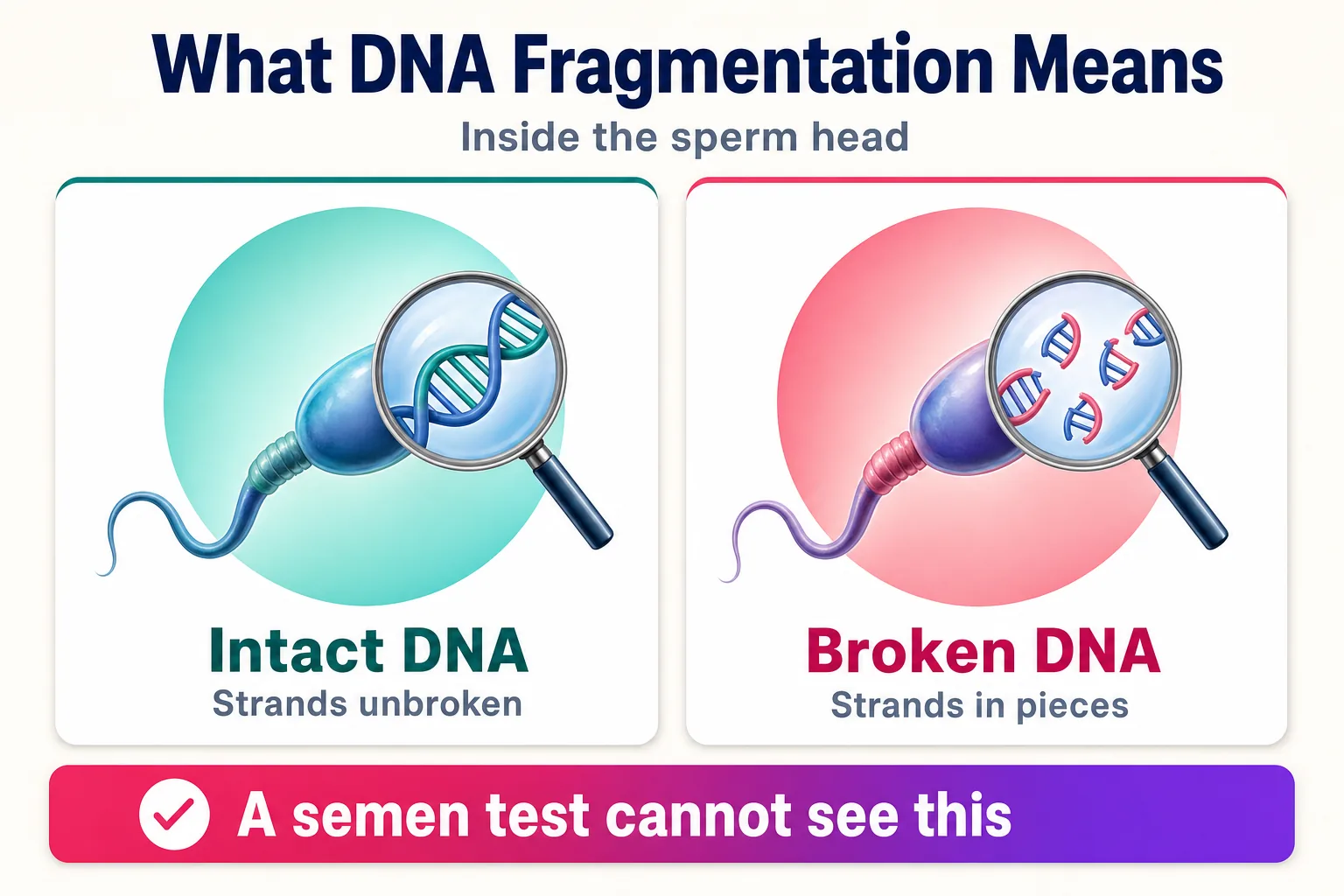
In intact DNA, the strands are unbroken. In broken DNA, the strands are in pieces, and a semen test cannot see the difference.
A man can therefore have a normal count, movement and shape, and still have a high DFI on a report. That gap is why the test gets sold: it sounds like it finds something hidden.
When the semen analysis and the hormones are normal, I still do not order a DFI test.
My guide on how to read a semen analysis report covers the basics.
What causes sperm DNA fragmentation?
Experts link this damage to oxidative stress, a build-up of reactive oxygen in the semen. Reactive oxygen plays a significant role in breaking sperm DNA (Evenson, 2022).
Antioxidant pills are offered for a high DFI because of that oxidative stress link. I explain further down why I skip them.
Smoking, heat, a recent fever and age all raise sperm DNA damage too. Reason 7 below lists them, with the evidence.
How is a DFI test done?
The lab asks for a semen sample, the same way as for a semen analysis. Most labs also ask for two to seven days without ejaculation first. My guide on how to collect a semen sample covers the practical steps.
The lab then stains the sperm and judges each one as intact or broken. The result is written as a percentage.
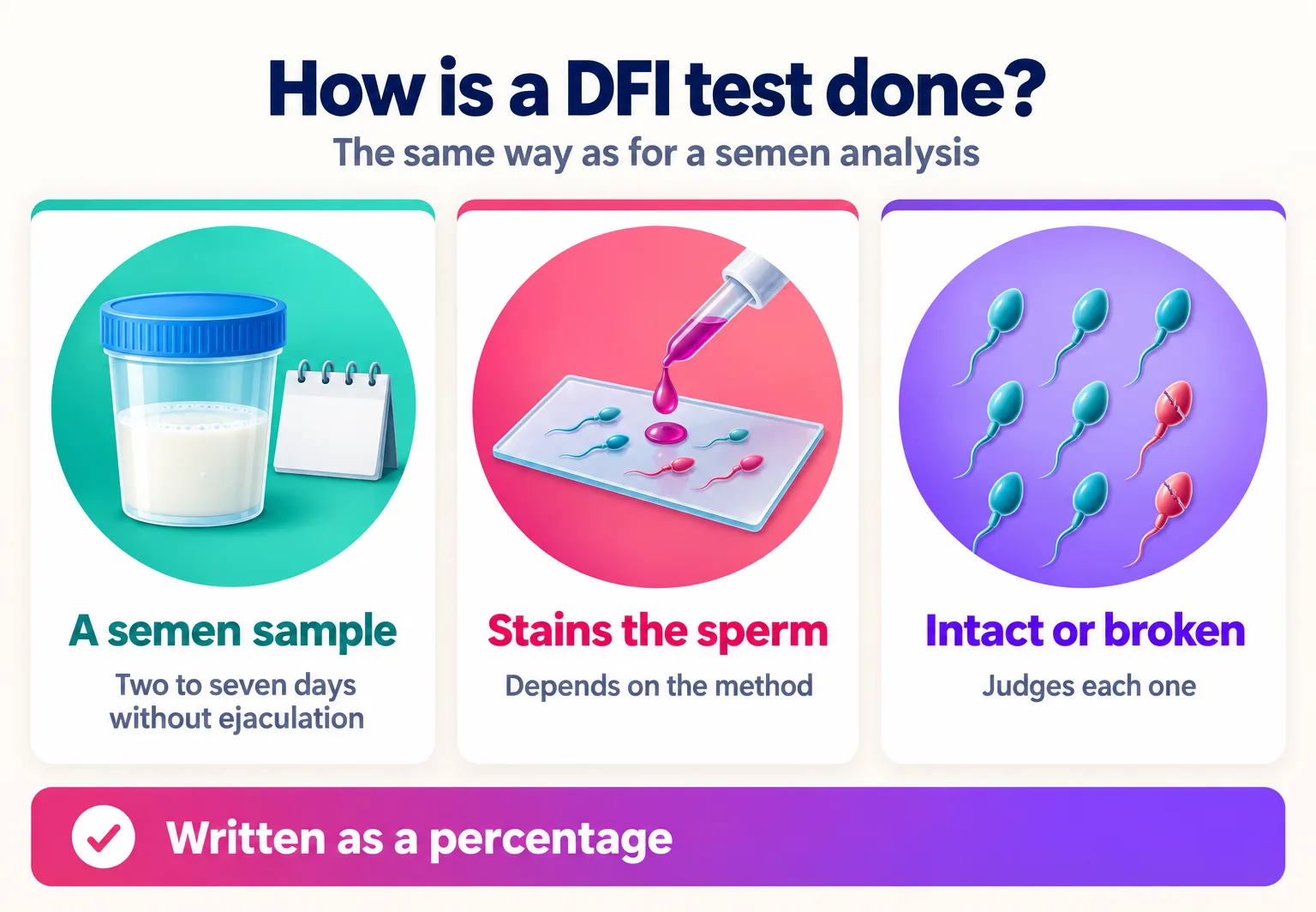
How the lab stains and reads the sperm depends on the method. The lab’s handling changes the number, and studies differ on the waiting time (Gosálvez, 2011; Szabó, 2023), as reason 6 explains.
SCD, TUNEL, SCSA and Comet: the four DFI tests compared
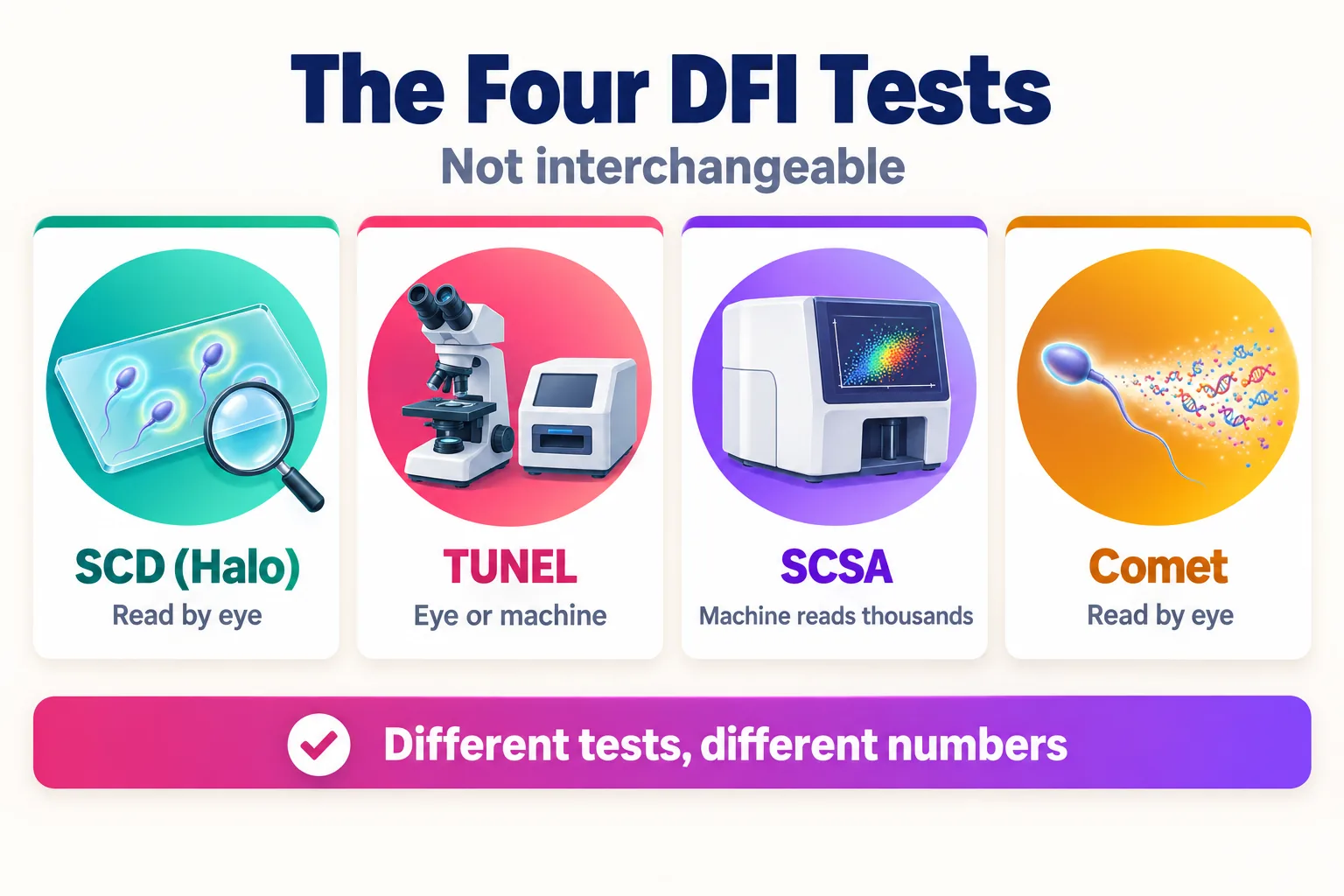
There is not one DFI test. Instead, there are four main ones, each looking at the DNA in a different way. The UK fertility regulator lists the same four on its page on sperm DNA fragmentation.
The four DFI tests at a glance (On a phone, swipe the table sideways.)
| Test | What it shows | How it is read | How many sperm |
|---|---|---|---|
| SCD (Halo) | Intact DNA forms a halo around the sperm head; broken DNA forms a small halo or none | Read by eye | A small sample |
| TUNEL | A stain sticks to the broken ends of the DNA | Eye or machine | Depends on the method |
| SCSA | Acid, then acridine orange stain; broken DNA glows a different colour | Machine reads thousands | 5,000 to 10,000 sperm |
| Comet | Broken DNA trails behind the head like a comet tail | Read by eye | A small sample |
Two of the four are read by eye. The other two can instead be read by a machine that counts thousands of cells.
The SCD or Halo test
SCD stands for sperm chromatin dispersion. Its inventors showed that two trained readers agree closely on the same slide (Fernández, 2003). The test also tracked flow cytometry closely in their hands (Fernández, 2005).
SCD is common and inexpensive. Its weak point is the size of the sample: a person judges a small number of sperm by eye (Kuroda, 2023). Reason 4 explains why that matters.
The TUNEL test
Read by flow cytometry, TUNEL is becoming more popular (Sharma, 2021). But the microscope version, like SCD, depends on how many sperm a person counts.
The SCSA test (flow cytometry with acridine orange)
SCSA is the sperm chromatin structure assay. The sperm are treated with acid and stained with acridine orange. A machine called a flow cytometer then reads 5,000 to 10,000 sperm in about 10 minutes (Evenson, 2022).
SCSA is still called the gold standard among these tests (Gupta, 2017).
Of the four tests, I trust flow cytometry with acridine orange (SCSA) most for a steady number, because it reads about 5,000 cells. Even so, I never do these tests routinely.
A steadier number is not a better predictor. In one study of five tests, SCSA ranked last of the four that could tell fertile from infertile men (Ribas-Maynou, 2013).
The Comet assay
In the Comet assay, broken pieces of DNA drift out of the head in an electric current. Its cut-offs sit much higher than the other tests (Ribas-Maynou, 2013).
Whichever test your report names, the same questions apply: how many sperm were judged, and by whom. Sperm shape is also judged by eye, and labs differ there too. My page on abnormal sperm morphology explains why a repeat test in a careful lab matters.
6 reasons the DFI test is never routine
A routine test is one that every man trying for a baby should have. A semen analysis, for example, is routine.
Hormone tests are routine in my practice, as part of a proper male infertility assessment. The DFI test is not.
1. No major guideline makes it a routine test
The American Society for Reproductive Medicine reviewed sperm DNA tests. Its verdict: they cannot be recommended routinely (ASRM Practice Committee, 2013).
The current American guideline says the same. Its 2024 version states: “Clinicians should not recommend sperm DNA fragmentation analysis in the initial evaluation of the infertile couple”. You can read it in the AUA/ASRM male infertility guideline.
England’s NICE fertility guideline goes further. It says: “Do not carry out testing for sperm DNA integrity (fragmentation)”. You can read it in NICE guideline NG257.
Some guidelines do recommend the test for selected couples, for example after repeated miscarriage. I set out the main ones in what the guidelines say. Not one of them makes it a test for every man.
2. The four tests do not agree with each other
You might expect four tests of the same thing to give the same answer. But the four DFI tests do not.
Researchers once damaged the same samples on purpose, by freezing them or keeping them in the lab. All four tests saw the damage. But they disagreed badly on how much it rose (Calamai, 2025).
In another study, SCD agreed with the other tests only in part. SCD’s correlations were 0.70 with SCSA and 0.68 with TUNEL (Javed, 2019).
Even two versions of the same SCD test can differ. In one comparison, a new SCD kit read by computer differed from an older SCD kit by 6.3 points on average (Kuroda, 2023).
On a single sample, the gap could reach about 20 points. The authors still judged the two methods to agree overall (Kuroda, 2023).
The HFEA puts it plainly. There is no standardisation of sperm DNA fragmentation testing. Its page on the test warns that the same patient can get very different results from different labs.
3. Each test draws the line in a different place
A number is only useful if you know where “normal” ends. Here, however, the line moves with the test.
In one study, five tests were run on the same group of men. The cut-off for infertility came out at 18.9% for SCSA, 20.1% for TUNEL and 22.8% for SCD. For the alkaline Comet test, the cut-off was 45.4% (Ribas-Maynou, 2013).
The neutral Comet test could not tell fertile from infertile men at all (Ribas-Maynou, 2013). A second study, using a lab-modified SCSA method, found a similar spread of cut-offs (Javed, 2019).
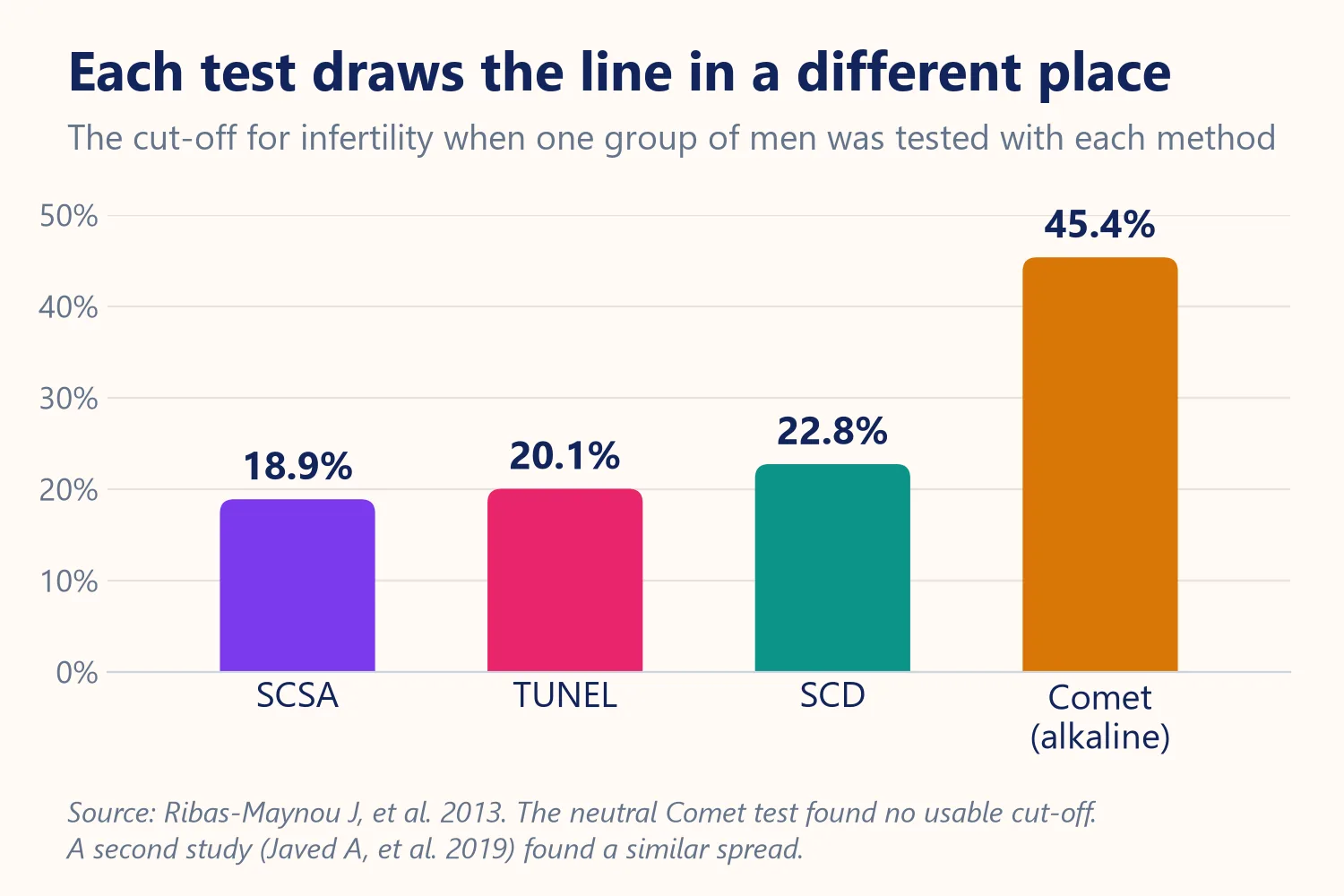
A DFI of 25% can therefore be high on one test and normal on another. A 2026 review says there is still no single agreed cut-off, because the methods differ so much (Cheng, 2026).
Thresholds even shift with the lab’s own technique (Punjabi, 2019). The HFEA agrees. There is no agreement, in the UK or internationally, on what counts as a high level.
4. A small sample cannot speak for millions of sperm
A normal ejaculate holds tens of millions of sperm. Yet an SCD report is often built on a small sample, judged by eye (Kuroda, 2023).
Sometimes a lab counts only about 100 sperm in an SCD test and stretches that result to millions. In my view, that does not give a correct picture. As a report, it usually misleads more than it helps.
The arithmetic is simple. A chart and a checker for your own report follow just after reason 6.
5. The same man’s number swings from sample to sample
Suppose the lab is perfect. Your own DFI still moves between samples.
In one study, the same men gave repeated SCSA samples, and their DFI varied a lot between tests. Of the men above 30% on the first test, 37% fell below 30% on the second. The authors therefore advised repeating the test (Erenpreiss, 2006).
In another study, 85% of men stayed on the same side of 30% on a second SCSA (Oleszczuk, 2011). The trouble is the men near the line. Those men are exactly the ones who get worried by a report.
The number also moves with the season and with age (Christensen, 2025). These swings were measured with SCSA itself, the test whose count moves least by chance.
6. How the sample is collected and kept changes the number
Your DFI does not depend on your sperm alone.
Shorter abstinence lowered the measured DNA fragmentation in several studies (Gosálvez, 2011; Lo Giudice, 2024). One large review found no clear effect of abstinence, so studies differ (Szabó, 2023). The number also changes with the time of day the sample is given (Ni, 2019).
Lab handling counts too. For example, the number rises if the acid step runs longer. Keeping the semen in the fridge for two days raises it as well (Lu, 2021).
One report therefore mixes three things: your sperm, the day you gave the sample and the lab’s handling.
Why counting 100 sperm cannot speak for millions
Imagine a bag of a million marbles. Some are cracked.
You pull out 100 and find 25 cracked ones. Can you say exactly 25% of the whole bag is cracked?
No. With only 100 marbles, luck alone moves the result. So the true share could be a fair bit lower or higher.
Pull out 5,000 marbles, and your answer gets much tighter.
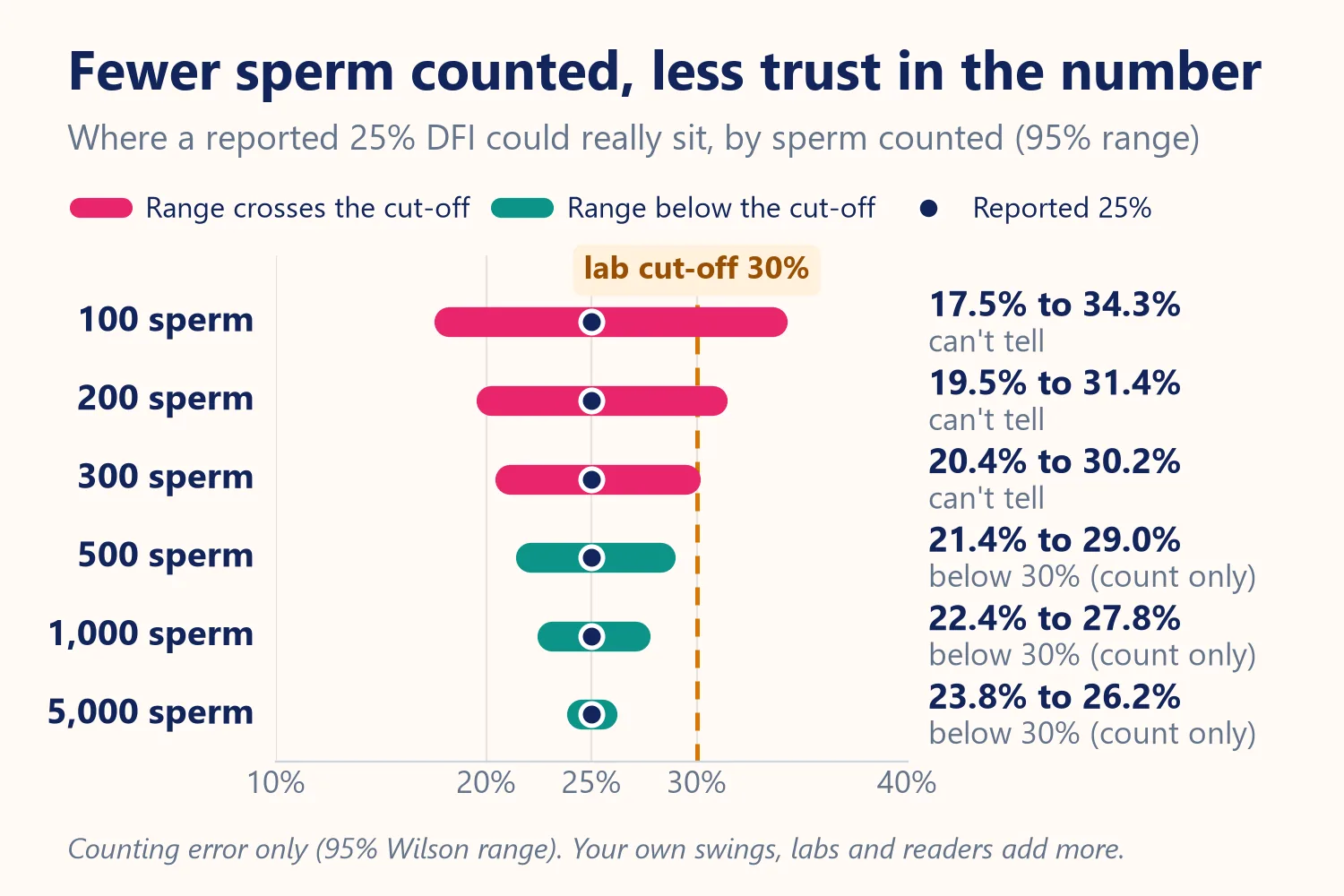
A DFI report is the same. In my view, a number built on about 100 sperm cannot speak for millions. The arithmetic shows why:
What the numbers mean
Each range below is a 95% range: where the true value very likely lies.
Where a printed DFI of 25% could really sit
| Sperm counted | Where the true DFI could lie | Against a 30% cut-off |
|---|---|---|
| 100 | 17.5% to 34.3% | Can’t tell |
| 200 | 19.5% to 31.4% | Can’t tell |
| 300 | 20.4% to 30.2% | Can’t tell |
| 500 | 21.4% to 29.0% | Below 30% on counting alone |
| 1,000 | 22.4% to 27.8% | Below 30% on counting alone |
| 5,000 | 23.8% to 26.2% | Below 30% on counting alone |
Look at the first row. With 100 sperm counted, a printed 25% could be anywhere from about 18% to 34%. The report therefore cannot tell you which side of 30% you are on.
Turn it around. With 100 sperm counted, a report must read above about 39% to clear a 30% cut-off with its whole range.
A report must read below about 21% for its whole range to sit under the cut-off. Anything in between, the report simply cannot call.
If your lab counted 300 or 500 sperm, the range is narrower. But a result close to the cut-off still cannot be called.
A printed 27% from 500 sperm, for example, could be anywhere from 23.3% to 31.1%. And this is only the counting error. Your own swings from sample to sample come on top.
Check your own DFI report
Have a report in hand? Use the checker below. It works out the same range for your own numbers.
- Enter the DFI printed on your report.
- Pick the test your report names, such as SCD or SCSA.
- Enter how many sperm the lab counted. Look for “sperm counted” or “cells scored”. If the number is not printed, the checker starts at 100 for an SCD report, and you can ask the lab for the real number.
- Enter the cut-off printed on your report.
How much can you trust your DFI number?
A lab scores a small sample of sperm and prints one number. Enter what your report says, and see how far the true figure could sit from that number just by chance.
This range covers only the luck of which sperm were counted. Differences between labs, stains and the person reading the slide add more.
For education only. It does not diagnose anything, and it is no reason to start a medicine on your own.
The checker does not diagnose anything. The checker shows how much weight one printed number can carry.
For the fuller picture, start with a proper semen analysis test and your hormones. My semen analysis calculator then reads the rest of your report.
6 reasons a sperm DNA fragmentation test is never required
“Never routine” means it is not a test for every man. “Never required” goes further. Even for the men it is usually recommended for, I can do my job without it.
7. The causes of DNA damage can be found without it
A large review linked the highest DFI levels with smoking, pollution and a varicocele. Raised blood sugar before diabetes and a father aged over 50 were on that list too (Szabó, 2023).
Professional drivers, who spend long hours with heat on the scrotum, had more sperm DNA damage than fertile men (Budzinska, 2024).
In one man followed after a fever, sperm DNA damage stayed raised for weeks (Sergerie, 2007). Older age is linked with a higher DFI in most studies (Gonzalez, 2022).
Each of these causes shows up in the history, the examination or a blood test. A careful semen analysis, such as computer-assisted semen analysis, adds more.
A DFI number does not tell you which cause is at work. If your count is low too, see my page on low sperm count.
8. FSH, LH and testosterone tell me more than a DFI number
The pituitary gland at the base of the brain sends out LH and FSH.
LH tells the testes to make testosterone. FSH works on the Sertoli cells, which nurse the developing sperm. Both testosterone and FSH are needed for sperm to be made in normal numbers (McLachlan, 2002).
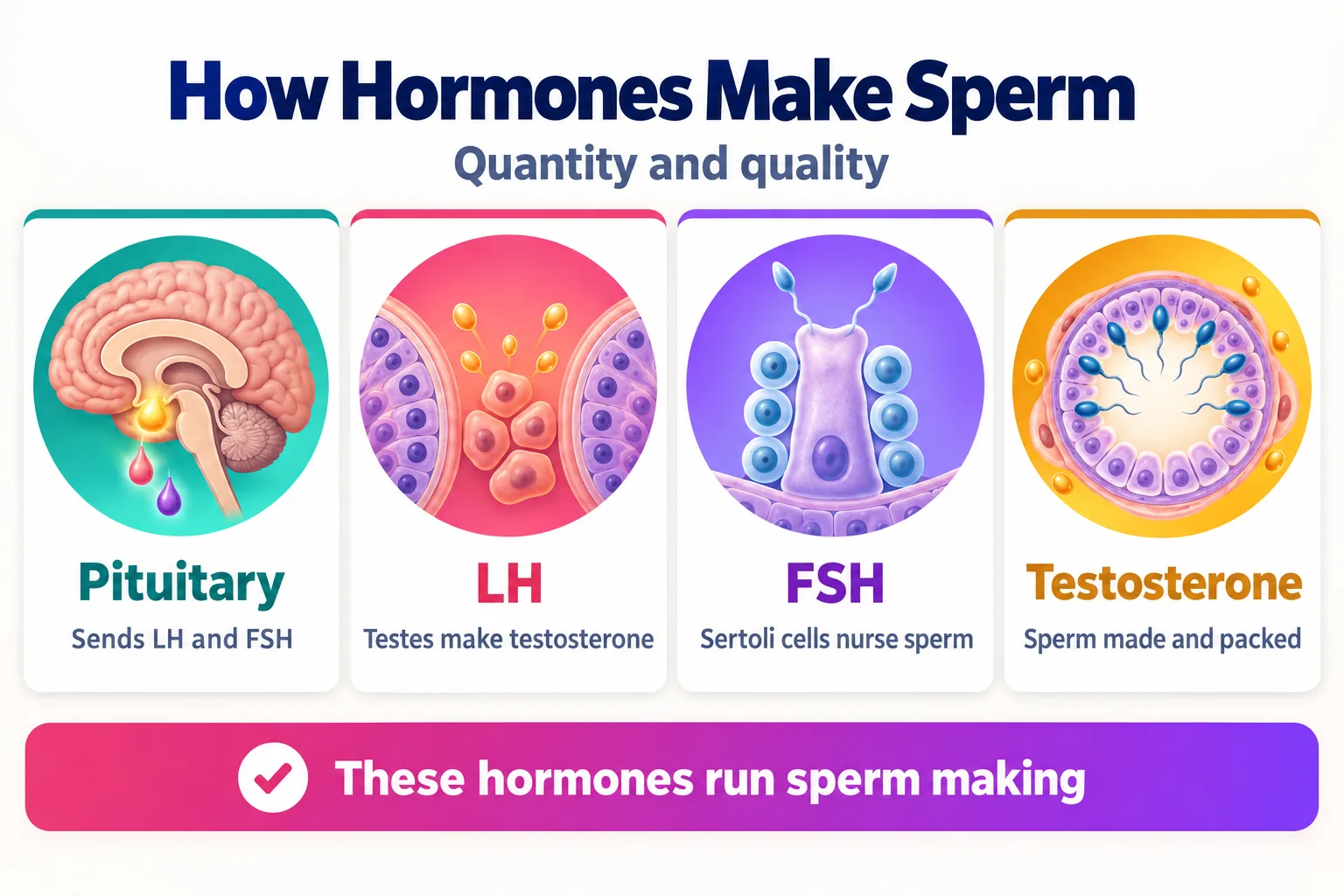
In rats, both FSH and testosterone seem needed to pack the sperm DNA tightly (Gill-Sharma, 2011). So these hormones run sperm making, and seem to shape the DNA as well.
Men with very high or very low FSH and LH had more DNA damage (Wdowiak, 2014). In the same study, DNA damage also fell as testosterone rose.
Low testosterone went with more DNA damage in another study (Serbouti, 2026).
In a 2024 study of infertile men with no known cause, those with a DFI of 30% or more had a higher FSH and a lower testosterone (Boeri, 2024). Men with clearly low testosterone were not included. The same study found a high DFI in about half of these men, and its authors favour testing.
When FSH and LH are high, or testosterone is low, I already expect weaker sperm DNA. These hormones are needed for both the quality and the quantity of sperm production.
The hormone result also tells me what to treat. A DFI number does not.
The hormone links are modest. One large study of 1,010 men found DFI rose with LH and FSH (Lu, 2018). In that study, though, DFI was unrelated to testosterone.
Hormones are not a one-for-one stand-in for a DFI number. My page on low testosterone symptoms lists the signs.
9. The result would not change my first steps
A test earns its place when its result changes the plan. A DFI result rarely changes mine.
The HFEA says it directly. The results of a sperm DNA damage test are unlikely to impact on the management of your fertility treatment. You can read that on its sperm DNA fragmentation page.
A large 2026 review also points the same way. The review pooled 52 studies with 19,930 people (Vitthala, 2026).
In that review, a high DFI did go with worse outcomes. Even so, a high DFI was only a poor-to-moderate guide to which couples would struggle (Vitthala, 2026). On its own, a DFI number has limited power to tell a couple whether they will conceive or miscarry.
For IVF and ICSI, one meta-analysis found pregnancy somewhat more likely when DFI was below the cut-off. With SCSA alone, the difference was not significant, and the authors could not confirm that DFI predicts the outcome (Zhang, 2015).
DFI also says little about embryo quality (Jiang, 2025). Before IUI, the test had limited power to tell couples apart (Sugihara, 2020).
First, I order the hormone tests and a repeat semen analysis. Then I treat the cause I find. A man who arrives with a high report is treated too, as I explain below.
10. No trial shows that ordering it brings more babies
The question that matters to a couple is simple. Does ordering the test lead to more babies? So far, no trial has shown that.
For couples having IVF or ICSI, a meta-analysis found too little evidence to recommend routine testing (Cissen, 2016). The finding held both for predicting pregnancy and for choosing a treatment.
The 2026 review says the test’s value still needs to be shown in well-designed trials (Vitthala, 2026). An umbrella review calls for standard tests and large prospective studies before routine use (Wan, 2026).
The AUA/ASRM male infertility guideline makes the same point: “There are no prospective studies that have directly evaluated the impact of DNA fragmentation testing on the clinical management of infertile couples”. Even the experts who favour the test rate their own evidence as moderate to low quality (Esteves, 2021).
11. A high number is used to sell treatments that are not proven
After a high DFI report, a couple may be advised to try add-on treatments. The HFEA has rated those add-ons.
Antioxidants after a DNA fragmentation test are rated grey. In other words, there is not enough good evidence to say they help.
Sorting the sperm by density gradient or MACS before ICSI, or using PICSI, is rated grey too. In the studies the HFEA reviewed, these sorting methods made no significant difference to the chance of having a baby.
Testicular sperm extraction or aspiration with ICSI, after the test, is rated red for male factor infertility. Red means there is not enough good evidence of benefit, and the procedure carries risks. The ratings are on the HFEA page.
A 2024 review looked at men with a high DFI who still have sperm in the semen. The review found higher pregnancy and live birth rates with testicular sperm, but the evidence was weak (Khoo, 2024). The review’s authors say ICSI with testicular sperm should not be routine until better trials exist.
12. In 12 years, I have not needed it as a first test
In 12 years, I have never ordered a DFI test as a first-line investigation.
If you already hold a high DFI report, I do not ignore it. I treat the cause, and I re-check the DFI if you ask. You will find exactly what I do further down.
My guide to male infertility treatment lists what works and what to skip.
DFI normal range: what 15%, 25% and 30% really mean
Many SCSA reports print three bands: under 15% is called normal, 15% to 30% moderate, and over 30% high. These lines come from early SCSA work (Evenson, 1999). The HFEA says “high” usually means a DFI above 25%.
The three bands belong to particular tests and studies. So there is no single normal range for every report.
Cut-offs you may see on a DFI report, and where they come from
| Cut-off | Where it comes from |
|---|---|
| 15% | One study counted a DFI above 15% as abnormal (Serbouti, 2026) |
| 20% | Men with a DFI above 20% were more often infertile in a case-control study (Giwercman, 2010) |
| 25% | The HFEA says “high” usually means a DFI above 25% |
| 30% | Early SCSA work: none of the couples who conceived within three months had a DFI of 30% or more (Evenson, 1999) |
| 40% | The chance of natural conception becomes small above 40% (Spanò, 2000) |
One team summed up earlier work this way. Above a DFI of 20%, natural pregnancy is less likely, even with a normal semen analysis. Above 30%, pregnancy by natural conception or insemination is very unlikely (Oleszczuk, 2013).
One SCSA study looked back at 406 couples in their first IVF or ICSI cycle. Ongoing pregnancies fell above a DFI of 15 after IVF, and above 25 after ICSI (Christensen, 2025).
On an SCD or Comet report, the same number can mean something different. A band also means little when the count behind it is small.
I read any DFI number next to the count, the sperm movement and the hormones.
What the guidelines say about DNA fragmentation testing
I promised to be honest about this. Guidelines differ, so you deserve to see both sides.
What the main sources say about sperm DNA fragmentation testing
| Source | What it says |
|---|---|
| AUA/ASRM male infertility guideline (2020, amended 2024) | “Clinicians should not recommend sperm DNA fragmentation analysis in the initial evaluation of the infertile couple”. For couples with recurrent pregnancy loss, it says clinicians should evaluate the male partner with “karyotype” and “sperm DNA fragmentation” (a moderate recommendation). It adds: “DNA fragmentation testing may be advantageous for males in couples undergoing IVF with repeated IVF failure” |
| NICE fertility guideline NG257, England 2026 | “Do not carry out testing for sperm DNA integrity (fragmentation)”. It also advises: “Do not offer supplements, antioxidants or medical treatments to improve sperm DNA integrity (fragmentation)” |
| ASRM recurrent pregnancy loss committee opinion (2026) | “Sperm DNA fragmentation testing may be considered in patients with otherwise unexplained recurrent miscarriage or RPL and concomitant infertility”. |
| American Society for Reproductive Medicine (2013) | Sperm DNA tests cannot be recommended routinely (ASRM Practice Committee, 2013) |
| European urology guideline, EAU 2026 | A strong recommendation: “Perform sperm DNA fragmentation (SDF) testing in the assessment of couples with recurrent pregnancy loss from natural conception and failure of ART or males with unexplained infertility” |
| WHO semen manual, 6th edition | An extended test, not part of the basic semen analysis (Baldi, 2022) |
| Global Andrology Forum (2026) | Supports the test in chosen situations, but says gaps in the evidence limit its routine use (Çayan, 2026) |
| One 2021 meta-analysis | Argues that routine testing is justified for IVF (Ribas-Maynou, 2021) |
| HFEA, the UK fertility regulator | Antioxidants and sperm sorting after the test: grey. Testicular sperm with ICSI after the test: red |
When guidelines advise the test, and when they do not
Some guidelines do recommend the test for selected couples. The HFEA lists the usual situations: repeated miscarriage, failed IVF, and unexplained infertility in the man. Europe’s urology panel has also written a guide on when to consider the test (Tharakan, 2022).
England’s NICE guideline, however, takes the opposite view. It advises against testing sperm DNA integrity at all.
Why I still do not order it
I respect the guidelines that recommend the test for selected couples. I still do not order the test, for three reasons.
The four tests disagree with each other. The same man’s number swings between samples. No trial has yet shown that ordering the test brings more babies.
Most experts surveyed do use the test. In a global survey, about three in four tested some men with unexplained infertility (Agarwal, 2023). Even so, practice in that survey varied widely, with few society guidelines behind it.
In an earlier survey, specialists named cost, poor validation and low precision as the main drawbacks. The authors added that many methods with different cut-offs held back routine use (Majzoub, 2017).
For the full work-up I do instead, read my guide to male infertility.
Sperm DNA fragmentation and miscarriage
Let me be clear. A high DFI is linked with miscarriage, and sperm DNA damage is not harmless.
A review of 16 studies with 2,969 couples looked at miscarriage. Miscarriage was about twice as common with high sperm DNA damage (Robinson, 2012). The same review also noted that the studies used different tests and different cut-offs.
After IVF and ICSI, high sperm DNA damage went with more miscarriages too (Zhao, 2014). Men whose wives had repeated miscarriages had a higher DFI than men whose wives had healthy pregnancies. The gap was about 12 points (McQueen, 2019).
Couples with unexplained repeated miscarriage had higher DNA fragmentation in another review (Dai, 2021). One study found more sperm DNA damage in these husbands too (Kumar, 2012).
Now the other side. An umbrella review rated all seven meta-analyses on semen and repeated miscarriage low or very low in quality (Zhang, 2024). Even so, DNA fragmentation and sperm movement had the best-supported links with repeated miscarriage in that review (Zhang, 2024).
A high DFI also predicts miscarriage poorly (Vitthala, 2026). So the link is real, but for any one couple the test is a poor guide.
What I check after repeated miscarriage
The American guideline does advise testing the man after recurrent pregnancy loss. The table above quotes its words.
Here I part company with that guideline. After repeated losses, I check his testosterone, FSH and LH first. I do not order a DNA fragmentation test.
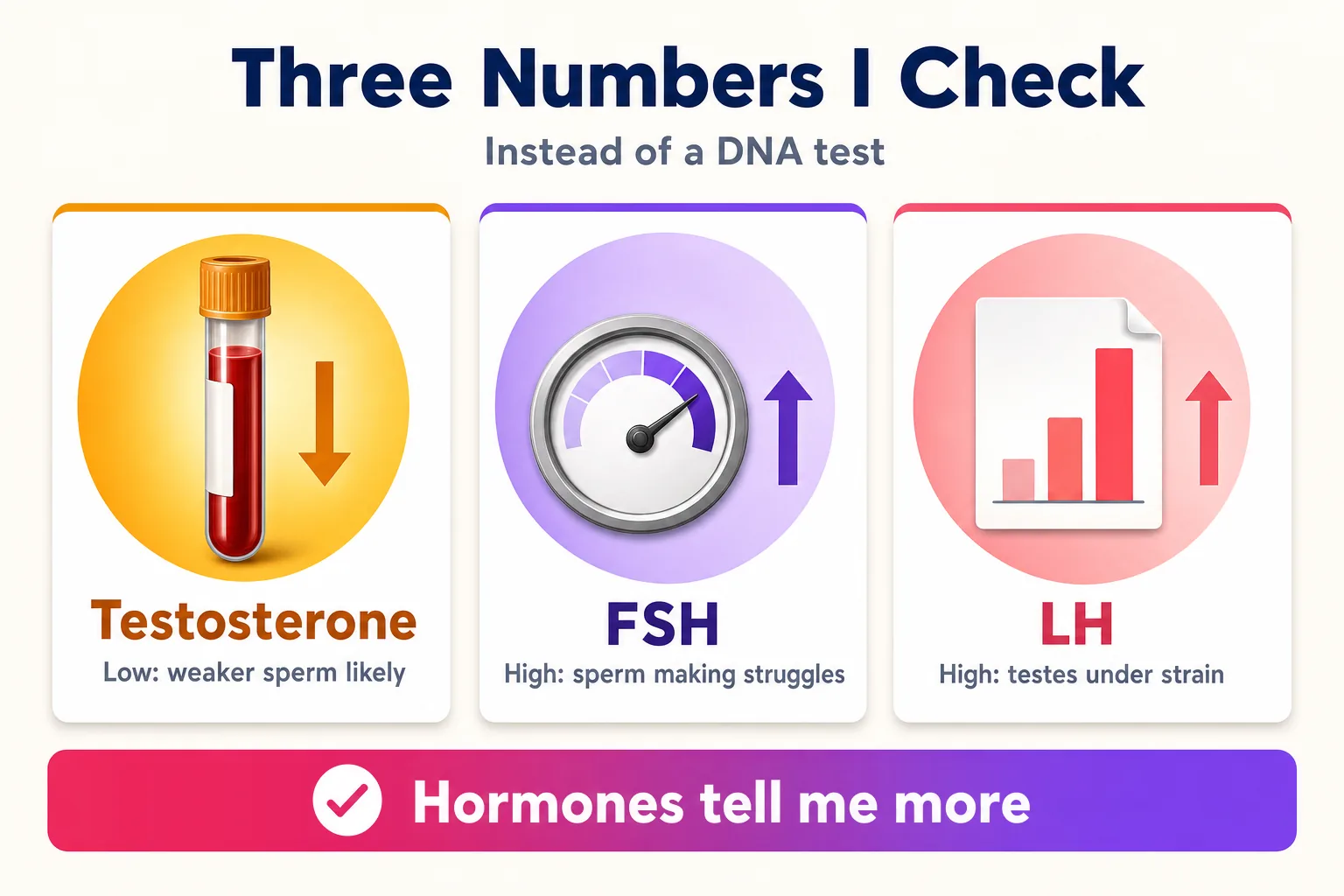
Testosterone, FSH and LH are the three numbers I check instead of a DNA test. I check them not to predict a miscarriage, but because they point to a cause I can treat:
- Testosterone. Low testosterone makes weaker sperm likely.
- FSH. A high FSH means sperm making struggles.
- LH. Raised LH means the testes are under strain.
Miscarriage has many causes on the wife’s side as well. Her doctor should therefore check those too. For the man’s side, read my page on low sperm count and miscarriage.
Sperm DNA fragmentation, natural pregnancy, IUI and IVF
Read these numbers as averages across many couples, not as a forecast for you.
Natural conception with a high DFI
The chance of conceiving naturally falls as the share of damaged sperm rises. That chance becomes small above 40% (Spanò, 2000).
A re-analysis looked at two SCSA studies. Pregnancy was more likely below a DFI of 30% in one, and below 40% in the other (Evenson, 2008).
IUI with a high DFI
Here the studies disagree. One meta-analysis found a lower pregnancy rate after IUI with high DNA fragmentation (Chen, 2019).
An updated meta-analysis found no significant drop in pregnancy rate after IUI with high DNA fragmentation (Liu, 2025). My page on IUI explains how it works.
IVF and ICSI with a high DFI
Sperm DNA damage was linked with a lower clinical pregnancy rate after IVF or ICSI (Simon, 2017). One review found the pregnancy link in IVF but not in ICSI (Zhao, 2014).
Another review found the pregnancy link in both, but weaker with ICSI (Simon, 2017). The link with miscarriage stays with ICSI (Zhao, 2014; Wan, 2026).
Live birth after IVF or ICSI was a little higher with a low DFI. For ICSI the gain was smaller, and it was no longer significant in a stricter re-analysis (Osman, 2015).
The pregnancy link is real, but modest. On its own, a DFI number could not be shown to predict how IVF or ICSI will go (Zhang, 2015).
In my view, a DFI number on its own cannot tell you whether you need IVF.
Sperm preparation picks the moving, better-shaped sperm
A DFI report usually measures the raw semen. For IUI, IVF and ICSI, however, the lab does not use the raw semen. The sperm are first washed and prepared, often by density gradient centrifugation.
Sperm preparation separates the moving sperm from sperm that do not move or have a poor shape (Henkel, 2003). In men with many misshapen sperm, density gradient lowered both the share of abnormal shapes and the DFI, compared with the raw semen (Xue, 2014). Two more studies found less DNA fragmentation after preparation than in the raw semen (Jamil, 2023; Jensen, 2026).
The HFEA, the UK fertility regulator, describes density gradient as a way to separate high-quality sperm from lower-quality sperm, including sperm with DNA damage.
The gain is not the same in every man. In one study, density gradient raised the share of sperm swimming forward from 53% to 81%, but the DNA fragmentation was not lower (Amano, 2024). In another, density gradient raised the DNA fragmentation in 10 of 20 men, and the authors report that such men have about half the chance of pregnancy (Muratori, 2019).
For ICSI, the embryologist then picks one moving, normal-looking sperm for each egg. In infertile men, though, a normal-looking sperm can still carry broken DNA (Avendaño, 2009). The HFEA grey rating in reason 11 covers sorting chosen after a DNA fragmentation test, because there is too little good evidence that it brings more babies.
One more reason I do not order the test before IUI, IVF or ICSI: a DFI number from the raw semen does not describe the sperm that are finally used.
Already have a high DFI report? Here is what I do
Perhaps you did the test before you met me. That is fine.
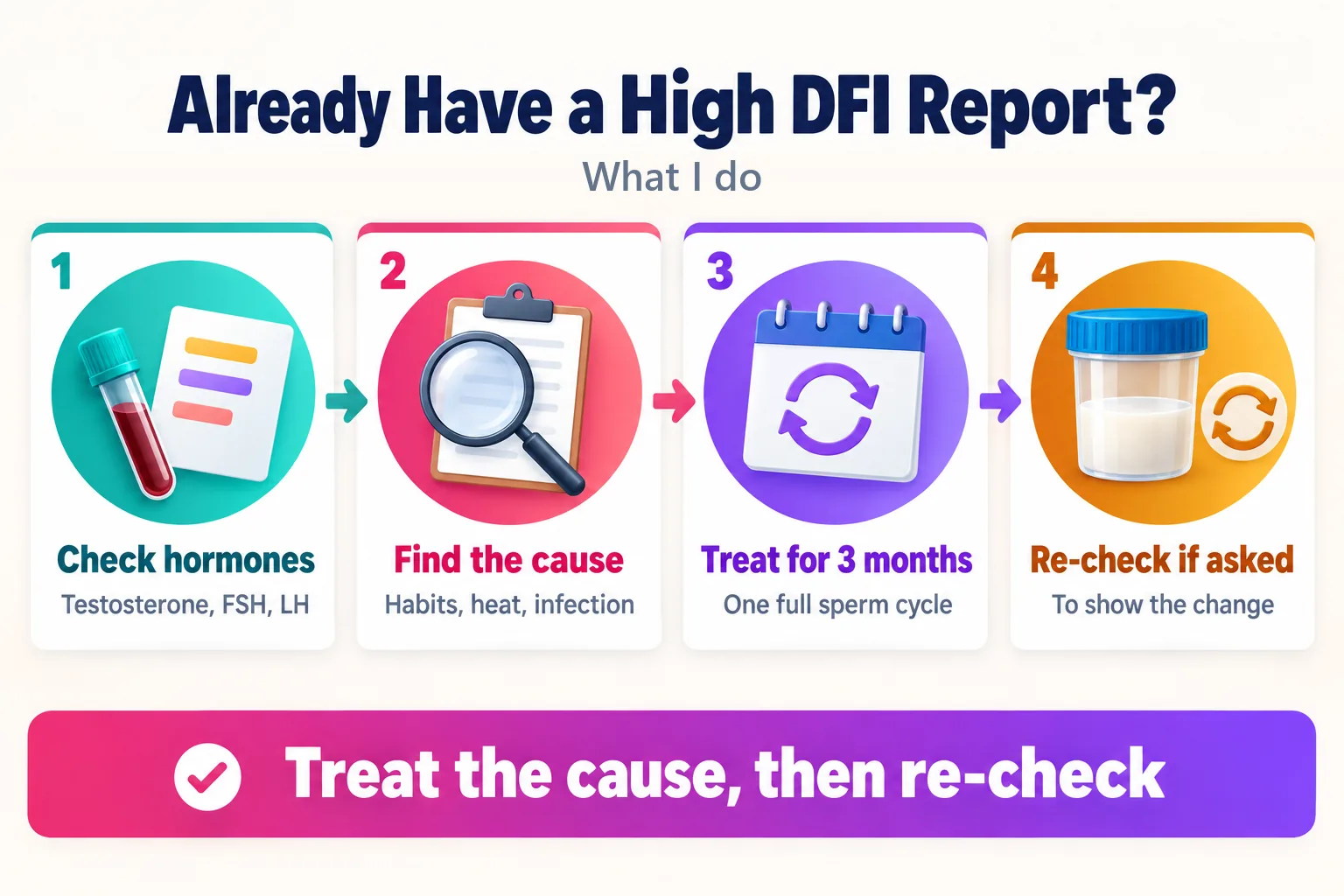
I will not ignore your report. I will not make you repeat the test at the start. My four steps:
- Check hormones: testosterone, FSH and LH.
- Find the cause: habits, heat or an infection.
- Treat for 3 months: one full sperm cycle.
- Re-check if asked, to show the change.
Let me explain each step.
Steps 1 and 2: hormones and the cause
Hormones come first, with a repeat semen analysis and an examination. If the semen shows signs of infection, that infection is treated. The first clue is often pus cells in semen, and a semen culture confirms it.
Step 3: the medicines I use for a high DFI
For high DNA fragmentation, I use Lyon bean extract with letrozole, or Lyon bean extract with anastrozole.
Never start any of these on your own. They need hormone tests first. They also need a doctor to follow you up.
Letrozole and anastrozole belong to a group called aromatase inhibitors. They help a man’s body keep more of its own testosterone. Their use in male infertility is off-label (Yang, 2021).
A meta-analysis concluded that aromatase inhibitors may be effective in infertile men with a low testosterone-to-oestradiol ratio (Guo, 2022). Against other hormone medicines, they did no better on count or shape, and improved movement less (Guo, 2022).
In one study, anastrozole improved hormones in about 95% of men (Shoshany, 2017). But sperm improved in only about one man in four in that study.
In another study, sperm count improved in about half the men treated (Naelitz, 2023). The count fell in about one man in eight.
The DNA evidence for these medicines is small. No study has yet measured DFI before and after anastrozole. For letrozole there is one small study, of 20 men with a low testosterone-to-oestradiol ratio.
In that study, letrozole lowered sperm DNA damage, and 4 couples conceived without other treatment (Kooshesh, 2020). Still, the study had no comparison group.
For a high DFI, I give no antioxidants and no supplements, and Lyon bean extract is neither: in my experience, it raises total testosterone, FSH and LH. I do not give a dose or brand here on purpose. Never start it on your own.
Step 4: the re-check, only if you ask
New sperm take about three months to form. The HFEA notes this on its sperm DNA fragmentation page. So any re-check comes after three months of treatment, not before.
If ever I have written a sperm DNA fragmentation test, it was for a man who already had a high DFI report. We give the medicines, re-check the DNA fragmentation, and show him the improvement. In some couples, a spontaneous pregnancy follows.
When you are ready, bring every report you have: the DFI report, semen analyses and any hormone tests. Prefer to message first? Send your report on WhatsApp, and my team will help you book.
Just as important is what I leave out. Each of these gets offered to men with a high DFI report.
Myths and add-ons
What I don’t do for high sperm DNA fragmentation
Antioxidant cocktails
Two randomised trials found no extra babies, and one found more DNA damage.
Varicocele surgery
A varicocele often travels with subfertility. I never recommend surgery for it.
Clomiphene
I do not use clomiphene in my practice, for this or for a low count.
FSH or hCG injections
Only for pituitary failure. Never for an ordinary low count or a high DFI.
Testosterone injections
Testosterone from outside switches off your own sperm production.
A routine DFI test
Never as a first-line test.
Why I skip antioxidant cocktails
Pooled studies report that DFI falls by about 3 points with lifestyle change (Szabó, 2025). DFI falls by more with antioxidant pills or FSH treatment, but a lower DFI on paper has not yet been shown to bring more babies.
In a controlled trial of antioxidant pills for men, fewer couples had a baby on the antioxidants than on dummy pills: 15 in 100 versus 24 in 100 (Steiner, 2020). The trial was small, so that gap may be chance. What it clearly did not show is any benefit.
In the largest zinc and folic acid trial, there were no extra babies, and sperm DNA damage went up (Schisterman, 2020). That is why I do not prescribe antioxidant cocktails.
The same antioxidant trial did not find even a lower number. In men who already had a high DFI, the DFI did not differ at three months. The DFI was 29.5% on antioxidants and 28.0% on dummy pills (Steiner, 2020).
Why I never recommend varicocele surgery
Varicoceles are common. They are found in 12% of men with normal semen (Chiba, 2016). Only about one in five men with a varicocele has a fertility problem (Chiba, 2016).
You may read that varicocele surgery lowers the DFI number, but a couple needs a baby, not a lower number.
A Cochrane review found low-certainty evidence that treating a varicocele may raise pregnancy rates (Persad, 2021). But the same review found no clear evidence on live births.
That evidence is not strong enough for me to send a man for surgery. I never recommend varicocele surgery.
Why I avoid clomiphene, hormone injections and testosterone
I do not use clomiphene in my practice.
For pituitary failure only, hCG and FSH injections restart sperm production. I never use them for an ordinary low count. In men with pituitary failure, most reached a measurable sperm count on hormone injections (Hosseinifar, 2013).
Never take testosterone while you are trying for a baby. It tells your own testes to stop making sperm.
For what does help sperm, read my guide on how to improve sperm quality.

Private 1-on-1 consultation
Holding a high DFI report? Let’s find the cause.
A private consultation with a practising andrologist. We find your cause first, then make a plan that fits it.
Book a Confidential Consultation
How to reduce sperm DNA fragmentation without a test
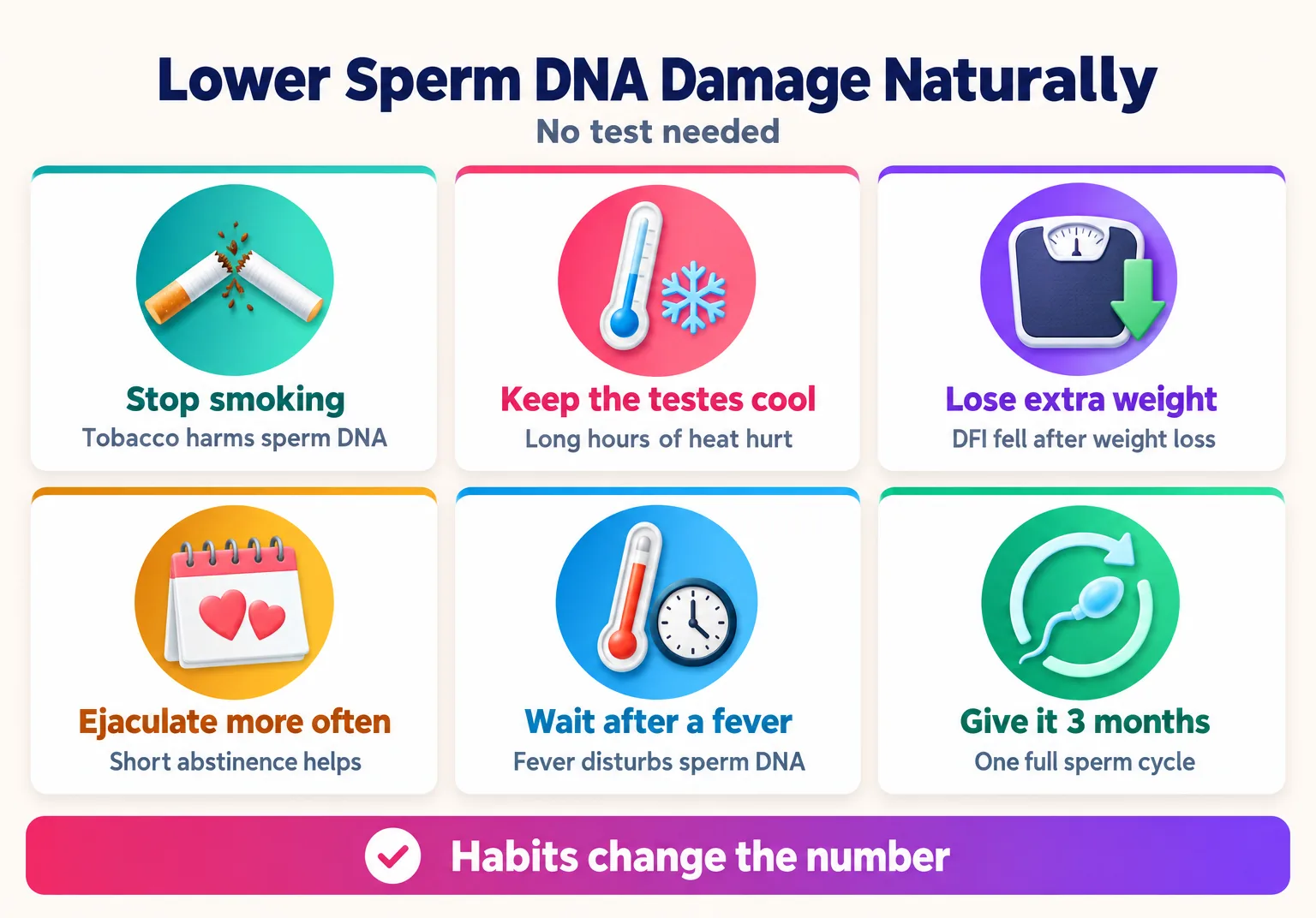
No test needed: you do not need a DFI number to protect your sperm DNA. The same six habits help every man, whatever a report says:
- Stop smoking, because tobacco harms sperm DNA.
- Keep the testes cool, since long hours of heat hurt.
- Lose extra weight: DFI fell after weight loss in a meta-analysis.
- Ejaculate more often: short abstinence helps in several studies.
- Wait after a fever, because fever disturbs sperm DNA. Never judge your sperm on a sample given soon after one.
- Give it 3 months: one full sperm cycle.
For smoking and heat, read my pages on smoking and sperm and tight underwear. My page on hot water baths covers the rest.
Weight
In obese men who lost weight, the average DFI fell from 20.2% to 17.5% (Mir, 2018). A meta-analysis found that weight loss may improve sperm count and movement, and the DFI also fell (Santi, 2025). No direct link between BMI and DNA fragmentation has been proven (Sepidarkish, 2020).
Ejaculating more often
In men with abnormal semen, a second sample given within four hours of the first had better movement and less DNA damage (Barbagallo, 2022). Shorter abstinence also went with less DNA damage in another meta-analysis (Lo Giudice, 2024). Frequent ejaculation does not harm sperm DNA in these studies.
My own study looked at 2,037 Tamil men who came to a fertility clinic. Sperm concentration, movement and shape did not differ significantly from under a day of abstinence to over a month, and samples given within 24 hours were no worse (Dupesh, 2020). My study did not measure DNA fragmentation, so it speaks only to the routine semen numbers.
Read does masturbation cause infertility for the myths. For the timing, see how often to have sex to get pregnant.
When should you see an andrologist?
See an andrologist, not just a lab, if any of these apply to you:
- You have tried for a baby for a year, or six months if your wife is 35 or older.
- Your semen report shows a low count, poor movement or poor shape.
- Your wife has had two or more miscarriages.
- You already hold a high DFI report and do not know what to do with it.
A proper male infertility assessment covers your history, an examination, two semen analyses and your hormones. My page on male fertility testing explains each test in turn. If a report shows no sperm at all, read my page on azoospermia first.
Private consultation
Bring your reports. Leave with a plan.
A confidential consultation with a practising andrologist. Bring your DFI report, every semen analysis and any hormone tests you have.
Sperm DNA fragmentation test: your questions answered
What does sperm DFI stand for and what does it measure?
DFI stands for DNA Fragmentation Index. It is the percentage of sperm in a semen sample that a lab judges to carry broken DNA. It is not part of a routine semen analysis.
Is a DNA fragmentation test worth it?
No, not in my practice. It is not a routine test, the four methods disagree, and the result rarely changes the plan. A semen analysis and testosterone, FSH and LH tests are worth more.
Is 18% considered high DNA fragmentation for sperm?
The answer changes with the test. On SCSA, 18% sits between the common 15% and 30% lines (Evenson, 1999), while on an alkaline Comet test it is low. Either way, your hormones and semen analysis guide what I do.
Is the SCD (Halo) test accurate?
Trained readers agree well on the same slide (Fernández, 2003). The weak point is the count. When a lab judges only a small sample of sperm by eye, the true DFI can sit far from the printed number.
What happens if DFI is high?
A high DFI is linked with a lower chance of pregnancy and more miscarriage, on average. On its own, it does not decide your plan. I check hormones, treat the cause, and re-check only if you ask.
Can I get pregnant if my husband has sperm DNA fragmentation?
Yes, it is possible. A high DFI lowers the odds on average, but it does not rule out pregnancy. In my clinic, some couples conceive naturally once the cause is treated.
Can you have a healthy baby with high DNA fragmentation?
Yes. A high DFI raises the average risk of miscarriage, not the certainty of it (Robinson, 2012). I treat the man’s cause, and his wife’s doctor checks her side.
How can I reduce my DFI?
Stop smoking, keep the testes cool, lose extra weight, ejaculate more often and wait after a fever. New sperm take about three months to form. Give each change that long.
How long does it take to fix DNA fragmentation in sperm?
Any change takes about three months to show. New sperm take roughly that long to form. That is why any re-check comes only after three months of treatment.
Is sperm fragmentation treatable?
Yes, the number can come down over about three months. I find and treat the cause, then, after hormone tests, add Lyon bean extract with letrozole or anastrozole. Never start these on your own.
What are the treatment options for sperm DNA fragmentation?
Fix the cause first: smoking, heat, weight, infection and hormones. I skip antioxidant cocktails. For a high DFI, after hormone tests, I add Lyon bean extract with letrozole or anastrozole; never start these on your own.
How do you test for DNA fragmentation?
A lab stains a semen sample and judges each sperm as intact or broken. A person reads the slide by eye, or a machine reads it. The four common tests are SCD, TUNEL, SCSA and Comet.
Is the DFI test a blood test?
No. It is done on a semen sample, not blood. The blood tests I prefer are testosterone, FSH and LH.
Is abstinence required for a DFI test?
Most labs ask for two to seven days without ejaculation. Several studies found that shorter abstinence lowered the measured DFI (Gosálvez, 2011; Lo Giudice, 2024). One large review found no clear effect (Szabó, 2023).
How much does a sperm DNA fragmentation test cost?
I do not quote prices on this site. I never order it as a first test, so it is not a cost you need to plan for. A semen analysis and three hormone tests tell me more.
Should the husband’s sperm DNA be tested after two miscarriages?
The American and European urology guidelines recommend it after repeated pregnancy loss. I still do not order it. I check his testosterone, FSH and LH, treat what I find, and her doctor checks her side.
Does sperm DNA fragmentation increase with age?
Yes. Older age is linked with a higher DFI in most studies (Gonzalez, 2022). In one study, men over 38 had more than twice the odds of a DFI above 30% (Pozzi, 2023).
Which sperm DNA fragmentation test is best?
Of the four, I trust SCSA most for a steady number: a machine reads 5,000 to 10,000 sperm. A steadier number is not a better predictor. I never order SCSA as a first test either.
Do I need a DFI test before IVF or ICSI?
No, I do not order it before IVF or ICSI. A meta-analysis could not confirm that DFI predicts IVF or ICSI outcome (Zhang, 2015). Your semen analysis, your hormones and your wife’s age guide the plan.
Does sperm washing reduce DNA fragmentation?
Often, but not in every man. Density gradient keeps the moving, better-shaped sperm, and three studies found less DNA damage afterwards (Xue, 2014; Jamil, 2023; Jensen, 2026). One study found the opposite in 10 of 20 men (Muratori, 2019).
The bottom line on the sperm DNA fragmentation test
The sperm DNA fragmentation test is never routine, and in my view it is never required. The four tests disagree, and a small sample cannot speak for millions of sperm. And the result would not change my first steps.
A careful semen analysis, an examination and three hormone tests tell me what to treat. If you already hold a high DFI report, I treat the cause and re-check the DFI if you ask.
If you are ready to start, call 97907 83856 or message on WhatsApp. I will read your reports with you, and we will make a plan together. You can also book a semen analysis at my clinic.
Stay healthy, and stay hopeful.
References
Guidelines and how doctors use the test
- Practice Committee of the American Society for Reproductive Medicine, 2013: The clinical utility of sperm DNA integrity testing: a guideline (PMID 23391408).
- Cissen M, et al., 2016: Measuring Sperm DNA Fragmentation and Clinical Outcomes of Medically Assisted Reproduction: A Systematic Review and Meta-Analysis (PMID 27832085).
- Çayan S, et al., 2026: Global Andrology Forum Clinical Guidelines on the Relevance of Sperm DNA Fragmentation in Reproductive Medicine (PMID 40263962).
- Baldi E, et al., 2022: Extended semen examinations in the sixth edition of the WHO Laboratory Manual for the Examination and Processing of Human Semen: contributing to the understanding of the function of the male reproductive system (PMID 34986981).
- Tharakan T, et al., 2022: European Association of Urology Guidelines Panel on Male Sexual and Reproductive Health: A Clinical Consultation Guide on the Indications for Performing Sperm DNA Fragmentation Testing in Men with Infertility and Testicular Sperm Extraction in Nonazoospermic Men (PMID 33422457).
- Ribas-Maynou J, et al., 2021: Clinical implications of sperm DNA damage in IVF and ICSI: updated systematic review and meta-analysis (PMID 33644978).
- Agarwal A, et al., 2023: Controversy and Consensus on Indications for Sperm DNA Fragmentation Testing in Male Infertility: A Global Survey, Current Guidelines, and Expert Recommendations (PMID 37118960).
- Majzoub A, et al., 2017: Sperm DNA fragmentation testing: a cross sectional survey on current practices of fertility specialists (PMID 29082205).
- Esteves SC, et al., 2021: Sperm DNA fragmentation testing: Summary evidence and clinical practice recommendations (PMID 33108829).
- Wan B, et al., 2026: Sperm DNA fragmentation and assisted reproduction: an umbrella meta-analysis (PMID 41501955).
The four tests and their cut-offs
- Fernández JL, et al., 2003: The sperm chromatin dispersion test: a simple method for the determination of sperm DNA fragmentation (PMID 12514084).
- Fernández JL, et al., 2005: Simple determination of human sperm DNA fragmentation with an improved sperm chromatin dispersion test (PMID 16213830).
- Kuroda S, et al., 2023: Novel sperm chromatin dispersion test with artificial intelligence-aided halo evaluation: A comparison study with existing modalities (PMID 37002661).
- Sharma R, et al., 2021: TUNEL assay-Standardized method for testing sperm DNA fragmentation (PMID 32706440).
- Gupta S, et al., 2017: Inter-and Intra-Laboratory Standardization of TUNEL Assay for Assessment of Sperm DNA Fragmentation (PMID 29117433).
- Evenson DP, 2022: Sperm Chromatin Structure Assay (SCSA®) for Fertility Assessment (PMID 35926128).
- Calamai C, et al., 2025: Induction of Sperm DNA Fragmentation by Cryopreservation and In Vitro Incubation: Comparison of TUNEL, SCSA, SCD Test and COMET Assay (PMID 41009547).
- Javed A, et al., 2019: Evaluation of sperm DNA fragmentation using multiple methods: a comparison of their predictive power for male infertility (PMID 30827073).
- Ribas-Maynou J, et al., 2013: Comprehensive analysis of sperm DNA fragmentation by five different assays: TUNEL assay, SCSA, SCD test and alkaline and neutral Comet assay (PMID 23843251).
- Cheng S, et al., 2026: Sperm DNA fragmentation and its impact on pregnancy outcomes: a narrative review focusing on threshold definition and clinical strategies (PMID 42729063).
- Punjabi U, et al., 2019: DNA fragmentation in concert with the simultaneous assessment of cell viability in a subfertile population: establishing thresholds of normality both before and after density gradient centrifugation (PMID 31089933).
How much a DFI number moves
- Erenpreiss J, et al., 2006: Intra-individual variation in sperm chromatin structure assay parameters in men from infertile couples: clinical implications (PMID 16684843).
- Oleszczuk K, et al., 2011: Intra-individual variation of the sperm chromatin structure assay DNA fragmentation index in men from infertile couples (PMID 21984572).
- Christensen P, et al., 2025: Role of intra-individual variation in the detection of thresholds for DFI and for misclassification rates: A retrospective analysis of 14,775 SCSA (PMID 39545580).
- Ni W, et al., 2019: Diurnal variation in sperm DNA fragmentation: analysis of 11,382 semen samples from two populations and in vivo animal experiments (PMID 31418296).
- Lu JC, et al., 2021: [Standardization and quality control for detection of sperm DNA damage by flow cytometry: A preliminary investigation] (PMID 34914327).
Natural pregnancy and miscarriage
- Spanò M, et al., 2000: Sperm chromatin damage impairs human fertility. The Danish First Pregnancy Planner Study Team (PMID 10632410).
- Evenson DP, et al., 1999: Utility of the sperm chromatin structure assay as a diagnostic and prognostic tool in the human fertility clinic (PMID 10221239).
- Evenson DP, et al., 2008: Data analysis of two in vivo fertility studies using Sperm Chromatin Structure Assay-derived DNA fragmentation index vs. pregnancy outcome (PMID 18191126).
- Giwercman A, et al., 2010: Sperm chromatin structure assay as an independent predictor of fertility in vivo: a case-control study (PMID 19840147).
- Oleszczuk K, et al., 2013: Prevalence of high DNA fragmentation index in male partners of unexplained infertile couples (PMID 23596042).
- Robinson L, et al., 2012: The effect of sperm DNA fragmentation on miscarriage rates: a systematic review and meta-analysis (PMID 22791753).
- Zhao J, et al., 2014: Whether sperm deoxyribonucleic acid fragmentation has an effect on pregnancy and miscarriage after in vitro fertilization/intracytoplasmic sperm injection: a systematic review and meta-analysis (PMID 25190048).
- McQueen DB, et al., 2019: Sperm DNA fragmentation and recurrent pregnancy loss: a systematic review and meta-analysis (PMID 31056315).
- Dai Y, et al., 2021: Relationship Among Traditional Semen Parameters, Sperm DNA Fragmentation, and Unexplained Recurrent Miscarriage: A Systematic Review and Meta-Analysis (PMID 35058886).
- Kumar K, et al., 2012: Predictive value of DNA integrity analysis in idiopathic recurrent pregnancy loss following spontaneous conception (PMID 22692280).
- Zhang L, et al., 2024: Association between semen parameters and recurrent pregnancy loss: An umbrella review of meta-analyses (PMID 38204154).
IUI, IVF, ICSI and predicting outcomes
- Vitthala S, et al., 2026: Value of sperm DNA fragmentation (SDF) in predicting reproductive outcomes – a systematic review and meta-analysis (PMID 41693253).
- Zhang Z, et al., 2015: Sperm DNA fragmentation index and pregnancy outcome after IVF or ICSI: a meta-analysis (PMID 25392073).
- Jiang H, et al., 2025: Sperm DNA fragmentation index: limited effectiveness on predicting embryo quality in assisted reproduction technology treatments (PMID 39863907).
- Sugihara A, et al., 2020: The role of sperm DNA fragmentation testing in predicting intra-uterine insemination outcome: A systematic review and meta-analysis (PMID 31707171).
- Chen Q, et al., 2019: The association between sperm DNA fragmentation and reproductive outcomes following intrauterine insemination, a meta analysis (PMID 30905832).
- Liu X, et al., 2025: The Effect of Sperm DNA Fragmentation on Clinical Pregnancy and Miscarriage Following Intrauterine Insemination: Updated Systematic Review and Meta-analysis (PMID 40412538).
- Simon L, et al., 2017: A systematic review and meta-analysis to determine the effect of sperm DNA damage on in vitro fertilization and intracytoplasmic sperm injection outcome (PMID 27345006).
- Osman A, et al., 2015: The effect of sperm DNA fragmentation on live birth rate after IVF or ICSI: a systematic review and meta-analysis (PMID 25530036).
- Khoo CC, et al., 2024: Does Testicular Sperm Improve Intracytoplasmic Sperm Injection Outcomes for Nonazoospermic Infertile Men with Elevated Sperm DNA Fragmentation? A Systematic Review and Meta-analysis (PMID 37709593).
How the lab prepares sperm
- Henkel RR, et al., 2003: Sperm preparation for ART (PMID 14617368).
- Jamil M, et al., 2023: Comparison between density gradient centrifugation method, an extended version of the horizontal swim up method and the combination of both for sperm selection (PMID 36883228).
- Jensen MB, et al., 2026: SwimCount Harvester™ versus Density Gradient Centrifugation: A Pilot Study exploring Sperm DNA Fragmentation and Motile Sperm Recovery (PMID 42133854).
- Amano K, et al., 2024: Swim-up method is superior to density gradient centrifugation for preserving sperm DNA integrity during sperm processing (PMID 38288089).
- Muratori M, et al., 2019: Sperm selection with density gradient centrifugation and swim up: effect on DNA fragmentation in viable spermatozoa (PMID 31097741).
- Xue X, et al., 2014: Efficacy of swim-up versus density gradient centrifugation in improving sperm deformity rate and DNA fragmentation index in semen samples from teratozoospermic patients (PMID 25015033).
- Avendaño C, et al., 2009: Fragmentation of DNA in morphologically normal human spermatozoa (PMID 18440529).
Hormones and sperm DNA
- McLachlan RI, et al., 2002: Identification of specific sites of hormonal regulation in spermatogenesis in rats, monkeys, and man (PMID 12017541).
- Gill-Sharma MK, et al., 2011: Sperm chromatin protamination: an endocrine perspective (PMID 21443490).
- Wdowiak A, et al., 2014: Levels of FSH, LH and testosterone, and sperm DNA fragmentation (PMID 24625916).
- Boeri L, et al., 2024: One out of two idiopathic infertile men has pathologic sperm DNA fragmentation values: Potential implications for clinical practice (PMID 38979907).
- Serbouti A, et al., 2026: Low Testosterone and Sperm Quality Alterations: A Prospective Study of Sperm DNA Fragmentation and Chromatin Condensation in Infertile Men (PMID 41677758).
- Lu JC, et al., 2018: Analysis of human sperm DNA fragmentation index (DFI) related factors: a report of 1010 subfertile men in China (PMID 29540184).
- Pozzi E, et al., 2023: Clinical parameters associated with altered sperm DNA fragmentation index among primary infertile men: Findings from a real-life cross-sectional study (PMID 36598012).
- Hosseinifar H, et al., 2013: Assessment of deoxyribonucleic acid fragmentation index, testicular volume, semen parameters, and hormone profile in gonadotropin-treated men with hypogonadotropic hypogonadism (PMID 24094652).
Medicines and the add-ons I skip
- Yang C, et al., 2021: Clinical application of aromatase inhibitors to treat male infertility (PMID 34871401).
- Guo B, et al., 2022: Efficacy and safety of letrozole or anastrozole in the treatment of male infertility with low testosterone-estradiol ratio: A meta-analysis and systematic review (PMID 35438843).
- Shoshany O, et al., 2017: Outcomes of anastrozole in oligozoospermic hypoandrogenic subfertile men (PMID 28069178).
- Naelitz BD, et al., 2023: Testosterone and luteinizing hormone predict semen parameter improvement in infertile men treated with anastrozole (PMID 37392782).
- Kooshesh L, et al., 2020: Effect of Letrozole on sperm parameters, chromatin status and ROS level in idiopathic Oligo/Astheno/Teratozoospermia (PMID 32404173).
- Steiner AZ, et al., 2020: The effect of antioxidants on male factor infertility: the Males, Antioxidants, and Infertility (MOXI) randomized clinical trial (PMID 32111479).
- Schisterman EF, et al., 2020: Effect of Folic Acid and Zinc Supplementation in Men on Semen Quality and Live Birth Among Couples Undergoing Infertility Treatment: A Randomized Clinical Trial (PMID 31910279).
- Chiba K, et al., 2016: Clinical Outcomes of Varicocele Repair in Infertile Men: A Review (PMID 27574593).
- Persad E, et al., 2021: Surgical or radiological treatment for varicoceles in subfertile men (PMID 33890288).
Age, heat, fever and smoking
- Szabó A, et al., 2023: Lifestyle-, environmental-, and additional health factors associated with an increased sperm DNA fragmentation: a systematic review and meta-analysis (PMID 36653793).
- Gonzalez DC, et al., 2022: Advanced Paternal Age and Sperm DNA Fragmentation: A Systematic Review (PMID 33987998).
- Budzinska M, et al., 2024: The role of the intrinsic pathway of apoptosis in human ejaculated sperm damage under a state of scrotal heat stress (PMID 38062334).
- Sergerie M, et al., 2007: High risk of temporary alteration of semen parameters after recent acute febrile illness (PMID 17434502).
Weight
- Mir J, et al., 2018: Impact of weight loss on sperm DNA integrity in obese men (PMID 29388233).
- Santi D, et al., 2025: Weight Loss as Therapeutic Option to Restore Fertility in Obese Men: A Meta-Analytic Study (PMID 39344112).
- Sepidarkish M, et al., 2020: The effect of body mass index on sperm DNA fragmentation: a systematic review and meta-analysis (PMID 31949297).
Abstinence and lifestyle
- Gosálvez J, et al., 2011: Shorter abstinence decreases sperm deoxyribonucleic acid fragmentation in ejaculate (PMID 21924714).
- Barbagallo F, et al., 2022: The Impact of a Very Short Abstinence Period on Conventional Sperm Parameters and Sperm DNA Fragmentation: A Systematic Review and Meta-Analysis (PMID 36555920).
- Dupesh S, et al., 2020: Ejaculatory abstinence in semen analysis: does it make any sense? (PMID 32596668).
- Lo Giudice A, et al., 2024: Effects of long and short ejaculatory abstinence on sperm parameters: a meta-analysis of randomized-controlled trials (PMID 38828413).
- Szabó A, et al., 2025: Assessing the efficacy of varicocelectomy, antioxidants, FSH treatment, and lifestyle modifications on sperm DNA fragmentation: a systematic review and meta-analysis (PMID 40128318).