

Penile implant surgery places two rods or two inflatable cylinders inside the penis, permanently. It is a last-resort treatment option for erectile dysfunction, and no man should ever rush into it without understanding its implications.
With the standard technique, the operation replaces the spongy erection tissue, so natural erections rarely return. In my clinic, most men with erectile dysfunction get good erections without an operation.
A man under 35 should have the cause found and the reversible treatments tried first. Priapism that has damaged the erection tissue is the main exception.
Hello! Vanakkam and Namaste. This is Dr Shah Dupesh, consultant andrologist and sexologist in Chennai.
Young men under 35 come to my clinic after a penile implant and break down in front of me. They tell me the penis feels artificially erect, all day. They cannot walk freely in a public place, because the penis juts out against their trousers.
My stance is simple: when the cause of an erection problem is properly diagnosed and treated, most men get good erections without surgery.
In my view, too many young men choose a permanent operation before the cause of their erection problem has been found, when their erections could have come back without surgery.
Here are 25 reasons not to rush, each with its research, and section 8 on when an implant becomes the last resort. To talk it through, call me on 97907 83856 or message me on WhatsApp.
Read this first
Penile implant surgery in 60 seconds
It is permanent
The cylinders take the place of the spongy erection tissue. With the standard technique, only about 7 to 15% of men keep any natural swelling afterwards (Mohamed, 2026).
Most erection problems need no surgery
In the sildenafil trials, 83% of men had at least one successful intercourse, against 45% on a dummy tablet (Fink, 2002). If tablets fail, injections or a vacuum device come next.
Under 35 is a different problem
At one clinic, one man in four seeking help for new erectile dysfunction was 40 or younger (Capogrosso, 2013). The cause is often anxiety or daily habits.
A malleable implant never goes down
The cheaper, bendable type stays firm all the time. It has to be bent and hidden under your clothes, every single day.
Inflatable implants wear out
At one centre, 77.5% of inflatable implants were still in place at 10 years and 58.7% at 15 years (Moncada, 2026). A young man should plan for another operation.
Keep it as the last resort
It has a place after prostate cancer treatment, after priapism, with Peyronie’s disease, or when nothing else has worked, and only once you understand what it takes away.
Jump straight to your question:
🔍 1. What is penile implant surgery?
Penile implant surgery, also called a penile prosthesis operation, places a man-made device inside the penis. The device gives a man an erection that he can use for sex, whatever the cause of his erectile dysfunction.
Inside the penis are two long chambers, side by side, called the corpora cavernosa. In a natural erection, blood fills the spongy tissue in these chambers and the penis becomes hard. In implant surgery, the surgeon opens up each chamber and places one cylinder or rod inside it.
The malleable penile implant
A malleable implant, also called a semi-rigid implant, is a pair of bendable rods. Most modern rods have a metal core inside a silicone cover. They descend from silicone devices first used decades ago (Martinez, 2015).
There is nothing to pump. You bend the penis up for sex and bend it down afterwards.
The penis is always firm. It never softens. Constant firmness is the root of the complaints I hear in my clinic, which I explain in reason 15.
The inflatable penile implant
An inflatable implant has two cylinders in the penis and a small pump in the scrotum. In the three-piece version, a reservoir of fluid sits behind the lower abdominal wall.
You squeeze the pump to fill the cylinders and press a release valve to empty them. The penis looks and feels softer when it is not in use.
A review that compared the two types found that patients and partners were more satisfied with inflatable implants. Malleable implants broke down less often (Satwikananda, 2024). They have no moving parts to fail.
Malleable vs inflatable penile implant at a glance (On a phone, swipe the table sideways.)
| Malleable (semi-rigid) | Inflatable (two- or three-piece) | |
|---|---|---|
| What sits inside | Two bendable rods | Two cylinders, a scrotal pump, and a reservoir in the three-piece |
| Firm when not in use? | Yes, always | No, soft until pumped |
| Hard to hide under clothes? | Yes | Usually not |
| Mechanical failure | Less common | More common (Satwikananda, 2024) |
| Patient and partner satisfaction | Lower | Higher (Satwikananda, 2024) |
| Cost in India | Lower | Higher |
How the operation is done
The surgery is done under spinal or general anaesthesia, through a small cut at the base of the penis or in the scrotum, and usually takes about an hour to an hour and a half. Most men go home within a day or two. Sex is off for about six weeks while the tissues heal.
The operation is the easy part to describe. The hard part is everything this page is about: what the operation takes away, what can go wrong, and why a young man so rarely needs it.
🪜 2. What should come before a penile implant?
Erectile dysfunction is a symptom. The cause can be the blood vessels, the nerves, the hormones, a medicine, the mind, or a mix of these. Good treatment starts by finding the cause, and then climbs a ladder from the simplest fix upwards.
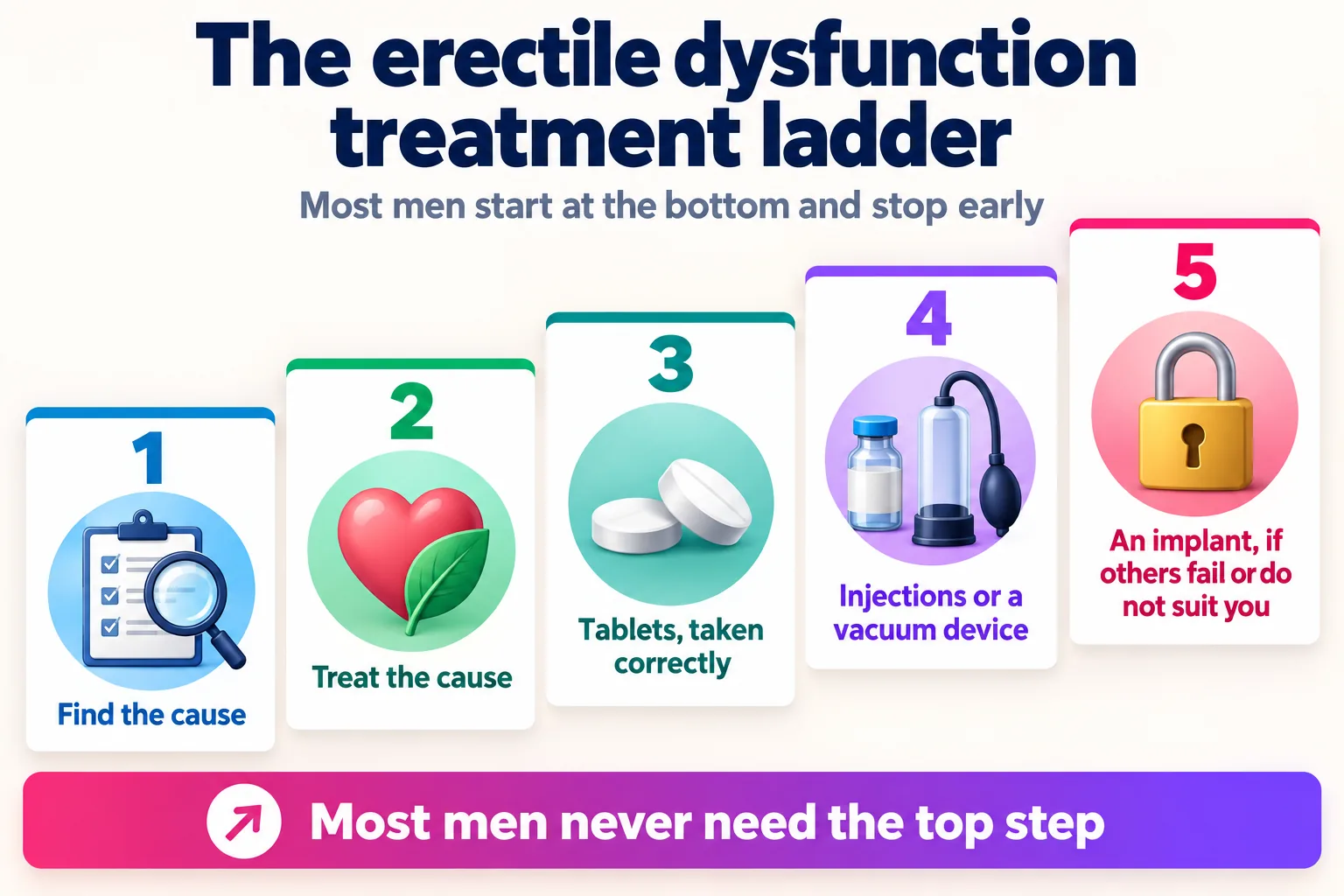
Here is that ladder in words, step by step. Each step is explained with its evidence in the 25 reasons below.
Most men start at the bottom and stop early.
1
2
3
4
5
Source: Levine, 2016
What the guidelines say
The international sexual medicine recommendations place the implant for men whose erection problem has not responded to less invasive treatment, or for whom that treatment is unsuitable or unacceptable (Levine, 2016). The American guideline adds that every option, the implant included, should be explained with its benefits and burdens, so that you and your partner decide with full understanding (Burnett, 2018).
My advice is simple. Treat the implant as the last resort, and try the treatments that can be undone before the one that cannot. My page on erectile dysfunction treatment in Chennai explains how I work through these steps with each man.
💊 3. Reasons 1 to 6: something simpler probably works
The first six reasons are about the treatments that come before an implant. Each one can be stopped, changed or undone, which is exactly why they come first.
1. Tablets work for most men
Sildenafil and tadalafil belong to a group of medicines called PDE5 inhibitors. They help blood flow into the penis when you are sexually aroused. They do not cause an erection on their own.
A review of the sildenafil trials pooled results from more than 2,000 men. On sildenafil, 57% of attempts at intercourse succeeded, against 21% on a dummy tablet. Over the course of treatment, 83% of men had at least one successful intercourse, against 45% on the dummy tablet (Fink, 2002).
Those men were of all ages and many causes. If you want to know which tablet suits your routine, my page on sildenafil vs tadalafil compares the two.
2. A tablet that “failed” was often taken the wrong way
A common story goes like this. One tablet, taken once, after a heavy dinner, at too low a dose, with no foreplay. Then the verdict: the tablets do not work.
One urologist studied 253 men who had been sent to him as sildenafil failures. Incorrect use of the tablet accounted for 81% of the failures. After re-education with a short video, personal instruction and written instruction sheets, 41.5% of the remaining non-responders became responders (Atiemo, 2003).
A tablet that was never given a fair trial has not failed. It has not yet been tried.
3. A daily low-dose tablet is a different treatment
Tadalafil can be taken as a small dose every day, instead of before sex. A daily dose takes away the planning, and the pressure of watching the clock.
A pooled analysis of six randomised trials, with 1,596 men taking tadalafil 5 mg a day for six months or more, found better erection scores than with a dummy tablet. Side effects were few (Ma, 2020). For a man whose anxiety rises every time he swallows a tablet before sex, a daily dose can change everything.
4. Injections and a vacuum device work when tablets do not
An injection of alprostadil into the side of the penis produces an erection directly, without depending on arousal. In a six-month study of 683 men injecting at home, sexual activity was possible after 94% of injections. Men rated the sex satisfactory after 87% of injections, and their partners after 86% (Linet, 1996).
I will be honest about the weakness. Many men stop injecting over the years. In one long follow-up, only 32% were still using injections after five years (Sundaram, 1997).
The drop-out is one reason some older men eventually reach the last resort, as section 8 explains. For a young man, it is no reason to skip injections.
A vacuum erection device is the other option that needs no surgery. A plastic cylinder over the penis draws blood in, and a ring at the base holds it. After prostate surgery, men using a vacuum device had better erection scores and kept more of their penile length (Pirola, 2024).
5. Losing weight and moving more can bring erections back
In an Italian trial, 110 obese men with erectile dysfunction were split into two groups. One group got a two-year programme of weight loss and exercise. By the end, 17 of the 55 men in that group had normal erection scores again, against 3 of the 55 men in the comparison group (Esposito, 2004).
Weight loss and exercise brought back normal erections in about one man in three, with no tablet, no injection and no operation. Smoking works in the opposite direction, and my page on whether smoking causes erectile dysfunction explains how. Long hours on a bicycle saddle can matter too, as my page on cycling and erectile dysfunction shows.
6. Hormones and blood sugar can be corrected
Low testosterone, an underactive thyroid and uncontrolled diabetes all weaken erections. Each one is found with a blood test, and each one can be treated.
Anabolic steroids taken for the gym deserve a special mention. Steroid use can shut down the body’s own testosterone, and that steroid-induced hypogonadism can be managed once it is properly assessed (Rahnema, 2014). The signs to watch for are on my page about low testosterone symptoms, and the lifestyle side is on my page about how to increase testosterone naturally.
An implant gives you an erection. It does not raise your testosterone, and it does not control your sugar.
🧑 4. Reasons 7 to 11: you are young
Most of what we know about implants comes from older men. In the large review of implant satisfaction, the average man was 58 years old, and satisfaction did not depend on age (Corona, 2025).
So the question for a young man is not whether he would like an implant. It is whether he needs one at all, with a different body, a different cause and many more years to live with the decision.
7. At one clinic, one man in four with new erectile dysfunction was 40 or younger
One clinic studied the men who came for first help with a new erection problem. One in four, 26%, was 40 or younger, and their average age was 32. These young men had fewer other illnesses and higher testosterone levels than the older men (Capogrosso, 2013).
Young men with erectile dysfunction are common, and they are usually otherwise healthy. My page on what causes erectile dysfunction in young men goes through the usual causes one by one.
8. In young men, the cause is often in the mind or in daily habits
Across all ages, the authors of one large clinic study concluded that about one in nine men presenting with erectile dysfunction met the criteria for a primarily psychological cause (Pozzi, 2022). Performance anxiety is a common one.
A 2025 review of erectile dysfunction in men under 40 linked it with pornography use, poor sleep, poor diet, too little exercise and recreational drugs. The treatment it describes combines tablets, hormone treatment where needed, lifestyle change and cognitive behavioural therapy (Safa, 2025).
Many young men also blame masturbation. My page on whether masturbation causes erection problems sets that worry straight.
An implant cannot treat anxiety. It only removes the need for an erection.
If pornography is part of your story, read my page on porn-induced erectile dysfunction. If anxiety is part of the problem, psychosexual counselling treats the cause instead of bypassing it.
9. Nobody should operate before the cause is found
A review on young men with erectile dysfunction says every one of them deserves a thorough work-up. That means a focused history, an examination and basic blood tests, followed by targeted tests of the blood vessels, nerves and hormones when the first round points that way (Papagiannopoulos, 2015).
Even the penile Doppler scan, the main test of blood flow, is done in many different ways, with no agreed normal values (Nascimento, 2020). One borderline scan is not a reason to operate.
Here is a simple clue you can check at home. If you still wake with firm erections, your blood vessels and nerves are probably working.
My page on early morning erections explains what they tell a doctor. An implant in a man with healthy erection tissue replaces working tissue with a device.
10. You will outlive the device
Implants are machines, and machines wear out. One centre followed 426 men with inflatable implants for up to 27 years (Moncada, 2026).
Share of implants still in place, 426 men followed for up to 27 years at one centre
96.2%
86.7%
77.5%
58.7%
Source: Moncada, 2026
For a man of 70, a device that lasts 15 years may well outlive him. For a man implanted at 30, the same figures mean roughly a four-in-ten chance that his device has been removed by the time he is 45. He should plan for at least one more operation in his life.
11. Every repeat operation is harder and riskier
Replacing an implant is not like the first operation. The tissues are scarred, and infection is far more likely.
Highest rates reported in a review of implant infection
Source: Cosentino, 2020
Antibiotic-coated devices and careful washing of the chambers bring these numbers down. In one series of coated implants, no first implants in men without diabetes became infected. In repeat operations, 10% became infected without an antiseptic washout and 3% with one (Wilson, 2007).
When an infected implant has to come out, the empty chambers scar and shrink. Infection, removal and scarring together make up the most feared complication in implant surgery, because they make the next implant difficult (Shaeer, 2019). A young man who starts down this road early has more operations ahead of him, and each one is harder than the last.

Private 1-on-1 consultation
Offered a penile implant? Get a second opinion first.
A private consultation in T Nagar, Chennai. I find the cause of the erection problem, review what you have already tried, and tell you honestly whether an implant is right for you.
Book a Confidential Consultation
🔒 5. Reasons 12 to 18: what the operation takes away
Every operation takes something away to give something back. With an implant, the trade is bigger than most men expect. These seven reasons are about the things you lose, some of them for good.
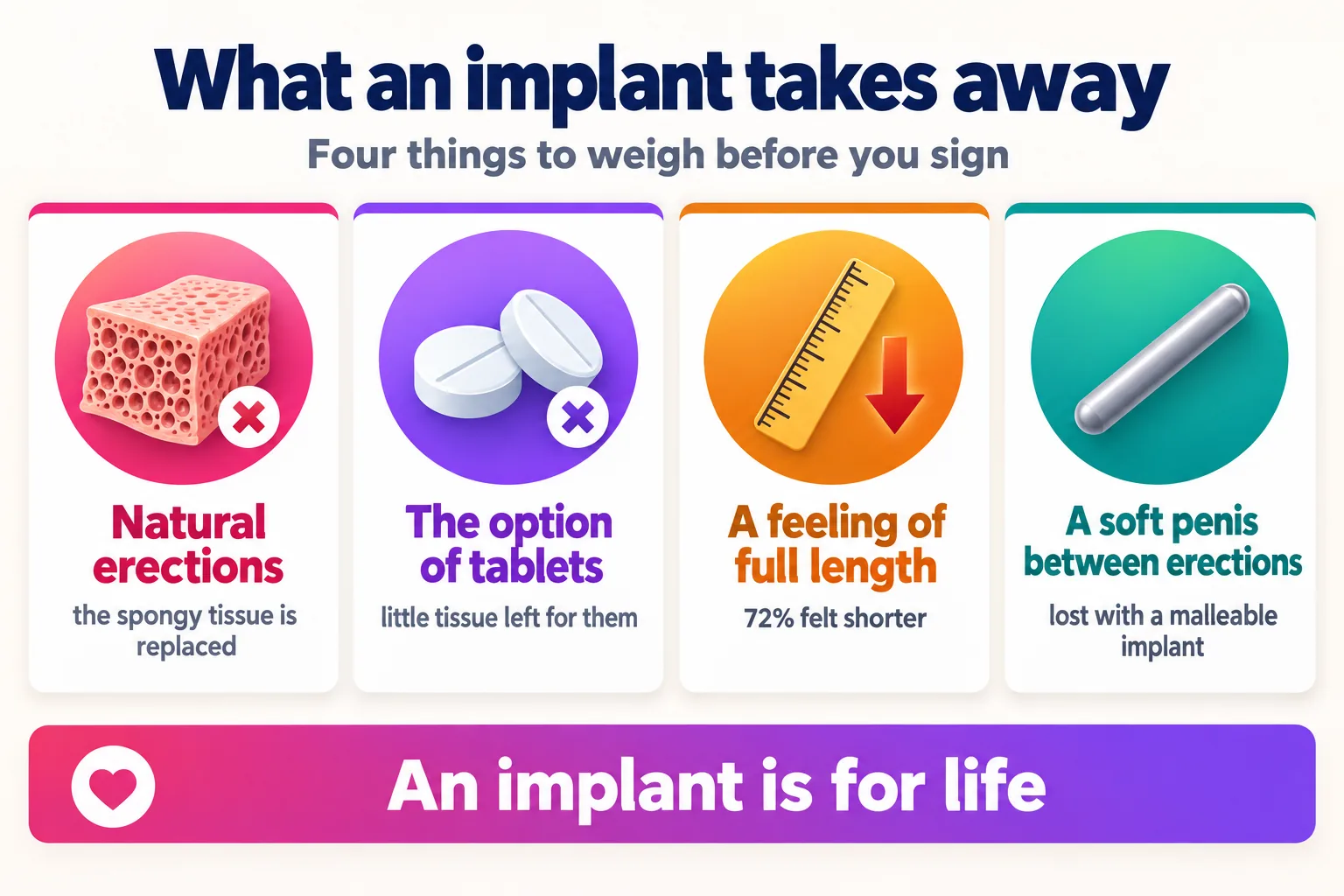
12. It is permanent
To make room for the cylinders, the surgeon widens each erection chamber. With the standard technique, the spongy erection tissue is largely lost.
A 2026 review found that only 6.6 to 15.2% of men kept any natural swelling of the penis after standard surgery. With newer tissue-sparing techniques, 86.6 to 89.1% kept some (Mohamed, 2026).
Bars show the middle of each reported range
Source: Mohamed, 2026
Ask your surgeon which technique he uses. But even the best technique leaves a device inside you for life. There is no version of this operation that you can simply reverse.
13. There is no going back to tablets
Tablets and injections work by filling the spongy tissue with blood. With the standard technique, natural swelling survives in only 6.6 to 15.2% of men (Mohamed, 2026), so tablets and injections have little left to work on. Tissue-sparing techniques keep more.
With a standard implant, signing for the operation usually means signing away the treatments that came before it. If the implant is ever removed and not replaced, natural erections are very unlikely to return.
14. Most men feel shorter afterwards
In one study of 56 men after implant surgery, 72% said their penis felt shorter than before, even though the measured stretched length had not changed (Deveci, 2007). Part of the gap is recall bias: men compare the implant with the erections they remember (Panuganti, 2021). The feeling still matters, because perceived loss of length is one of the commonest reasons men are unhappy with an implant (Trost, 2013).
Surgeons now use several techniques to protect length, and with them the reported gain ranges from 0.2 to 6.0 cm, though the same review notes these results are not reproducible at every centre (Krishnappa, 2025). A man’s stretched length before surgery also predicts how satisfied he will be afterwards (Abdelwahab, 2025).
An implant is not a penis-enlargement operation, and no young man should choose it for size. If size is the real worry, my page on small penis syndrome is the better place to start.
15. A malleable implant stays firm all day
This is the reason I wrote this page. A malleable implant has two bendable rods, and the penis stays firm at all times.
You bend it up for sex. The rest of the day, you bend it down and hide it.

Manufacturers keep improving the rigidity and concealment of these rods, and a review of the six main malleable devices stresses strict counselling about what to expect (Chung, 2023). Patients and partners are less satisfied with malleable implants than with inflatable ones (Satwikananda, 2024).
The malleable implant is the cheaper of the two. In my clinic, the cheaper malleable implant is the problem: it is the kind the distressed young men have had. Here is how they describe it.
Young men under 35 come to me after a penile implant and break down in my clinic.
They tell me the penis feels artificially erect, all day.
They cannot walk freely in a public place, because the penis juts out against their trousers.
An implant is a last resort. For a young man it comes last, not first, unless priapism has damaged the erection tissue.
If you already have a malleable implant and are struggling, call me on 97907 83856 and we will go through your options. Section 9 covers the practical side of living with one.
16. The head of the penis does not harden
An implant stiffens the shaft. It does not stiffen the head, the glans, which sits beyond the end of the cylinders. Reduced swelling of the glans is one of the recognised reasons men are unhappy after an implant (Trost, 2013).
In some men the head flops forward or downward over the firm shaft. Surgeons call this glanular hypermobility, and it sometimes needs another operation to fix (Ziegelmann, 2018).
17. A penile implant can affect sensation
Most men keep their orgasm and their ejaculation. In one study of 35 men, the implant did not interfere with either (Coleman, 1985).
Yet a review of why implant patients are dissatisfied lists altered sensation during erection and ejaculation, and a feeling that the erection is unnatural (Trost, 2013). My young patients put it in their own words: the penis feels artificially erect.
18. Your partner may be less happy than you
In the large review of implant satisfaction, partners were less satisfied than the men themselves. Their satisfaction was higher with inflatable devices (Corona, 2025). Another review found partner satisfaction rates between 50% and 90%, consistently lower than the patients’ own (Singh, 2023).
Your wife or partner lives with this decision too. Bring her to the consultation, and let her hear everything you hear.
⚠️ 6. Reasons 19 to 22: what can go wrong
These are the numbers every man deserves to hear before he signs.
19. An infected implant usually has to come out
A review puts infection after a first implant at up to 3%, and calls it hard to manage and correct (Cosentino, 2020). Diabetes and the antibiotic routine both matter. In men with diabetes, one multicentre study found infection after a first implant in 5.6% with the standard American-guideline antibiotic regimen and 1.9% with broader combinations (Rezaee, 2020).
Men with diabetes need particular care, because diabetes is also one of the commonest causes of erectile dysfunction in the first place. In the series of antibiotic-coated implants, 1 of 83 men with diabetes developed an infection after a first implant (Wilson, 2007). An infected implant usually means removing the device, and that brings the scarring of reason 11.
20. Parts can break
Inflatable implants have cylinders, tubing, a pump and a reservoir, and any of them can fail. In the 27-year follow-up, 11% of men had their device removed because of mechanical failure. The cylinders were the commonest part to fail (Moncada, 2026).
Inflatable implants fail mechanically more often than malleable rods (Satwikananda, 2024). The trade-off is plain: the type that hides better is the type that breaks more.
21. The implant can push through the tissues
Erosion means the device wears through the tissue around it, sometimes towards the skin or the urine pipe. In the large satisfaction review, long-term erosion happened in about 3% of men and mechanical failure in about 4.6% (Corona, 2025). In the 27-year follow-up of 426 men, 6.3% had a device removed because a cylinder pushed out of place (Moncada, 2026).
22. More than one man in four had a complication over the years
Across the whole 27-year follow-up, 28.2% of men had a complication, and most of them happened more than six months after surgery (Moncada, 2026).
Share of 426 men, followed for up to 27 years
Source: Moncada, 2026
A study from one sexual function registry found that 12.9% of men needed another operation for a problem after implant surgery (Pineda, 2017).
🗣️ 7. Reasons 23 to 25: how the decision is made
The last three reasons are about the conversation before the operation. That conversation decides more of your future than the operation itself.
23. You are entitled to hear every option first
The American Urological Association guideline puts shared decision-making at the centre of erectile dysfunction care. Every treatment that is safe for you should be explained, whatever its invasiveness or permanence, with its benefits and its burdens, so that you and your partner understand it fully (Burnett, 2018). The European guideline uses a decision algorithm tailored to each patient, and says patients should be fully counselled on every available treatment (Salonia, 2025).
If an operation is the only option you have heard about, ask for the others to be explained before you decide.
24. The alternatives you were offered shape how you feel afterwards
A review of why implant patients end up unhappy listed the expected causes: lost length, a soft glans, a change in sensation, a dissatisfied partner and complications. It also listed one that surprises men: the extent of the alternative treatments a man was offered before his implant (Trost, 2013).
The same review found that men with high expectations before surgery were more likely to be disappointed. An implant chosen in a hurry carries the highest expectations of all.
25. Get a second opinion before you sign
International recommendations describe the implant as an appropriate treatment for the man who wants his erections restored and who understands the risks of mechanical failure and infection (Levine, 2016). Understanding takes time, and it takes more than one voice.
A second opinion costs you one consultation. An implant cannot be undone.
The same caution applies to other operations offered for erection problems, as my page on whether varicocele surgery improves erectile dysfunction explains. Section 10 lists the questions to take with you.
⚖️ 8. When does penile implant surgery become the last resort?
An implant is a last resort, and I am not here to promote it. But there are a few situations where that last resort is reached, and a man in one of them deserves to know.
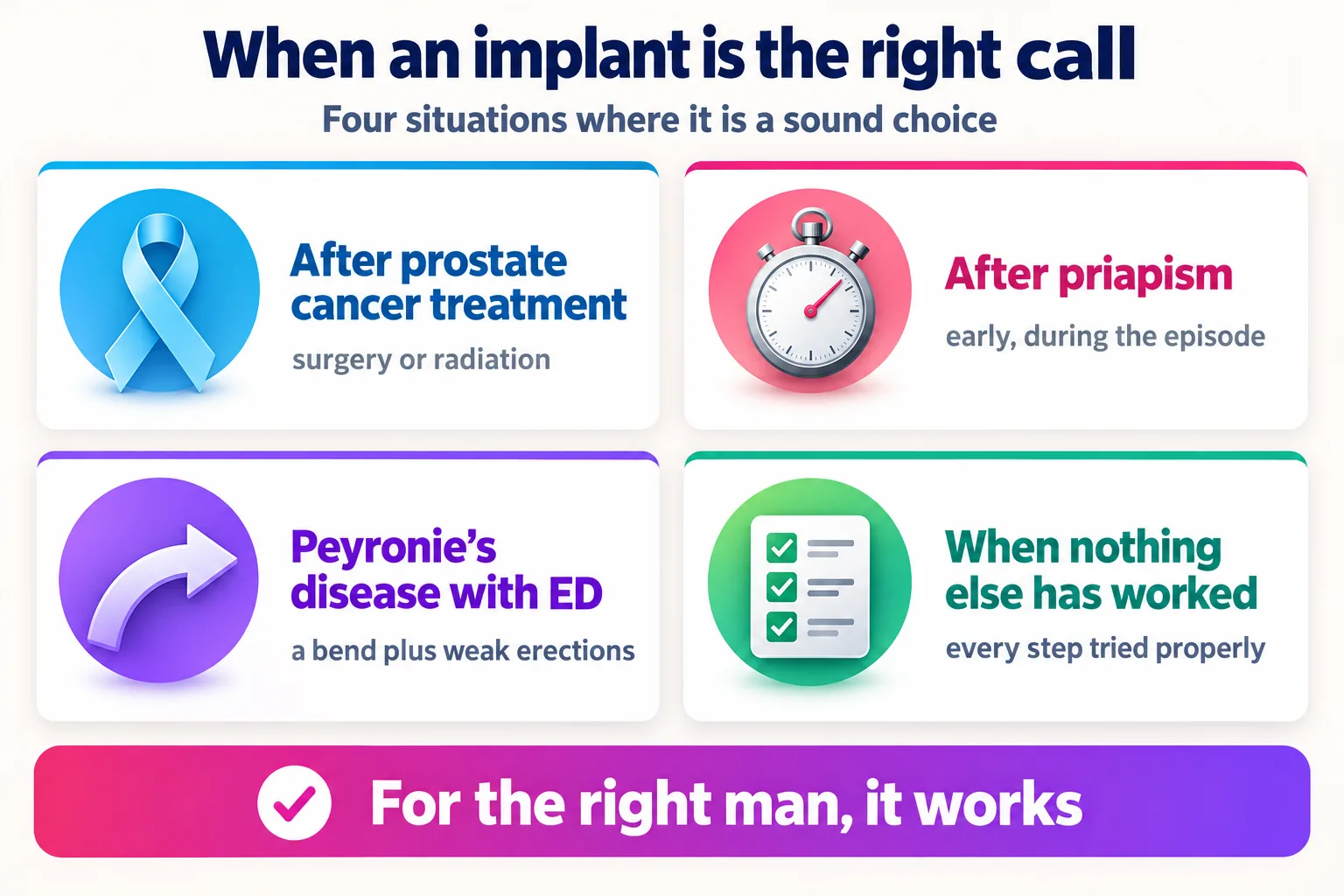
These are the four situations I mean.
After prostate cancer surgery or radiation
Removing the prostate, or radiation to the pelvis, can damage the nerves and blood vessels of erection beyond repair. A three-piece implant can be placed safely even after pelvic radiation, with revisions needed in 14.1% of men over about four years (Loh-Doyle, 2018). Even so, implants are uncommon in this group: among older American men, only 2.3% went on to an implant after prostate removal (Tal, 2011).
My page on erectile dysfunction in older men covers this group in more detail.
After priapism that would not settle
Priapism is an erection that lasts for hours and will not go down. A priapism that does not settle can kill and scar the erection tissue. In this one situation, waiting harms a young man.
A review of nine studies found that men who had an implant early, within 30 days of the priapism, had fewer complications and far less scarring than men implanted later. They were also more satisfied (Elmarasi, 2024). In a 2026 study of men implanted after priapism, 39 of 167 men answered the questionnaire, and all 39 said they did not regret it (Dighero, 2026).
Peyronie’s disease with erectile dysfunction
Peyronie’s disease is a scar inside the penis that bends it. The 2025 European guideline says men whose bend gets in the way of sex, and who also have erectile dysfunction, should be offered a penile implant (Salonia, 2025). My page on whether a curved penis is normal explains where a normal curve ends and Peyronie’s begins.
When nothing else has worked
Some men have severe disease of the blood vessels, from long-standing diabetes or other causes, and have tried every step of the ladder properly. For them, an implant can restore erections when nothing else does.
In the large review, 83% of men were satisfied (Corona, 2025). Men also keep using an implant longer than injections: in one long follow-up, 63 months on average against 37 (Sexton, 1998).
Even the young men who did well in published series were carefully chosen. In a series of 64 men under 40, whose average age was 32, 92.8% of those who answered were satisfied and 4.7% needed a revision over a median of seven years (Sevinç, 2025). But look at who they were.
Their erection problem had lasted a median of six years. Every man had a duplex scan and an injection test before surgery.
In 64% the cause was in the blood vessels, and in 28.1% no cause was found. These were thoroughly tested men, not men who had tried one tablet.
🔄 9. Malleable or inflatable penile implant: if you do go ahead
If you and your doctor decide an implant is right, the type matters more than most men realise. Choose it for your daily life, not for the bill alone.
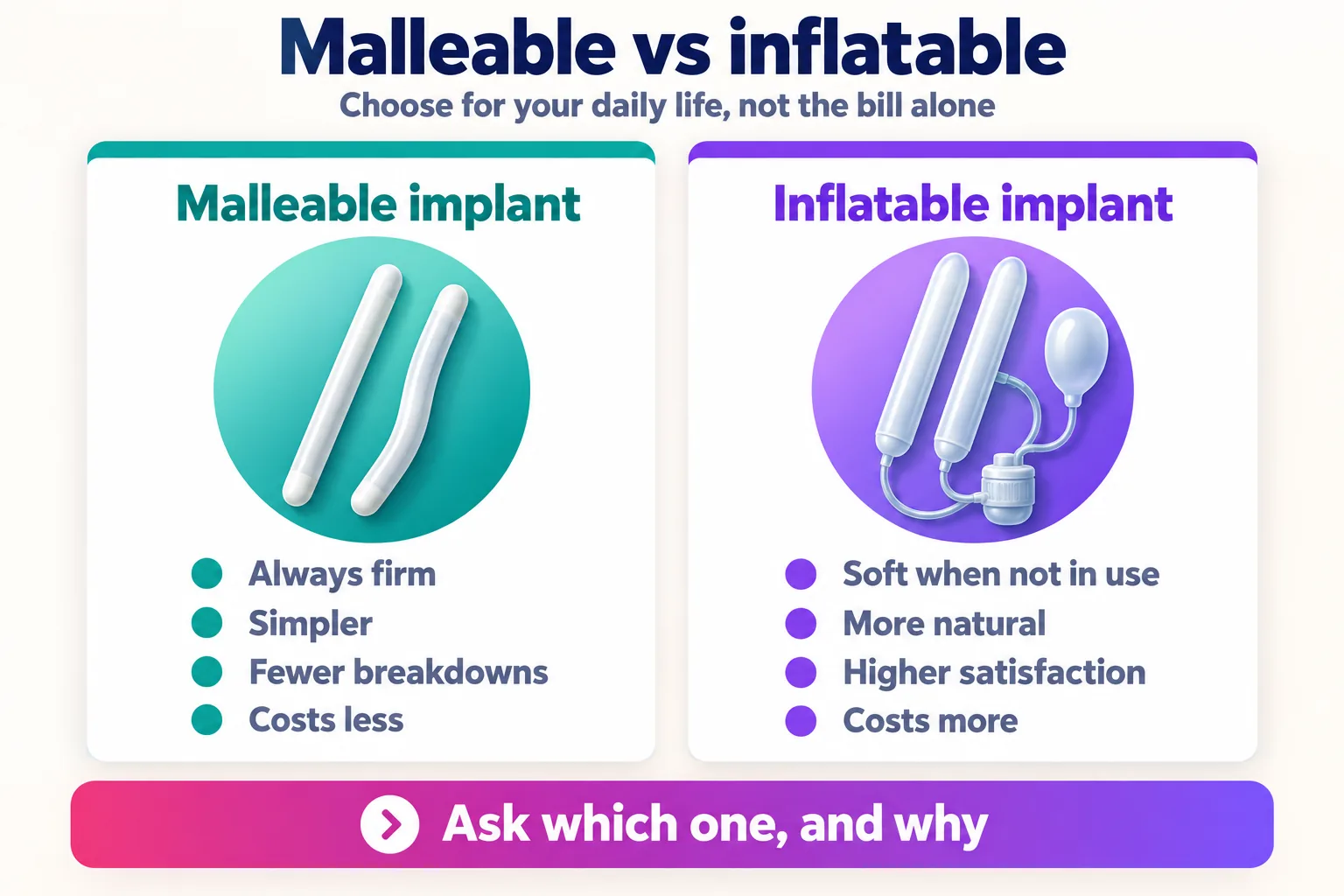
Inflatable implants look and feel more natural, and patients and partners prefer them. Malleable implants break down less often (Satwikananda, 2024), and they are simpler and cheaper. A malleable implant also suits a man who cannot manage a scrotal pump, for example because of weak or stiff hands.
How to hide a malleable implant
A malleable implant can be bent downward or to the side, and held there by close-fitting briefs. Looser, darker trousers help. When you sit, a downward position against the thigh is usually the least visible.
Practical tips help, but they do not change the basic fact: the penis is firm all day. If you already have a malleable implant and are struggling with it, call me on 97907 83856 and we will go through your options. The strain it puts on a marriage is real, and my page on how to fix a sexless marriage covers that side of it.
📝 10. Questions to ask before penile implant surgery
Take these questions to your consultation, and write the answers down.
- What is the cause of my erectile dysfunction, and how was it tested? Ask to see the blood tests and the Doppler report. My page on erectile dysfunction treatment lists the tests I use.
- Which treatments have I truly tried? At the right dose, the right way, more than once.
- Which exact device will you use, and why that one? Malleable or inflatable, and the brand name.
- Is the device antibiotic-coated, and what is your infection plan? Coated devices reduce infection (Wilson, 2007).
- Will you use a tissue-sparing technique? It decides how much natural swelling survives (Mohamed, 2026).
- How much length should I expect to lose, or keep?
- What happens, and what does it cost, if the device fails or gets infected?
- Can my wife or partner come to the consultation?
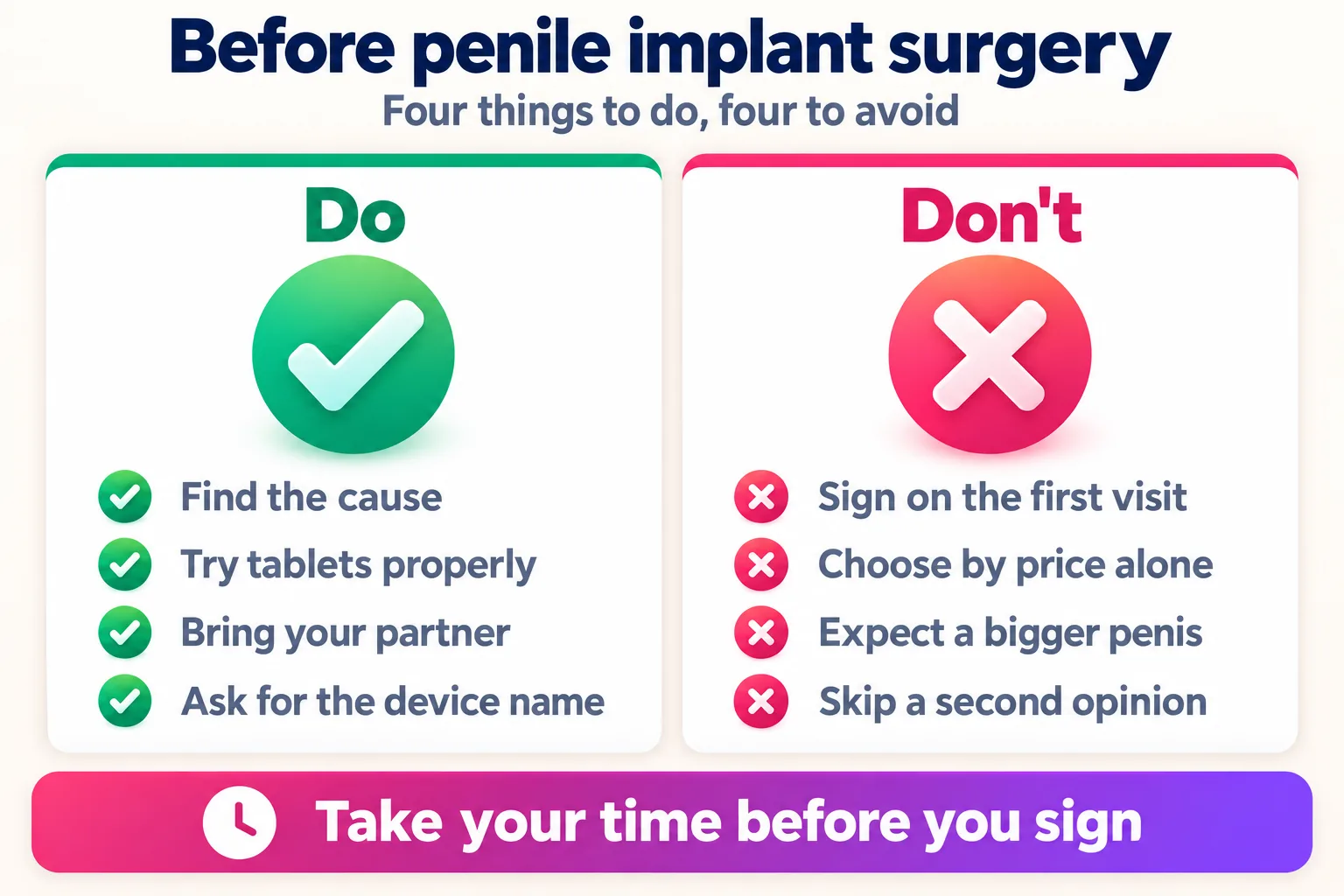
A vague answer to any of them is a good reason to pause and get a second opinion.
Myths, cleared
🧠 11. Six myths about penile implants
Myth: an implant makes the penis bigger
Most men feel shorter afterwards, not longer.
Myth: an implant cures erectile dysfunction
It bypasses the problem. The cause is still there.
Myth: it can be removed and I will be normal
The erection tissue does not come back.
Myth: all implants are the same
Malleable and inflatable implants feel very different.
Myth: tablets failed once, so nothing works
Many tablet failures were tablets taken the wrong way.
Myth: I will lose my orgasm
Most men keep their orgasm and ejaculation.
These six misunderstandings push men towards an implant, or keep them from asking the right questions. Here is the evidence behind each card.
The myths about what an implant does
“An implant makes the penis bigger.” In one study, 72% of men said their penis felt shorter after the operation, even though measured length had not changed (Deveci, 2007). My page on whether penis lengthening works covers the operations that claim to add size.
“An implant cures erectile dysfunction.” It gives an erection on demand. Diabetes, low testosterone or anxiety are still there afterwards, and still need treatment.
“It can be removed and I will be back to normal.” With the standard technique, natural swelling survives in only 6.6 to 15.2% of men (Mohamed, 2026). Removal after infection scars the chambers further (Shaeer, 2019).
The myths about choosing one
“All implants are the same.” Patients and partners are more satisfied with inflatable implants, and malleable ones fail mechanically less often (Satwikananda, 2024).
“Tablets failed once, so nothing works.” In one study, 41.5% of men labelled as tablet failures responded after being taught to take the tablet properly (Atiemo, 2003).
“I will lose my orgasm.” In one study of 35 men, the implant did not interfere with orgasm or ejaculation (Coleman, 1985).
❓ Penile implant surgery: your questions answered
Short answers to the questions men search for most. The detail, and the evidence, is in the sections above.
What is penile implant surgery?
An operation that places two rods or two inflatable cylinders inside the penis. It is a last-resort treatment for erectile dysfunction. It is permanent, and the standard technique replaces most of the natural erection tissue.
How does a penile implant work?
The cylinders or rods sit inside the two erection chambers of the penis. A malleable implant is bent up for sex. An inflatable one is filled from a pump in the scrotum and emptied with a release valve afterwards.
How common is a penile implant?
Uncommon. Even after prostate removal, which often leaves severe erectile dysfunction, only 2.3% of older American men went on to an implant (Tal, 2011). Most men with erection problems are treated without surgery.
How much does a penile implant cost in India?
Malleable implants cost far less than imported inflatable ones, and costs vary widely with the device. Ask for a written estimate that includes the cost of a repeat operation if the device fails or gets infected.
How effective is a penile implant?
It produces an erection reliably, but it does not satisfy everyone. In a review of more than 12,000 men, 83% were satisfied, and partners were less satisfied than the men (Corona, 2025).
What is a malleable penile prosthesis?
A pair of bendable rods with a metal core inside a silicone cover. The penis stays firm all the time. You bend it up for sex and down afterwards.
Which penile implant is better, inflatable or malleable?
Inflatable implants feel more natural and satisfy patients and partners more. Malleable implants break down less often (Satwikananda, 2024), and they are simpler and cheaper.
How do you hide a malleable penile implant?
Bend it downward or to the side and hold it with close-fitting briefs. Looser, darker trousers help. It never softens, so hiding it is a daily task.
Can a man feel with a penile implant?
Yes. The implant sits inside the erection chambers, and most men keep orgasm and ejaculation (Coleman, 1985). Some men notice changed sensation, or describe the erection as unnatural (Trost, 2013).
What are the negatives of penile implants?
It is permanent, and natural erections rarely return. Most men feel shorter, the head stays soft, and infection, erosion and mechanical failure can mean more surgery. A malleable implant is always firm.
How long do you stay hard with a penile implant?
With a malleable implant, always. With an inflatable implant, as long as you want: it stays firm until you press the release valve, and orgasm does not end the erection.
How long does it take to recover from penile implant surgery?
Most men go home within a day or two. Sex is usually off for about six weeks while the tissues heal, and an inflatable device is then taught and practised.
How is life after a penile implant?
In a review of more than 12,000 mostly older men, 83% were satisfied, partners less so (Corona, 2025). A young man who did not need one may get a penis that feels artificially erect, and more operations.
Do people regret getting a penile implant?
Few studies measure regret directly. After priapism, all 39 men who answered had no regret (Dighero, 2026). Dissatisfaction is linked with high expectations, lost length, a soft glans and the range of alternatives offered (Trost, 2013).
Is a penile implant safe?
No operation is risk-free, and this one is permanent. Infection affects up to 3% after a first implant and up to 18% after a repeat one (Cosentino, 2020). It is higher in men with diabetes (Wilson, 2007).
How long does a penile implant last?
In a 27-year follow-up of 426 men, 77.5% of inflatable implants were still in place at 10 years and 58.7% at 15 years (Moncada, 2026).
What is the success rate of malleable penile implants?
Malleable implants break down less often than inflatable ones, but patients and partners are less satisfied with them (Satwikananda, 2024). Their weakness is concealment, not reliability.
Can a penile implant be removed?
Yes, but natural erections are unlikely to come back. Removing an infected implant scars the chambers, which makes the next implant harder (Shaeer, 2019).
Is it possible to enlarge penis size with an implant?
No. It is not an enlargement operation. In one study, 72% of men felt shorter afterwards, though measured length had not changed (Deveci, 2007). Length-saving techniques do not make a small penis large.
Am I too young for a penile implant?
Age alone does not rule it out, and carefully chosen men under 40 did well (Sevinç, 2025). But a young man needs full testing and a proper trial of the reversible treatments first, unless priapism has damaged the erection tissue.
Do erection tablets still work after a penile implant?
Usually not for the erection itself. Tablets work by filling the spongy erection tissue. With the standard technique, natural swelling survives in only 6.6 to 15.2% of men (Mohamed, 2026).
🎯 The bottom line
A penile implant is a last resort. It has a place after prostate cancer surgery, after priapism, with Peyronie’s disease, or with severe disease that nothing else helps, as section 8 explains.
The operation is also permanent. It takes away the natural erection tissue, it usually leaves the penis feeling shorter, and a malleable implant keeps the penis firm every hour of every day. Devices wear out, and repeat operations are harder.
For a young man, the order matters. First the cause is found and treated. Tablets are taken properly, and injections or a vacuum device are tried if needed.
The implant is the last resort, and most young men who work through these reversible steps never reach it. Priapism that has damaged the erection tissue is the exception.
If you have been offered an implant, or you already have one and are struggling, talk to me before you decide anything else. Read how I approach erectile dysfunction treatment in Chennai, then call 97907 83856 or message me on WhatsApp.
Private consultation
Erectile dysfunction, treated from the cause up
Proper testing, the right treatment in the right order, and an honest answer about surgery. Confidential, in Chennai.
References
Guidelines and recommendations
- Burnett AL, et al., 2018: Erectile Dysfunction: AUA Guideline (PMID 29746858).
- Salonia A, et al., 2025: European Association of Urology Guidelines on Male Sexual and Reproductive Health: 2025 Update on Male Hypogonadism, Erectile Dysfunction, Premature Ejaculation, and Peyronie’s Disease (PMID 40340108).
- Levine LA, et al., 2016: Penile Prosthesis Surgery: Current Recommendations From the International Consultation on Sexual Medicine (PMID 27045255).
Treatments before an implant
- Fink HA, et al., 2002: Sildenafil for male erectile dysfunction: a systematic review and meta-analysis (PMID 12076233).
- Atiemo HO, et al., 2003: Salvage of sildenafil failures referred from primary care physicians (PMID 14634415).
- Ma J, et al., 2020: Role of application of tadalafil 5 mg once-daily (≥6 months) in men with erectile dysfunction from six randomized controlled trials (PMID 32676425).
- Linet OI, et al., 1996: Efficacy and safety of intracavernosal alprostadil in men with erectile dysfunction. The Alprostadil Study Group (PMID 8596569).
- Sundaram CP, et al., 1997: Long-term follow-up of patients receiving injection therapy for erectile dysfunction (PMID 9187703).
- Pirola GM, et al., 2024: Vacuum erection device for erectile function rehabilitation after radical prostatectomy: which is the correct schedule? Results from a systematic, scoping review (PMID 37085734).
- Esposito K, et al., 2004: Effect of lifestyle changes on erectile dysfunction in obese men: a randomized controlled trial (PMID 15213209).
- Rahnema CD, et al., 2014: Anabolic steroid-induced hypogonadism: diagnosis and treatment (PMID 24636400).
Erectile dysfunction in young men
- Capogrosso P, et al., 2013: One patient out of four with newly diagnosed erectile dysfunction is a young man–worrisome picture from the everyday clinical practice (PMID 23651423).
- Pozzi E, et al., 2022: Primary organic versus primary psychogenic erectile dysfunction: Findings from a real-life cross-sectional study (PMID 35723046).
- Safa A, et al., 2025: Erectile Dysfunction in Young Adults: A Narrative Review (PMID 40809937).
- Papagiannopoulos D, et al., 2015: Evaluation of young men with organic erectile dysfunction (PMID 25370205).
- Nascimento B, et al., 2020: A Critical Analysis of Methodology Pitfalls in Duplex Doppler Ultrasound in the Evaluation of Patients With Erectile Dysfunction: Technical and Interpretation Deficiencies (PMID 32631763).
What an implant takes away
- Mohamed H, et al., 2026: Impact of cavernous tissue-sparing techniques on postoperative outcomes in penile prosthesis surgery: a systematic review and meta-analysis (PMID 41563060).
- Deveci S, et al., 2007: Penile length alterations following penile prosthesis surgery (PMID 17084508).
- Panuganti S, et al., 2021: Expanding the Limits-Improving Penile Length With Inflatable Penile Prosthesis Implantation: A Review (PMID 32863198).
- Krishnappa P, et al., 2025: Penile length preservation in penile prosthesis placement: tips & tricks (PMID 40604139).
- Abdelwahab M, et al., 2025: Maximizing postoperative satisfaction in penile prosthesis surgery: the predictive power of preoperative length and its role in tailoring enhancement procedures (PMID 40684256).
- Chung E, et al., 2023: State-of-art review of current malleable penile prosthesis devices in the commercial market (PMID 37465318).
- Satwikananda H, et al., 2024: Efficacy and safety of malleable penile prosthesis compared to inflatable penile prosthesis in erectile dysfunction patients (PMID 38934528).
- Trost LW, et al., 2013: Managing the difficult penile prosthesis patient (PMID 23551538).
- Ziegelmann MJ, et al., 2018: Modified Glanulopexy Technique for Supersonic Transporter Deformity and Glanular Hypermobility in Men With Penile Prostheses (PMID 29731427).
- Coleman E, et al., 1985: Effects of penile implant surgery on ejaculation and orgasm (PMID 4068047).
- Martinez DR, et al., 2015: The Evolution and Utility of the Small-Carrion Prosthesis, Its Impact, and Progression to the Modern-Day Malleable Penile Prosthesis (PMID 26565570).
Complications and device survival
- Cosentino M, et al., 2020: Treatment of Penile Prosthesis Implant’s Infection (PMID 32541156).
- Wilson SK, et al., 2007: Infection reduction using antibiotic-coated inflatable penile prosthesis (PMID 17826502).
- Rezaee ME, et al., 2020: A Multicenter Investigation Examining American Urological Association Recommended Antibiotic Prophylaxis vs Nonstandard Prophylaxis in Preventing Device Infections in Penile Prosthesis Surgery in Diabetic Patients (PMID 32519913).
- Shaeer O, et al., 2019: Shaeer’s Anti-Scarring Technique: A Preventive Measure Against Corporal Fibrosis Upon Explantation of Infected Penile Implants (PMID 31296493).
- Moncada I, et al., 2026: Excellent long-term device survival of inflatable penile prosthesis over 27 years (PMID 39949289).
- Pineda M, et al., 2017: Distinguishing Failure to Cure From Complication After Penile Prosthesis Implantation (PMID 28400085).
Satisfaction and the right candidates
- Corona G, et al., 2025: Long-term penile prosthesis couple’s satisfaction: A systematic review and meta-analysis (PMID 39010798).
- Singh A, et al., 2023: A Systematic Review of Partner Satisfaction After Penile Prosthesis with Special Emphasis on LGBTQ + Populations (PMID 36670232).
- Sevinç AH, et al., 2025: Outcomes of Penile Prosthesis Implantation in Patients Under 40: Insights and Efficacy (PMID 40488735).
- Sexton WJ, et al., 1998: Comparison of long-term outcomes of penile prostheses and intracavernosal injection therapy (PMID 9474156).
- Tal R, et al., 2011: Penile implant utilization following treatment for prostate cancer: analysis of the SEER-Medicare database (PMID 21426495).
- Loh-Doyle J, et al., 2018: Three-Piece Inflatable Penile Prosthesis Placement Following Pelvic Radiation: Technical Considerations and Contemporary Outcomes (PMID 29731428).
- Elmarasi M, et al., 2024: Early vs delayed insertion of penile prosthesis in patients with refractory priapism: a systematic review and meta-analysis (PMID 38465856).
- Dighero I, et al., 2026: Quality of life outcomes following penile prosthesis insertion in the post-ischaemic priapism setting (PMID 40715809).
Visit us in Chennai
A private, judgment-free space to talk through fertility and men’s sexual health. Walk in, or book ahead by phone.
No 21, Sree Kalki Apartments, Ground Floor, Bazullah Road, T-Nagar, Chennai 600017