
Gooning is prolonged, deliberately drawn-out masturbation — arousal sustained for hours with orgasm held off, usually with pornography running. It is not a medical diagnosis, but it is not something I would tell any young man to take up: my advice as an andrologist is to avoid it, and to stop if you have started. If you already have, you have not permanently damaged yourself and the effects are largely reversible — both of those things are true at once.
I am Dr Shah Dupesh, MBBS, DCE, FASM, a consultant andrologist in Chennai. I have sat with close to 9,000 men carrying some version of this worry, and in the last two years the word they bring me has changed. It used to be “porn addiction”. Now young men walk in and say they have been gooning, and they are frightened — that they have wrecked their testosterone, ruined their erections, rotted their brain. It is the same fear I have been treating for years in a different costume, alongside the older worry about how often masturbation is safe at all. So let me do what neither the dictionary pages nor the panic threads will do: tell you what the word describes, what the evidence genuinely shows, and what I see happen in clinic when men stop.
In a nutshell
Gooning is not a medical diagnosis
I could find no indexed medical paper using the term. The nearest real clinical constructs are compulsive sexual behaviour disorder and problematic pornography use (Ince, 2026).
Most people who use pornography never lose control of it
Only a small proportion develop genuinely problematic use — so the odds are strongly that you are not in that group (Castro-Calvo, 2026).
It does not lower your testosterone in any lasting way
Testosterone is unaltered by orgasm, and a period of abstinence raises it rather than lowering it (Exton, 2001). There is no evidence of a meaningful or lasting fall.
The sexual problems associated with it appear to be largely reversible
Uncontrolled clinical reports suggest stopping pornography is sometimes enough on its own to reverse them (Park, 2016).
“Brain rot” is a figure of speech, not a brain disease
The only paper I could find examining the term treats it as a heuristic, driven mainly by lost sleep, and explicitly warns against reading it as neurodegeneration (Ekici, 2026).
The real red flag is control, not frequency
What matters clinically is whether you can stop, and what it is costing you (Weinstein, 2026; Antons, 2020).
What gooning actually means
The term comes out of online pornography communities and describes a state rather than a technique: arousal sustained over a long period, with orgasm deliberately withheld, driven by continuous pornography use. What distinguishes it from ordinary masturbation is the duration and the dependence on constantly escalating material. I am not going to describe how it is done, because that is not what makes it a clinical problem — the duration and the loss of control are.
The word originated in queer internet communities and has since moved into general Gen Z usage; Merriam-Webster now carries an entry for it.
You will meet a few related words in the same corner of the internet. A gooner is someone who describes themselves as doing it. Goonmaxxing is the self-improvement-parody framing of doing more of it. A goon cave is community slang for the physical set-up. None of these are clinical terms, and I could find none of them in the medical literature — they are internet vocabulary, and I mention them only so you are not confused by them.
Gooning is a slang description of a behaviour pattern. It is not a condition, and no doctor can diagnose you with it. What a doctor can recognise is the clinical picture that sometimes sits underneath it, and that picture has a real name.
The bridge from slang to something a clinician can actually treat
Two constructs in the medical literature describe what men are really asking me about. Compulsive sexual behaviour disorder (CSBD) entered ICD-11 as a recognised diagnosis, and problematic pornography use (PPU) is the more specific pattern most of these men describe. CSBD is defined as a failure to control intense, repetitive sexual impulses resulting in behaviour that causes marked distress or impairment (Weinstein, 2026) — that is, by loss of control and real harm to your life, not by how long a session lasts or how often you do it. The same emphasis on distress and functional impairment across personal, relational and occupational life runs through the wider literature on non-substance addictive behaviours (Antons, 2020). CSBD is now also included in international consensus definitions of male sexual dysfunction (Trost, 2026), and the field has a dedicated measurement instrument, the CSBD-19, whose validation literature spans 22 studies and 69 samples (Engelhardt, 2026). An interdisciplinary expert review covers the same ground across eleven domains, adolescents included (Ince, 2026).
Here is the part that matters most for the frightened reader, and I want it stated as loudly as any warning on this page: only a small proportion of pornography users experience problems controlling it (Castro-Calvo, 2026). Trying this, or doing it for a stretch of months, does not place you in that group.
Gooning versus edging — the distinction almost everyone gets wrong
These two words get used interchangeably online and they should not be. Conflating them is the single commonest error in everything written about this topic.
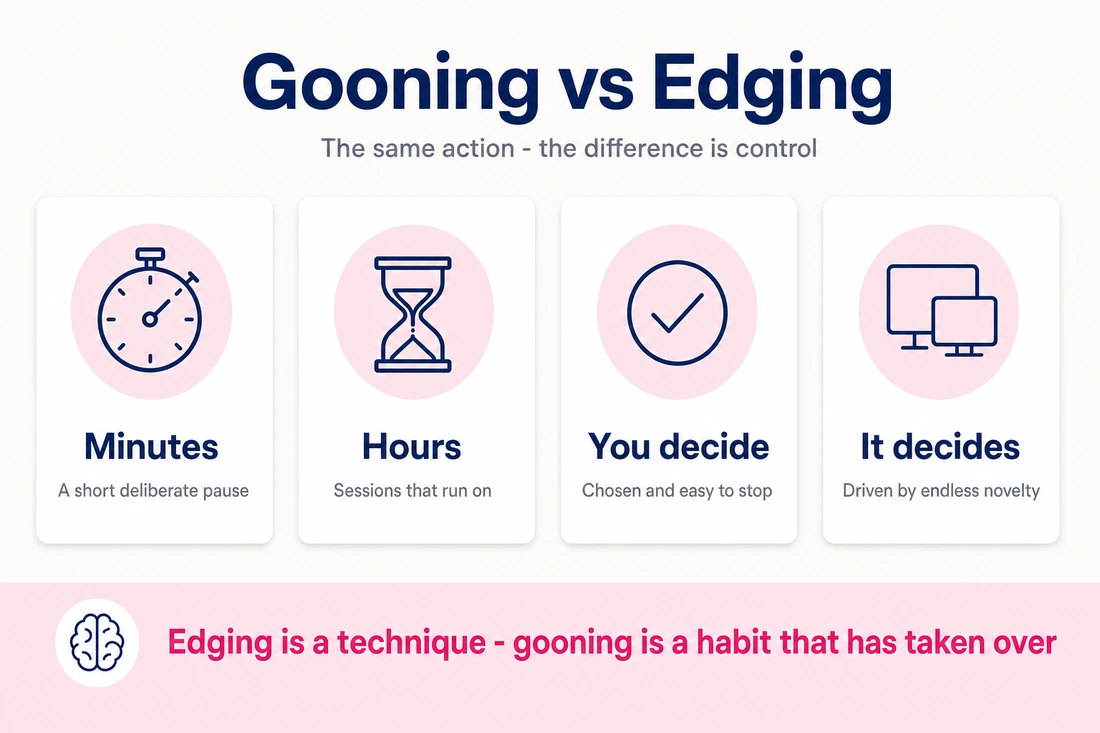
Edging means deliberately approaching orgasm and backing off, then repeating. In adults being treated for premature ejaculation, graded behavioural therapy is a recognised component of management — usually alongside medication rather than instead of it (McMahon, 2013; Martin-Tuite, 2020). If that is what you have been doing, you have not harmed yourself. It is not something I would suggest anyone take up on their own as a practice, and it is not relevant to teenagers.
Gooning, as the word is used online, describes much longer sessions built around escalating pornography. That duration is not itself a disorder — most people who have done it are not compulsive. It becomes a clinical problem at the point the session is running you rather than you running it: when you meant to stop and could not.
| Edging | Gooning | |
|---|---|---|
| Typical length | Minutes | Hours |
| Who is in charge | You choose to start and stop | The session tends to run you |
| Role of pornography | Often none | Central, and escalating |
| Clinical standing | Part of therapy for premature ejaculation, with guidance | Not a diagnosis; may reflect compulsive sexual behaviour disorder |
| Outcome | Better ejaculatory control | Usually none — but when it turns compulsive: conditioned arousal, lost sleep, distress |
The difference is not the movement. It is duration, dependence on escalating novelty, and whether you are choosing it.
Is gooning bad for you?
Let me be blunt, because this is where most articles go soft: as an andrologist, I am telling you not to do it. If you have already been gooning, you have not permanently damaged yourself and the effects are largely reversible — that part is true and I will not frighten you. But those two statements are not in conflict. “You can recover from it” is not the same as “it is fine”, and I have no interest in being another page that shrugs this off as harmless fun.
I say that because of who I see. The men who come to me with this are not having a good time. They have lost their nights, their focus and their sex lives, and they are ashamed. Nothing about hours-long, pornography-driven sessions is neutral for a young man’s sleep, his concentration, his relationships or his ability to be present with a real partner. My advice to anyone young enough to still be deciding: do not start, and if you have started, stop. The habit gets harder to break the longer it runs, and the version of this I treat at twenty-five is much easier than the version I treat at thirty-five.
I refuse two lies about this, the same two I refuse about masturbation and its supposed side effects generally. The first is that it is entirely harmless and you should not give it a thought — which ignores the men in front of me whose partnered sex has genuinely stopped working. The second is that it is draining your vitality and rotting your body — which is medically false and does nothing but deepen the fear that keeps the loop spinning. That second lie has a long history in India, where it shows up as semen-loss anxiety and Dhat syndrome — and I see the gooning worry feeding straight into it.
What it does to the skin and the tissue
The most immediate consequences are the most mundane. Hours of continuous friction produces soreness, raw or broken skin, swelling and irritation, and friction injuries are worse the longer and more forcefully a session runs. Most of it is minor and settles in a few days of leaving the area alone.
- the foreskin has been pulled back behind the head of the penis and will not go forward again — especially if the head is swelling, darkening or increasingly painful (paraphimosis);
- an erection has lasted more than four hours, or has become painful (priapism) — this matters more if you have used erection tablets or stimulants;
- there was a sudden crack or pop with immediate pain, bruising and loss of the erection (penile fracture);
- there is spreading redness, heat or fever.
These are hours-matter problems, and all are treatable when seen early. They are uncommon — but they are the only things on this page that are time-critical. Do not wait until morning, and do not keep forcing a trapped foreskin forward.
Outside those, if soreness persists beyond a week, if there is a discharge, or if skin is cracked and not healing, get examined rather than guessing.
What it does to sensitivity and arousal
Two different things get called “loss of sensitivity”, and separating them matters.
The first is physical numbness — the penis feeling genuinely less sensitive to touch. Hours of firm friction can leave the skin temporarily desensitised and sore, in the same way any skin does after prolonged rubbing. Where the force itself has re-set the ejaculatory threshold, that is death grip syndrome. This settles within days of stopping. Persistent true numbness, especially with pins and needles or numbness spreading to the perineum, is not typical and should be examined rather than assumed.
The second, and by far the commoner, is conditioned arousal — nothing is wrong with the nerve endings, but the trigger for arousal has been retrained. The mechanism is conditioning. When arousal is repeatedly paired with a specific set of cues and escalating novelty, the brain learns that pairing. The I-PACE model describes it: cue-reactivity and craving strengthen while inhibitory control weakens, and what began as a choice becomes a habit (Brand, 2019). The same cue-reactivity and reduced inhibitory control appear across non-substance addictive behaviours (Antons, 2020), and neuroimaging in compulsive sexual behaviour finds altered reactivity to erotic cues (Golec, 2021) alongside an imbalance between reward-motivation and control networks (Feng, 2026).
In the consulting room that is simple and not mystical. Pornography’s limitless novelty can condition arousal to features that do not readily transition to a real partner, so that sex with someone you actually want stops registering as it should (Park, 2016).
And here is the essential half of that sentence: conditioning runs both ways. What was learned can be unlearned. In the men I treat, once the escalating material is removed, arousal re-anchors to a real partner over a few weeks. In this second pattern nothing has been physically damaged — something has been learned, and what is learned can be unlearned.
None of this depends on who your partner is. The conditioning, the consequences and the recovery work the same way for gay, bisexual and straight men, and I see all of them in clinic with the same story.
Does gooning affect testosterone?
No. There is no evidence that it causes a meaningful or lasting fall in testosterone. This is the question I am asked most, and the one the internet answers worst, so here is the actual data — and an honest account of how little of it there is.
Three studies form very nearly the entire direct literature.
The most useful followed 28 men whose serum testosterone was measured daily through abstinence after ejaculating. Fluctuations from the second to the fifth day were minimal. On the seventh day of abstinence a clear peak appeared, reaching 145.7% of baseline (p < 0.01), after which no regular fluctuation followed (Jiang, 2003). Notice what that shows: a rise after a week without ejaculating, not a fall from sexual activity.
One caution, because this number gets misused constantly: a transient one-day peak in a 28-man study is not a reason to force abstinence, and it does not mean ejaculating costs you anything. Nothing here supports “retention” as a health practice.
Second, ten healthy men were studied during masturbation-induced orgasm before and after three weeks of abstinence. Orgasm raised blood pressure, heart rate, catecholamines and prolactin — but plasma testosterone was unaltered by orgasm, while higher testosterone concentrations were seen after the abstinence period (Exton, 2001). That is the sentence that kills the myth. Climaxing does not move your testosterone.
Third and oldest, a full steroid panel before and after masturbation in healthy young men found all steroids significantly increased afterwards, with no change in luteinising hormone — the pituitary signal that would have to shift for any lasting suppression of testosterone production (Purvis, 1976). That study measured two timepoints and did not follow the levels back to baseline.
Now the honesty this deserves. That is three studies, with 28 men, ten men and a small sample, published in 2003, 2001 and 1976. I could find no study of gooning specifically. So the defensible claim is “there is no evidence of a meaningful or lasting fall in testosterone”, not “studies prove gooning cannot affect your hormones”. I would rather tell you the evidence is thin than pretend to a certainty I do not have. For the fuller treatment, I have written it out on does masturbation reduce testosterone.
That said — if you have lost your morning erections, your libido has flattened and you are persistently tired, that combination deserves an 8–10 a.m. total testosterone with LH and FSH. Not because gooning caused it, but because low testosterone is real, common enough and easily measured. One low reading is not a diagnosis — it has to be confirmed on a second morning sample before anyone acts on it. Rule it in or out rather than assuming either way.
Does gooning affect muscle growth or growth hormone?
No evidence suggests it stunts muscle growth or damages your growth hormone — and I should be straight with you about the standard of proof. No study has measured growth hormone in this context at all, so this section reasons from physiology rather than from data.
The muscle worry is downstream of the testosterone worry, and it fails at the same point. For gooning to blunt muscle growth it would have to lower testosterone in a sustained way, and the direct evidence shows the opposite — testosterone is unaltered by orgasm, and abstinence raises rather than lowers it (Exton, 2001; Jiang, 2003). Masturbation produces a rise in circulating steroids with no change in luteinising hormone (Purvis, 1976), which is to say the hormonal axis that drives muscle growth is not being suppressed — at least acutely; nobody has measured what a repeated, hours-long pattern does to it.
The growth-hormone worry has even less behind it. Growth hormone is released mainly in pulses during deep sleep — that is textbook physiology rather than a finding about gooning — and it is where the real link sits, though not the one people fear. It is not the act that threatens it; it is doing it until three in the morning. Heavy late-night screen use is consistently associated with delayed sleep onset, shorter sleep and circadian disruption (Ekici, 2026).
So if your lifting has stalled, the honest answer is that this is not the cause. Look at your sleep first, then your protein and your training load.
Does gooning cause erectile dysfunction?
It can contribute, and this is where I see the genuine clinical consequence — but the outlook is good, and there is one thing you must do first.
Erectile difficulty in men under 40 is common, reported in up to 35%, and pornography use is one of several lifestyle factors linked to it (Safa, 2025). But that same review is explicit that a significant proportion of young men with erectile dysfunction have an organic cause. New erectile difficulty in a young man is not automatically “the porn” — it needs a proper workup first, and in this age group it can be the first sign of cardiovascular disease. I have set that workup out in full on porn-induced erectile dysfunction.
On the pornography link itself: among 66 married young men already diagnosed with psychogenic erectile dysfunction after organic causes had been excluded, erectile function scores correlated strongly and negatively with how often they used pornography (r = −0.535, p < 0.001), with relationship adjustment mediating the effect (Kazan Kizilkurt, 2024). That is a cross-sectional finding in an ED clinic population, not a measurement of what pornography does to men in general.
Now the reassurance, which is evidence-based rather than kind-hearted: uncontrolled clinical reports suggest that stopping internet pornography is sometimes enough on its own to reverse the dysfunction — and the authors of that review are explicit that controlled studies are still needed (Park, 2016). I see this in clinic repeatedly. In most young men I treat, once the organic causes are excluded and the pornography goes, the erections come back within weeks.
If erections are your main worry, read that page next — it carries the mechanism, the full workup and the recovery in detail.
Gooning and delayed ejaculation — the consequence nobody warns you about
This is the one I flag hardest, because almost nothing written about gooning mentions it and it is the problem I most often end up treating.
Delayed ejaculation is worsened by an inadequate combination of what the literature calls “friction and fantasy”, and assessing it means asking directly about how a man masturbates — because many men with delayed ejaculation have an idiosyncratic masturbatory style, defined as a masturbation technique not easily duplicated by the partner’s hand, mouth, or vagina (Perelman, 2016).
Read that definition again with hours-long, escalating, pornography-driven sessions in mind. A highly specific physical pattern paired with constant novelty is close to the textbook description. The result is a man who cannot finish with a partner, or who becomes preoccupied with how long sex is supposed to last, and concludes something is broken in his body. Nothing is. His ejaculatory reflex has been trained to conditions a partner cannot recreate — and that is trainable back. Delayed ejaculation is a recognised ejaculatory disorder, and treatment options exist — psychotherapy, pharmacotherapy, penile vibratory stimulation — though the evidence base is limited and no drug is formally approved for it in the US (Martin-Tuite, 2020; Gray, 2018). In practice, the behavioural work of changing what arousal is trained on is where I see most of the gain.
What about brain rot?
“Brain rot” was Oxford’s Word of the Year in 2024 and it has attached itself firmly to gooning. It describes the foggy, flattened feeling people report after long stretches of low-quality, high-intensity digital content. It deserves a careful answer, because the honest one is more reassuring than the phrase sounds.
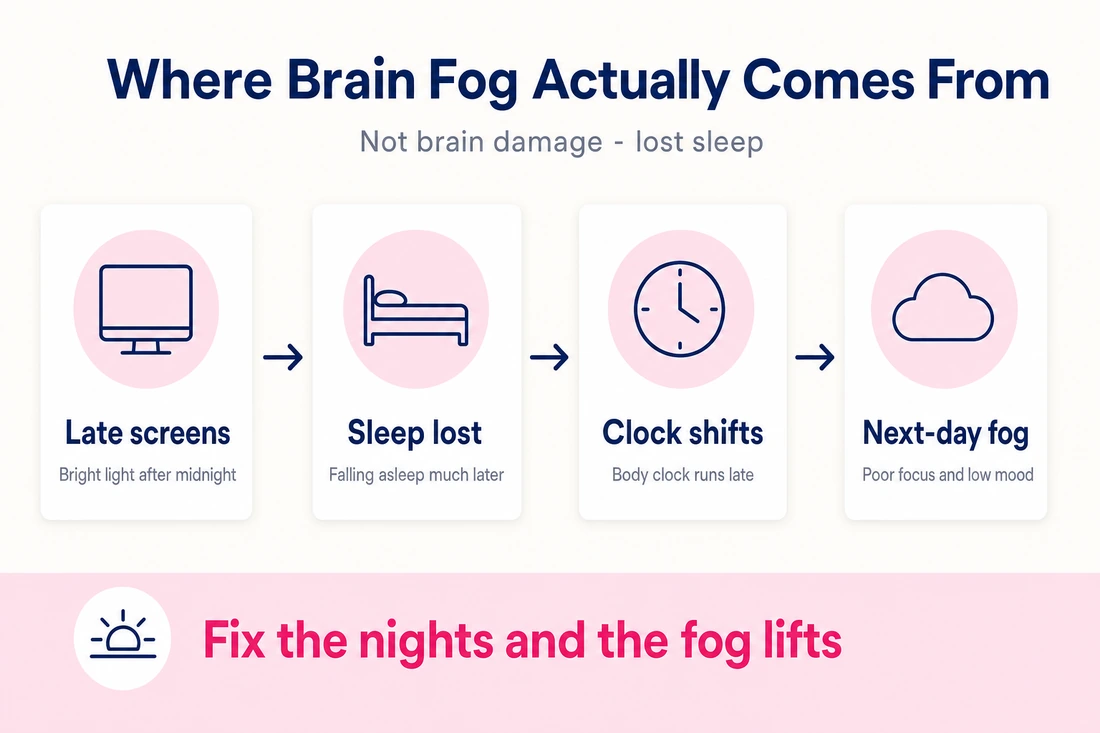
The only indexed paper I could find taking the term as its subject is careful about what it claims. It treats “brain rot” explicitly as a heuristic bridge concept rather than a formal diagnosis, describing the attentional fragmentation, cognitive fatigue and motivational blunting people report. The strongest human evidence points to an ordinary pathway: evening and post-bedtime screen exposure displaces sleep, suppresses melatonin, delays the circadian rhythm and shortens sleep — producing next-day problems with attention and emotional regulation. Crucially, it states that evidence linking this kind of partial sleep restriction to amyloid or tau accumulation remains indirect and should not be interpreted as proof of neurodegeneration (Ekici, 2026).
So: is your brain rotting? No. Are hours of night-time screen arousal wrecking your sleep, and is wrecked sleep making you foggy, flat and unable to concentrate? Almost certainly — and that is a mechanism you can reverse this week, which is a very different proposition from brain damage.
The broader literature on heavy technology use describes neurocognitive effects in similar terms (Subramanian, 2026; Patel, 2025). Adolescents and young adults are the most vulnerable group, partly because of the developmental phase-delay in their sleep biology (Ekici, 2026).
Does gooning cause acne?
Briefly, because this comes up constantly and I have answered it properly elsewhere: no, it does not cause acne. Masturbation, at any frequency, is not a cause of acne — the hormonal changes involved are short-lived and do not drive the process that produces spots. The full explanation, including where the myth came from, is on does masturbation cause acne.
Why do kids say gooning?
Mostly as a joke. Among teenagers the word circulates as an insult, a punchline and a meme long before it means anything specific, and a great many children repeat it with no real idea what it describes. If you have heard your child or their friends use it, that is not evidence they are doing anything — it is evidence they are on the internet.
That said, the word does have a meaning, and it does travel alongside pornography. So it is a reasonable prompt for a conversation, not a reason to panic.
If you are a parent reading this
You have probably arrived because you saw the word on your child’s phone, and I would rather you had an accurate picture than a frightening one.
What the evidence actually supports. A systematic review of 19 studies in young people aged 10 to 19 examined pornography exposure and sexual behaviour. Some associations were found — most consistently with earlier first sex — but the authors are explicit that because most studies were cross-sectional or substantially limited, causal inference could not be made, and that evidence on other outcomes was conflicting or insufficient (Pathmendra, 2023). Anyone telling you the science has proved pornography ruins children is overstating what exists.
What is genuinely well-supported is broader and more practical. The Italian Society of Pediatrics Digital Dependency Commission’s practice guideline for families and paediatricians reviewed excessive digital media exposure and found associations with sedentary behaviour and cardiometabolic risk, with language delays, impaired attention, reduced executive functioning and reported structural brain changes on imaging — observational findings that show association rather than proven permanent damage — and, most consistently, sleep disruption, with delayed sleep onset, reduced duration and circadian disturbance, along with anxiety, depressive symptoms and emotional dysregulation (Bozzola, 2026). A systematic review of screen time and mental health in younger children points the same way (Santos, 2026).
What I would actually do. Deal with the sleep and the device-at-night problem first, because that is where the strongest evidence and the fastest gains are. Talk about pornography rather than raiding the phone; the prevention framework proposed in this literature is built on comprehensive, sex-positive, developmentally appropriate education and pornography literacy rather than shame (Castro-Calvo, 2026) — a reasoned proposal rather than a tested programme, but it is the direction the field is taking. And keep proportion: adolescent masturbation is ordinary and not a sign of anything wrong.
The one thing to rule out. Most of the time this is ordinary curiosity. But if your child is secretive in a frightened rather than embarrassed way, is panicking about messages, is being asked for money, or has been sent sexual material by someone older, that is not a masturbation problem — it is possible grooming or sextortion, and it needs acting on rather than discussing. Tell your child they will not be in trouble, keep the messages, and report it: in India, the National Cyber Crime Reporting Portal (cybercrime.gov.in) or 1930, and the child helpline on 1098. Boys are frequently targeted, and shame is the mechanism the offender relies on.
If your child is distressed, the distress is the thing to treat — not the behaviour.
When it stops being a habit and becomes a problem
Here are the honest red flags I look for in the clinic. If several ring true, the question is no longer how long a session lasted; it is the grip the habit has on you.
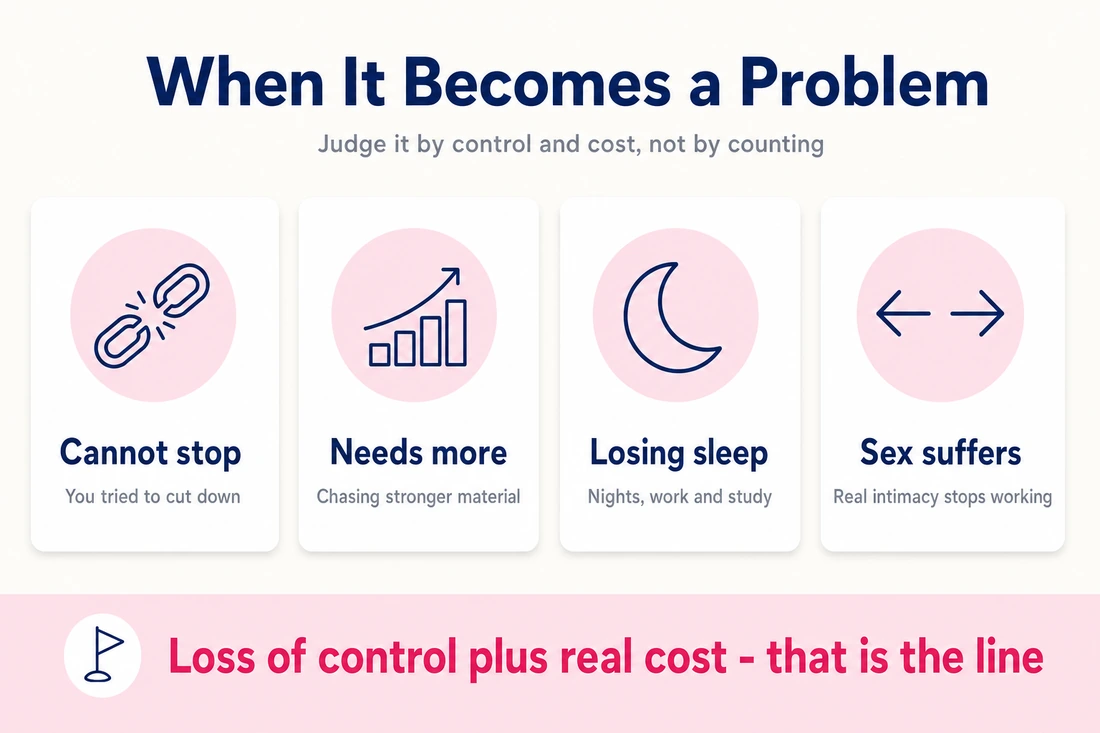
- Sessions run for hours and you did not decide that — you meant to stop and could not.
- You need increasingly extreme or novel material to stay aroused or to finish (Park, 2016).
- You have genuinely tried to cut down and could not.
- It is eating your sleep, your studies or your work.
- Partnered sex has stopped working, or you have started avoiding it.
- You feel real distress about it, and that distress is not fading.
That last pair is what separates a phase from a disorder. Loss of control plus functional impairment is the actual clinical threshold (Weinstein, 2026; Antons, 2020) — not duration, not frequency, and not whether you feel guilty afterwards.
And if that distress is heavy — if you are low most days, not sleeping, or withdrawing from people — treat that as the priority and speak to a doctor or a mental health professional. This is not a matter of willpower and it is not something to wait out. If someone online has sent you sexual material, asked you for images, or is threatening you over them, that is a crime against you and not your fault — report it on cybercrime.gov.in or 1930.

Private 1-on-1 consultation
You have not broken anything. Let us check properly.
A private, judgement-free consultation: I examine you, rule out the things that genuinely need ruling out, and help you break the loop.
Book a Confidential Consultation
How to stop gooning: what recovery actually looks like
I will not give you a technique, because the answer is not a better technique. It is removing the thing arousal has been conditioned to.
What works best is removing the escalating material rather than rationing it, because the novelty is the active ingredient. The night-time screen habit goes with it, which repairs the sleep that was producing the fog. Arousal gets re-anchored to real intimacy at a realistic pace, and a partner needs to know enough to be part of that rather than confused by it — where this has already hollowed out a relationship, the same staged approach I use for a sexless marriage applies here. If you slip, that is not failure — it is the normal shape of behaviour change, and it tells you which cue caught you.
Where the pattern is entrenched, this is treatable with structured psychological help. Structured psychological therapy is the intervention with the most consistent evidence across problematic digital behaviours generally (Balhara, 2026) — though that same meta-analysis found too few studies of problematic pornography use specifically to pool a result, so this is reasoned extrapolation rather than direct proof. Ask your doctor, or a qualified clinical psychologist or sex therapist, for CBT-based treatment for compulsive sexual behaviour. You do not need a diagnosis to ask.
Where behaviour change alone is not enough, I do prescribe. In my own practice, when a man cannot break the loop by removing the material and fixing his nights, I commonly use fluoxetine, an SSRI, to take the edge off the compulsive drive and give the behavioural work a chance to land. Where the picture also involves premature ejaculation, low mood, performance anxiety or an underlying hormonal problem, I treat those alongside it with whatever is appropriate to the case. I want to be precise about the status of this: it is my clinical practice and my clinical judgement, not a protocol lifted from a trial — the evidence base for medication in compulsive sexual behaviour is thin, and fluoxetine is not licensed for it. It is a prescription drug with real side effects, including sexual ones, and it needs a doctor who has examined you and knows your history. Do not source it yourself.
These are the timelines I quote in clinic. They come from my own practice rather than from published trial data, and they are averages, not deadlines — men move at different speeds, and being slower than this table is not a sign that something is wrong with you.
| What improves | How long it usually takes |
|---|---|
| Soreness and skin irritation | A few days |
| Sleep and concentration | 1–2 weeks after screens leave the bedroom |
| Morning erections | 2–6 weeks |
| Arousal with a partner | A few weeks to a couple of months |
| Mood and self-confidence | Follows the sleep first, then the intimacy |
The partnered-arousal window is the part men find hardest to sit through — and it is also the part I most often get to tell them has resolved. If prone masturbation is part of your pattern, I always advise stopping it outright rather than substituting, and I have written that out at how to stop prone masturbation.
Dr Shah’s notes (from my clinical observation)
In more than a decade of consultations, the young men who come to me terrified about gooning almost never have a body problem. Their testosterone is normal, their examination is clean, their fertility is intact. What they have is a night-time, pornography-driven loop they are ashamed of, a wrecked sleep pattern, and a partnered sex life that has quietly stopped working — and they have usually been told one of two lies: that it is completely harmless so they should stop worrying, or that it is destroying their body. Both are wrong, and the second is actively harmful, because the fear is part of what keeps the loop turning. My job is to check the things that genuinely need checking, show them the body is healthy, name the real problem as conditioning and lost sleep, and help them break it. Once the pornography and the compulsion go, the erections, the mood and the real intimacy come back — usually within weeks.
Breaking the porn-and-compulsion loop
The stepwise plan I give my own patients, in plain English.
Free guide · no spam · unsubscribe anytime.
Frequently Asked Questions
Is gooning bad for a 12 year old?
If you are the young person asking this: you have not damaged yourself. Masturbation at your age is ordinary and has not broken your body, your hormones or your future. Coming across pornography at 12 is not your fault either — it is everywhere online. Two things genuinely matter: it is worth not seeking it out, because it is made for adults and teaches misleading things about sex; and phones late at night wreck sleep, which is what actually makes people feel foggy and low (Bozzola, 2026). If you feel you cannot stop, or you feel awful about it, that feeling is the thing to get help with — tell a parent, a school counsellor or your doctor. If someone online has sent you sexual material, asked you for pictures, or is threatening you, tell a trusted adult today; you will not be in trouble.
If you are the parent asking this: hearing the word is not evidence your child is doing it. Deal with the device at night first, talk without shaming, and treat distress rather than the behaviour.
Does gooning lower testosterone?
No. There is no evidence of a meaningful or lasting fall. Plasma testosterone is unaltered by orgasm, and abstinence produces higher levels rather than lower ones (Exton, 2001). Daily measurement through abstinence shows a peak at 145.7% of baseline on day seven, then no regular pattern (Jiang, 2003). Masturbation causes a rise in steroids with no change in luteinising hormone (Purvis, 1976). The direct literature is only these few small studies — but nothing in it supports the fear. If you have lost morning erections and your libido has flattened, ask for a morning testosterone with LH and FSH rather than assuming.
Is gooning bad for muscle growth?
No evidence suggests it is. To blunt muscle growth it would have to suppress testosterone in a sustained way, and the direct evidence shows the opposite (Exton, 2001; Purvis, 1976). If your training has stalled, look at sleep, protein and training load first.
Is gooning bad for growth hormones?
No study has measured growth hormone in this context, so this is reasoning from physiology rather than data. Growth hormone is released mainly in pulses during deep sleep, so the plausible risk is not the act — it is staying up half the night. Short sleep is the more likely culprit for stalled progress.
Does gooning daily lower testosterone?
No — frequency is not the variable that matters. Testosterone is unaltered by orgasm however often it happens (Exton, 2001), and there is no evidence that doing it daily, or several times a day, produces a lasting fall. What does matter is whether you can stop and what it is costing you in sleep and in your relationships.
Is gooning the same as edging?
No, and the difference matters. Edging is deliberately approaching orgasm and backing off; in adults being treated for premature ejaculation, graded behavioural therapy of that kind is a recognised part of management, usually alongside medication (McMahon, 2013). Gooning describes much longer sessions driven by escalating pornography, where the session is running you rather than the reverse.
Can gooning cause permanent erectile dysfunction?
Usually not — but only after organic causes have been excluded, because a significant proportion of young men with ED have one (Safa, 2025). Where the cause is psychogenic, uncontrolled clinical reports suggest stopping pornography is sometimes enough on its own to reverse it (Park, 2016).
Why can’t I finish with my partner any more?
Most often because your ejaculatory reflex has been conditioned to a pattern your partner cannot reproduce — described in the literature as an idiosyncratic masturbatory style, and a recognised contributor to delayed ejaculation (Perelman, 2016). It is treatable, and the first step is changing what arousal is being trained on.
Is “brain rot” real?
Not as a brain disease. The only indexed paper I could find on the term treats it as a heuristic rather than a diagnosis, and locates the mechanism in sleep displacement and circadian delay from late-night screen use — while stating explicitly that the link to neurodegeneration is indirect and should not be read as proof (Ekici, 2026). The fog is real. The rotting is not.
Should I stop gooning?
Yes. As an andrologist my advice is to avoid it, and to stop if you have started — it costs you sleep, focus and, in the men I treat, a working sex life, and it gets harder to break the longer it runs. That is separate from the question of damage: if you have been doing it, you have not permanently harmed yourself, and the problems it does cause are largely reversible once the pornography and the late nights go (Park, 2016). Stop because of what it is taking from you now, not because you are afraid of what it has already done.
How do I know if I actually have a problem?
Judge it by control and cost, not by counting. The clinical threshold is loss of control plus genuine impairment to your relationships, work or wellbeing (Weinstein, 2026; Antons, 2020). If you can stop and it is not costing you anything, you do not have a disorder — and most pornography users never develop one (Castro-Calvo, 2026).
References
- Exton MS, Krüger TH, Bursch N, Haake P, Knapp W, Schedlowski M, Hartmann U (2001). Endocrine response to masturbation-induced orgasm in healthy men following a 3-week sexual abstinence. World journal of urology. PMID 11760788
- Purvis K, Landgren BM, Cekan Z, Diczfalusy E (1976). Endocrine effects of masturbation in men. The Journal of endocrinology. PMID 135817
- Jiang M, Xin J, Zou Q, Shen JW (2003). A research on the relationship between ejaculation and serum testosterone level in men. Journal of Zhejiang University. Science. PMID 12659241
- Brand M, Wegmann E, Stark R, Müller A, Wölfling K, Robbins TW, Potenza MN (2019). The Interaction of Person-Affect-Cognition-Execution (I-PACE) model for addictive behaviors: Update, generalization to addictive behaviors beyond internet-use disorders, and specification of the process character of addictive behaviors. Neuroscience and biobehavioral reviews. PMID 31247240
- Antons S, Brand M, Potenza MN (2020). Neurobiology of cue-reactivity, craving, and inhibitory control in non-substance addictive behaviors. Journal of the neurological sciences. PMID 32534370
- Perelman MA (2016). Psychosexual therapy for delayed ejaculation based on the Sexual Tipping Point model. Translational andrology and urology. PMID 27652228
- Safa A, Waked C (2025). Erectile Dysfunction in Young Adults: A Narrative Review. Cureus. PMID 40809937
- Park BY, Wilson G, Berger J, Christman M, Reina B, Bishop F, Klam WP, Doan AP (2016). Is Internet Pornography Causing Sexual Dysfunctions? A Review with Clinical Reports. Behavioral sciences (Basel, Switzerland). PMID 27527226
- Pathmendra P, Raggatt M, Lim MS, Marino JL, Skinner SR (2023). Exposure to Pornography and Adolescent Sexual Behavior: Systematic Review. Journal of medical Internet research. PMID 36853749
- Subramanian A, Reddy RA, Ravichandran A, Sekar M, Wong LS, Chandra Y, R M, T T, K M, Kumarasamy V, Subramaniyan V (2026). Virtual Dementia in the Digital Age: Neurocognitive Mechanisms, Behavioural Impact and Public Health Implications of Technology Overuse. Annals of neurosciences. PMID 42311879
- Ekici F, Atılgan MC, Kaya S, Selvi Y (2026). Brain rot in the digital age: Sleep loss, circadian disruption, and neurocognitive vulnerability. Chronobiology international. PMID 42267439
- Feng Y, Lin X, Li Y, Li H, Zhu S, Cheng Y, Wu J, Sacca V, Yang WFZ, Ren B, Jiang S, Pu C (2026). Striato-limbic and frontoparietal dysfunction underlying imbalance of reward-motivation and cognitive control in compulsive sexual behaviour disorder: A neuroimaging meta-analysis. Journal of behavioral addictions. PMID 42189603
- Engelhardt R, Way BM, Borgogna NC, Jo D, Bőthe B, Maes J, Kraus SW (2026). The Compulsive Sexual Behavior Disorder Scale (CSBD-19): A Scoping Review of Validation Evidence from 22 Studies. Journal of sex & marital therapy. PMID 41669818
- Balhara YPS, Bhattacharjee O, Bhatia RK, Sanahan R, Ganesh R, Sarkar S, Ranjan R, Kattimani S (2026). Therapeutic Interventions Targeted at Problematic Use of Digital Technology: Systematic Review and Meta-Analysis of Evidence. JMIR mental health. PMID 42119142
- Castro-Calvo J, García-Barba M, Beltrán-Martínez P, Billieux J (2026). Toward a theoretically grounded preventive framework for Problematic Pornography Use: The PPU-PrevFrame. Acta psychologica. PMID 41946137
- Ince C, Antons S, Ashton S, Borgogna NC, Brand M, Briken P, Castro-Calvo J, Chen L, Coleman E, Efrati Y, Fernández DP, Fuss J, Gleason N, Gola M, Jennings TL, Kowalewska E, Kraus SW, Lewczuk K, Grubbs JB, Lew-Starowicz M, Love T, Mestre-Bach G, Potenza MN, Rahm-Knigge RL, De Tubino Scanavino M, Stark R, Demetrovics Z, Bőthe B (2026). Compulsive sexual behavior disorder (CSBD) and problematic pornography use (PPU): A comprehensive, interdisciplinary, and expert-informed narrative review with suggested future directions. Journal of behavioral addictions. PMID 41879870
- Weinstein AM (2026). Sex differences in compulsive sexual behavior disorder. Frontiers in behavioral neuroscience. PMID 42273399
- Trost L, Rowland D, Meston C, Kingsberg S, Briken P, Gross M, Esho T, Lewis R, Giraldi A (2026). Definitions, classification, and epidemiology of sexual dysfunction: a consensus statement from the Fifth International Consultation on Sexual Medicine 2024. Sexual medicine reviews. PMID 42149688
- Diers M, Müller SM, Mallon L, Schmid AM, Thomas TA, Klein L, Krikova K, Stark R, Wegmann E, Steins-Loeber S, Brand M, Antons S (2023). Cue-reactivity to distal cues in individuals at risk for gaming disorder. Comprehensive psychiatry. PMID 37437451
- Brand M, Müller A, Stark R, Steins-Loeber S, Klucken T, Montag C, Diers M, Wolf OT, Rumpf HJ, Wölfling K, Wegmann E (2021). Addiction Research Unit: Affective and cognitive mechanisms of specific Internet-use disorders. Addiction biology. PMID 34409697
- Golec K, Draps M, Stark R, Pluta A, Gola M (2021). Aberrant orbitofrontal cortex reactivity to erotic cues in Compulsive Sexual Behavior Disorder. Journal of behavioral addictions. PMID 34437297
- Martin-Tuite P, Shindel AW (2020). Management Options for Premature Ejaculation and Delayed Ejaculation in Men. Sexual medicine reviews. PMID 31668585
- Gray M, Zillioux J, Khourdaji I, Smith RP (2018). Contemporary management of ejaculatory dysfunction. Translational andrology and urology. PMID 30211060
- McMahon CG, Jannini E, Waldinger M, Rowland D (2013). Standard operating procedures in the disorders of orgasm and ejaculation. The journal of sexual medicine. PMID 22970767
- Kazan Kizilkurt O, Kazan O, Efiloglu O, Erol B, Yildirim A (2024). Effect of internet pornography use frequency on psychogenic erectile dysfunction severity in young Turkish men: the mediating role of dyadic adjustment. International journal of impotence research. PMID 38052977
- Bozzola E, Irrera M, Barni S, Caruso C, Leccese B, Franzese E, Fioretti L, Bernardelli L, Scarpato E, Cupertino V, Mazzone T, Russo R, Benevento A, Strappato B, Cervellini M, Ferrara P, Agostiniani R (2026). Digital media exposure and pediatric health: the recommendations from the Italian Society of Pediatrics Digital Dependency Commission. Italian journal of pediatrics. PMID 41578309
- Santos RMS, Ventura SA, Gonçalves MEOA, Nogueira YJA, Mendes CG, Miranda DM, Romano-Silva MA (2026). The associations between screen time and mental health in children aged 0-12: A systematic review. Journal of child and adolescent mental health. PMID 42340201
- Patel DG, Hanumanpratap Singh Kshatri A, Kommuru S, Javvaji CK (2025). A Narrative Review of Digital Addiction and Health: A New Challenge for Modern Medicine. Cureus. PMID 41625856
A private, judgment-free space to talk through fertility and men’s sexual health. Walk in, or book ahead by phone.
📍No 21, Sree Kalki Apartments, Ground Floor, Bazullah Road, T-Nagar, Chennai 600017