Andrologist in Chennai for Male Infertility Treatment

Does Penis Size Matter to Get Pregnant?

Does penis size matter to get pregnant — a hopeful young Indian couple optimistic about starting a family

Does penis size matter to get pregnant — a hopeful young Indian couple optimistic about starting a family Does penis size matter to get pregnant? No — penis size has essentially no bearing on natural conception. What gets a woman pregnant is depositing semen near the cervix during her fertile window, and a penis of almost any size can do that. Your sperm count and motility matter far more than your size. I want to say this clearly before we go any further, because I know it is the question keeping you awake: in over a decade of andrology practice in Chennai, I have never once told a man he could not father a child because his penis was “too small.” Not once. The anxiety is incredibly common — and almost always misplaced. Let me walk you through exactly why, the way I would across the desk in my clinic, and then I will be honest with you about the rare situations where penile anatomy genuinely does come into play (and how every one of those is treatable). Quick facts Sperm reach the cervix and even the fallopian tubes within minutes of ejaculation — regardless of position or penile size. Particles placed at the top of the vagina have reached the tubes in as little as two minutes (ASRM, 2022). There is no evidence that coital position affects the chance of pregnancy. Sperm appear in the cervical canal within seconds of ejaculation (ASRM, 2022). The much-quoted 2021 “penis size and infertility” study found a difference of only ~1.1 cm — and the authors themselves said it does not mean smaller-penis men are infertile (Slade et al., 2021). Men with a micropenis can and do father children naturally when their sperm count is normal (Give Legacy, 2024). The genuine exceptions are anatomical/functional, not “size” — severe hypospadias, a buried penis, or erectile/ejaculatory dysfunction — and all are treatable (Cleveland Clinic, 2024). The short, honest answer Conception is, at its core, a delivery problem. For natural pregnancy, semen needs to be deposited high in the vagina, near the cervix, around the time an egg is released. Once it is there, the sperm take over — and they are astonishingly fast. The American Society for Reproductive Medicine notes that sperm placed at the cervix are found in the fallopian tubes within about fifteen minutes, and tracer particles put at the top of the vagina have travelled to the tubes in as little as two minutes (ASRM, 2022). Notice what is not in that equation: the length of the penis, its girth, or the position you used. As the same ASRM committee opinion states plainly, there is no evidence that coital position affects fecundability, and sperm can be found in the cervical canal seconds after ejaculation, regardless of position (ASRM, 2022). If position does not matter, length certainly does not. An average vagina at rest is only around 7-9 cm long — far shorter than most men assume — and it actively lengthens and “tents” upward during arousal, drawing the cervix down toward the pool of semen rather than the other way round. So even a well below-average penis comfortably reaches the depth that matters, and the body itself is designed to close the rest of the distance. The penis does not need to “reach” the cervix to make a baby. It only needs to deposit semen inside the vagina. Does this affect your chance of getting a woman pregnant? What the evidence says Penis length or girth No — sperm reach the cervix within seconds, whatever the size (ASRM, 2022) Having a small penis or micropenis No — men with a micropenis father children naturally when sperm is normal (Give Legacy, 2024) Deeper or harder thrusting No — depth and force make no difference (ASRM, 2022) Sperm count and motility Yes — the real engine of male fertility Timing sex to the fertile window Yes — the single biggest lever (ASRM, 2022) Hypospadias, buried penis, erectile or ejaculatory dysfunction Can interfere with delivery — but every one is treatable (Cleveland Clinic, 2024) Does penis size affect fertility: size does not matter, sperm reach the cervix in seconds, what counts is sperm quality, treatable exceptions exist What actually matters for conception (it isn’t penis size) If you are going to spend your worry budget somewhere, spend it here — on the things that genuinely move the needle: Sperm count and motility. This is the real engine of male fertility. A semen analysis tells you far more about your chances than a measuring tape ever could. (You can get a feel for your numbers with our semen analysis calculator, and if motility is the issue, read low sperm motility.) Timing. Having sex in the fertile window — the five days before and the day of ovulation — is the single biggest lever a couple can pull. Frequency matters too; see how frequently should you have sex to get pregnant. Successful deposition. That simply means a firm-enough erection, penetration, and ejaculation inside the vagina. Achieve that, and size is irrelevant — and you do not need any special positions or routines afterwards (see how long to lie down after sex to get pregnant). If you want one concrete next step, it is the semen analysis: it is the single real test of male fertility, it is cheap and quick, and it answers in a couple of days the question that no amount of measuring or worrying ever can. That is the whole list. Penis size is not on it. Talk to an andrologist The 2021 study everyone quotes — what it really said You may have seen a headline claiming “men with smaller penises are more likely to be infertile.” That headline comes from a single 2021 study in Translational Andrology and Urology (Slade et al., 2021). Researchers measured the stretched penile length of a group of men and found that those attending for infertility had, on average, a slightly shorter measurement than those who

Why is there blood in my sperm ? Hematospermia explained

Men’s Health Blogs Why is there blood in my sperm ? Hematospermia explained Why is there blood in my sperm? In this informative video and post, we aim to address a commonly asked question: Why do some individuals notice blood in their semen? Why is there blood in my sperm? https://www.youtube.com/watch?v=4KJp4dCaoyw Join me as we explore the details of this phenomenon, its causes, and when to seek medical attention. Unveiling Hematospermia: Definition and Diagnosis Hematospermia, also known as blood in semen, is a clinical condition that prompts concern among patients. It refers to the presence of blood in semen or blood mingling with sperm upon ejaculation. Various underlying conditions warrant testing and evaluation to accurately diagnose hematospermia. To understand why there is blood in my sperm, an accurate knowledge of the conditions is necessary. Underlying Conditions and Differential Diagnosis When diagnosing hematospermia, we must rule out several conditions, including sexually transmitted infections such as chlamydia and gonorrhea. Additionally, we must assess you for prostatic abscess, prostatic cysts, renal and liver abnormalities, as well as bleeding disorders. As a sexologist, sti testing is particularly more important. These evaluations are essential, as these conditions often correlate with hematospermia (blood in semen). Why is there blood in my sperm? (Hematospermia: the Impact of Age) Is the presence of blood in semen a cause for alarm? For any normal human being, it is! It’s traumatizing to see blood mixed with sperm. Why is there blood in my sperm However, the scientific answer is different. The answer varies with age. For individuals under 40 years old, observing blood in semen on one or two occasions is usually considered benign. While comprehensive testing and ultrasounds are advisable, there’s typically no need for major investigations. This transient occurrence is likely to resolve on its own. Blood in semen frequently goes away on its own over a median period of 6 months to 8 months in young men under 40. Dr. Shah Dupesh Consultant Andrologist & Sexologist Ready to improve your Reproductive Health? Discuss your concerns in a private setting and get personalized guidance tailored to your needs. Book a Call Book a Call I am over 40, should I be worried when I see blood in my semen? However, for those over 40 years old, with a family history of prostate cancer, the presence of blood in semen demands more attention. In such cases, prostate malignancy must be definitively ruled out. Why is there blood in my sperm Endorectal MRI emerges as the gold standard for identifying the source of bleeding within the male reproductive tract. It’s a crucial step in assessing potential prostate cancer. To conclude if you are over 40, never ever ignore blood in semen and definitely get a check-up done with your andrologist. Subscribe to our Newsletter Key Takeaways: Understanding Hematospermia In summary, the significance of blood in semen varies with age and frequency. Individuals under 40 experiencing isolated incidents need not overly worry, as it commonly resolves. Yet, those above 40, especially with prostate cancer risk factors, should pursue thorough investigations to exclude malignancy. Conclusion: Empowering Informed Choices I hope this video has provided insights into hematospermia, assuaging any alarm you might feel upon observing blood in your semen. Remember, you’re welcome to seek clarification or share your doubts in the comments below. Feel free to like, subscribe, and share this video with those seeking clarity on this topic ‘why is there blood in my sperm’. This is Dr. Shah, signing off with best wishes and healthful regards. References Stefanovic KB, Gregg PC, Soung M. Evaluation and treatment of hematospermia. American family physician. 2009 Dec 15;80(12):1421-7. Leocádio DE, Stein BS. Hematospermia: etiological and management considerations. International urology and nephrology. 2009 Mar;41:77-83. Related Blogs Recent Blogs Having more doubts? Consult with our doctor Consult with Dr. Shah Leave Your Comment Cancel Reply Logged in as Dr Shah Dupesh. Log out? Δ

When you ejaculate how much sperm comes out?

Men’s Health Blogs When you ejaculate how much sperm comes out? In this video and post, the question we are going to answer is, when you ejaculate, how many sperms are actually released? More specifically when you ejaculate how much sperm come out? Now many people have a common doubt that when ejaculation happens, are the sperms being properly deposited in the vagina? Understanding the intricacies of this process is crucial, especially for those curious about sperm deposit and conception probabilities. So, let’s delve into the science behind ejaculation and its implications for fertility. How many sperms are going to be deposited in the vagina? To understand this, you must understand the physiology of ejaculation. So when ejaculation happens, the important point to know here is that the first few drops of semen contains the sperm rich fraction. That means the first one or two drops of the semen contain most of the spermatozoa, representing a significant proportion. So that means ejaculation should happen in the vagina strictly and you cannot partially ejaculate outside and then have a partial ejaculation inside. Furthermore, following penetration of your partner or loved one, it’s essential to ensure that you withdraw the organ only after complete ejaculation has occurred Why?? Because during the process of ejaculation, when you have an orgasm, the first one or two drops of the semen contains the sperm rich fraction, SRF. Termed SRF, the sperm-rich fraction essentially indicates that those drops contain the highest number of spermatozoa. And it’s very interesting because when patients collect a sample in a sperm testing laboratory, normally when we see a report, if we notice low semen volume, if we notice a low count,we ask the patient, did the patient spill the first 2-3 drops of the semen on the floor at the time of collecting the sample? As a result, if the answer to the question is yes, we conclude that the report indicates a low semen volume. Given that a significant portion of motile sperm is lost in the spilled drops of semen, the low sperm count report could be inaccurate.. Thus, what’s important to understand here is that the first couple of drops of the semen contains the highest fraction of motile spermatozoa. Dr. Shah Dupesh Consultant Andrologist & Sexologist Ready to improve your Reproductive Health? Discuss your concerns in a private setting and get personalized guidance tailored to your needs. Book a Call Book a Call Some patients also have the question that after I withdraw the organ, I see the semen back flowing. So, when you ejaculate how much sperm comes out? That’s completely fine.  Remember when you ejaculate intra-vaginally, as early as 2-3 minutes after ejaculation, the spermatozoa are going to rapidly swim up and reach the Fallopian tube. What happens after about 10 minutes of ejaculation is that basically the semen is going to liquefy. The liquefaction time is where the coagulated thick semen becomes watery and it becomes thin and watery. So because it becomes liquefied, that is because it loses its viscosity or it becomes liquefied by nature, what’s going to happen? It will flow back down the vaginal canal, and this back flow of semen is termed “effluem-seminis.” That is a physiological process, 99-100% of couples will note that after ejaculation, in 5-7 minutes, semen back flows. The Crucial Initial Phase (Where semen = Gold). When you ejaculate how much sperm comes out? However, the pivotal factor remains the initial phase of ejaculation—specifically, during orgasm. Proper deposition of the first portion of ejaculate into the vagina significantly heightens the chances of pregnancy. The rapid expulsion of the initial 2-3 drops during a man’s orgasm holds particular importance. The depositing these drops in the vagina significantly increases the likelihood of pregnancy. Subscribe to our Newsletter This is more so if the woman is close to her ovulation period or the ovulation window. So I hope you found this video useful and informative and please like, comment and subscribe. Here is  one more bonus point here for you is that when you ejaculate, how many sperms actually comes out? That’s not the right question because in fundamental you need to know what is your sperm concentration per ml. The normal sperm concentration per ml can range anywhere from 13 million per ml to 16 million per ml. I hope this answers the question with some clarity. Please like, comment and subscribe and share this video with all your friends. This is Dr. Shah, consultant andrologist and sexology doctor in chennai I’ll see you back with another video. Bye for now. I hope you enjoyed reading this article on ‘when you ejaculate how much sperm comes out’ References King R, Dempsey M, Valentine KA. Measuring sperm backflow following female orgasm: a new method. Socioaffective Neuroscience & Psychology. 2016 Jan 1;6(1):31927. Doyle JB. The Cervical Spoon: A New Method of Semen Sampling and Assaying Spermigration; a Preliminary Report. The Journal of Urology. 1948 Dec;60(6):986-9. Related Blogs Recent Blogs Having more doubts? Consult with our doctor Consult with Dr. Shah Leave Your Comment Cancel Reply Logged in as Dr Shah Dupesh. Log out? Δ

Dhat Syndrome: Symptoms, Causes & Treatment, Explained by an Andrologist

A weary, low and anxious young Indian man sitting alone on his bed in the early morning, showing the real fatigue and worry of Dhat syndrome

Here’s the honest answer, straight away: Dhat syndrome is a real, recognised medical condition — not a myth, and not “all in your head.” It is a culture-bound syndrome in which deep anxiety about losing semen drives genuine fatigue, weakness, low mood and sexual symptoms. The fear is misplaced, but the suffering is real — and it is very treatable. As a practising andrologist in Chennai, I see this almost every week: a young man, often in his early twenties, convinced that semen lost through masturbation, a nightfall, or a few drops passed in urine is draining his strength, his manhood and his future. Let me explain what is actually happening, because once you understand it, the fear loosens its grip — and the treatment is genuinely good. Talk to Dr Shah Quick Facts Dhat syndrome is real and classified. It sits in the ICD-10 under neurotic/culture-specific disorders, is retained in ICD-11, and is listed in DSM-5 among the cultural concepts of distress (Kar, 2021). The symptoms are genuine — the folk mechanism is not. Semen loss does not physically drain testosterone or destroy fertility; the symptoms are driven by an anxiety–depression and compulsive-behaviour loop (Prakash, 2015). It mainly affects South Asian and East Asian men — India, Pakistan, Bangladesh, Sri Lanka, Nepal and China — typically young, unmarried men aged 16–25 (Udina, 2014). Anxiety and depression travel with it. In a nationwide Indian study, most men with Dhat syndrome had a co-existing depressive or anxiety disorder (Grover, 2015). It is very treatable — reassurance and correcting the semen myth, CBT, treating the anxiety or depression, and breaking the masturbation/porn loop turn it around (Strong, 2022). What is Dhat syndrome? Dhat syndrome — Dhat rog, dhatu loss, “semen-loss anxiety” in plain English — is a clinical condition in which a man becomes preoccupied and distressed about losing semen, and attributes a whole cluster of bodily and sexual symptoms to that loss. The word comes from the Sanskrit dhatu, meaning a vital bodily essence; in classical belief, semen was held to be the most precious of these essences, distilled from blood and food over many days. It was first described in the medical literature decades ago as “a culture-bound sex neurosis of the orient” (Malhotra & Wig, 1991), and it has been studied steadily ever since. So let me say plainly what so few articles do: this is not a made-up complaint and you are not weak for having it. It is a recognised diagnosis with a real symptom picture, a known psychology, and a clear treatment path. I want to be precise about one thing, because the whole site links back to this page for it. The condition is real; the explanation men inherit for it is wrong. Your tiredness, your low mood, your erection trouble — those are real and worth treating. The idea that each drop of semen is physically bleeding away your vitality is the part that is medically untrue. Hold both of those at once and you already understand Dhat syndrome better than most. Is Dhat syndrome real, or a myth? The crucial distinction This is the question I am asked most, and getting it right matters. The honest, evidence-based position is this: the syndrome is real, the distress is real, the diagnosis is real — but the crude folk mechanics are false. Semen is not a finite reservoir of “life force.” Losing it through masturbation, through a nightfall during sleep, or as a few drops passed in urine does not lower your testosterone, shrink your organ, or wreck your fertility. Your body remakes sperm continuously; I explain the daily reality of that in my piece on what happens if you release sperm every day. So the men who tell me their strength is “leaking out” are describing a true experience built on a false premise. Where do the symptoms come from, then? From the anxiety itself. Worry, guilt and hyper-vigilance about semen loss produce very physical effects — fatigue, poor sleep, muscle tension, low mood, and performance anxiety that blocks erections. The semen never harmed you; the fear did. That is not a dismissal — it is the doorway to treatment, because anxiety and depression are things I can actually treat. Worried this is you? Talk to Dr Shah today. Book a Call Dhat syndrome symptoms: the real cluster Men with Dhat syndrome do not complain of one thing — they bring a recognisable cluster, and naming it is itself reassuring. The core complaints I hear, supported by the published reviews (Kar, 2021; Strong, 2022), are: The real symptom cluster of Dhat syndrome — driven by anxiety about semen loss, not by the loss itself. The core symptoms men describe Preoccupation and anxiety about semen loss — through masturbation, nightfall (nocturnal emission), or passing “dhat” in urine. This is the central, defining feature. A pervasive sense of weakness and fatigue — feeling drained, low on energy, “not the man I was.” Lower-back ache — a classic and very common complaint in this group. Self-perceived shrinking of the penis or testes — the conviction that the organ is reducing in size. In my clinic this very often crosses over into small penis syndrome — a perceived shrinkage, not an anatomical one. Erectile dysfunction and premature ejaculation — and in this group the erectile dysfunction is frequently severe, not mild; comorbid sexual dysfunction is a documented, distinctive feature of Dhat syndrome (Rajkumar, 2016; Vivekanandan, 2019). Poor concentration, low motivation, and depressed mood — sometimes deep enough to meet criteria for clinical depression (Mumford, 1997). The symptoms are real and measurable in their impact: the longer Dhat syndrome goes untreated, the more it erodes coping, quality of life and day-to-day function (Ashwin, 2026). That is exactly why I never wave it away — and why catching it early matters. Dhat syndrome: the folk belief vs the medical reality What men fear (the myth) What is actually true (the medicine) Each drop of semen drains my “vital fluid”

Pus Cells in Semen: Normal Range & When to Worry

A relatable Indian man in early morning light reading his semen analysis and realising his pus cells in semen are within the normal range and usually harmless

Here is the straight answer on the normal range of pus cells in semen: a normal semen report shows up to 1 million peroxidase-positive white cells per millilitre — the WHO 6th-edition cut-off — which usually reads as roughly 1–4 round cells per high-power field (HPF). Most “pus cells” your lab reports are actually harmless round cells, not true infection. As a practising andrologist in Chennai, I get a message like this almost every day: a man photographs the line on his semen report that says “pus cells: 8–10/HPF,” and is convinced his fertility is finished and an infection is eating away inside him. Let me settle your nerves first, then give you the facts. In the large majority of these reports there is no infection and nothing to treat — the lab has simply counted round cells and called them pus. For the smaller number who do have a real problem, the fix is a targeted antibiotic course after a culture, not panic. Book a Consultation Most raised pus-cell counts on a semen report are harmless round cells, not infection. Quick Facts Normal is up to 1×10⁶ peroxidase-positive white cells/mL — the WHO 6th-edition threshold for true leukocytospermia (Dutta & Agarwal, 2025); on most Indian reports that corresponds to about 1–4 round cells per HPF. Not every “pus cell” is a white blood cell. Round cells in semen include both inflammatory cells (true pus) and immature sperm-making cells; you cannot tell them apart by eye, only with a peroxidase stain (Johanisson, 2000). Leukocytes in semen are common, not automatically a disease — found in about 30% of infertile men and up to 20% of fertile men (Henkel, 2024). White cells turn up even in proven-fertile sperm donors and these are linked to normal or improved fertilisation outcomes (Barraud-Lange, 2011). A genuine bacterial infection is the version that bites — it lowers sperm quality and raises sperm DNA fragmentation (Eini, 2021), which is exactly why a semen culture matters before antibiotics. What is the normal range of pus cells in semen? For most men I see, the honest answer is: lower than you fear. The internationally accepted reference is the World Health Organization’s: true leukocytospermia means more than 1 million peroxidase-positive leukocytes per millilitre of semen (Dutta & Agarwal, 2025). On the per-HPF count your Indian lab actually prints, that threshold usually works out to about 1–4 round cells per high-power field being well within normal. So a report of 2–4, or even an isolated 4–6, is rarely the catastrophe it feels like at 6 a.m. The trouble is that the two scales do not line up neatly. The WHO number is a concentration per millilitre measured with a stain; your lab’s number is a rough visual count per microscope field. That mismatch is why I always interpret the count alongside the rest of the full semen analysis report — the sperm count, the motility, and whether there is any clinical symptom — rather than reacting to one line in isolation. What “normal” actually means on your report Normal does not mean zero. A few white cells are part of a healthy ejaculate — they are housekeeping cells. What we are screening for is a count high enough, and a clinical picture suspicious enough, to suggest real inflammation or infection. A single number, divorced from your symptoms and the rest of the report, tells me very little. Why the lab reports a count per HPF Most Indian semen reports do a manual microscope count and express it as cells “per high-power field.” It is quick and cheap, but it cannot distinguish a neutrophil (a true pus cell) from an immature germ cell — both look like “round cells” down the eyepiece. That single limitation is behind most of the over-diagnosis I unwind in clinic. Round cells include harmless immature germ cells and true peroxidase-positive leukocytes — only a stain tells them apart. Pus cells vs round cells: the mix-up most reports make Here is the most important thing on this page. The cells your lab labels “pus cells” are more correctly called round cells, and round cells are a mixed bag. Some are genuine inflammatory white blood cells — neutrophils, lymphocytes, macrophages — and those are the true pus cells. But a large share are immature germ cells: young sperm-making cells shed normally from the testis. Under an ordinary microscope, the two look almost identical, and morphology alone cannot reliably tell them apart (Johanisson, 2000). So when a report says “8–10 pus cells/HPF,” what it very often means is “8–10 round cells/HPF” — and a good chunk of those may be harmless immature germ cells, not infection at all. Why not every “pus cell” is a true white blood cell To know whether those round cells are really leukocytes, the lab has to do a peroxidase test (also sold as a leuco-screen). Peroxidase-positive cells are true white cells; the rest are germ cells. Without that stain, a high “pus cell” count is an unconfirmed suspicion, not a diagnosis. This is precisely why I rarely treat a number alone — I treat a confirmed, symptomatic infection. What your exact pus-cell count means (2–4 to 20–25 per HPF) Searchers land here having typed their exact count, so let me give you the interpretation I use in clinic. Read this as a guide, not a verdict — the count is always weighed against your symptoms and the rest of the report. Pus cells in semen by count (per HPF) — likely meaning and what I do Count per HPF What it most likely means What I do 0–1 Completely normal Nothing — reassurance 2–4 Normal; well within WHO range Nothing — reassurance 4–6 Upper-normal; usually round cells, not infection Repeat sample after 3–4 days’ abstinence if symptomatic 8–10 Mildly raised; could be round cells or early leukocytospermia Peroxidase test ± semen culture only if symptoms 10–12 Raised; confirm whether truly leukocytes Peroxidase test + semen culture 20–25 Clearly high; true leukocytospermia likely

Does Masturbation Cause Acne?

A young man examining his skin in a mirror, reassured by a calm male doctor in a Chennai clinic

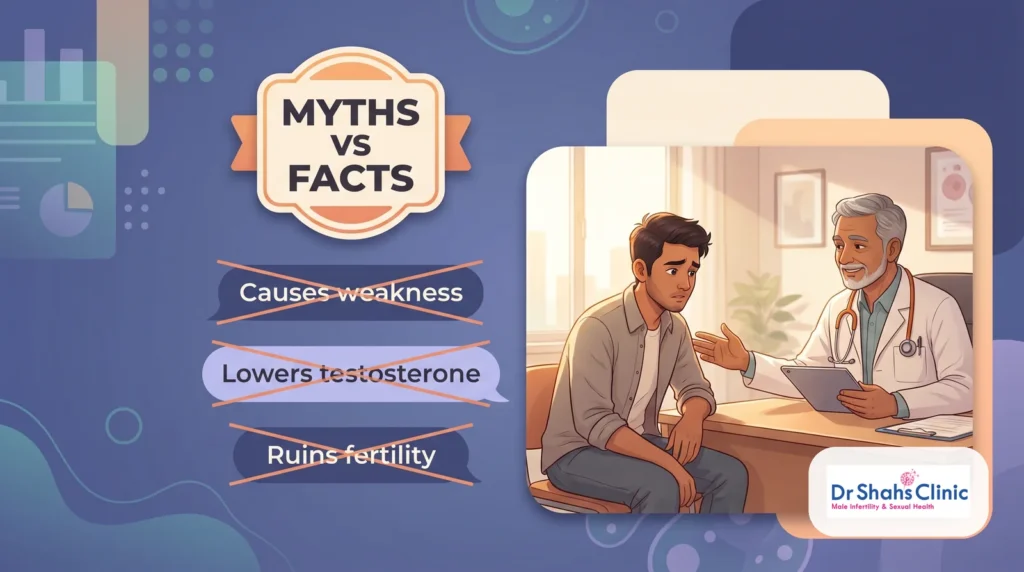
A Chennai andrologist debunks the myth that masturbation causes acne – the testosterone misunderstanding, why both start at puberty, and what really causes acne.

What to do if you cant ejaculate? Delayed ejaculation & its treatment explained

Men’s Health Blogs What to do if you cant ejaculate? Delayed ejaculation & its treatment explained In this post, we are going to go through quickly about ‘what to do if you cant ejaculate’. More specifically, we will briefly look at delayed ejaculation and delayed ejaculation treatment. You can also watch the video below In this post, we are going to go through quickly about ‘what to do if you cant ejaculate’. More specifically, we will briefly look at delayed ejaculation and delayed ejaculation treatment. You can also watch the video below The last thing any man or (his better half) wants to experience in their sex lives, is ‘the inability to cum’. Its frustating, unfulfilling and bloody irritating. So, what to do if you cant ejaculate? Lets first science the shit out of the topic. Now, delayed ejaculation (DE) is also called inhibited ejaculation. In this condition, men are unable to ejaculate after penetration of the vagina, in partnered sex. The important point to note here is the ‘average ejaculatory latency time’ which is about 4 to 10 mins. Interestingly this 4 to 10 minute time is also the ‘average duration of sex’ in most couples. So, technically, how long should sex last? about 4 to 10 mins post penetration. However, in delayed ejaculation, the sex lasts really long. Men who fail to ejaculate, keep thrusting their partners from anywhere between 30 to 60 minutes, but do not ejaculate. Thus these men in principle do not achieve their orgasm. This causes tremendous sexual frustration, depression and distress to the male. But, when it comes to the female partner, the distress and stress results from the consequent infertility issues. Since men with delayed ejaculation suffer due to the inability to deposit sperm in the vagina, infertility results, thereby affecting the relationships. Not just that, female partners of men who cant ejaculate also suffer from poor self esteem issues, disturbed body image problems and a range of other psychological problems. They think that, they are probably not ‘attractive’ and thereby their unable to make their partner come. Dr. Shah Dupesh Consultant Andrologist & Sexologist Ready to improve your Reproductive Health? Discuss your concerns in a private setting and get personalized guidance tailored to your needs. Book a Call Book a Call So what should you do if you cannot ejaculate? Keep Reading! The problem of delayed ejaculation is seen in about 4 to 8% of men presenting to male fertility clinic with sexual health issues. Now, here comes the icing on the cake. A large proportion of men with DE, seem to suffer from DE due masturbatory behavior. Men who engage in masturbation are frequently ‘auto-sexual’ or more specifically auto-sexually oriented. Can masturbation cause delayed ejaculation? Hell yeah it can. For these men, unfortunately, are compelled to take their hand and stimulate their organ. The thrusting force generated from their hand actually offers much greater gratification than the ‘vagina’s’ (of their partners) Moreover, men with delayed ejaculation also suffer from an idiosyncratic masturbation style called as ‘prone masturbation‘. Individual’s who engage in prone masturbatory practice frequently orgasm or achieve ejaculation by rubbing their organ on the bed or on the floor. The rubbing of course helps the individual get a tremendous high triggering an ejaculatory response. Other yet equally important causes of DE include 1. Major pelvic and abdominal surgeries 2. High Prolactin 3. Low Testosterone 4. Genito-urinary tract infections (from stds like chlamydia and gonorrhea et cetera)* 5. Mullerian cysts and prostatic utricles *Whats interesting to note here is that, specifically with STD’s the patient will have burning sensation while ejaculation. Thus, the pain will eventually inhibit the ejaculation completely Subscribe to our Newsletter What can you do immediately if you cant ejaculate? The best thing you can do for yourself is to visit a sexologist near you A thorough psychological and psycho-sexual evaluation is a definite must. Most importantly, a point of interest would be to get the individual evaluated on their sexual orientation. Many men suffer from conflicts regarding their sexual orientations. In men with DE, the said patient may be in a heterosexual relationship but would rather prefer to be homosexual. This conflict in the psyche can in itself cause and inhibition of the ejaculation (or ejaculatory response). Next, a thorough evaluation of the male sex hormones is also definitely required. Ultimately, treatment depends on the cause. If the issues are psychological. Treatment options include 1. Cognitive behavioral therapy or 2. REBT therapy combined with psychosexual therapy If the issues are organic (a bodily physiological problem) Hormonal therapy can be done. For example for men with elevated prolactin, medications to reduce prolactin can be given. Similarly for men with hypogonadotrophic hypogonadism (where no sperm in the semen is seen) hormonal injections with testosterone replacement therapy is recommended. Fundamentally the END-GOAL is to help the patient achieve a normal antegrade ejaculation. Some medications which we have used in our practice include medications like 1. Tab Cabergoline 0.5 mg twice a week for 8 weeks 2. Midrodine Hydrochloride and Ephredine. So, that about summates the post on ‘what to do if you cant ejaculate’. I hope you found this post interesting and useful. Do drop in your comments below. I will see you in this space with more interesting content to read Cheers! References Abdel-Hamid IA, Ali OI. Delayed ejaculation: pathophysiology, diagnosis, and treatment. The World Journal of Men’s Health. 2018 Jan 1;36(1):22-40. Althof SE. Psychological interventions for delayed ejaculation/orgasm. International journal of impotence research. 2012 Jul;24(4):131-6. Related Blogs Recent Blogs Having more doubts? Consult with our doctor Consult with Dr. Shah Leave Your Comment Cancel Reply Logged in as Dr Shah Dupesh. Log out? Δ

Does Penis Stretching Work? The Truth about ‘Jelqing’

Men’s Health Blogs Does Penis Stretching Work? The Truth about ‘Jelqing’ So, you are going to love this post. Its about ‘the penis stretching exercises’. Does penis stretching work? How effective is ‘jelqing’. Can it make your organ BIG?. Watch the video below Now, the truth is a large number of men have serious problems with the size of their organ. An estimated 45% to 55% of men believe their organ is small (teenie weenieee) in terms of size. Full thanks and salutations to the porn industry, since, men tend to compare their organ sizes with porn stars while watching them do it. Moreover, they a develop a strange complex called as the ‘small penis syndrome’. Furthermore, these men compare the size of their organ with other men, while sharing common spaces in showers and toilets. I mean it really get to the head of these guys. They lose hope, they get depressed and feel their lives are over, fundamentally based on their penis size. They develop whats called as small penis syndrome. Moreover, men with this condition strongly believe and feel that they cannot satisfy their partners in bed. They believe and eventually end up with erectile dysfunction. Consequently, they avoid intimate relationships, and resort to masturbation where the element of judgement from another partner is fundamentally absent. Dr. Shah Dupesh Consultant Andrologist & Sexologist Ready to improve your Reproductive Health? Discuss your concerns in a private setting and get personalized guidance tailored to your needs. Book a Call Book a Call But the TRUTH of the matter is, their organ sizes are actually NORMAL Now, lets discuss a bit about penis size….since this is were most men have a problem. The mean average penis size ranges from about 5 to 5.5 inches when erect. But most men do not know to measure their organ. They end up comparing their size with what they see in the pro, leading to distress, anxiety, depression and a whole host of other issues. So, say you truly have a small size, does penis stretching work? Or does penis lengthening work? We hear all this humbug on these penis lengthening exercise, penis massage blah blah. However, these exercises will not increase the size of your equipment. Sorry to disappoint you. Penis stretching or Jelqing involves rubbing the organ back and forth using lubricants. This pseudoscience claims that repeated penis massage and stretches ends up causing micro tears in the deep tissue of the penis. Moreover, after the minor injuries heal, the scar tissue formed will make the organ feel and appear thicker. But, most people forget to notice that, the penile tissues are not just made of muscles. The penile tissue is made full of ‘neurovasculature’ that is, the organ is filled with blood vessels and nerves. Furthermore, it has 3 erectile tissues inside, the corpora cavernosa and the corpora spongiosum, so, stretching this organ will cause permanent long term damage. Not just, that, their are case reports and studies that suggest that, in men who engage in jelqing or penis stretching organ damage occurs. I have personally seen patients who engage in jelqing & eventually ending up with erectile dysfunction. The last thing you want to do to yourself is self-harm by doing these things. Remember, their are about a 100 factors based on which a women will judge you. And organ size is NOT IMPORTANT. So, please do not worry about your penis size. Visit an andrologist or sexologist near you to get a correct estimate of your organ. Subscribe to our Newsletter This is because a self-estiamtion of your size, by looking at your organ from top-down will make your organ look much smaller than it actually is. In all probability, your organ size is most probably normal. As a bonus point please never use ‘penile extenders’ for stretching your organ. It will cause permanent erection problems, by either incorrect usage or by penis stretching. Penis size can be increased by other methods, like utilizing whats called as a ‘Jess extender’ OR similar devices. But, stretching techniques or stretching devices or other surgical interventions do not work. So, remember 3 things 1. Estimate your size correctly 2. Penis stretching is not required 3. Visit an andrologist for the right treatment with respect to stretching I hope you liked this short post on ‘does penis stretching work’. Pleas drop in your comments below References Veale D, Miles S, Read J, Troglia A, Wylie K, Muir G. Sexual functioning and behavior of men with body dysmorphic disorder concerning penis size compared with men anxious about penis size and with controls: A cohort study. Sexual medicine. 2015 Sep 1;3(3):147-55. Sigalos J, Eleswarapu S, Mills J. HF01-17 PENILE STRETCHING PRACTICES THROUGH TIME AND CULTURE. The Journal of Urology. 2022 May;207(Supplement 5):e217. Related Blogs Recent Blogs Having more doubts? Consult with our doctor Consult with Dr. Shah Leave Your Comment Cancel Reply Logged in as Dr Shah Dupesh. Log out? Δ

Male Fertility Tips To Get Pregnant Fast – 5 Quick Actionable strategies to implement

Men’s Health Blogs Male Fertility Tips To Get Pregnant Fast 5 Quick Actionable strategies to implement Hey guys! you are going to find this post both fun to read & easy as a pie to follow. Let get to the crux of the topic without wasting time. So, we are going to quickly discuss on male fertility tips to get pregnant fast (I mean super fast from a biological perspective). Watch the short below. It wont take a more than a minute of your time. Okay, you must be a newly wed or you are in a long term relationship with your girlfriend or whatever. You are ready to take that next big step to have a baby? [most people do not understand that they are screwing themselves over when they decide on having a child :-)]. However, since you are dead serious on this goal, you must be married for a year or two. Since social pressure from your relatives (specifically the damn in-laws) builds up rampantly. During this time, sexual intercourse which was once heavenly becomes a chore. In principal, sex happens just to have a child. You start tracking your partners ovulation days, her fertile window and plan intercourse. But still a pregnancy simply just does not seem to happen. Am I right? (I know I am). Both you and your partner are damn frustrated. It gets frustrating, trust me!. So, then what are the male fertility tips to get pregnant fast? The answer lies below in 5 quick actionable strategies to get your partner pregnant. FAST Dr. Shah Dupesh Consultant Andrologist & Sexologist Ready to improve your Reproductive Health? Discuss your concerns in a private setting and get personalized guidance tailored to your needs. Book a Call Book a Call Male fertility tips to get pregnant fast – 5 actionable strategies you should implement right now Tip 1 : Having frequent sex Regular sex can help. But do not at any cost make it mechanical. If sexual intercourse happens with all the planning around your partners fertile window, you are not going to get her pregnant. How much sex to get pregnant then? Remember its roughly 3 times per week. Studies suggest that when sexual intercourse happens at the rate of 3 times per week, their is roughly a 60 to 70 percent chances of getting your partner pregnant in the next 8 months. Yup that is roughly 8 months. When the frequency of intercourse falls to less than 3 per week, consequently the chances of pregnancy also drop. On average, the chance of getting your partner pregnant is roughly varies from 4% to 6% per month, when you have sex 3 times per week. So have fun, while you are at it. Making babies, no big deal as such. Tip 2 : Take the famed ABC Juice ABC juice (Expanded as Apple, carrot and beetroot juice) is an excellent natural anti-oxidant. Remember to take lots of it. Take the ABC juice everyday. Regular intake of ABC juice helps improve sperm motility fast,  increase sperm concentration and also boosts overall male fertility. One of the best home remedies to improve male fertility is taking a combination of ABC juice, lemon juice and orange juice. I would recommend taking each of these juices on an alternative day to boost male fertility. This is probably on of the best male fertility tips to get pregnant fast. Tip 3: Improve your erection Now, you are going to find this tip interesting. The tip is a double treat, both for you and your partner. Remember having a good erection, is paramount to satisfactory sexual intercourse. You cant argue with that right? However, the better and harder your penis. The larger the amount of semen deposited in the vagina. Now to put in simple words. More semen = more sperm (i.e the total number of sperm deposited per ejaculate is higher). So you definitely need to treat erectile dysfunction if you have it and also improve your existing hardness of your organ. Trust me, its worth it.  A simple way to improve erection is by going for a walk and hitting 10,000 steps per day. Try to use a pedometer and keep track of your steps. Or hit a daily target of 6 km/day while walking. Subscribe to our Newsletter Tip 4: Restful sleep and avoid night-shift jobs Its not worth working nights. Simple as that. We are not biologically designed to function with full potential in the nights. Quit your night shift work. In my experience as an andrologist and sexologist, I have seen a large number of patients suffer from numerous fertility & sex related problems due to night work only. Patients working in nights frequently suffer from low sperm concentration, low sperm motility and also decreased erectile dysfunction. They also have low sex interest and feel fatigued all the time. So please quit working at nights and ensure you get 6 to 8 hours of restful sleep. Trust me, it will make all the difference. Tip 5: Quit Smoking & Alcohol Lastly, definitely quit smoking and alcohol. Its just not going to help you, since it kills your sperm and it also kills your erectile functions. To conclude, in order to improve your overall male fertility, following simple lifestyle changes is all that is required. Take it easy and relax. Do not worry. Keep trying and you will achieve your goals of fatherhood. I will see you soon with another blog post References Begot I, Peixoto TC, Gonzaga LR, Bolzan DW, Papa V, Carvalho AC, Arena R, Gomes WJ, Guizilini S. A home-based walking program improves erectile dysfunction in men with an acute myocardial infarction. The American Journal of Cardiology. 2015 Mar 1;115(5):571-5. Pasqualotto FF, Lucon AM, Sobreiro BP, Pasqualotto EB, Arap S. Effects of medical therapy, alcohol, smoking, and endocrine disruptors on male infertility. Revista do Hospital das Clínicas. 2004;59:375-82. Deng N, Kohn TP, Lipshultz LI, Pastuszak AW. The relationship between shift work and men’s health. Sexual medicine reviews. 2018 Jul 1;6(3):446-56. Related Blogs Recent Blogs Having