

Fordyce spots are normal oil (sebaceous) glands: tiny, painless, pale yellow or white dots, 1 to 3 mm, on the penis, scrotum, lips or inner cheeks. They are not an STD, not contagious, and need no treatment.
Hello! Vanakkam and Namaste. This is Dr Shah Dupesh, consultant sexologist in Chennai.
Had a sexual exposure and now see a bump? Do not decide for yourself that it is a Fordyce spot.
Come in for an examination. Call 97907 83856 or message me on WhatsApp; you are seen in private, by me, in T Nagar.
I see men with Fordyce spots regularly. Many arrive sure they have caught something, and the infection they fear most is herpes.
So let me be clear from the start. I do not treat Fordyce spots, because there is nothing to treat. What I do is examine you, tell a Fordyce spot apart from herpes or warts, and test you when there is any doubt.
But here is the warning I give every man who has had a recent sexual exposure. A self-diagnosis of “just Fordyce spots” can cost you dearly.
Early herpes, warts and syphilis can all start small and painless, and a missed infection can pass to your partner. So read this guide to understand your skin, not to replace an examination.
This guide covers what Fordyce spots are, how common they are, and how to tell them from the bumps men most often confuse them with: pearly papules, warts, herpes, molluscum, syphilis and angiokeratoma. It also covers what makes them worse, and the few signs that do need a test.
Read this first
Fordyce spots in six points
Normal oil glands
They are sebaceous (oil) glands with no hair, about 1 to 3 mm across, most often in the mouth and on genital skin (Pallua, 2013).
Not an STD
They are not caught from sex and do not spread to a partner, yet they are commonly mistaken for sexually transmitted infections (Pietkiewicz, 2023).
Herpes looks different
Herpes tingles, burns, blisters and breaks into sores. Fordyce spots do not burn and do not blister.
Common, and normal
Among 400 men seen in a skin clinic for genital lesions, 9% had Fordyce spots or similar oil-gland bumps (Michajłowski, 2012). In the mouth, some surveys find them in most adults.
No treatment needed
I do not treat them. Removal is cosmetic only, and the evidence for it is a few small case series and case reports.
After an exposure, get examined
Had a sexual exposure? Do not label a new bump as Fordyce yourself. Early infections can look harmless; an in-person examination settles it.
Jump straight to your worry:
What are Fordyce spots?
Fordyce spots are ectopic sebaceous glands: oil glands sitting where you would not expect them, most often in the mouth and on the genital skin (Pallua, 2013). They are also called Fordyce granules, Fordyce glands or Fordyce bodies. The name comes from John Addison Fordyce, the American dermatologist who described them in 1896.
Normally, an oil gland empties into a hair follicle. A Fordyce spot is an oil gland without a hair (Gaballah, 2014), so it opens straight onto the surface, and you see the gland itself as a pale dot.
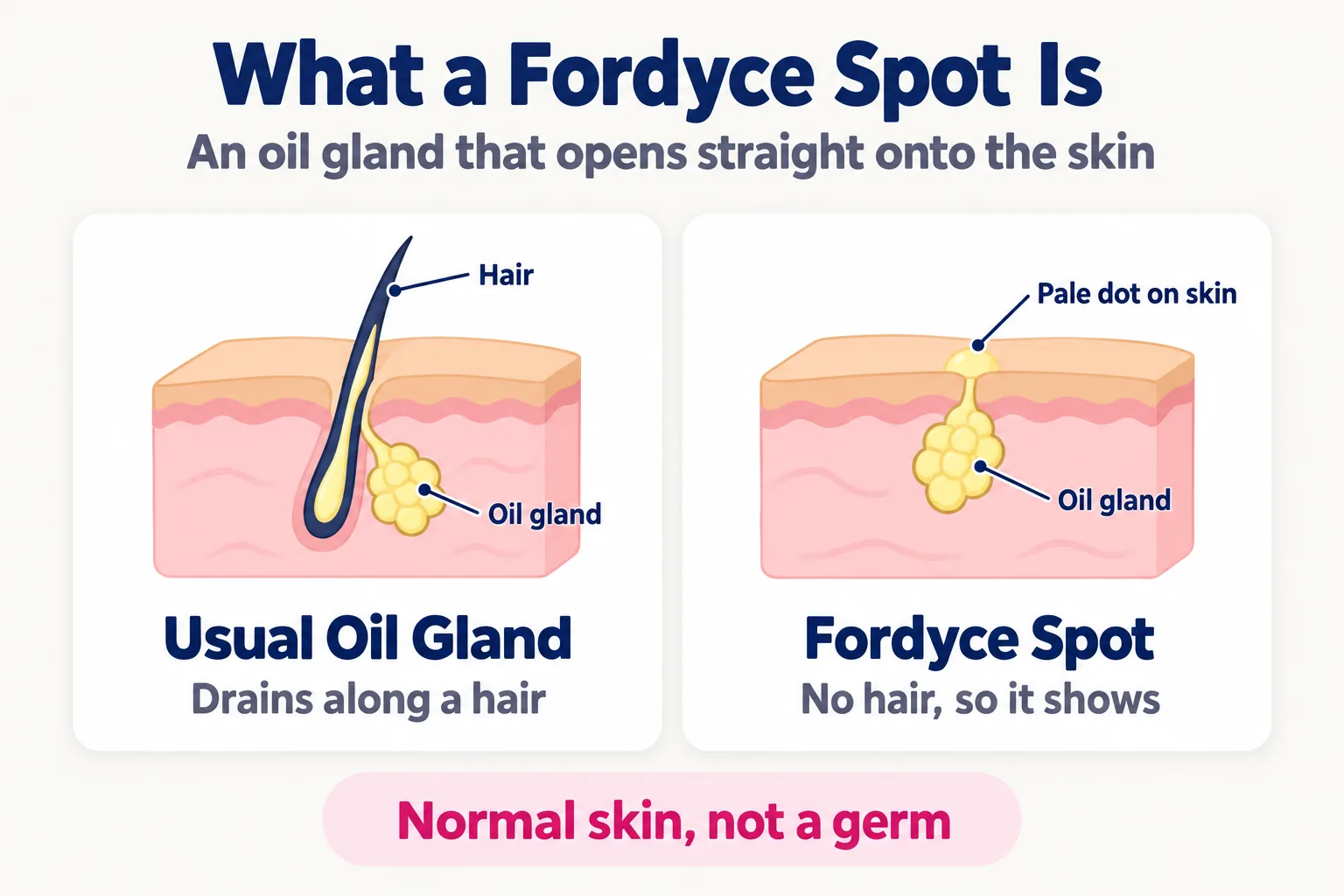
Under the microscope, they look like ordinary skin oil glands, and disease inside them is rare (Dreher, 1995). Specialist reviews list them as a normal variant of penile skin, alongside pearly penile papules (Rane, 2013; Köhn, 2016).
That is the key idea of this page. A Fordyce spot is a part of your skin, not something that got into it.
- On the penis and scrotum: the shaft, the foreskin and the scrotal skin, often in small clusters. In one teenager they even ran in a line along the shaft (Paolino, 2018).
- In the mouth: the border of the lips and the inside of the cheeks (Gorsky, 1986).
- Women get them too, on the labia minora (Hedberg, 2020).
They are among the most common harmless growths on genital skin (Stamm, 2017). That makes them a classic cause of a needless STD scare.
What do Fordyce spots on the penis look like?
They look like tiny, slightly raised dots, usually in groups. On the penis they are skin-coloured to yellowish (Paolino, 2018), and on genital skin they can look faintly pink. They do not hurt, ooze or bleed, and they rarely itch.
Most men notice them suddenly, for example on the shaft or foreskin. But they were almost certainly there before. Stretching the skin, such as during an erection, simply makes them stand out.
What Fordyce spots look like: the features that matter
| Feature | Fordyce spots | Why it matters |
|---|---|---|
| Size | Pinhead, about 1 to 3 mm (Ahn, 2019; Pallua, 2013) | Bigger, growing lumps are something else |
| Colour | Pale yellow, white, skin-coloured or faintly pink | Red, dark or raw spots are something else |
| Feel | Smooth, slightly raised, not painful | Pain, burning or tingling points to herpes |
| Pattern | Clusters or scattered dots, sometimes a line (Paolino, 2018) | Neat rows round the rim are pearly papules |
| Over time | Stay much the same for years | Blisters, sores or spread need a test |
| When stretched | Look more obvious | Why men notice them during an erection |
Some men with genital Fordyce spots do report mild itching or discomfort during sex (Pallua, 2013). But burning, blisters or sores are not part of the picture. Those are the signs that point elsewhere.
Can you get Fordyce spots on the glans?
Yes, but it is less typical. When pathologists find ectopic oil glands on the glans or inner foreskin, they sometimes call them Tyson’s glands (Paolino, 2018).
On the head of the penis, neat rows of dome bumps round the rim are far more often pearly penile papules. Still, both are normal.
Why do I have white spots on the inside of my foreskin?
The commonest harmless causes are Fordyce spots and trapped smegma, the normal white secretion under the foreskin. On the other hand, a red, sore, itchy foreskin is more likely balanitis. Painful blisters there need a herpes test.
How common are Fordyce spots?
Common. On genital skin, the best figure comes from 400 men seen in a dermatology clinic for genital lesions: 9% had ectopic oil glands or the closely related sebaceous hyperplasia (Michajłowski, 2012). In the mouth they are far more frequent, and some surveys find them in most adults.
You will read online that “70 to 80% of adults” have them. But the honest picture is messier. The figures run from under 1% to about 95%, depending on who was examined and how closely.
Share of people found with Fordyce spots on the lips or inside the mouth, by study. Mouth and lip studies only: these are not penile figures.
Source: Gorsky, 1986; Olivier, 2006; Jahanbani, 2009; Reichart, 2000; Vieira-Andrade, 2011; Pereira, 2025; Tortorici, 2016; Al-Mobeeriek, 2009; Oivio, 2020; Bhatnagar, 2013. India is highlighted in pink.
Why do the numbers vary so much?
The highest figure, 94.9% of 2,462 Israeli adults, came from a survey dedicated to looking for Fordyce spots (Gorsky, 1986). A general dental survey of 8,866 adults in Uttar Pradesh recorded only 0.13% (Bhatnagar, 2013).
Part of that gap is how closely examiners looked and what they counted as a spot. Part is a real difference between populations (Gorsky, 1986; Olivier, 2006). Put the published estimates we reviewed side by side, and they scatter across the whole range.
A histogram: each column counts how many published estimates fall in each 20-point band. All are mouth and lip surveys, including children, newborns, transplant patients and healthy control groups. The spread reflects who was examined, how closely, and what was counted as a spot.
12
4
0
2
2
Source: 0 to 20%: Al-Mobeeriek, 2009; Oivio, 2020; Bhatnagar, 2013; El Toum, 2018; Mansour Ghanaei, 2013; De Felice, 2005 (controls); Sedano, 1989 (children); Niranjan, 2020 (newborns); Tortorici, 2016; Collins, 2021; Ponti, 2015 (controls); Pereira, 2025 · 20 to 40%: Jahanbani, 2009; Reichart, 2000 (two age groups); Vieira-Andrade, 2011 · 60 to 80%: Olivier, 2006 (men); Güleç, 2010 · 80 to 100%: Gaballah, 2014; Gorsky, 1986
Even so, the more cautious surveys still rank them among the most common normal findings. In Portugal, they were the commonest non-disease finding in 2,674 adults (Pereira, 2025). Similarly, in Finland, they were the commonest normal variation (Oivio, 2020).
Are Fordyce spots more common in men?
Possibly slightly. Some studies find them more often in men (Jahanbani, 2009; Dreher, 1995). Others find no real difference: 62.1% of men against 57.3% of women in one South African group (Olivier, 2006).
In 2,251 Jordanian schoolchildren, girls had them more often (Safadi, 2018). So being a man is not the reason you have them.
Do Fordyce spots appear with age?
They become visible as children grow. In 32,022 Mexican children the rate was about 1 in 1,000, against an 85.6% adult figure quoted from earlier research (Sedano, 1989).
In adults the picture is mixed. One German survey found 26.6% at 35 to 44 and 23.7% at 65 to 74 (Reichart, 2000). An Iranian clinic found them more often in older patients (Jahanbani, 2009), while another study found fewer spots per person with age (Gaballah, 2014).
The glands form before birth. Hormones decide when they become big enough to see.
Source: Shamloul, 2021; Zouboulis, 2010; Niranjan, 2020; Reichart, 2000.
What causes Fordyce spots?
You are born with the glands; puberty makes them visible. Oil glands form before birth, and no new ones form afterwards, but they grow with age (Shamloul, 2021). At puberty, androgens (male hormones) stimulate and enlarge them (Dhurat, 2021).
So a 17-year-old who suddenly “finds” spots on his penis has usually just grown into them. Oil output rises from about age 9 and reaches adult levels by 17 (Zouboulis, 2010).
Here is what does not cause them:
- Masturbation or nightfall. Ejaculation does not create oil glands. The similar pearly penile papules show no link with how often men have sex (Agha, 2009).
- A sexual infection. No germ makes an oil gland.
- Poor hygiene. They are part of the skin, so washing neither causes nor removes them.
- “Body heat”, diet or oily food. We found no study showing that any of these causes them.
- A hidden disease. In an ordinary man they are not a sign of illness; an older review found no link with general disease (Dreher, 1995). The two rare exceptions researchers have studied, an inherited bowel-cancer syndrome and raised blood fats, are explained further down.
What triggers Fordyce spots to become noticeable?
Mostly hormones at puberty, and then attention. For example, a man who has just had a risky encounter inspects himself closely for the first time, and finds spots that were there all along.
Can you prevent them? No, and you do not need to. Nothing you do or avoid will stop a normal gland from being visible.
Are Fordyce spots an STD?
No. Fordyce spots are not a sexually transmitted disease, not an infection, and not contagious.
They are part of normal skin. Yet they are commonly misdiagnosed as sexually transmitted infections (Pietkiewicz, 2023).
If your worry is the real signs of an STD, those look and feel different: discharge, burning, sores, blisters or rough growths.
Are Fordyce spots caused by HPV?
No. HPV causes genital warts, not oil glands. In the similar pearly penile papules, studies found no link with a positive HPV test (Hogewoning, 2003) and no link with STIs (Aldahan, 2018).
Can my partner catch Fordyce spots from me?
No. There is nothing to pass on. Your partner may have their own Fordyce spots, on the lips or genitals, but they did not come from you.
I had oral sex. Are the spots on my lips from that?
No. The lip border is one of the commonest places for Fordyce spots (Gorsky, 1986).
Many men first notice them in the mirror the morning after an encounter. If you are worried about infection from oral sex, read my guide to STDs from oral sex; spots on the lip border are not one of them.
Fordyce spots or herpes? How to tell the difference
This is the mix-up I see most. Fordyce spots are painless, pale pinheads that stay the same. Herpes tingles or burns, forms small blisters in a group, then breaks into raw sores that heal and can come back.
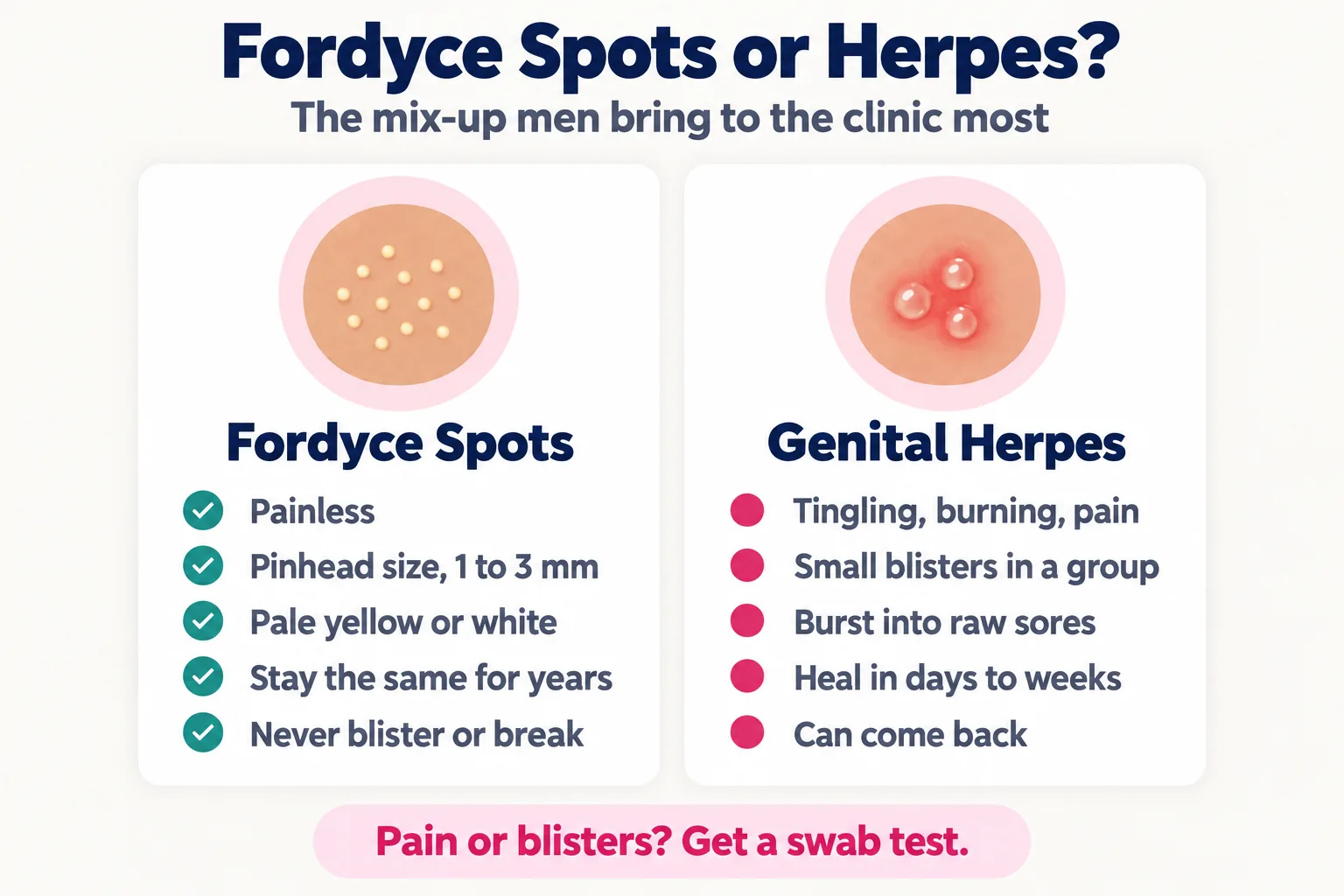
In genital ulcer studies, herpes goes with lesions that are blistered, multiple and recurrent (Gomes Naveca, 2013). Most recurrent genital herpes is caused by HSV-2, which recurs about six times more often than HSV-1 (Papini, 2012).
Five differences you can check yourself
- Pain. Herpes stings, burns or tingles, sometimes a day before anything shows. Fordyce spots do not burn or tingle.
- Blisters. Herpes starts as tiny fluid blisters on a red base. Fordyce spots are solid and do not fill with fluid.
- Sores. Herpes blisters break into shallow, raw sores. A Fordyce spot does not break open.
- Timing. Herpes comes, heals and may return. In one small study, repeat outbreaks treated early with tablets settled in a median of 5 days (Bavaro, 2008); untreated sores can last longer. Fordyce spots were there yesterday, and will be there next year.
- Colour. Fordyce spots are pale yellow or white. Herpes sits on red, angry skin.
Can you tell herpes apart just by looking?
Not reliably. In a large Indian clinic study, looking at a genital sore could not reliably tell herpes from other causes (Becker, 2010). Also, many herpes infections cause no symptoms at all (Buechner, 2002).
So if there is pain, a blister or a sore, do not decide by looking. Get a swab.
How often each feature is part of the picture. Read across a row to see which bumps share it.
On a phone, swipe the table sideways to see every column.
| Fordyce spots | Pearly papules | Genital warts | Herpes | Molluscum | Syphilis sore | |
|---|---|---|---|---|---|---|
| Painful, burning or tingling | no | no | no | typical | no | sometimes |
| Blisters, then raw sores | no | no | no | typical | no | no |
| Grows or multiplies over weeks | no | no | typical | no | typical | no |
| Changes within days: blister, sore, heals | no | no | no | typical | no | sometimes |
| Pale yellow-white pinheads | typical | no | no | no | no | no |
| Neat rows round the rim | no | typical | no | no | no | no |
| Dome with a central dimple | no | no | no | no | typical | no |
| Passed on through sex (adults) | no | no | typical | typical | typical | typical |
| Needs treatment | no | no | typical | typical | sometimes | typical |
Source: Pietkiewicz, 2023; Gomes Naveca, 2013; Towns, 2016; Leung, 2018; Hill, 2024; Rane, 2013.
What is the difference between Fordyce spots and HSV-1?
HSV-1 is the herpes virus behind most cold sores on the lips, and it can also infect the genitals. Cold sores sting, blister and crust.
Fordyce spots on the lip border, by contrast, are painless pale dots that never crust. One is a virus; the other is your own oil glands.
If it is herpes, what happens next?
In my clinic, once the examination shows a sore that looks like herpes, I start antiviral tablets straight away. A PCR swab, ideally from an intact blister (Dewald, 2026), is taken with the usual STD tests to confirm it.
For sores that are slow to settle, I add imiquimod cream. That is an off-label step from my own practice, not a standard guideline step, and I explain it on my herpes treatment page. Herpes cannot be cured, but daily tablets control it well; the details are there too.
Fordyce spots vs pearly penile papules, warts and other lookalikes
Three common genital bumps are harmless: Fordyce spots, pearly penile papules and angiokeratomas. Three are infections: warts, herpes and molluscum. The difference is mostly in the shape, the pattern and whether they change.
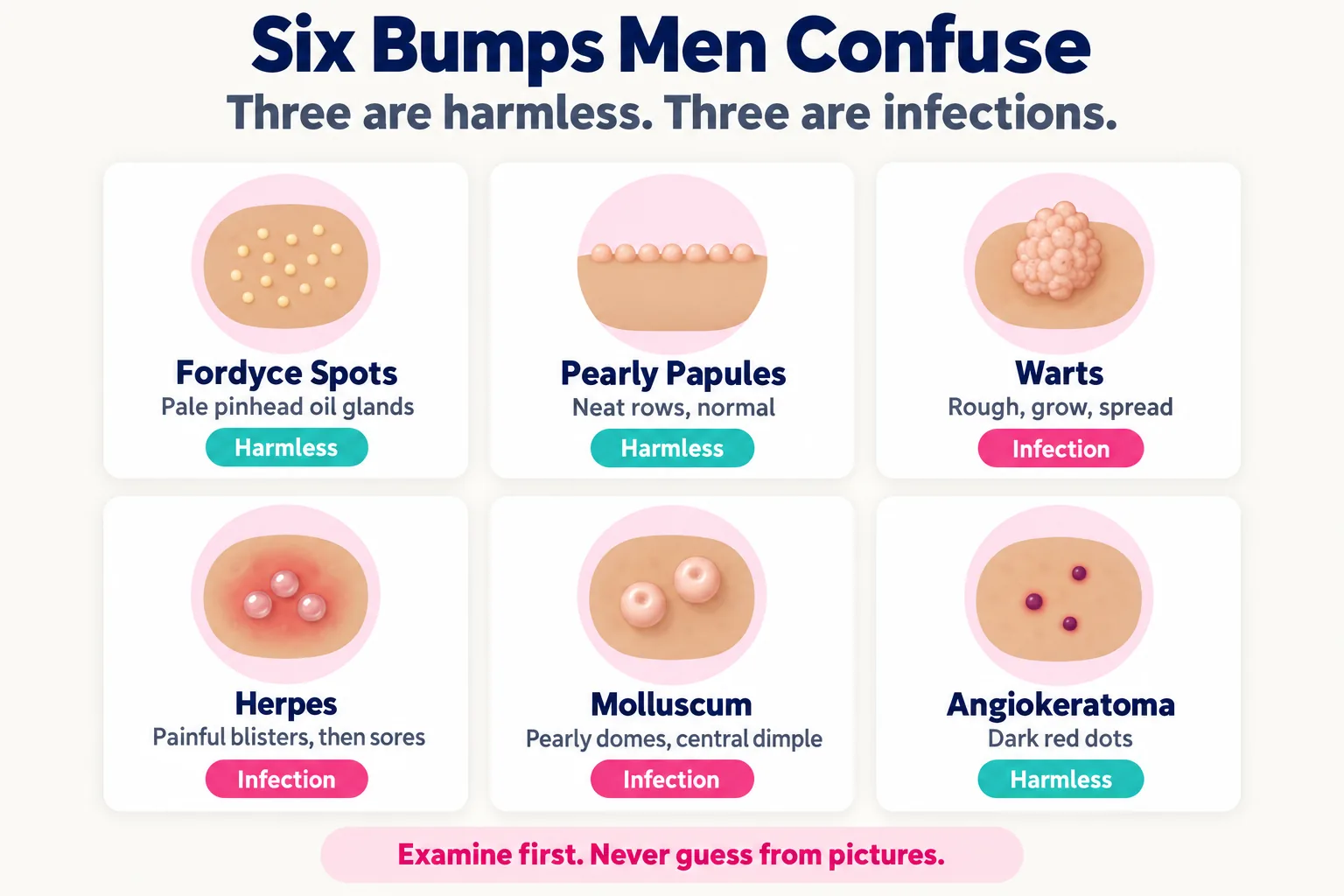
The table gives the same six side by side. Notice the last column: half of them need nothing at all.
Fordyce spots and five bumps men confuse them with (On a phone, swipe the table sideways.)
| Bump | Infection? | What it looks like | What to do |
|---|---|---|---|
| Fordyce spots | No | Pale yellow-white pinheads in clusters | Nothing |
| Pearly penile papules | No (Aldahan, 2018) | Tiny smooth domes in rows round the rim of the head | Nothing |
| Genital warts | Yes, HPV | Rough, flesh-coloured, cauliflower-like (Leung, 2018); they grow and spread, and can also appear on the groin, thighs or around the anus | Treat; warts guide |
| Herpes | Yes, HSV | Painful grouped blisters, then raw sores | Swab, then antivirals |
| Molluscum contagiosum | Yes, a skin virus | Firm, smooth, pearly domes with a central dimple (Hill, 2024) | Examine, screen for STIs |
| Angiokeratoma | No | Dark red to purple dots, mainly on the scrotum (Baumgartner, 2017) | Nothing, unless they bleed; a new or changing dark spot needs examining (Baumgartner, 2017) |
Are pearly penile papules the same as Fordyce spots?
No, but they are cousins: both are normal. Pearly penile papules are tiny smooth domes in neat rows round the rim of the head, no more than 3 mm across (Maranda, 2017). Fordyce spots are flatter pale dots, scattered on the shaft or foreskin.
Share of men with pearly penile papules, by study (one group checked themselves).
Source: Sonnex, 1999; Agha, 2009; Hogewoning, 2003; Rufli, 1978; Rehbein, 1977; Yildiz, 2017. Older men highlighted in pink.
Pearly papules fade with age: 38.3% of men under 25 had them, against 11.4% over 50 (Agha, 2009). In the same study they were unrelated to how often men had sex. That, with the lack of any HPV link (Hogewoning, 2003), fits with them not being caught.
Is it normal to have little white bumps on the shaft?
Usually, yes. Fordyce spots are the commonest cause of pale pinheads on the shaft. But they are far from the only normal finding men worry about.
Normal variants found on examination, in men aged 3 to 91 seen for genital lesions.
Source: Michajłowski, 2012. Fordyce-type bumps highlighted in pink. 32 of the 400 men (8%) came only because of a normal variant.
In that clinic, 8% of the men came only because of something normal (Michajłowski, 2012). Similarly, a Melbourne male genital skin clinic diagnosed a normal variant as the main finding in 17 of 331 new patients (Elakis, 2017).
What STD has bumps on the shaft?
Mainly genital warts and molluscum. Warts are rough and grow; molluscum are pearly domes with a dimple. A syphilis sore is usually a firm ulcer, and in one Australian clinic study about half were painful (Towns, 2016).
If it is warts, what happens next?
Warts are caused by HPV (Leung, 2018). In my clinic the usual STD tests come first, then imiquimod cream, and sometimes Podowart (podophyllotoxin) paint. In one large trial, imiquimod worked about as well as podophyllotoxin cream (Gilson, 2020).
What is Fox-Fordyce disease?
A different condition that only shares the name. It is an itchy bump rash in the armpits, and sometimes the groin or around the nipples, mostly in young women, from inflamed apocrine sweat glands (Salloum, 2022). So it has nothing to do with Fordyce spots on the penis.
What are the treatment options for angiokeratoma of Fordyce?
Usually none: they are harmless dark red dots, mostly on the scrotum. If they bleed or bother you, a dermatologist can treat them with laser (Baumgartner, 2017).
How does a doctor tell Fordyce spots apart?
Usually by looking. A trained eye is enough in most cases, and a magnifying skin scope (dermoscopy) adds confidence (Pietkiewicz, 2023). Under the scope, Fordyce spots show white-yellow clods with dots (Shreya, 2025); under UV-light dermoscopy, bright dots over yellowish-greenish clods (Pietkiewicz, 2023).
Videodermatoscopy shows distinct patterns for Fordyce spots, pearly papules, warts and molluscum, which can avoid a biopsy (Micali, 2011). As a result, a biopsy is rarely needed. When it is, a simple stain separates warts from pearly papules: all 11 warts stained positive, and all 5 pearly papules negative (Gardner, 2019).
Fordyce spot or STD: a 30-second checklist
- Pale, painless pinheads you have had for months, with no recent sexual exposure? Very likely Fordyce spots.
- Pain, burning, blisters or raw sores? Herpes until proven otherwise: get a swab, and a syphilis blood test too, because syphilis sores can also hurt (Towns, 2016).
- Rough bumps that grow or multiply? Warts until proven otherwise.
- Any firm sore, painful or not, or a rash on the palms and soles? Test for syphilis.
- A new bump after a sexual exposure, even a painless one? Do not self-diagnose: come in for an examination.
- Any doubt at all? Get examined, then tested. That is the rule in my clinic.
Had a sexual exposure? Why you should not diagnose yourself
Because the stakes are uneven. If a Fordyce spot is called an infection, you lose a little time. If an infection is called a Fordyce spot, you can pass it on and let it progress.
Early infections often do not look like the textbook pictures. About half of primary syphilis sores are not painful (Towns, 2016), and many herpes infections cause no obvious symptoms (Buechner, 2002). Even trained eyes cannot reliably name a genital sore by looking (Becker, 2010).
So if the bump appeared after a risky encounter, a physical examination comes first, with the right tests if needed. Only then can you relax about it.
Can I check it with an app or online photos?
Not reliably. A genital skin app picked the right diagnosis first 68.9% of the time, against 73.2% for dermatologists (Mehta, 2024). Better than guessing, but one in three wrong is not good enough for peace of mind.
A photo cannot replace an in-person examination, especially after an exposure. Online pictures are worse still, because they show the most dramatic cases. For the wider picture, see my guide to STD symptoms in men.

Private 1-on-1 consultation
Found a bump? Get a clear answer.
A private, in-person examination in T Nagar, Chennai, to tell Fordyce spots from herpes and warts, especially after a sexual exposure. The usual STD tests when there is any doubt, and treatment only if you need it.
Book a Confidential Consultation
Do Fordyce spots go away?
Usually not; they tend to stay for life, much the same. They are part of the skin’s normal oil glands, so there is nothing for the body to clear. In one large German survey, rates were similar in the 30s and the 70s (Reichart, 2000).
Some people do find them less obvious later in life. The number of spots tends to fall with age (Gaballah, 2014), and oil output in men falls almost to zero by 60 to 70 (Shamloul, 2021).
Do Fordyce spots spread or multiply?
Not in the way an infection spreads. You may notice more of them as you look more closely, or when the skin is stretched, but they do not travel to a partner or to new parts of the body. A bump that blisters, breaks open, grows or spreads quickly is the one to show a doctor.
Do Fordyce spots need treatment?
No. Fordyce spots are normal and need no treatment, and I do not treat them.
Removing a normal variant is appropriate only for cosmetic reasons (Gabrielson, 2019). For pearly papules, the first-line treatment is reassurance (Honigman, 2020); the same logic applies here.
What I do instead is examine you and, through my STD clinic, test when there is any doubt. Still, you will find clinics online that offer removal. So here, in fairness, is what the research shows.
Number of patients each removal method has been reported in, in the published studies we reviewed. Only micro-punch was studied on genital skin.
Source: Pallua, 2013; Ocampo-Candiani, 2003 (2 cases); Bhingradia, 2024 (3 cases); Mutizwa, 2014; Ahn, 2019.
What does the evidence for each method show?
In the studies we reviewed, that adds up to about 30 patients across five small reports. Most were 23 men in a single genital micro-punch series; the other four reports were on the lips or mouth. We found no trial comparing any of these with leaving the spots alone.
Fordyce spot removal methods: what the published evidence shows (On a phone, swipe the table sideways.)
| Method | Where studied | What was reported | The catch |
|---|---|---|---|
| Micro-punch excision | Male genital skin, 23 men | No recurrence over 12 to 84 months (Pallua, 2013) | Surgery on healthy skin; can scar |
| CO2 laser | Lips or mouth, 2 and 3 cases | Healed in 2 weeks with no spots left (Ocampo-Candiani, 2003) | Not studied on the penis; scarring risk |
| Isotretinoin tablets | Lips, 2 patients | One responded long-term, one did not (Mutizwa, 2014) | A strong acne drug with real side effects |
| Microneedle radiofrequency | Lips, 1 patient | Marked improvement (Ahn, 2019) | A single case |
You will also see electrosurgery (cautery), cryotherapy (freezing), pulsed-dye laser, photodynamic therapy, tretinoin cream or bichloracetic acid offered online. In the studies we reviewed, none of these had published results for Fordyce spots on penile skin.
Laser, cautery, chemicals and micro-punch all injure the skin to remove the gland, and all carry a risk of scarring (Ahn, 2019). Isotretinoin avoids that, but it is a strong drug with real side effects. On the penis, a scar is permanent and can look worse than the spots ever did.
How do I get rid of Fordyce spots on my private area?
Honestly, the safest plan is to leave them. If they truly distress you, see a dermatologist who does this work, and ask about scarring first. Never treat them yourself.
Is there a way to get rid of Fordyce spots on the foreskin?
Only the cosmetic procedures above, and none was studied on the foreskin specifically. Do not use wart paints or acids there: foreskin skin is thin and burns easily.
What is the best treatment for Fordyce spots?
Reassurance after a proper examination. That is not me brushing you off. It is the best-supported option, because it is the only one with no risk of a scar.
What makes Fordyce spots worse? Leave them alone
Squeezing, wart creams, home acids and random tablets. None of them removes a Fordyce spot, and all of them can damage healthy skin.
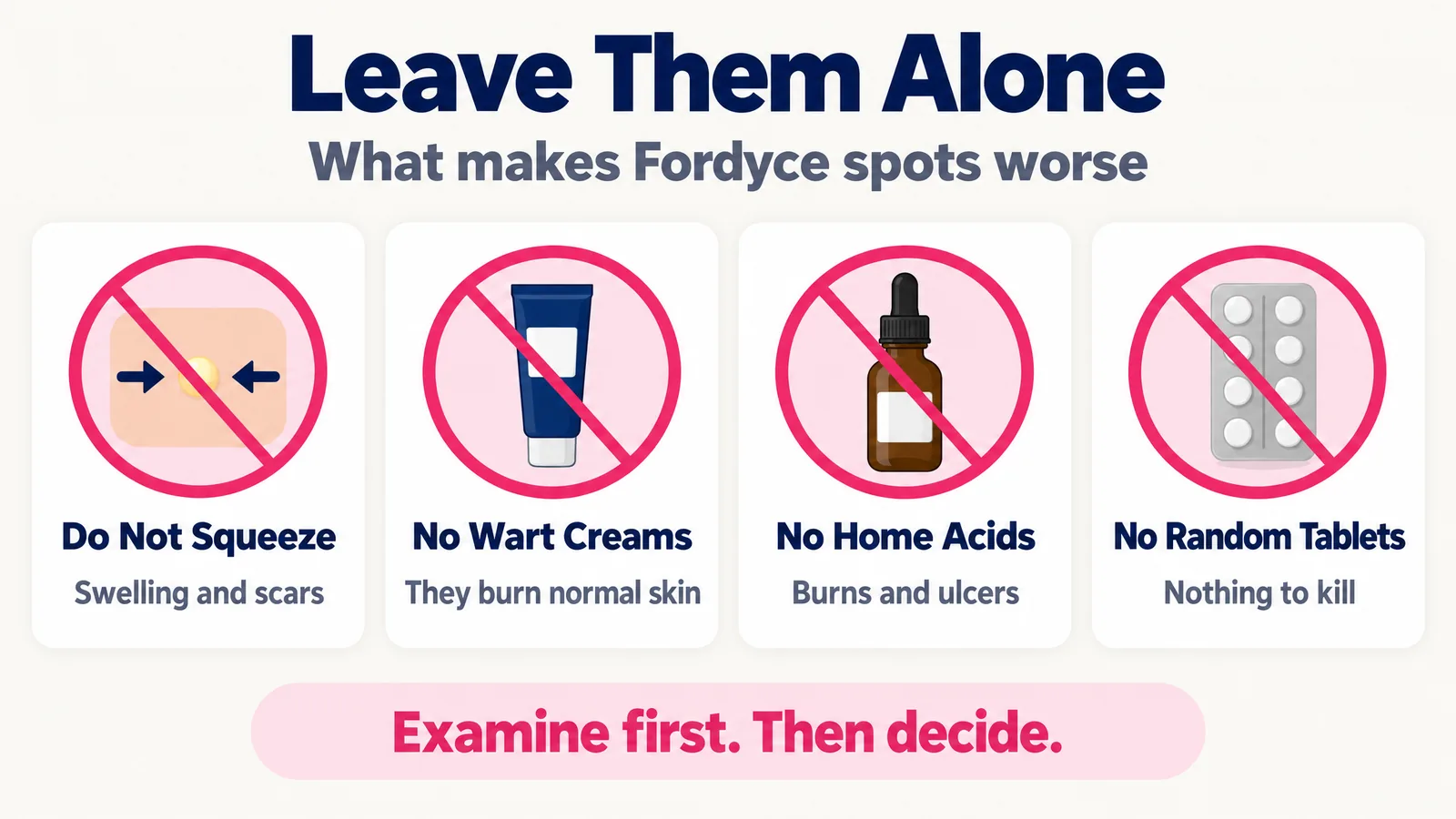
Here is why each one is a mistake:
- Squeezing. You can push out a little oil, but the gland stays. The skin swells, breaks and can scar.
- Wart creams and paints. They are made to destroy wart tissue, so on a normal gland they just burn the skin around it.
- Home acids and “mole removers”. They cause chemical burns and ulcers on thin genital skin.
- Antibiotics or antivirals “just in case”. There is no germ to kill. Treating without a diagnosis also hides a real infection if there is one.
Doctors have warned that pearly papules’ similarity to warts can lead to “unwanted and hazardous treatments” (Yildiz, 2017). The same trap applies to Fordyce spots.
Home remedies for Fordyce spots: do any work?
No home remedy has been shown to remove Fordyce spots. Coconut oil, jojoba oil, tea tree oil, apple cider vinegar, garlic, toothpaste and Vaseline appear in countless videos, but we found no study behind any of them.
How to cure Fordyce spots naturally?
There is no natural cure, because there is no disease to cure. A gentle wash with plain water and a mild soap keeps the skin comfortable. That is all the care they need.
Can Vaseline cure Fordyce spots?
No. Vaseline only softens the surface. It is harmless on the lips, but it will not change the oil gland underneath.
The real danger with home remedies is not that they fail. It is that acids, lemon juice and garlic burn thin genital skin, and a burn can then look like a genuine sore.
Fordyce spots on the lips: the same harmless glands
The lips are one of the commonest sites. In one large survey, the upper lip border was the commonest site of all (Gorsky, 1986). They look like tiny pale dots along the lip edge or inside the cheeks.
Where Fordyce spots show in the mouth, in 2,462 adults
| Site | Share with spots there |
|---|---|
| Upper lip border | 82.2% |
| Behind the back teeth (retromolar area) | 73.3% |
| Inside the cheeks | 65.9% |
| Lower lip border | 29.2% |
Do Fordyce spots on lips go away?
Usually not; like genital spots, they tend to stay. They may look more obvious when the lip is stretched or dry. Also, they are not cold sores, and they are not catching.
What are the treatment options for Fordyce spots on the lips?
You do not need to. Most removal reports are on the lips, using CO2 laser in a few people (Ocampo-Candiani, 2003; Bhingradia, 2024).
If you choose that route, see a dermatologist. No lip cream has been shown to remove them; lip balm only eases dryness, and home treatments have no evidence behind them.
Can Fordyce spots be a sign of cancer?
No. Fordyce spots are not cancer, and disease inside them is rare (Dreher, 1995). In a Portuguese oral-cancer screening of 2,674 adults, they were classed as the commonest non-disease finding (Pereira, 2025).
You may read about a link with Lynch syndrome, an inherited bowel-cancer condition. Here is what that research actually found:
- In 15 members of families with this syndrome, 13 had Fordyce spots in the mouth, against 6 of 630 healthy controls (De Felice, 2005).
- In a related condition, all 13 gene carriers had mouth spots, against 9 of 140 controls (Ponti, 2015).
- When oral Fordyce spots were tested, all 9 kept normal repair-protein staining (Fernandez-Flores, 2017).
These are tiny studies, of the mouth only, in families already known to carry the syndrome. Fordyce spots are far too common to act as a cancer test on their own. We found no study linking genital Fordyce spots to any cancer syndrome.
When should this matter to you? Only if several close relatives had bowel or womb cancer at a young age. Then tell your doctor about the family history, whatever your skin looks like.
Are Fordyce spots linked to high cholesterol?
One study of 350 people found more spots in those with raised blood fats (Gaballah, 2014). However, it gave no effect size, and we found no study confirming it. Do not use your spots to judge your cholesterol.
When should you see a doctor about a new bump on your penis?
See a doctor if a bump hurts, burns, blisters, breaks into a sore, bleeds, grows or spreads. Also see one if you simply cannot stop worrying. And if the bump appeared after a sexual exposure, come in for an examination even if it is painless; do not label it Fordyce yourself.
When should you be seen sooner?
Get seen sooner in any of these situations:
- Any new bump, blister or sore after a new sexual contact, even a painless one.
- Any firm sore, painful or not, or a rash on your palms or soles: test for syphilis.
- Fever, body aches or tender swollen glands in the groin together with new sores.
- A sore, lump or red patch that has not healed after 3 weeks.
- White, shiny or scarred patches, especially if the foreskin is getting tight: this can be lichen sclerosus, which needs treatment, usually starting with a steroid cream. See my page on a tight foreskin.
- Discharge or burning when you pass urine.
- A sexual risk in the last 72 hours: contact a doctor today about preventive treatment, and read what to do after a condom breaks.
- A new lump inside the scrotum, rather than on the skin: see my guide to a lump on the testicle. Sudden, severe testicle pain needs a doctor within hours.
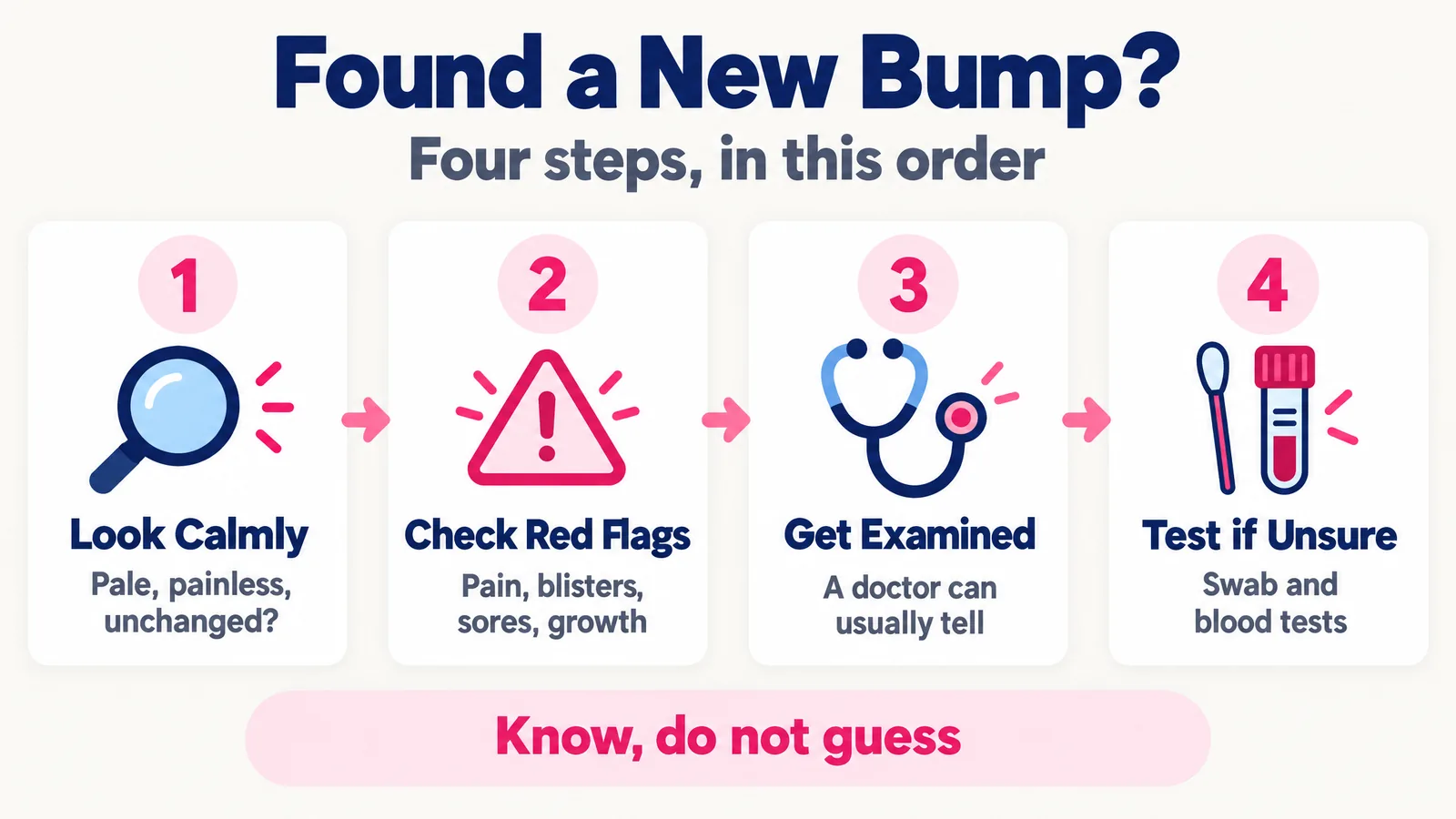
What to do, step by step
The detail behind each step, and where each path ends:
Look, check, get examined, then test if unsure.
1
2
3
4
Source: Pietkiewicz, 2023; Becker, 2010; Dewald, 2026.
In my clinic, a visit for a worrying bump starts with an examination. If anything is not clearly Fordyce, we do the usual STD tests, so that any treatment matches the cause.
When the worry about Fordyce spots will not stop
Many men with Fordyce spots are not really asking about oil glands. They are asking, “Did I catch something that night?” That fear can outlast every normal result.
72 people who came to a clinic convinced they had a sexual infection.
- 59.7%psychiatric diagnosis, mostly anxiety
- 40.3%no psychiatric diagnosis
Source: Kc, 2020. Genital bumps were the commonest complaint (25%), and pearly papules the commonest finding.
Doctors call this venereophobia: a fear of sexual infection that persists despite reassurance. It is very common in men, and sufferers often seek repeated consultations even after being told they are clear (Sakkaravarthi, 2025). Checking the skin again and again, and visiting several doctors, is typical (Kc, 2020).
Being seen by several doctors without a clear diagnosis is itself distressing (Gabrielson, 2019). For this reason, I name what you have, show you why it is normal, and test you if there is any doubt.
If the fear continues after clear tests, it deserves care in its own right. Read my page on HIV phobia; the same pattern applies to every STD fear.
Myths, corrected
Six things men believe about Fordyce spots
“They are an STD”
They are normal oil glands, yet they are commonly mistaken for an STI (Pietkiewicz, 2023).
“Masturbation caused them”
No. Oil glands grow under hormones at puberty (Dhurat, 2021). Ejaculation does not create them.
“My partner will catch them”
There is nothing to catch. Your partner may have their own.
“They are HPV”
HPV causes warts. Pale oil-gland dots are not how HPV shows itself.
“A cream will remove them”
No cream has been shown to. Wart creams burn normal skin.
“They will turn into cancer”
No. They are classed as a non-disease finding even in cancer screening (Pereira, 2025).
If any of these beliefs has kept you awake, you are in good company. They are exactly the worries that bring men to clinics with normal skin (Kc, 2020).
Fordyce spots: your questions answered
Short answers to the questions men search for most. The detail is in the sections above.
What is the cause of Fordyce spots?
They are oil glands without a hair, present from before birth. Hormones at puberty enlarge them until they become visible. They are not caused by infection, hygiene or masturbation.
Do penile Fordyce spots go away?
Not usually. On the penis, they generally stay much the same for years. That stability is reassuring, because herpes changes within days and warts grow or spread over weeks to months.
Can you get Fordyce spots on the scrotum?
Yes. They show as tiny pale yellow or white dots in the scrotal skin, often clearer when the skin is stretched. Dark red dots there are usually angiokeratomas, also harmless.
Are Fordyce spots from HPV?
No. HPV causes genital warts, which are rough and grow. Fordyce spots are your own oil glands, and no virus causes them. Studies of the similar pearly papules found no HPV link (Hogewoning, 2003).
Is a Fordyce spot harmful?
No. They are harmless, painless and not contagious. The only harm comes from squeezing them or using wart creams and acids, which damage healthy skin.
Are Fordyce spots a bad thing?
No. They are a normal variant of skin, seen in many healthy men. They say nothing bad about your health, hygiene or sexual history.
How to know if it’s Fordyce or an STD?
Fordyce spots are pale, painless pinheads that stay the same. Pain, blisters, sores or rough growing bumps suggest an STD. After any sexual exposure, do not self-diagnose: get examined in person.
What can be mistaken for a Fordyce spot?
Pearly penile papules, genital warts, herpes, molluscum contagiosum, angiokeratomas and sebaceous hyperplasia. Only an examination tells them apart reliably.
Are pearly penile papules an STD?
No. Pearly penile papules are normal skin, unrelated to sex or to HPV. They are smooth domes in rows round the rim of the head, and they fade with age.
Does PPP in men go away?
Over time, often. They are much less common in older men: 38.3% under 25 against 11.4% over 50 in one study (Agha, 2009).
Why do I have small white bumps on my private area?
The commonest harmless causes are Fordyce spots, pearly penile papules and trapped smegma. Painful, blistering or growing bumps need an examination and STD tests.
What are non-STD bumps?
Fordyce spots, pearly penile papules, angiokeratomas, skin tags, pimples, ingrown hairs and small cysts. All are common and harmless.
What could be causing a pimple on my scrotum?
Usually a blocked hair follicle, an ingrown hair or a small cyst on the skin. Dark red dots are usually angiokeratomas. A painful lump inside the scrotum needs a doctor the same day; sudden severe pain, within hours.
Can herpes be misdiagnosed?
Yes. In an Indian clinic study, looking at a sore could not reliably separate herpes from other causes (Becker, 2010). Harmless Fordyce spots get called herpes too. If there is a blister or sore, a PCR swab settles it.
Do you get pimples with herpes?
Herpes can start as small red bumps that look like pimples. Within a day or two they turn into fluid blisters, then painful sores. Fordyce spots never blister or break open.
What are some other types of sores that can look like herpes but are not?
Syphilis sores, friction tears after sex, ingrown hairs, fungal balanitis and allergic reactions. Fordyce spots are not sores at all. A swab and a syphilis blood test tell them apart.
What causes white patches on a man’s private area?
White patches, rather than dots, are usually a fungal infection, balanitis, vitiligo or lichen sclerosus. Fordyce spots are separate pinhead dots. Patches that itch, spread or tighten the foreskin need an examination.
What does balanitis look like?
A red, sore, sometimes itchy head of the penis, often with a white coating or smell under the foreskin. It is an inflammation, not a pale spot. See my balanitis guide.
Can stress cause Fordyce spots?
No. Stress does not create oil glands. But stress makes men inspect themselves closely, which is often when spots that were always there get noticed.
Can I have sex if I have Fordyce spots?
Yes. They are not contagious and need no precautions. Use condoms for the usual reasons, not because of Fordyce spots.
Do Fordyce spots affect fertility or erections?
No. They sit in the skin surface and do not affect sperm, hormone levels or erections.
Which doctor should I see for Fordyce spots?
An andrologist, sexologist or dermatologist can recognise them. If you also want STD testing, an andrologist or sexual health clinic can do both in one visit.
The bottom line on Fordyce spots
Fordyce spots are tiny, pale, painless oil glands. They are normal skin, not an STD, not contagious, and they need no treatment. The commonest mistake is confusing them with herpes, which hurts, blisters and breaks into sores.
So leave them alone, and do not treat yourself from photos or a chemist. And if a bump appeared after a sexual exposure, do not diagnose yourself at all: an in-person examination is the only safe answer.
I hope this put your mind at rest. This is Dr Shah, consultant andrologist in Chennai.
If you have found a bump, call 97907 83856 or message me on WhatsApp. Nothing you say leaves the room.
Private consultation
A clear answer instead of a month of worry
An examination by a practising andrologist in Chennai, STD tests when anything is unclear, and a straight answer about what you have.
References
What Fordyce spots are
- Pallua N, et al. Micro-punch technique for treatment of Fordyce spots: a surgical approach for an unpleasant condition of the male genital. 2013. PMID 23026471.
- Gaballah KY, et al. Can presence of oral Fordyce’s granules serve as a marker for hyperlipidemia?. 2014. PMID 25426145.
- Dreher A, et al. [Fordyce spots. A little regarded finding in the area of lip pigmentation and mouth mucosa]. 1995. PMID 7662086.
- Pietkiewicz P, et al. Differentiating Fordyce Spots from Their Common Simulators Using Ultraviolet-Induced Fluorescence Dermatoscopy-Retrospective Study. 2023. PMID 36900129.
- Rane V, et al. Penile appearance, lumps and bumps. 2013. PMID 23781523.
- Köhn FM. [Dermatological diseases of the male genital tract]. 2016. PMID 27590352.
- Paolino G, et al. Linear ectopic sebaceous hyperplasia of the penis: the last memory of Tyson’s glands. 2018. PMID 27598618.
- Stamm AW, et al. Urologic Dermatology: a Review. 2017. PMID 28667573.
- Hedberg ML, et al. Symptomatic vulvar demodicosis: A case report and review of the literature. 2020. PMID 33448447.
- Ahn GR, et al. A case of successful treatment of Fordyce spots with a single insulated microneedle radiofrequency device. 2019. PMID 31323158.
- Shreya K, et al. A Single Centre Cross-Sectional Observational Study on Dermatoscopy of Oral Mucosal Disorders and Histopathological Correlation in Tertiary Care Centre from Central India. 2025. PMID 40740406.
How common they are, and why
- Michajłowski I, et al. Normal variants in patients consulted in the Dermatology Clinic for lesions of the male external genitalia. 2012. PMID 24578916.
- Gorsky M, et al. Fordyce’s granules in the oral mucosa of adult Israeli Jews. 1986. PMID 3461911.
- Olivier JH. Fordyce granules on the prolabial and oral mucous membranes of a selected population. 2006. PMID 16711559.
- Jahanbani J, et al. Evaluation of oral mucosal lesions in 598 referred Iranian patients. 2009. PMID 19444343.
- Reichart PA. Oral mucosal lesions in a representative cross-sectional study of aging Germans. 2000. PMID 11014516.
- Vieira-Andrade RG, et al. Oral mucosa alterations in a socioeconomically deprived region: prevalence and associated factors. 2011. PMID 22031051.
- Pereira D, et al. Oral pathology in a population observed within an oral cancer screening developed in Portugal. 2025. PMID 39582407.
- Tortorici S, et al. Prevalence and distribution of oral mucosal non-malignant lesions in the western Sicilian population. 2016. PMID 27374359.
- Al-Mobeeriek A, et al. Prevalence of oral lesions among Saudi dental patients. 2009. PMID 19700894.
- Oivio UM, et al. Prevalence of oral mucosal normal variations and lesions in a middle-aged population: a Northern Finland Birth Cohort 1966 study. 2020. PMID 33298037.
- Bhatnagar P, et al. Prevalence study of oral mucosal lesions, mucosal variants, and treatment required for patients reporting to a dental school in North India: In accordance with WHO guidelines. 2013. PMID 23723730.
- El Toum S, et al. Prevalence and Distribution of Oral Mucosal Lesions by Sex and Age Categories: A Retrospective Study of Patients Attending Lebanese School of Dentistry. 2018. PMID 29887889.
- Mansour Ghanaei F, et al. Prevalence of oral mucosal lesions in an adult Iranian population. 2013. PMID 24396581.
- Collins JR, et al. Prevalence of oral mucosal lesions in an adult population from eight communities in Santo Domingo, Dominican Republic. 2021. PMID 35088812.
- Güleç AT, et al. Lip and oral mucosal lesions in 100 renal transplant recipients. 2010. PMID 19926164.
- Sedano HO, et al. Clinical orodental abnormalities in Mexican children. 1989. PMID 2671852.
- Niranjan MM, et al. Assessment of Intraoral Findings of Neonates, Born in and around Meerut City. 2020. PMID 32581479.
- Shamloul G, et al. An updated review of the sebaceous gland and its role in health and diseases Part 1: Embryology, evolution, structure, and function of sebaceous glands. 2021. PMID 33354858.
- Zouboulis CC. [The sebaceous gland]. 2010. PMID 20512305.
- Dhurat R, et al. Spironolactone in adolescent acne vulgaris. 2021. PMID 33326148.
- Safadi RA, et al. The significance of age group, gender and skin complexion in relation to the clinical distribution of developmental oral mucosal alterations in 5-13 year-old children. 2018. PMID 29246755.
Lookalikes: herpes, warts, pearly papules and others
- Gomes Naveca F, et al. Etiology of genital ulcer disease in a sexually transmitted infection reference center in Manaus, Brazilian Amazon. 2013. PMID 23704961.
- Papini M. Herpes genitalis without frontiers: from clinical aspects to viral identification. 2012. PMID 23007253.
- Becker M, et al. Etiology and determinants of sexually transmitted infections in Karnataka state, south India. 2010. PMID 19901864.
- Buechner SA. Common skin disorders of the penis. 2002. PMID 12175386.
- Dewald C, et al. [Management of genital herpes]. 2026. PMID 41686237.
- Bavaro JB, et al. One-day regimen of valacyclovir for treatment of recurrent genital herpes simplex virus 2 infection. 2008. PMID 18362859.
- Leung AK, et al. Penile warts: an update on their evaluation and management. 2018. PMID 30622585.
- Gilson R, et al. Imiquimod versus podophyllotoxin, with and without human papillomavirus vaccine, for anogenital warts: the HIPvac factorial RCT. 2020. PMID 32975189.
- Hogewoning CJ, et al. Pearly penile papules: still no reason for uneasiness. 2003. PMID 12833007.
- Aldahan AS, et al. Diagnosis and Management of Pearly Penile Papules. 2018. PMID 27316776.
- Sonnex C, et al. Pearly penile papules: a common cause of concern. 1999. PMID 10563558.
- Agha K, et al. Pearly penile papules regress in older patients and with circumcision. 2009. PMID 19833692.
- Rufli T, et al. [Papillomatosis coronae glandis. Frequency of occurrence and clinical picture]. 1978. PMID 625640.
- Rehbein HM. Pearly penile papules: incidence. 1977. PMID 837718.
- Yildiz H, et al. The Prevalence of Penile Pearly Papules among Young Men. 2017. PMID 28511750.
- Maranda EL, et al. Laser therapy for the treatment of pearly penile papules. 2017. PMID 27586159.
- Hill RC, et al. Molluscum contagiosum is associated with atopic dermatitis and sexually transmitted infections in a matched case-control study using a national database. 2024. PMID 39239849.
- Baumgartner J, et al. Genital angiokeratomas of Fordyce 595-nm variable-pulse pulsed dye laser treatment. 2017. PMID 28665237.
- Salloum A, et al. Pathophysiology, clinical findings, and management of Fox-Fordyce disease: A systematic review. 2022. PMID 33817950.
- Towns JM, et al. Painful and multiple anogenital lesions are common in men with Treponema pallidum PCR-positive primary syphilis without herpes simplex virus coinfection: a cross-sectional clinic-based study. 2016. PMID 26378262.
- Elakis JA, et al. Skin disease of penis and male genitalia is linked to atopy and circumcision: caseload in a male genital dermatology clinic. 2017. PMID 27170096.
- Micali G, et al. Augmented diagnostic capability using videodermatoscopy on selected infectious and non-infectious penile growths. 2011. PMID 22097996.
- Gardner KM, et al. Distinction of Condylomata Acuminata From Vulvar Vestibular Papules or Pearly Penile Papules Using Ki-67 Immunostaining. 2019. PMID 30556421.
- Mehta N, et al. The performance of an artificial intelligence-based computer vision mobile application for the image diagnosis of genital dermatoses: a prospective cross-sectional study. 2024. PMID 38314623.
Treatment, associations and the worry
- Gabrielson AT, et al. Male Genital Dermatology: A Primer for the Sexual Medicine Physician. 2019. PMID 30458984.
- Honigman AD, et al. Management of Pearly Penile Papules: A Review of the Literature. 2020. PMID 31690111.
- Ocampo-Candiani J, et al. Treatment of Fordyce spots with CO2 laser. 2003. PMID 12859392.
- Bhingradia YM, et al. Treatment of Fordyce Spots with CO. 2024. PMID 38736855.
- Mutizwa MM, et al. Dichotomous long-term response to isotretinoin in two patients with fordyce spots. 2014. PMID 22486258.
- De Felice C, et al. Fordyce granules and hereditary non-polyposis colorectal cancer syndrome. 2005. PMID 15879014.
- Ponti G, et al. Fordyce granules and hyperplastic mucosal sebaceous glands as distinctive stigmata in Muir-Torre syndrome patients: characterization with reflectance confocal microscopy. 2015. PMID 25213213.
- Fernandez-Flores A, et al. Mismatch Repair Protein Expression in Fordyce Granules. 2017. PMID 26894645.
- Kc S, et al. Clinical Scenario of Venerophobia in Patients Presenting in Outpatient Department. 2020. PMID 33210645.
- Sakkaravarthi V, et al. Venereophobia – A comprehensive review. 2025. PMID 40546383.
Visit us in Chennai
A private, judgment-free space to talk through fertility and men’s sexual health. Walk in, or book ahead by phone.
No 21, Sree Kalki Apartments, Ground Floor, Bazullah Road, T-Nagar, Chennai 600017