

Low libido in men, or low sex drive, is a lasting drop in interest in sex. You have fewer sexual thoughts and less wish to start it, and it is not the same as erectile dysfunction.
About 1 in 5 men aged 40 to 70 report it. The usual causes are stress, depression, medicines, poor sleep, sugar, fear of failing in bed, relationship strain and low testosterone. Most are treatable.
Hello! Vanakkam and Namaste. This is Dr Shah Dupesh, consultant sexologist in Chennai.
Men rarely walk in and say “low libido”. Instead, they say “Doctor, I just don’t feel like it any more”. A few tell me, “I have lost interest in sex”.
Sometimes the wife makes the appointment. He sits quietly while she explains that months have passed without any closeness.
Some are newly married and frightened that something is wrong with them. Others are in their forties, working twelve-hour days. They cannot remember the last time they wanted sex.
Many have already bought a “testosterone booster” online. Some have also been told by a gym trainer that they need injections.
So let me be blunt. Low libido is a symptom, not a disease. It always has a cause, and usually more than one.
In fact, low testosterone is only one of 21 causes I check for. And I rarely start a man on testosterone.
In this guide I walk you through the 21 causes and the tests that find yours. Then I show you what brings desire back, and what wastes your money. But first, let me clear away what you have probably been told.
🧠 Seven things you have probably been told wrong about low libido
Before the causes and the cures, let me clear up seven wrong ideas. I undo these in my clinic more than any others. Each one sends men down the wrong road for months.
1. “Low libido means low testosterone”
Not usually. In a 15-year study of Boston men, testosterone and libido were linked across the whole group.
But a man’s own report of low libido was only a modest guide to his own level (Travison, 2006). In my clinic, stress, mood, medicines and the relationship come up far more often.
2. “A real man always wants sex”
Desire rises and falls in every man. One survey asked 5,255 men about a single year. In that year, 14.4% had a distressing loss of interest lasting two months or more (Carvalheira, 2014).
So you are not broken. Instead, something is pressing on your desire.
3. “Testosterone injections will fix it”
Injected testosterone switches off your own sperm production. In a WHO trial, 65% of fertile men had no sperm at all by six months (WHO Task Force, 1990). Moreover, there is no clear evidence that it helps desire when your level was normal to begin with.
In men who are not clearly deficient, the benefit is uncertain (Corona, 2014a). I never use injections or tablets of testosterone.
4. “Herbal sex-power capsules are natural and safe”
Many are neither. For example, look at the supplements the US regulator flagged as secretly adulterated.
Almost half were sold for sexual enhancement, and nearly half of those hid sildenafil (Tucker, 2018). In other words, you may be taking a prescription drug without knowing the dose.
5. “Losing semen through masturbation drains your desire”
This is the oldest fear in Indian clinics. For example, in a general clinic in southern India, men most often blamed semen loss for their sexual problems (Thangadurai, 2014). Semen is not a store of strength.
The worry, however, is real, and worry itself flattens desire. I take these fears apart one by one in my guide to masturbation side effects.
6. “It is just age, nothing can be done”
Desire does fall slowly with age (Araujo, 2004). But even among men aged 40 to 70, about four in five did not report low libido (Travison, 2006). So a sudden drop, at any age, is a sign to look for a cause, not to give up.
7. “Low libido is the same as erectile dysfunction”
They are different problems that often travel together. Low libido is about wanting sex; ED is about the erection.
Yet among 3,714 men at a sexual-medicine clinic, low libido stood alone in only 5.1% (Corona, 2013a). Because of that overlap, treating it means looking at all three, as you will see.
Read this first
Low libido in men in 60 seconds
A symptom, not a disease
Low libido means a lasting drop in sexual thoughts and the wish for sex. It is a signal that something is pressing on desire.
Common
About 1 in 5 men aged 40 to 70 reported low libido in one long study (Travison, 2006).
Testosterone is one cause of 21
In my clinic, other causes come up more often than low testosterone alone. Think stress, depression, medicines, sugar, sleep, fear of failing in bed and the relationship.
ED and PE hide behind it
Fear of failing in bed quietly switches desire off. So I treat erections and timing first when they are part of the story.
A morning blood test
Testosterone must be checked fasting in the morning and repeated if low (Bhasin, 2018). I ask for the sample before about 10 am.
Desire can return
I fix the cause first. Testosterone gel is my last option, and I never use injections or tablets of testosterone.
Jump straight to your worry:
🔎 What is low libido in men?
Let me start with the libido meaning, in plain words. Libido is your sex drive: how often you think about sex, feel drawn to it, and want to start it.
Low libido means that drive has dropped and stayed low. It is also called low sex drive in men, decreased sex drive or loss of libido.
Many men simply call it no interest in sex. As a result, you have fewer sexual thoughts and fantasies, and you rarely start sex.
Doctors use “low sexual desire” as the umbrella term (Rubio-Aurioles, 2013). Sometimes it lasts and causes real distress or strain in the relationship. Then the formal name is hypoactive sexual desire disorder, or HSDD (Brotto, 2010).
Psychiatrists’ current manual uses six months or more as the yardstick. So a man with a lower drive than his friends, who is content, does not have a disorder.
Low libido, ED or PE: how to tell them apart
However, low libido is easy to confuse with two other problems men bring to me. Here is how I tell them apart.
Low libido, erectile dysfunction or premature ejaculation? (On a phone, swipe the table sideways.)
| Low libido | Erectile dysfunction (ED) | Premature ejaculation (PE) | |
|---|---|---|---|
| What is affected | Wanting sex | Getting or keeping an erection | Control over when you finish |
| Typical words | “I don’t feel like it” | “It doesn’t stay hard” | “I finish too fast” |
| Morning erections | Often normal | Often reduced | Normal |
| First test I order | Morning testosterone, prolactin, TSH, HbA1c | Sugar, lipids, testosterone | Usually none; history and examination |
| Can it cause the others? | Yes, it reduces arousal | Often: fear kills desire | Often: avoidance kills desire |
The last row matters most. In real life, these three often occur together (Corona, 2013a).
They can also feed each other, which is why I always ask about all three. Read more in my guides to erectile dysfunction and premature ejaculation.
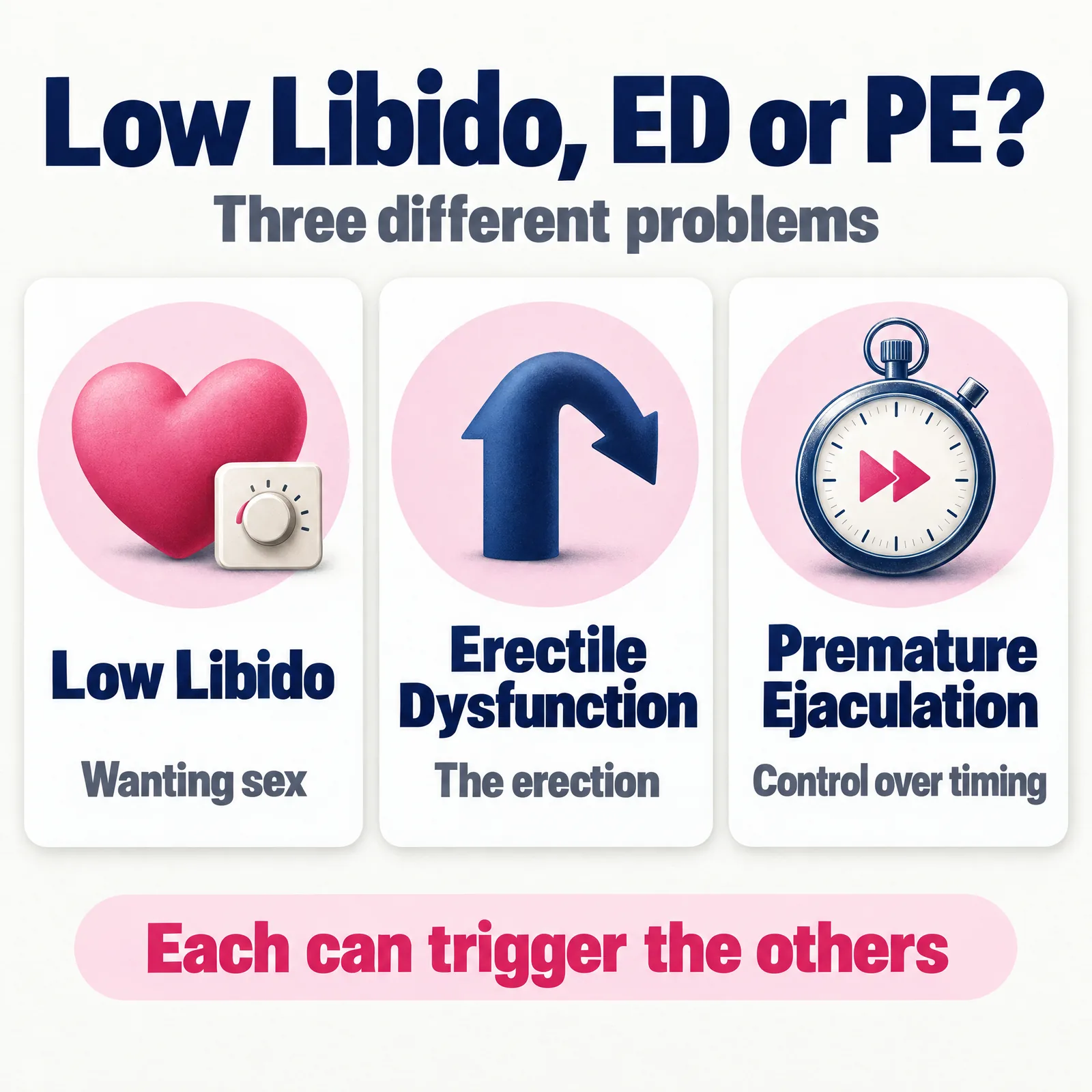
Put simply, do you still wake with erections but not want sex? Then the problem is more likely desire than blood flow. Either way, I check both.
✅ How do you know if a man has a low libido?
Low libido is quiet. There is no pain and no lump.
So men often notice it late, or the partner notices first. These are the signs I ask about.
- Fewer sexual thoughts: days or weeks go by without thinking about sex.
- You rarely start sex: your partner always makes the first move, or nobody does.
- Avoidance: staying up late, working late, or “being too tired” so that sex does not come up.
- Less masturbation and fewer fantasies than was normal for you.
- Sex feels like a duty: you go along with it but do not look forward to it.
- Fewer morning erections: this one points towards a hormone or blood-flow cause (what morning erections tell you).
A quick self-check
Answer these six questions honestly. They are the same ones I start with in clinic.
- Has your desire been clearly lower than your normal for more than three months?
- Does it bother you, or is it causing tension with your partner?
- Have your morning erections become rare?
- Have you felt low, anxious or hopeless most days?
- Did you start any new tablet, or stop a gym supplement, around the time it began?
- Are you avoiding sex because of trouble with erections or finishing too fast?
Did you answer “yes” to the first two? Then it is worth a proper assessment. The other answers point me to the likely cause.
For example, a “yes” to question 3 points me to the hormone tests below. A “yes” to question 5 points me to your medicines and, after steroids, your hormones.
⏱️ What is a normal sex drive for a man?
There is no normal number for men’s sex drive. No study has found a “correct” number of times a week a man should want sex. So anyone who quotes one is guessing.
Your own past is the best measure: what matters is a clear drop from what was normal for you. The same is true of timing, as I explain in how long sex really lasts.
Most couples come to me because of a mismatch, not a number. In Britain’s national sex survey, 23.4% of men in a relationship said one partner wanted sex more than the other (Mitchell, 2013). That gap, more than any count, is what causes the fights.
Is it normal to not want sex?
Yes, for a while. A lack of interest in sex for a few weeks is normal. For example, desire dips with exams, a new baby, a death in the family or a hard month at work.
It becomes a problem when it lasts for months, or when it upsets you or your partner. It is also a problem when it arrives suddenly, for no clear reason.
Equally, a man who has never felt much desire and is not troubled by it is not ill. Doctors call it a disorder only when it bothers the man or the couple (Brotto, 2010). So I treat what troubles you, not a statistic.
Sex drive after 40, 50 and 60
Your sex drive after 40 does change, but gradually. In a nine-year study of men aged 40 to 70, desire, sexual activity and erections all declined.
The fall was also faster at older ages (Araujo, 2004). Age was also a clear factor in lack of interest among 13,618 men aged 40 to 80 across 29 countries (Laumann, 2005).
But age alone rarely explains a man who has lost interest completely. After all, testosterone falls slowly. In one Boston study, 24% of men had a reading below 300 ng/dL.
Yet only 5.6% had truly symptomatic low testosterone (Araujo, 2007). So when a 45-year-old tells me desire vanished in six months, I look for a cause.
So, how do you increase sex drive for men over 40, 50 or 60? Start with the causes below, especially sugar, sleep, weight and medicines. Age itself is my last explanation, not my first.
📊 How common is low libido in men, really?
Low sex drive in men is far more common than men admit. Here are the figures from the best studies I trust.
Different studies, ages and definitions, so read each bar on its own.
Source: Travison, 2006; Carvalheira, 2014; Herkommer, 2024; Meissner, 2019
The spread looks wide because each study asked a different question. Still, the message is clear: you are far from alone.
Among 2,500 fifty-year-old men in Bavaria, 30% had at least one sexual problem. In that study, men with ED had about twice the odds of low libido (Herkommer, 2024).
India has no good population figure yet; our data come from clinics, not national surveys. Asian studies of low desire vary so widely that no single number can be quoted (Irfan, 2020).
In my own clinic, however, low desire is one of the commonest reasons couples see me. Often, though, it hides behind another complaint.
🧩 Why am I not interested in sex? 21 causes of low libido in men
Why is my sex drive so low? That is the question behind every visit. Here are the 21 causes I look for, in five groups.
Most men I see have two or three at once. So read the whole list, not just the first item.
Very often, the cause is not one dramatic disease but a pile-up. For example, poor sleep, rising weight, a stressful job and an argument that never got settled.
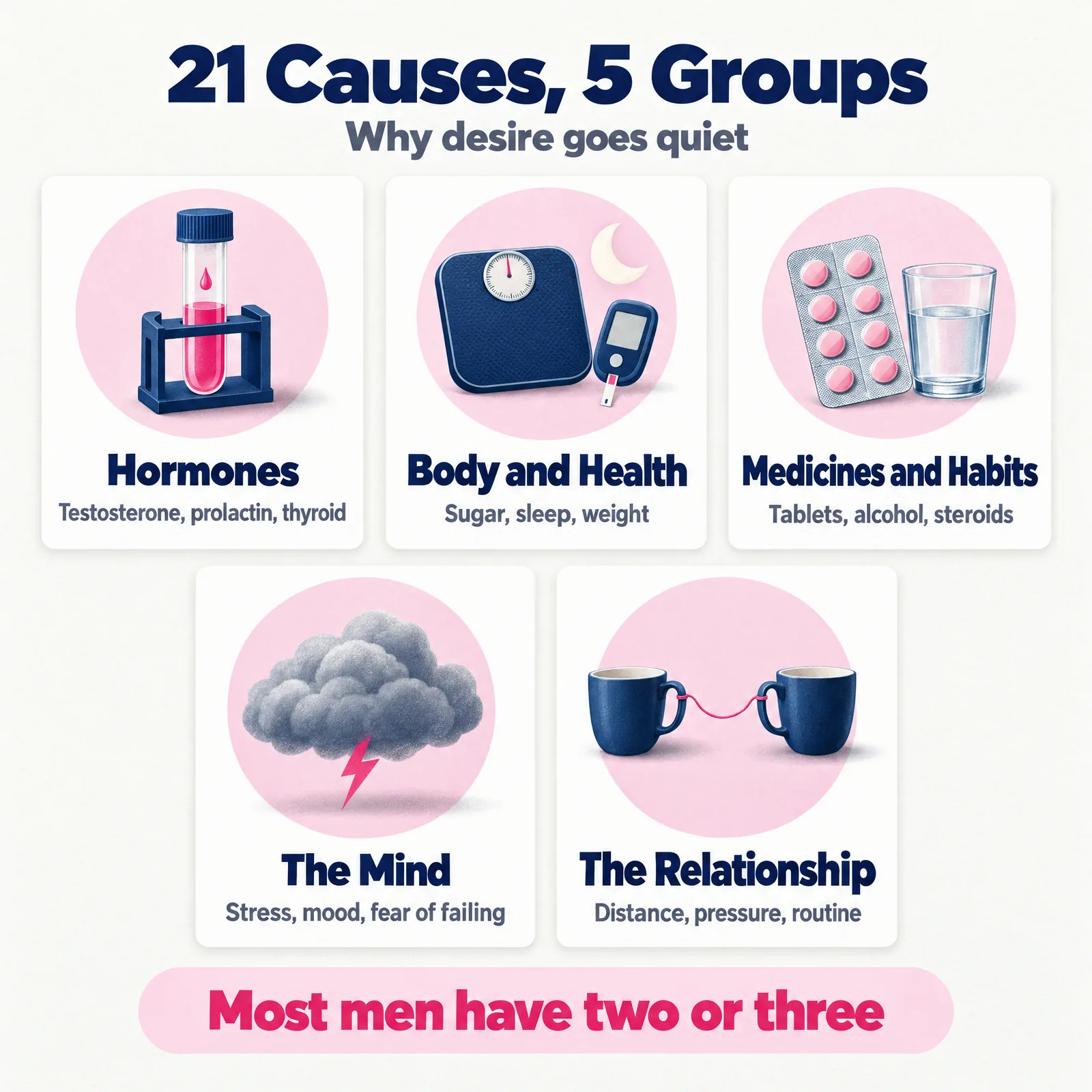
Before the list, match your own clues to the five groups. Here is the pattern I see in my clinic.
How strongly each clue points to each group of causes. Most men tick more than one row.
On a phone, swipe sideways to see all five groups.
| Hormones | Body and health | Medicines and habits | The mind | The relationship | |
|---|---|---|---|---|---|
| Sudden onset | likely | weak | strong | strong | likely |
| Fewer morning erections | strong | likely | possible | weak | weak |
| Low mood or poor sleep | possible | likely | possible | strong | possible |
| A new tablet | possible | weak | strong | weak | weak |
| Trouble with erections or finishing fast | possible | likely | possible | strong | possible |
| Tension with your partner | weak | weak | weak | possible | strong |
| Big waist or diabetes | strong | strong | weak | possible | weak |
| Past steroid use | strong | weak | weak | weak | weak |
Source: Dr Shah’s clinical pattern; see the causes below
Read across your row. A “strong” cell tells you which group to read first, but it is a guide, not a diagnosis.
Still, only the history, the examination and the tests confirm the cause. Now let me take the causes one by one.
Part 1: Hormones (causes 1 to 5)
Hormones come first because men ask about them first. But they explain fewer cases than you would think.
1. Low testosterone
Testosterone is the main hormone behind male desire (Corona, 2016). When it is truly low, only three symptoms reliably track it: low sexual desire, poor morning erections and ED (Wu, 2010). That large European study set a clear bar for late-onset low testosterone.
It needed three sexual symptoms, a total testosterone below 11 nmol/L (about 320 ng/dL) and a low free testosterone. Indian labs, however, usually report in ng/dL.
But there is no single cut-off that suits every man. In one andrology clinic, loss of libido became more common below 15 nmol/L (about 430 ng/dL) (Zitzmann, 2006). Each man’s own threshold for symptoms also differs (Kelleher, 2004).
So I never treat a number alone. I treat a man with symptoms and a confirmed low level.
I explain the full picture in my guide to low testosterone symptoms.
2. High prolactin
Prolactin is a pituitary hormone. When it is high, it switches desire off. One study looked at 2,146 men with sexual problems.
Severely raised prolactin was strongly tied to low desire, even after allowing for testosterone and other factors (Corona, 2007). Desire usually returns once prolactin is brought down (Corona, 2024).
It is uncommon, but I check it in every man with low libido. Interestingly, mildly raised readings were often normal on a repeat test (Corona, 2007). So I always recheck before acting.
3. An underactive or overactive thyroid
The thyroid sets your body’s speed. In one small study, nine of 14 men with an underactive thyroid had low desire. Rechecked 8 to 16 weeks after their thyroid levels were corrected, most men’s sexual problems had improved (Carani, 2005).
An overactive thyroid can lower desire too (Carani, 2005). Thyroid disease often affects erections as well (Krassas, 2008).
4. Steroids and “gym testosterone”
This is a growing problem among young men in Chennai gyms. Anabolic steroids shut down your own testosterone. In some men, it then stays low for years after stopping.
Former users were tested about 2.5 years after stopping. They still had lower testosterone, and 40.1% reported decreased libido (Rasmussen, 2016).
Can high testosterone cause low libido, then? Indirectly, yes. When outside testosterone stops, your own production can take a long time to recover.
Moreover, look at the muscle-building supplements US regulators caught with hidden drugs. Nearly 9 in 10 contained steroids (Tucker, 2018).
5. Excess body fat and the oestrogen balance
Fat tissue converts testosterone into oestrogen. That is not all bad, because a little oestrogen is needed for desire too.
In a careful trial, both low testosterone and low oestrogen lowered sexual function (Finkelstein, 2013). The real trouble comes with a large waist, where testosterone falls as fat rises.
But the good news is that weight loss raises testosterone. The more weight lost, the bigger the rise (Corona, 2013b).
I cover the practical plan in how to increase testosterone naturally. Men with this pattern often also develop breast tissue (gynecomastia), which is another clue.
Part 2: Body and health (causes 6 to 9)
The second group is about your general health. These causes are silent, so men rarely connect them with their sex life.
6. Diabetes and high sugar
Diabetes is one of the causes I find most often hiding behind low desire in my Chennai clinic. For instance, in one study, a third of men with type 2 diabetes had low testosterone of the pituitary type (Dhindsa, 2004). In another, 58.4% of men with newly diagnosed diabetes who noticed a sexual change had low desire (Corona, 2014b).
That is why an HbA1c test is part of every low libido work-up I do. Are you a man with diabetes, asking how to raise your sex drive? Here is the honest answer: sugar control comes first, and I check your testosterone too.
7. Poor sleep and sleep apnoea
Men who snore loudly, stop breathing at night and wake tired often have obstructive sleep apnoea. Low libido is often reported by men with apnoea.
In a small study of 10 such men, night-time testosterone was lower than in men without apnoea (Luboshitzky, 2002). A full night without sleep also lowers testosterone (Su, 2021).
Interestingly, treating apnoea with a breathing machine did not reliably raise testosterone (Cignarelli, 2019). Weight loss, on the other hand, does (Corona, 2013b). Even so, better sleep lifts energy and mood, and desire follows.
8. Long-term illness and pain
Any long illness drains energy and desire. That includes heart disease, high blood pressure, high cholesterol, kidney or liver disease and chronic pain. Britain’s national survey shows the link.
Men who rated their health as poor had more than twice the odds of low sexual function (Mitchell, 2013). Fear after a heart attack (“will sex strain my heart?”) is another quiet cause, and I talk it through with men.
9. Age
As above, desire declines slowly with age (Araujo, 2004). Age becomes the explanation only after the other causes have been ruled out. Indeed, in my practice, many men in their sixties regain good desire once sugar, sleep and medicines are corrected.
Part 3: Medicines and habits (causes 10 to 13)
The third group is the one most often missed. That is because men do not think to mention their tablets or their evening drinks.
10. Antidepressants
Antidepressants are among the commonest medical causes of low desire. When patients were asked directly, 25.8% to 80.3% reported sexual side effects, depending on the drug (Serretti, 2009). In a study of 1,022 people, 62.4% of men were affected (Montejo, 2001).
Low libido on sertraline (Zoloft) is real and common. In fact, in that review, sertraline was among the drugs with the highest rates (Serretti, 2009).
But never stop an antidepressant on your own. Some, like bupropion and mirtazapine, carry much less sexual effect.
A switch or dose change is often possible (Serretti, 2009; Segraves, 2014). I work this out with the man, and with his psychiatrist where needed.
11. Hair-loss and prostate tablets
Finasteride and dutasteride are widely used by young Indian men for hair loss. Across 17 trials, decreased libido was clearly more common in older men taking them for the prostate. But in men taking them for hair loss, the rise was not significant (Liu, 2016).
Even so, a small number of men report sexual side effects that persist after stopping (Irwig, 2011). Did your desire fall after starting one of these? Tell me, because it is worth reviewing.
12. Other medicines
Several other drug groups can also lower desire. For example, regular opioid painkillers lower testosterone (Bawor, 2015). Antipsychotics can raise prolactin, and so can benzamide stomach tablets such as levosulpiride and metoclopramide (Corona, 2007).
Levosulpiride is often combined with acid tablets in India. Domperidone can raise prolactin too.
In my practice, spironolactone, some anti-epileptics and hormone treatments for the prostate can also play a part. So can chemotherapy and the antifungal ketoconazole.
Beta-blockers are often blamed, but the evidence is weaker than men think. Across 15 trials, beta-blockers added only about five reports of sexual problems per 1,000 patients a year (Ko, 2002). In fact, men who were simply told about sexual side effects reported ED far more often (Silvestri, 2003).
So do not stop a heart tablet. Ask me instead, and if needed I will adjust it with your physician.
Medicines that can lower libido, and what to do (On a phone, swipe the table sideways.)
| Medicine group | Examples | What I usually do |
|---|---|---|
| SSRI and SNRI antidepressants | Sertraline, paroxetine, fluoxetine, citalopram, venlafaxine | Discuss a switch or dose change with the prescriber |
| Hair-loss and prostate tablets | Finasteride, dutasteride | Review the need; consider alternatives |
| Opioid painkillers | Tramadol, morphine, methadone | Review pain plan; check testosterone |
| Prolactin-raising drugs | Antipsychotics; levosulpiride, metoclopramide, domperidone | Check prolactin; discuss options |
| Hormone and other drugs | Spironolactone, prostate hormone therapy, some anti-epileptics | Weigh benefit against side effect with the prescriber |
| Blood pressure tablets | Beta-blockers | Rarely the real cause; I review it with your physician; never stop on your own |
The rule is simple: never stop a prescribed medicine on your own. Bring the strip to your appointment instead.
13. Alcohol, cannabis and tobacco
Alcohol relaxes you in small amounts, but heavy drinking does the opposite. In a north Indian study of alcohol-dependent men, 54.4% had problems with desire (Pendharkar, 2016). Smoking damages erections in a dose-dependent way (Allen, 2018).
Daily cannabis use is linked to orgasm and timing problems (Smith, 2010). A link with ED has also been reported, but it remains uncertain (Pizzol, 2019). If you use any of these daily, cutting down is one of the cheapest treatments there is.
Part 4: The mind (causes 14 to 18)
Desire begins in the brain. So the fourth group is about mood, stress and the stories men carry about sex.
14. Depression
Can depression affect a man’s sex drive? Very much so, and it runs both ways. In long-term studies, depression raised the risk of later sexual problems.
In turn, sexual problems raised the risk of later depression (Atlantis, 2012). Over 40% of depressed men reported lower sexual interest before taking any medicine (Kennedy, 1999).
In an Indian psychosexual clinic, depressed men were also more likely to report lack of libido (Rajkumar, 2015). So when desire is gone, I always ask about sleep, appetite, energy and enjoyment of life.
15. Stress, anxiety, burnout and past trauma
Can burnout affect libido? Yes.
In a large three-country survey, professional stress was the reason men gave most often for losing interest in sex (Carvalheira, 2014). A mind busy with deadlines, EMIs and family responsibilities has no room left for desire.
Anxiety works the same way. In the same Indian clinic, about one in four men with sexual problems had an anxiety disorder. Usually, the anxiety came first (Rajkumar, 2015).
Past sexual abuse, or a frightening early sexual experience, can do the same. Men almost never mention it unless asked.
Yet it can switch desire off for years. I ask gently, and counselling helps.
16. Fear of failing in bed
This is the cause I most often uncover once the blood tests come back normal. I explain it fully in “The thing most clinics miss” below.
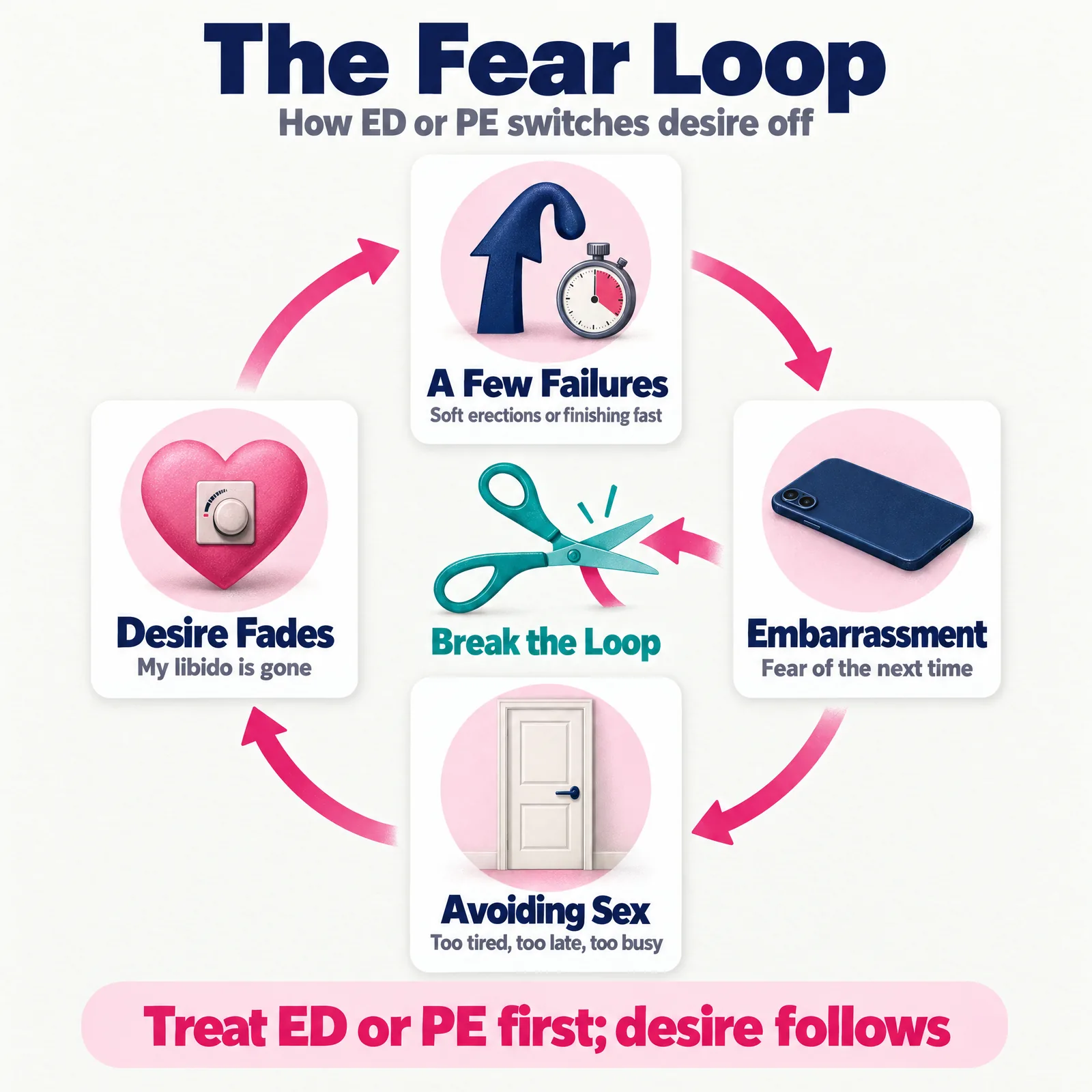
A man who has had a few failed erections, or who finishes very fast, starts to dread sex. To avoid the embarrassment, the brain simply stops wanting it.
He calls it low libido; underneath, it is ED or PE. Shame about body shape or penis size feeds the same fear.
17. Heavy porn use
Here I must be careful, because the research is mixed. In coupled men with low desire, frequent masturbation with porn went with sexual boredom and low intimacy.
It was a pattern “dissociated” from desire for the partner (Carvalheira, 2015). Yet another set of studies found little link between porn and sexual problems in young men (Landripet, 2015).
My clinical view sits between these. Porn does not cause low libido in every man. But in men who use it daily, desire for a real partner often fades, and a break helps.
It can also set expectations of sex that no real partner matches. I discuss this in porn-induced erectile dysfunction.
18. Guilt and worry about semen loss
Many Indian men grow up believing that losing semen weakens the body. As I said at the start, it was the commonest explanation men gave in a south Indian clinic study (Thangadurai, 2014).
It creates guilt after masturbation and fear after a night emission. Then the mind starts to avoid anything sexual.
Semen is made every day, and losing it does no harm. I explain this in my guide to Dhat syndrome and sexual tiredness.
Part 5: The relationship and daily life (causes 19 to 21)
The last group is the one men find hardest to talk about. But it is often the root.
19. Conflict, resentment and distance
Unspoken anger is a powerful desire-killer. Britain’s national survey linked low sexual function in men with two things.
One was not being happy in the relationship. The other was not being able to talk about sex with the partner (Mitchell, 2013).
Men in long relationships told researchers that feeling desired fed their desire. Rejection and emotional distance, on the other hand, drained it (Murray, 2017).
In a large clinic study, “primary” low libido, with no medical cause, went hand in hand with relationship and family trouble (Corona, 2013a). That is why I like to see the couple together, at least once.
20. Pressure, no privacy, and sex on a schedule
Some pressures are very Indian. A joint family with thin walls and no privacy. Relatives asking when the baby is coming.
Couples trying to conceive who have sex only on “ovulation days” because a chart says so. In my clinic, desire often disappears when sex becomes a task with a deadline.
Long relationships and routine lower interest too (Carvalheira, 2014). Novelty, time together and a little playfulness matter more than any tablet.
Men rarely admit it, but loss of libido after a baby, or after kids, is common in my clinic. Broken sleep, an exhausted couple and no time alone all press on desire. So protecting sleep and private time is where I start.
21. Loss of libido after marriage: attraction and adjustment
In arranged marriages especially, desire may take time to build. Not feeling drawn to the partner was one of the factors linked with low interest in the cross-cultural survey (Carvalheira, 2014).
This is not a fault in either person. Indeed, it is very common in the first months.
Time, honest talk and sometimes a few counselling sessions help a great deal. Have years passed with little or no intimacy? Then start with my roadmap in how to fix a sexless marriage.
All 21 causes at a glance
Here are all 21 causes on one page: how I find each one, and what fixes it.
Each cause: how I find it and what fixes it (On a phone, swipe the table sideways.)
| Cause | How I find it | What fixes it |
|---|---|---|
| 1. Low testosterone | Two fasting morning tests, LH and FSH | Weight and sleep, then herbals, then letrozole or anastrozole; gel last |
| 2. High prolactin | Prolactin, repeated; medicine check; scan if still unexplained | Stop the culprit tablet; a prolactin-lowering tablet |
| 3. Thyroid | TSH | Thyroid treatment |
| 4. Steroids | Testosterone, LH and FSH, semen test | Stop them under my care; recheck until your own testosterone recovers |
| 5. Body fat | Waist, testosterone | Weight loss |
| 6. Diabetes | HbA1c | Sugar control |
| 7. Sleep apnoea | Snoring history, sleep study | Weight loss, sleep treatment |
| 8. Long illness | History, examination | Treat the illness; talk through heart fears |
| 9. Age | Rule out the other 20 | Fix the other 20 |
| 10. Antidepressants | Medicine list | Dose change or switch |
| 11. Finasteride | Timeline | Review the need |
| 12. Other medicines | Medicine list, prolactin | Switch with the prescriber |
| 13. Alcohol, cannabis, tobacco | History | Cut down or stop |
| 14. Depression | Mood questions | Counselling; a sex-sparing antidepressant |
| 15. Stress, burnout, past trauma | History; I ask gently | Workload, sleep, counselling |
| 16. Fear of failing | Erection and timing history | Treat ED or PE first |
| 17. Heavy porn use | History | A break |
| 18. Semen-loss guilt | History | Psychosexual counselling |
| 19. Conflict and distance | Couple session | Couple counselling |
| 20. Pressure, no privacy | History | Private time, and sex off the calendar |
| 21. New marriage | Couple session | Time, honest talk, counselling |
⚡ Why has my husband suddenly lost his libido?
Wives often ask me this, and the word “suddenly” is an important clue. A slow fade over years points to age, weight, sugar and routine. A sudden drop over weeks or months points elsewhere.
When desire vanishes suddenly, I think first of these:
- A new medicine, especially an antidepressant, a hair-loss tablet or a strong painkiller.
- Depression or a major stress: a job loss, a bereavement, a business crisis.
- A relationship rupture: a fight that was never resolved, or a trust issue.
- A new erection or timing problem that he is too embarrassed to mention.
- Stopping steroids or gym supplements.
- A hormone problem such as high prolactin or a thyroid change.
When to see a doctor promptly
Book an appointment soon, rather than waiting, if low libido comes with any of these:
- new headaches, or blurring or loss of side vision (this can point to a pituitary problem);
- milky discharge from the nipples, or breast swelling;
- testicles that have become smaller or softer, or a lump or swelling in a testicle, especially with breast swelling in a young man;
- heavy low mood, or thoughts of harming yourself: do not wait for an appointment, read the note just below;
- trouble conceiving.
If your low mood is heavy, or you have had thoughts of harming yourself, please do not wait. Do not stay alone. Tell someone close to you right now, and speak to a doctor today.
These thoughts are more common in men with sexual problems and low mood (Rajkumar, 2015), and they are treatable. You can call my clinic on 97907 83856.
🚩 The thing most clinics miss: check erections and timing first
Here is the pattern I see every single week. A man comes in saying “my libido is gone”. He wants a testosterone test, and he is sure it will be low.
Then I ask about erections and how long he lasts. That is when the real story comes out.
Indeed, the research backs this up. Among men seeking help for ED who never mentioned desire, 30.8% still scored low for desire on a questionnaire (Cilio, 2024). Among 428 men with ED, four in ten had some loss of sexual interest (Corona, 2004).
A few failed erections, or finishing within a minute, create embarrassment. To protect you from that feeling, the brain stops wanting sex at all.
Fix the erection or the timing, and the confidence comes back. In my experience, desire usually follows within weeks.
That is why, in my practice, I treat ED or premature ejaculation first whenever they are part of the picture. Often, I also prescribe medicines to improve the erection or the timing.
Both problems can take away a man’s confidence, and with it, his desire. My comparison of sildenafil and tadalafil explains the ED tablets.
🩺 How low libido is diagnosed: the tests I do
Diagnosis starts with a conversation, not a blood test. I ask when it began, and whether it happens with your partner or across the board.
Then I ask about erections, timing, mood, sleep, alcohol, gym supplements and every tablet you take. Expert standard procedures say the work-up must cover mood, the relationship and hormones (Rubio-Aurioles, 2013).
Next, I examine you: weight and waist, blood pressure and body hair. I also check the breasts for gland tissue, and the size and feel of the testicles.
The blood tests, and why timing matters
Testosterone must be measured fasting, early in the morning, and repeated if low (Bhasin, 2018). That is not a formality.
In men aged 30 to 40, testosterone was 20% to 25% lower at 4 pm than at 8 am (Brambilla, 2009). A sugary drink lowered it by a quarter within two hours (Caronia, 2013).
Men sampled on three mornings and three afternoons; figure shown for men aged 30 to 40.
Source: Brambilla, 2009
In the same study, some men read below 300 ng/dL in the afternoon. About half of them were normal on every morning test (Brambilla, 2009).
So an afternoon test, or one taken after a sugary drink or breakfast, can label a normal man as “low”. I still see this mistake often. It has started many men on testosterone they never needed.
The tests I order
This is the panel I ask for, and why each test is on it.
The tests I order for low libido (On a phone, swipe the table sideways.)
| Test | Why I order it | When |
|---|---|---|
| Total testosterone | Confirms or rules out low testosterone | Fasting, before about 10 am; repeat if low |
| Free testosterone and SHBG | Needed when total testosterone is borderline | Same sample |
| LH and FSH | Shows whether the testicle or the pituitary is the cause | Same sample |
| Prolactin | High prolactin switches desire off | Same sample; repeat if mildly raised |
| TSH (thyroid) | Under- and over-active thyroid both lower desire | Any time |
| HbA1c and fasting sugar | Diabetes is a common hidden cause | Fasting |
| Lipid profile | Heart and blood-vessel health, linked to erections | Fasting |
| Oestradiol | Before and during letrozole or anastrozole, so oestrogen does not fall too low | Before starting, then during treatment |
| Haemoglobin (haematocrit) and PSA (over 40) | Safety checks before any testosterone gel | Before starting gel, then during treatment |
| Mood questions | Depression and anxiety are major causes | At the consultation |
What counts as low testosterone?
European and American guidelines both define low testosterone as a low level plus matching symptoms, never a number alone (Salonia, 2025; Mulhall, 2018). I follow the same rule.
In numbers, a large Boston population study and the TRAVERSE trial both counted total testosterone below 300 ng/dL (10.4 nmol/L) as low (Araujo, 2007; Pencina, 2024). The trial also asked for two such readings. Borderline results are where free testosterone decides (Bhasin, 2018).
Most men need nothing more. If prolactin is clearly high on a repeat test, I first check for medicines that raise it (Corona, 2007). If none explains it, I arrange a pituitary scan to find out why.

Private 1-on-1 consultation
Desire gone quiet? Let us find out why.
A private consultation in T Nagar, Chennai. I take a full history, examine you and order the right fasting morning blood tests. Then we fix the cause, not just the number.
Book a Confidential Consultation
🛠️ Low libido treatment: how to fix a very low libido
There is no single libido tablet for men. Treatment means finding the causes and fixing them, one by one. Here is the order I follow in my clinic.
The order I follow in clinic. Most men need two or three of these steps.
1
2
3
4
5
6
Source: Dr Shah’s clinical protocol; Rubio-Aurioles, 2013
Each step deserves a little explanation. One rule first: every medicine on this page is started only after an examination and tests, on a doctor’s prescription. Please do not buy any of them on your own.
1. Treat erection and timing problems first
If ED or PE is part of the story, I treat it first, as explained above. I use medicines to improve the erection or the timing. Once sex stops being frightening, interest usually returns.
2. Review your medicines
Is an antidepressant, hair-loss tablet, painkiller or prolactin-raising drug involved? Then I work with you, and your other doctors, to switch or adjust it. Some antidepressants carry far fewer sexual effects (Serretti, 2009).
3. Counselling, psychosexual therapy and treating depression
I counsel men and couples in my clinic myself. That means treating depression and anxiety, and working through relationship problems.
It also means psychosexual therapy, including cognitive behavioural therapy (CBT). This helps with performance fears, guilt and the semen-loss worries many Indian men carry.
I also teach couples to take the pressure off sex and rebuild closeness step by step. Here is how psychosexual counselling works.
Let me be honest about the evidence. The controlled trials of talking therapy for low desire were in women.
A critical review found none of them adequate yet (Pyke, 2015). Good trials in men are still missing.
So my confidence in counselling comes from my own clinic, where I see it work week after week. Because depression and sexual problems feed each other (Atlantis, 2012), I treat the mood and the desire together. Where an antidepressant is needed, I choose one that spares sexual function where possible (Serretti, 2009).
4. Correct prolactin, thyroid, sugar, weight and sleep
Raised prolactin is brought down with a tablet, usually cabergoline. I also find out why it was high, and desire usually returns (Corona, 2024). Thyroid treatment reverses many sexual problems within a few months (Carani, 2005).
Weight loss raises testosterone (Corona, 2013b). These are some of the most satisfying fixes in andrology.
5. Low testosterone: my treatment ladder
Only when testosterone is confirmed low, twice, in the morning, do I treat it. Even then, I start at the bottom of the ladder. The next section explains each rung.
🪜 If your testosterone is truly low: my treatment ladder
My rule is simple: fix the causes first, and use testosterone rarely. Most men with a low reading improve with weight loss, better sleep, less alcohol and better sugar control. If they do not, I climb this ladder, one rung at a time.
How is low testosterone confirmed, and what symptoms go with it? Both are in my guide to how low testosterone is diagnosed.
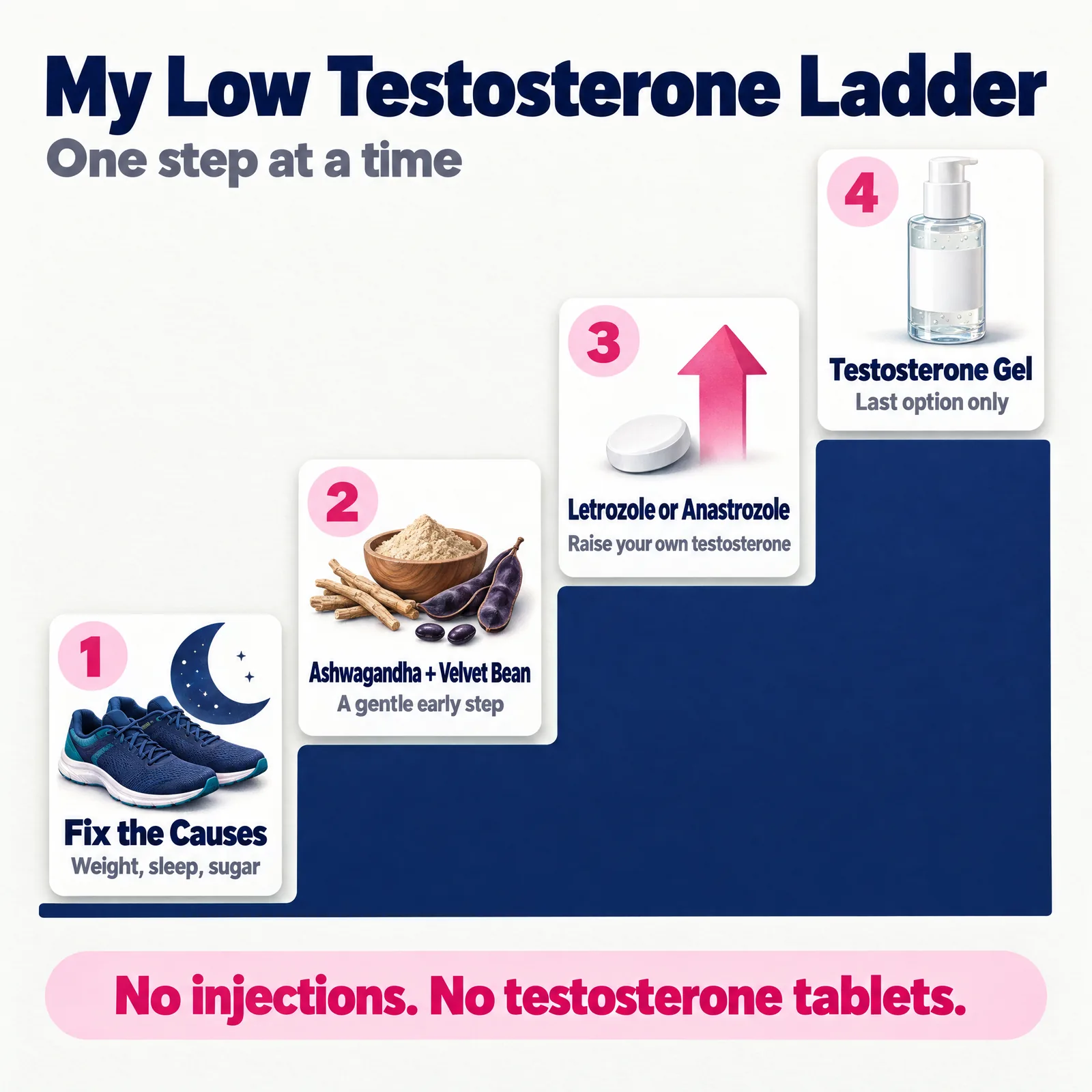
Here is each rung, and what the evidence says about it.
Letrozole, anastrozole, testosterone gel and even the herbal extracts need a prescription, the right dose and follow-up blood tests. Taken without a doctor, they can push hormones too high or too low and switch off sperm production. Please do not buy them online or over the counter.
With that rule in place, here is how I climb the ladder.
Rung 1: Lifestyle and the causes
In my experience, weight loss is the strongest lever. A review looked at 24 studies of obese men.
Both diet and surgery raised testosterone, and the more weight a man lost, the more it rose (Corona, 2013b). Sleep, alcohol and sugar control come next.
Rung 2: Ashwagandha and velvet bean extract
I use ashwagandha (Withania somnifera) and velvet bean extract (Mucuna pruriens, known in Ayurveda as kapikachhu). Two small eight-week trials tested ashwagandha root extract in healthy men.
It improved desire scores compared with placebo (Mutha, 2025; Khanna, 2026). However, a trial in older overweight men found a modest hormone rise but no clear gain in sexual well-being (Lopresti, 2019).
Velvet bean raised testosterone and lowered prolactin in infertile men in a Lucknow study (Shukla, 2009). But no placebo trial has measured libido. So I use these as a gentle early step, not as a promise.
I prescribe them as standardised extracts after a consultation, not as random online products. That matters, because one in five Ayurvedic medicines bought online contained lead, mercury or arsenic (Saper, 2008).
Natural does not mean risk-free. Ashwagandha has rare reports of liver injury.
So stop it and see me if you notice nausea, itching, dark urine or yellow eyes. I also avoid it in men with an overactive thyroid.
Velvet bean contains natural L-dopa, the same chemical used for Parkinson’s disease. So I do not give it to men on antipsychotics, MAO-inhibitor antidepressants or Parkinson’s medicines. Nor do I give it to men with a history of psychosis.
Rung 3: Letrozole or anastrozole
These tablets block the enzyme that turns testosterone into oestrogen. So your body’s own testosterone rises. In older men, anastrozole raised testosterone from 343 to 572 ng/dL, about 11.9 to 19.8 nmol/L (Leder, 2004).
In 12 severely obese men, weekly letrozole brought low testosterone back into the normal range. But free testosterone overshot the normal range in 7 of them (Loves, 2008).
Two honest cautions. First, this use in men is off-label and needs monitoring.
Oestrogen must not fall too far, because too little oestrogen lowers desire itself (Finkelstein, 2013). So I check oestradiol; testosterone can also overshoot.
Second, raising the number did not improve sexual scores in the one small trial that measured them (Leder, 2004). That is why I use these selectively, alongside the other steps.
Rung 4: Testosterone gel, as a last option
When testosterone is clearly low and the steps above have not worked, I consider a testosterone gel. It is applied to the skin.
In the large trials of men with proven low testosterone, gel improved sexual desire and activity, a “moderate benefit” (Snyder, 2016; Pencina, 2024). Improvement, when it comes, tends to show within about a month (Wang, 2000).
Two safety rules come with the gel. First, it rubs off.
Apply it to the shoulders or upper arms, let it dry, wash your hands and keep the area covered. Skin contact can pass testosterone to your wife or children, which matters most if she is pregnant.
Second, before starting I check your haemoglobin (haematocrit) and, over 40, your PSA. I then repeat them during treatment.
Guidelines advise against the gel in some men (Bhasin, 2018). That includes men trying for a baby soon, and men with prostate or breast cancer or a raised haematocrit. It also includes untreated severe sleep apnoea, uncontrolled heart failure, and a heart attack or stroke in the last six months.
But testosterone reliably helps desire only when it was truly low. In men who were not clearly deficient, the benefit was uncertain (Corona, 2014a).
What I never use: injections and testosterone tablets
Testosterone replacement comes as gels, skin patches, injections, tablets or capsules, and implanted pellets. In my practice I use only the gel, and only as a last option. I never use injectable or oral testosterone.
Injections shut down sperm production powerfully (WHO Task Force, 1990). For a man with low libido, I find the gentler steps above safer and usually enough.
👶 Trying for a baby? Read this before any treatment
This section is the most important part of the article for young married men. Any outside testosterone, whether injection, gel or a “booster” containing it, can switch off sperm production.
In the WHO contraception trial, weekly testosterone injections left 65% of men with no sperm within six months (WHO Task Force, 1990). Recovery after stopping usually takes months, and in some men up to two years (Liu, 2006). That is why the Endocrine Society advises against testosterone in men planning a pregnancy soon (Bhasin, 2018).
Do not start testosterone in any form. Tell me before any libido treatment, and never take a gym trainer’s injection.
Low testosterone can be raised in ways that keep sperm production going. I plan that with every couple who are trying.
Medicines such as clomiphene raise a man’s own testosterone rather than replacing it (Katz, 2012; Huijben, 2022). They are off-label and not right for everyone.
I decide this with each couple who are trying. If fertility is a worry, my guide to low sperm count is a good next read.
🌿 How to increase sex drive in men naturally
How can a man regain his libido without medicines? Often, by fixing the everyday things that quietly drain it.
So, here is how to increase sex drive naturally. I give every man these steps, in order of how much they help in my clinic.
What genuinely helps
- Lose the extra waist. Weight loss raises testosterone in overweight men, and the more weight lost, the bigger the rise (Corona, 2013b).
- Protect your sleep. Aim for seven to eight hours. Even one full night (24 hours) without sleep lowers testosterone (Su, 2021). Get loud snoring checked.
- Move every day, and add strength training twice a week, but do not overdo it. Exercise lifts mood, energy and erections. Interestingly, training did not raise testosterone in inactive men (Potter, 2021). And the very hardest endurance training went with lower libido (Hackney, 2017).
- Cut alcohol to a minimum. Heavy drinking goes with desire problems (Pendharkar, 2016).
- Stop smoking. It harms erections, and with them, confidence (Allen, 2018).
- Bring stress down. Stress is the most common reason men give for losing interest (Carvalheira, 2014). Even a daily walk, ten minutes of yoga or slow breathing, and a fixed switch-off time help.
- Take a break from porn if you use it daily, and see whether desire for your partner returns.
- Make time for each other. Feeling desired fuels desire in men (Murray, 2017). A weekly evening out, without phones, does more than any capsule.
- Check zinc and vitamin D only if you may be low. Zinc raised testosterone in a small study of zinc-deficient older men (Prasad, 1996). Vitamin D did nothing for men with normal testosterone (Lerchbaum, 2017).
- Eat a Mediterranean-style diet, the Indian way: vegetables, fruit, dal, nuts and fish, with less white rice and sweets. It helps your weight and sugar, which helps desire.
What does not help
Some popular advice does nothing, or harms. Men often ask me for a food to increase sex drive.
Here is the honest answer: no food works fast. Oysters, chocolate and “aphrodisiac” foods have no good trials behind them for desire in men.
Cold showers and fasting for days do not raise libido either. Neither does extreme endurance training; in fact, it can lower it (Hackney, 2017).
Equally, avoiding masturbation to “save” semen does not build desire. If anything, the guilt and anxiety make it worse. My guide to semen retention benefits explains what abstinence really does and does not do.
And do not wait it out. Months of silence harden into avoidance, and most causes are easier to fix early.
💊 Libido supplements for men: what the evidence shows
What supplements can increase libido in men? This is one of the commonest questions I get, usually with a photo of a capsule bottle. Here is an honest summary of the trials.
Overall, a review looked at 32 trials of 13 herbs. Only 9 showed a rise in testosterone, and only 6 were of low risk of bias (Smith, 2021).
So most “boosters” are unproven. Whatever you consider, take it only on a doctor’s prescription, never off the shelf or from a gym.
Common libido supplements: the honest evidence (On a phone, swipe the table sideways.)
| Supplement | What the trials show | My view |
|---|---|---|
| Ashwagandha | Better desire scores in two small 8-week trials in healthy men; no clear gain in older overweight men | My first herbal step when testosterone is low |
| Velvet bean (Mucuna pruriens, kapikachhu) | Raised testosterone in infertile men; no libido trial | I use it with ashwagandha |
| Tribulus (gokshura) | Did not raise testosterone; one branded trial improved desire | Weak evidence |
| Maca | Desire improved in healthy men without any hormone change; few small trials | Possible, unproven |
| Fenugreek (methi) | Mixed; one industry trial positive, another found no effect on libido | Weak evidence |
| Shilajit | No good libido trial; Ayurvedic products bought online can contain heavy metals | Avoid unbranded; unproven |
| Zinc | Raised testosterone in a small study of deficient men | Only if low |
| Vitamin D | No effect in men with normal testosterone | Only if low |
| Unbranded “sex power” capsules | The supplements regulators most often catch with hidden drugs, mainly sildenafil | Avoid |
Sources for the table (Mutha, 2025; Khanna, 2026; Lopresti, 2019; Shukla, 2009; Neychev, 2005; Kamenov, 2017; Gonzales, 2002; Shin, 2010; Steels, 2011; Lee-Ødegård, 2024; Prasad, 1996; Lerchbaum, 2017; Tucker, 2018; Saper, 2008).
The danger in “herbal” sex-power products
As I said above, sex-power products are the supplements most often caught with hidden drugs, mainly sildenafil (Tucker, 2018). Ayurvedic products bought online can also carry lead, mercury or arsenic (Saper, 2008).
So if a capsule gives you a sudden, strong erection within an hour, it probably contains a drug. With nitrate heart tablets such as isosorbide or nitroglycerin, hidden sildenafil can drop your blood pressure dangerously. Buy only from reputable makers, and tell me everything you take.
🔁 Can low libido be cured, and how long does it take?
Yes, in most men, because most causes can be fixed. The timeline follows the cause.
Here is roughly what I see in my clinic. Only the prolactin, thyroid and gel lines come from studies.
- Fear of ED or PE: often within weeks of the erection or timing improving.
- A medicine change: in my experience, usually weeks to a few months after the switch. A few men’s symptoms persist after stopping finasteride, though (Irwig, 2011).
- High prolactin: desire usually improves within months of treatment (Corona, 2007).
- Thyroid: sexual problems had improved when men were rechecked 8 to 16 weeks after thyroid levels normalised (Carani, 2005).
- Testosterone gel: gains tend to appear within about a month (Wang, 2000).
- Weight, sleep and stress: steady improvement over two to three months.
- Relationship work: varies from couple to couple; it is slower, but the results last.
Can it come back? Yes, if the cause returns: weight regained, stress rebuilt, a medicine restarted. That is why I teach men to recognise their own early signs.
💞 My husband has a low sex drive: how can I help him?
What can you do if your husband has low libido? First, please do not take it as rejection. In my experience, the wife usually blames herself.
She feels less attractive, or suspects an affair. Far more often, he is stressed, low, frightened of failing, or unwell.
The partner’s side matters in medicine too. In one clinic study, the partner’s illness or low desire was itself linked with low desire in the man (Corona, 2006). So this is a couple problem with a couple solution.
What to do if a man is not interested in sex
- Choose a calm moment, not the bedroom, to talk. Start with care: “I miss being close to you.”
- Ask about stress, sleep, mood and any new medicines, gently.
- Take the pressure off. For a few weeks, agree on closeness without any expectation of sex.
- Come to the appointment together if he agrees. I see couples together, and it shortens the journey.
What are the side effects of a lack of sex in a relationship?
Months without intimacy often bring distance, irritability, misunderstanding and self-doubt on both sides. Yet it is fixable at almost any stage. My guide to the sexless marriage covers this in depth.
Is it the wife whose desire has faded? Then my page on female sexual problems is the right place to start.
📅 When to see a doctor for low libido
Low libido is worth a proper assessment if:
- it has lasted more than three months and bothers you or your partner (you do not need to wait for the six months doctors use to label it);
- the drop began suddenly, or soon after starting a new medicine;
- erection problems, finishing too fast or fewer morning erections come with it;
- you have diabetes, a big waist, loud snoring or low mood;
- steroids or gym “testosterone” are, or were, part of your routine;
- a baby is planned in the next year or two;
- headaches, vision changes, nipple discharge, a testicular lump or shrinking testicles come with it (book promptly).
Which doctor should you see?
An andrologist or a sexologist, who can check hormones, erections, timing, mood and the relationship together.
In my clinic in T Nagar, Chennai, the first visit covers your history, an examination and the morning blood tests. Everything you say stays private.
In my clinic, low libido is almost never one thing. The commonest story is a man in his thirties or forties. He has rising weight, poor sleep, borderline sugar and a stressful job.
He has had a few failed erections and has quietly started avoiding sex. Yet his testosterone is often normal when tested properly in the morning.
So I rarely begin with hormones. I begin by fixing what is pressing on his desire. Then I treat the erection or timing problem, and I talk with the couple.
When testosterone is genuinely low, I start with ashwagandha and velvet bean extract. I add letrozole or anastrozole when needed, and keep testosterone gel as my last option. I never use testosterone injections or tablets.
If you recognise yourself in these notes, you are in good company. Most of these men are doing well a few months later.
❓ Low libido in men: your questions answered
Short answers to the questions men search for most. The detail is in the sections above.
What does low libido mean for a man?
Low libido is a lasting drop in sexual thoughts and the wish for sex. It is a symptom, not a disease, caused by stress, mood, medicines, sugar, sleep, hormones or the relationship.
Why do I have no interest in sex as a man?
Usually because something is pressing on desire: stress, low mood, poor sleep, a new medicine, diabetes, relationship strain or fear of failing in bed. Hormones are a less common cause, checked with a fasting morning blood test.
Why is my male sex drive so low?
The usual causes are stress, depression, poor sleep, weight gain, diabetes, medicines like antidepressants, alcohol, relationship strain, and fear of erection or timing problems. Low testosterone is only one of them.
What are the common causes of low libido in men?
Stress and burnout, depression, erection or timing problems, antidepressants, diabetes, obesity, poor sleep, heavy alcohol, high prolactin, thyroid problems, low testosterone and relationship conflict. Most men have more than one.
Is low libido a sign of low testosterone?
Sometimes, but not usually. Low desire is one of the symptoms that tracks truly low testosterone. However, in my clinic most men with low libido have normal levels when tested fasting in the morning.
Can high testosterone levels cause low libido?
Not naturally high levels. However, men who take steroids or gym testosterone often lose libido when they stop, because their own testosterone can stay low for months or even years.
Can depression affect a man’s sex drive?
Yes. Depression lowers desire, often before any medicine is started, and sexual problems in turn raise the risk of depression. So I treat both together, choosing medicines that spare sexual function where possible.
Can burnout affect libido?
Yes. In fact, work stress is the reason men give most often for losing interest in sex. Rest, sleep, a clear switch-off time and treating anxiety bring desire back.
Does age affect sex drive in men?
Desire falls slowly with age, yet even among men aged 40 to 70, about four in five did not report low libido. However, a sudden drop at any age points to a cause worth checking.
How to increase sex drive in men over 40?
Find and fix the causes: lose the extra waist, control sugar, sleep well, cut alcohol and review medicines. A fasting morning testosterone test is part of that check. Many men in their sixties regain good desire this way.
Why is my libido so low in my 20s?
In young men the common causes are stress, anxiety, porn habits, fear of failing in bed, steroid use, poor sleep and antidepressants. Low testosterone is less common at this age, but worth one morning test.
Why do men lose interest in sex after marriage?
Usually stress, routine, no privacy, a new baby, sex on a schedule or unresolved conflict. In arranged marriages, attraction can take time to build. Time, honest talk and counselling help a great deal.
Does testosterone affect erectile dysfunction?
Only partly; testosterone mainly drives desire. In two large trials of men with low testosterone, gel raised desire in both but improved erections in only one. Most ED has other causes.
How can a man regain his libido?
By fixing the cause: treating erection or timing problems, adjusting medicines, losing weight, sleeping well, cutting alcohol, treating mood and hormones, and rebuilding closeness with the partner.
What can you take to increase your libido?
There is no general libido tablet for men. Treatment targets the cause, such as an ED tablet when fear of failing is the driver, or a prolactin tablet when prolactin is high. Take nothing without a prescription.
What vitamin is best for sex drive?
None reliably raises it. Zinc raised testosterone in a small study of zinc-deficient men, and vitamin D did nothing for men with normal testosterone. So check your levels rather than buying supplements blindly.
What supplements can increase libido in men?
When testosterone is confirmed low, I start with ashwagandha, which has early evidence from small trials, plus velvet bean extract. Avoid unbranded sex-power capsules: they are the products most often caught hiding drugs such as sildenafil.
Does ashwagandha increase libido?
Two small eight-week trials in healthy men showed better desire scores than placebo, but a trial in older overweight men found no clear gain. I use it only when testosterone is confirmed low, as an early step.
What to eat before sex to increase desire?
No food reliably raises desire before sex. Instead, a light meal, little or no alcohol, and being relaxed matter more. Over months, a balanced diet that controls weight and sugar helps desire.
Does masturbation reduce libido?
Ordinary masturbation does not. In my clinic, daily masturbation with porn sometimes goes with fading desire for a partner, though studies disagree, and guilt about semen loss can lower desire too.
Does alcohol reduce libido?
A little may relax you, but heavy drinking goes with low desire and poorer erections. In fact, over half of alcohol-dependent men in one Indian study had desire problems.
Can diabetes cause low libido?
Yes, and it is one of the commonest hidden causes. A third of men with type 2 diabetes had low testosterone in one study, so I check HbA1c in every man with low libido.
Can thyroid problems cause low libido?
Yes. Both an underactive and an overactive thyroid can lower desire. However, treating the thyroid reverses many sexual symptoms within a few months, so a TSH test is part of every work-up.
Can finasteride cause low libido?
It can. Low libido was clearly more common in older men taking it for the prostate, but not significantly so in hair-loss trials. Even so, a few men report lasting effects.
Do antidepressants lower sex drive?
Many do, especially SSRIs. Never stop one on your own; your doctor can often lower the dose or switch to an option with fewer sexual effects, such as bupropion or mirtazapine.
Does low libido from sertraline go away?
Usually, once the dose is lowered or the medicine is switched; in my experience desire returns within weeks to a few months. Never stop sertraline on your own. Ask your doctor to adjust it.
Does testosterone gel increase libido?
Yes, when testosterone is truly low: in large trials of such men, gel improved desire and sexual activity. In men with normal levels the benefit is uncertain, and in my practice gel is a last option.
Does low libido affect fertility?
Low desire itself does not damage sperm, but less frequent sex lowers the chance of pregnancy. Never take testosterone while trying for a baby; it can switch off sperm production.
Can low libido be cured?
In most men, yes, because most causes are treatable. Recovery may take weeks for fear-driven or medicine-related low desire, and a few months for hormone and weight-related causes.
What is the best treatment for low libido in men?
The treatment that fixes your cause. For most men that means treating erection or timing problems, changing a medicine, counselling, and correcting sugar, sleep, prolactin or thyroid. Hormone treatment is only for truly low testosterone, with gel last.
Which doctor should I see for low libido?
An andrologist or sexologist, who can check hormones, erections, timing, mood and the relationship together. Bring a list of your medicines and come for a fasting morning blood test.
🎯 The bottom line
Low libido in men is common, and it is a symptom, not a verdict. Stress, mood, medicines, sugar, sleep, weight, hormones, the relationship and fear of failing in bed can all switch desire off. Most men have more than one.
The fix starts with finding every cause, with a proper fasting morning blood test and an honest conversation. I treat erection and timing problems first, review medicines, counsel the couple, and correct the hormones. When testosterone is truly low, I climb my ladder slowly and keep testosterone gel as the last option.
I hope this has answered your worry. This is Dr Shah, consultant andrologist in Chennai.
If your desire has gone quiet, call me on 97907 83856 or message me on WhatsApp. Nothing you say leaves the room.
Private consultation
Get your desire back, one cause at a time
A practising andrologist in Chennai. I check hormones, erections, timing, mood and the relationship together, then treat them in the right order.
References
Definition, prevalence and ageing
- Mitchell KR, et al., 2013: Sexual function in Britain: findings from the third National Survey of Sexual Attitudes and Lifestyles (Natsal-3) (PMID 24286787).
- Meissner VH, et al., 2019: Factors Associated with Low Sexual Desire in 45-Year-Old Men: Findings from the German Male Sex-Study (PMID 31196838).
- Herkommer K, et al., 2024: Prevalence, lifestyle, and risk factors of erectile dysfunction, premature ejaculation, and low libido in middle-aged men: first results of the Bavarian Men’s Health-Study (PMID 37676020).
- Carvalheira A, et al., 2014: Correlates of men’s sexual interest: a cross-cultural study (PMID 24344639).
- Laumann EO, et al., 2005: Sexual problems among women and men aged 40-80 y: prevalence and correlates identified in the Global Study of Sexual Attitudes and Behaviors (PMID 15215881).
- Irfan M, et al., 2020: Epidemiology of Male Sexual Dysfunction in Asian and European Regions: A Systematic Review (PMID 32623948).
- Brotto LA, 2010: The DSM diagnostic criteria for Hypoactive Sexual Desire Disorder in men (PMID 20929517).
- Rubio-Aurioles E, et al., 2013: Standard operational procedures for low sexual desire in men (PMID 22971157).
- Corona G, et al., 2013a: Risk factors associated with primary and secondary reduced libido in male patients with sexual dysfunction (PMID 23347078).
- Araujo AB, et al., 2004: Changes in sexual function in middle-aged and older men: longitudinal data from the Massachusetts Male Aging Study (PMID 15341552).
- Araujo AB, et al., 2007: Prevalence of symptomatic androgen deficiency in men (PMID 17698901).
Testosterone and sexual desire
- Wu FC, et al., 2010: Identification of late-onset hypogonadism in middle-aged and elderly men (PMID 20554979).
- Travison TG, et al., 2006: The relationship between libido and testosterone levels in aging men (PMID 16670164).
- Finkelstein JS, et al., 2013: Gonadal steroids and body composition, strength, and sexual function in men (PMID 24024838).
- Zitzmann M, et al., 2006: Association of specific symptoms and metabolic risks with serum testosterone in older men (PMID 16926258).
- Kelleher S, et al., 2004: Blood testosterone threshold for androgen deficiency symptoms (PMID 15292310).
- Corona G, et al., 2016: Endocrinologic Control of Men’s Sexual Desire and Arousal/Erection (PMID 26944463).
Testing and guidelines
- Bhasin S, et al., 2018: Testosterone Therapy in Men With Hypogonadism: An Endocrine Society Clinical Practice Guideline (PMID 29562364).
- Mulhall JP, et al., 2018: Evaluation and Management of Testosterone Deficiency: AUA Guideline (PMID 29601923).
- Salonia A, et al., 2025: European Association of Urology Guidelines on Male Sexual and Reproductive Health: 2025 Update on Male Hypogonadism, Erectile Dysfunction, Premature Ejaculation, and Peyronie’s Disease (PMID 40340108).
- Brambilla DJ, et al., 2009: The effect of diurnal variation on clinical measurement of serum testosterone and other sex hormone levels in men (PMID 19088162).
- Caronia LM, et al., 2013: Abrupt decrease in serum testosterone levels after an oral glucose load in men: implications for screening for hypogonadism (PMID 22804876).
Testosterone therapy, fertility and alternatives
- Snyder PJ, et al., 2016: Effects of Testosterone Treatment in Older Men (PMID 26886521).
- Pencina KM, et al., 2024: Effect of Testosterone Replacement Therapy on Sexual Function and Hypogonadal Symptoms in Men with Hypogonadism (PMID 37589949).
- Corona G, et al., 2014a: Testosterone supplementation and sexual function: a meta-analysis study (PMID 24697970).
- Wang C, et al., 2000: Transdermal testosterone gel improves sexual function, mood, muscle strength, and body composition parameters in hypogonadal men (PMID 10946892).
- WHO Task Force, 1990: Contraceptive efficacy of testosterone-induced azoospermia in normal men. World Health Organization Task Force on methods for the regulation of male fertility (PMID 1977002).
- Liu PY, et al., 2006: Rate, extent, and modifiers of spermatogenic recovery after hormonal male contraception: an integrated analysis (PMID 16650651).
- Katz DJ, et al., 2012: Outcomes of clomiphene citrate treatment in young hypogonadal men (PMID 22044663).
- Huijben M, et al., 2022: Clomiphene citrate for men with hypogonadism: a systematic review and meta-analysis (PMID 34933414).
- Leder BZ, et al., 2004: Effects of aromatase inhibition in elderly men with low or borderline-low serum testosterone levels (PMID 15001605).
- Loves S, et al., 2008: Letrozole once a week normalizes serum testosterone in obesity-related male hypogonadism (PMID 18426834).
Prolactin, thyroid, diabetes, weight and sleep
- Corona G, et al., 2007: Effect of hyperprolactinemia in male patients consulting for sexual dysfunction (PMID 17655655).
- Corona G, et al., 2024: Hyperprolactinemia and male sexual function: focus on erectile dysfunction and sexual desire (PMID 37340146).
- Carani C, et al., 2005: Multicenter study on the prevalence of sexual symptoms in male hypo- and hyperthyroid patients (PMID 16204360).
- Krassas GE, et al., 2008: Erectile dysfunction in patients with hyper- and hypothyroidism: how common and should we treat? (PMID 18270255).
- Dhindsa S, et al., 2004: Frequent occurrence of hypogonadotropic hypogonadism in type 2 diabetes (PMID 15531498).
- Corona G, et al., 2014b: Sexual dysfunction at the onset of type 2 diabetes: the interplay of depression, hormonal and cardiovascular factors (PMID 25041930).
- Corona G, et al., 2013b: Body weight loss reverts obesity-associated hypogonadotropic hypogonadism: a systematic review and meta-analysis (PMID 23482592).
- Cignarelli A, et al., 2019: Effects of CPAP on Testosterone Levels in Patients With Obstructive Sleep Apnea: A Meta-Analysis Study (PMID 31496991).
- Luboshitzky R, et al., 2002: Decreased pituitary-gonadal secretion in men with obstructive sleep apnea (PMID 12107256).
- Su L, et al., 2021: Effect of partial and total sleep deprivation on serum testosterone in healthy males: a systematic review and meta-analysis (PMID 34801825).
Mood and medicines
- Atlantis E, et al., 2012: Bidirectional association between depression and sexual dysfunction: a systematic review and meta-analysis (PMID 22462756).
- Kennedy SH, et al., 1999: Sexual dysfunction before antidepressant therapy in major depression (PMID 10701478).
- Rajkumar RP, et al., 2015: Depression and anxiety in men with sexual dysfunction: a retrospective study (PMID 25818906).
- Serretti A, et al., 2009: Treatment-emergent sexual dysfunction related to antidepressants: a meta-analysis (PMID 19440080).
- Montejo AL, et al., 2001: Incidence of sexual dysfunction associated with antidepressant agents: a prospective multicenter study of 1022 outpatients. Spanish Working Group for the Study of Psychotropic-Related Sexual Dysfunction (PMID 11229449).
- Segraves RT, et al., 2014: Antidepressant-induced sexual dysfunction in men (PMID 24239785).
- Liu L, et al., 2016: Effect of 5α-Reductase Inhibitors on Sexual Function: A Meta-Analysis and Systematic Review of Randomized Controlled Trials (PMID 27475241).
- Irwig MS, et al., 2011: Persistent sexual side effects of finasteride for male pattern hair loss (PMID 21418145).
- Ko DT, et al., 2002: Beta-blocker therapy and symptoms of depression, fatigue, and sexual dysfunction (PMID 12117400).
- Silvestri A, et al., 2003: Report of erectile dysfunction after therapy with beta-blockers is related to patient knowledge of side effects and is reversed by placebo (PMID 14585251).
- Bawor M, et al., 2015: Testosterone suppression in opioid users: a systematic review and meta-analysis (PMID 25702934).
Steroids, alcohol, tobacco and cannabis
- Rasmussen JJ, et al., 2016: Former Abusers of Anabolic Androgenic Steroids Exhibit Decreased Testosterone Levels and Hypogonadal Symptoms Years after Cessation: A Case-Control Study (PMID 27532478).
- Pendharkar S, et al., 2016: Sexual dysfunctions in alcohol-dependent men: A study from north India (PMID 28139538).
- Allen MS, et al., 2018: Health-Related Lifestyle Factors and Sexual Dysfunction: A Meta-Analysis of Population-Based Research (PMID 29523476).
- Smith AM, et al., 2010: Cannabis use and sexual health (PMID 19694929).
- Pizzol D, et al., 2019: Relationship Between Cannabis Use and Erectile Dysfunction: A Systematic Review and Meta-Analysis (PMID 31795801).
Erections, timing, relationships and porn
- Corona G, et al., 2004: Psycho-biological correlates of hypoactive sexual desire in patients with erectile dysfunction (PMID 14961059).
- Cilio S, et al., 2024: Prevalence and predictors of unrecognised low sexual desire/interest in men with new onset erectile dysfunction: findings from a cross-sectional, real-life study (PMID 36496478).
- Corona G, et al., 2006: Assessment of the relational factor in male patients consulting for sexual dysfunction: the concept of couple sexual dysfunction (PMID 16809271).
- Murray SH, et al., 2017: A Qualitative Exploration of Factors That Affect Sexual Desire Among Men Aged 30 to 65 in Long-Term Relationships (PMID 27136394).
- Carvalheira A, et al., 2015: Masturbation and Pornography Use Among Coupled Heterosexual Men With Decreased Sexual Desire: How Many Roles of Masturbation? (PMID 25189834).
- Landripet I, et al., 2015: Is Pornography Use Associated with Sexual Difficulties and Dysfunctions among Younger Heterosexual Men? (PMID 25816904).
- Thangadurai P, et al., 2014: Sexual dysfunction among men in secondary care in southern India: Nature, prevalence, clinical features and explanatory models (PMID 25668163).
- Pyke RE, et al., 2015: Psychological Treatment Trials for Hypoactive Sexual Desire Disorder: A Sexual Medicine Critique and Perspective (PMID 26610872).
Lifestyle and adulterated products
- Potter NJ, et al., 2021: Effects of Exercise Training on Resting Testosterone Concentrations in Insufficiently Active Men: A Systematic Review and Meta-Analysis (PMID 35134000).
- Hackney AC, et al., 2017: Endurance Exercise Training and Male Sexual Libido (PMID 28195945).
- Prasad AS, et al., 1996: Zinc status and serum testosterone levels of healthy adults (PMID 8875519).
- Lerchbaum E, et al., 2017: Vitamin D and Testosterone in Healthy Men: A Randomized Controlled Trial (PMID 28938446).
- Tucker J, et al., 2018: Unapproved Pharmaceutical Ingredients Included in Dietary Supplements Associated With US Food and Drug Administration Warnings (PMID 30646238).
- Saper RB, et al., 2008: Lead, mercury, and arsenic in US- and Indian-manufactured Ayurvedic medicines sold via the Internet (PMID 18728265).
Ashwagandha and velvet bean
- Smith SJ, et al., 2021: Examining the Effects of Herbs on Testosterone Concentrations in Men: A Systematic Review (PMID 33150931).
- Mutha AS, et al., 2025: Efficacy and safety of eight-week therapy with Ashwagandha root extract in improvement of sexual health in healthy men: Findings of a prospective, randomized, double-blind, placebo-controlled study (PMID 40582043).
- Khanna A, et al., 2026: Efficacy and safety of ashwagandha root extract on sexual health in healthy Men: a prospective, randomized, double-blind, placebo-controlled study (PMID 41766918).
- Lopresti AL, et al., 2019: A Randomized, Double-Blind, Placebo-Controlled, Crossover Study Examining the Hormonal and Vitality Effects of Ashwagandha ( Withania somnifera) in Aging, Overweight Males (PMID 30854916).
- Shukla KK, et al., 2009: Mucuna pruriens improves male fertility by its action on the hypothalamus-pituitary-gonadal axis (PMID 18973898).
Tribulus, maca and fenugreek
- Neychev VK, et al., 2005: The aphrodisiac herb Tribulus terrestris does not influence the androgen production in young men (PMID 15994038).
- Kamenov Z, et al., 2017: Evaluation of the efficacy and safety of Tribulus terrestris in male sexual dysfunction-A prospective, randomized, double-blind, placebo-controlled clinical trial (PMID 28364864).
- Gonzales GF, et al., 2002: Effect of Lepidium meyenii (MACA) on sexual desire and its absent relationship with serum testosterone levels in adult healthy men (PMID 12472620).
- Shin BC, et al., 2010: Maca (L. meyenii) for improving sexual function: a systematic review (PMID 20691074).
- Steels E, et al., 2011: Physiological aspects of male libido enhanced by standardized Trigonella foenum-graecum extract and mineral formulation (PMID 21312304).
- Lee-Ødegård S, et al., 2024: Effect of a plant extract of fenugreek (Trigonella foenum-graecum) on testosterone in blood plasma and saliva in a double blind randomized controlled intervention study (PMID 39288153).
Visit us in Chennai
A private, judgment-free space to talk through fertility and men’s sexual health. Walk in, or book ahead by phone.
No 21, Sree Kalki Apartments, Ground Floor, Bazullah Road, T-Nagar, Chennai 600017