

Epididymitis is inflammation of the epididymis, the coiled tube behind the testicle that stores sperm. It causes pain and swelling, usually on one side, and is usually bacterial: an STD such as chlamydia or gonorrhoea, or a urine germ such as E. coli. The right antibiotics cure most cases, and men treated early usually keep their fertility.
Pain that starts suddenly, wakes you from sleep, or comes with vomiting, or a testicle sitting higher than usual, may be testicular torsion: a twisted testicle. It needs surgery within hours; a scan must never delay it.
Call 97907 83856 now. If it looks like torsion, I send you straight to a general surgeon.
Hello! Vanakkam and Namaste. This is Dr Shah Dupesh, consultant andrologist and sexologist in Chennai.
A man with a swollen, aching testicle usually has two fears. The first is “Is this an STD?” The second, often left unsaid, is “Will I still be able to father a child?”
Both fears are fair. It is often an STD, even one that gave no warning, and it can lower sperm counts, so my order is fixed: examine you, rule out torsion with a Doppler scan, test for the germ, treat, and check your semen after recovery. Call 97907 83856 or message me on WhatsApp.
Read this first
Epididymitis in six points
A painful, swollen tube
The epididymis sits behind the testicle and matures sperm. When it is inflamed, the back of the testicle swells and hurts, usually on one side.
Common in men
About 400 cases a year in every 100,000 men: the most common urogenital infection in men (Pilatz, 2016).
STDs and urine germs
Chlamydia and gonorrhoea are typical in young men, and E. coli in older men. But STDs are not limited to men under 35 (Pilatz, 2015), so every sexually active man is tested.
Sudden pain is different
Sudden, severe pain may be torsion, which needs surgery within hours. Call 97907 83856 at once.
The right antibiotics cure most cases
Tests first, then the right antibiotic course, finished in full, with your partner treated too.
Protect your fertility
Severe or neglected epididymitis can block the sperm tubes or lower the count. A semen test about three months after cure tells you where you stand.
Jump straight to your worry:
What is epididymitis?
Epididymitis is inflammation of the epididymis. Most cases are caused by bacteria, and a few by viruses, medicines or injury.
The epididymis is the organ in which sperm mature and gain the ability to fertilise an egg (Pleuger, 2026). It is a tightly coiled tube, curled like a comma along the back of each testicle: a rounded head at the top and a thin tail at the bottom, where the vas deferens begins. Sperm leave the testicle, ripen in the epididymis, and then travel up the vas towards the urethra.
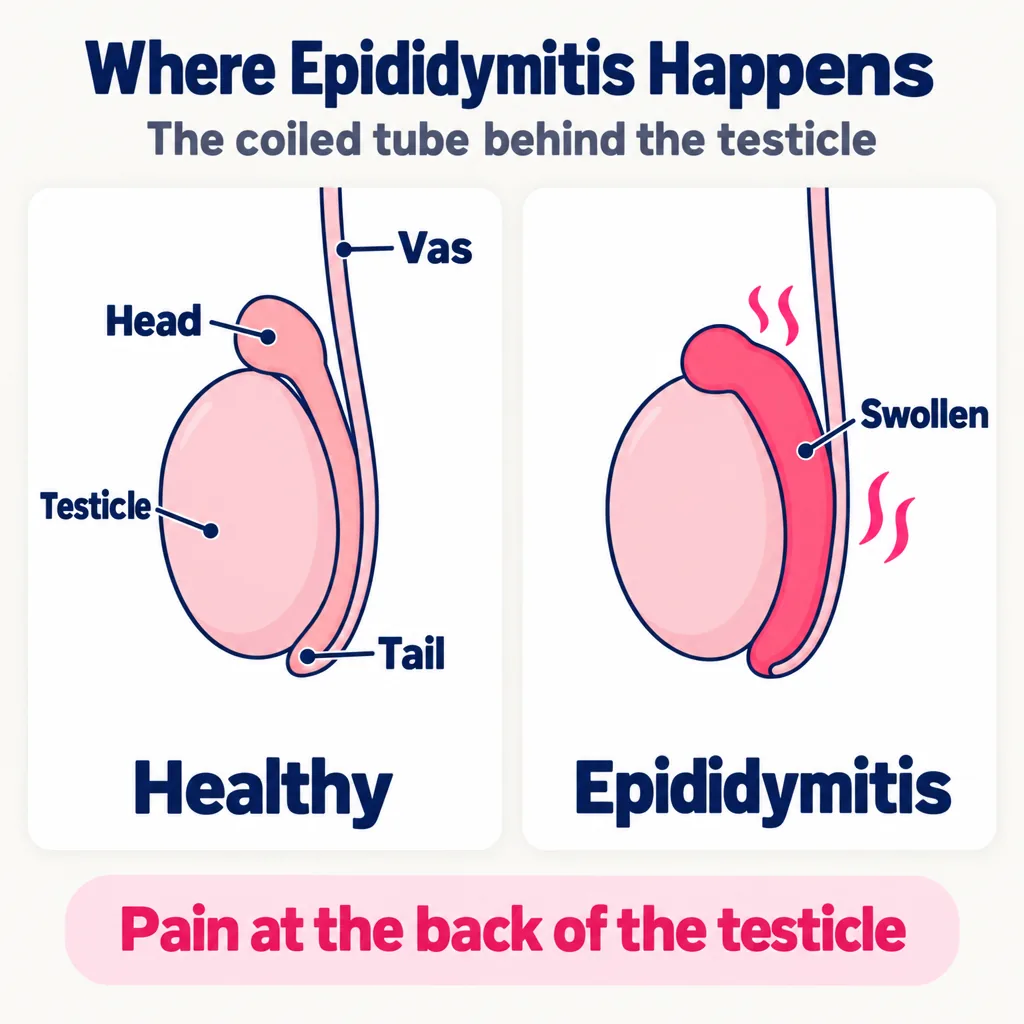
Because sperm pass through it, the epididymis must fight germs without attacking the sperm themselves. When that balance fails, inflammation and immune attacks on sperm can follow, at least in animal studies (Pleuger, 2026). That is the link to fertility, which I cover in detail further down.
Inflammation can affect any part of the tube. In Pilatz’s German scan study of 134 men, it sat in the head in 18%, the tail in 39% and both in 43% (Pilatz, 2013).
Epididymitis, orchitis and epididymo-orchitis: what is the difference?
Epididymitis is the tube alone; orchitis is the testicle; epididymo-orchitis is both. The two usually go together, and epididymitis on its own is more common than orchitis on its own (Walker, 2013). In the same German study, almost half the men (47%) already had orchitis on their first scan (Pilatz, 2013).
Epididymitis, orchitis and epididymo-orchitis: what each word means
| Term | What is inflamed | Usual cause |
|---|---|---|
| Epididymitis | The epididymis, the coiled tube behind the testicle | Bacteria: STDs or urine germs |
| Epididymo-orchitis | Both the epididymis and the testicle | Same bacteria, spreading into the testicle |
| Orchitis | Only the testicle | Mostly viruses, such as mumps (Ludwig, 2008) |
| Acute | Symptoms for less than 6 weeks | Usually an infection (Walker, 2013) |
| Chronic | Pain for 3 months or more | Often no germ is found (Nickel, 2002) |
Acute epididymitis lasts less than 6 weeks. Some guides add a sub-acute stage between 6 weeks and 3 months, and specialists call it chronic at 3 months (Walker, 2013; Nickel, 2002); repeated attacks are treated as chronic too. Chronic epididymitis has its own section below, because it behaves very differently.
How common is epididymitis?
With about 400 cases a year in every 100,000 men, acute epididymitis is the most common urogenital infection in men, and it occurs at every age (Pilatz, 2016). A European guideline quotes 2.45 cases per 1,000 men in the United Kingdom (Street, 2017).
How do you say it? Ep-i-did-i-MY-tis. The organ is the epididymis (ep-i-DID-i-mis).
What are the symptoms of epididymitis?
The main symptom is pain and swelling at the back of one testicle, building over a day or two. Fever is common; burning urine or a discharge is often absent.
Typically, the pain starts gradually at the back of the scrotum and may come with burning or frequent urination (McConaghy, 2016). On examination, the epididymis is swollen and tender, while the testicle sits in its normal position.
Share of 70 men aged 18 to 70 with each finding, tertiary care hospital, India.
Source: Nagula, 2026
In that Indian study, every man had pain and tenderness, most had fever and swelling, and about one in three had a reactive hydrocele, which is fluid around the testicle (Nagula, 2026).
Symptoms checklist
- Pain at the back of the testicle, usually one side, building over hours to a couple of days.
- Swelling, warmth or redness of that side of the scrotum; a heavy, dragging feeling.
- Burning or frequent urination, or a discharge from the penis (more likely with an STD).
- Fever and chills, especially with a bacterial infection.
- Pain on ejaculation, blood in the semen, or occasionally blood in the urine.
- Fluid around the testicle (hydrocele), which makes the whole side look bigger.
No burning or discharge? It can still be an STD
Here is the trap. Bacteria climbing up from the urethra cause most cases, yet only one man in three reports burning or other signs of urethritis (Pilatz, 2016). “I have no discharge” does not rule out an STD.
Blood in the semen with epididymitis
In a German study of 324 sexually active men with epididymitis, 15% noticed blood in their semen, appearing a median of 24 hours before the scrotal pain. Reassuringly, none of 56 men with blood in the semen alone went on to develop epididymitis (Dittmar, 2024). Read more on blood in the semen.
What does epididymitis pain feel like?
Most men describe a deep, dragging ache at the back of the testicle that can spread to the groin or lower belly. It is often worse when walking, sitting for long, lifting, straining on the toilet or ejaculating, and supporting the scrotum usually eases it.
That is quite different from blue balls (epididymal hypertension), the dull ache of prolonged arousal without ejaculation, which settles within hours and causes no fever or swelling. For other causes of a swollen scrotum, such as a hydrocele, varicocele or hernia, see what swelling in the testicles indicates. A painless lump is different again; see my guide to a lump on the testicle.
Is it torsion or epididymitis?
Torsion is a twisted testicle that cuts off its own blood supply. It usually starts suddenly and severely, and it needs surgery within hours. Epididymitis usually builds over a day or two.
If you are not sure which you have, treat it as torsion: call 97907 83856 now. I examine you straight away, and if torsion is likely I send you immediately to a general surgeon to untwist and fix the testicle.
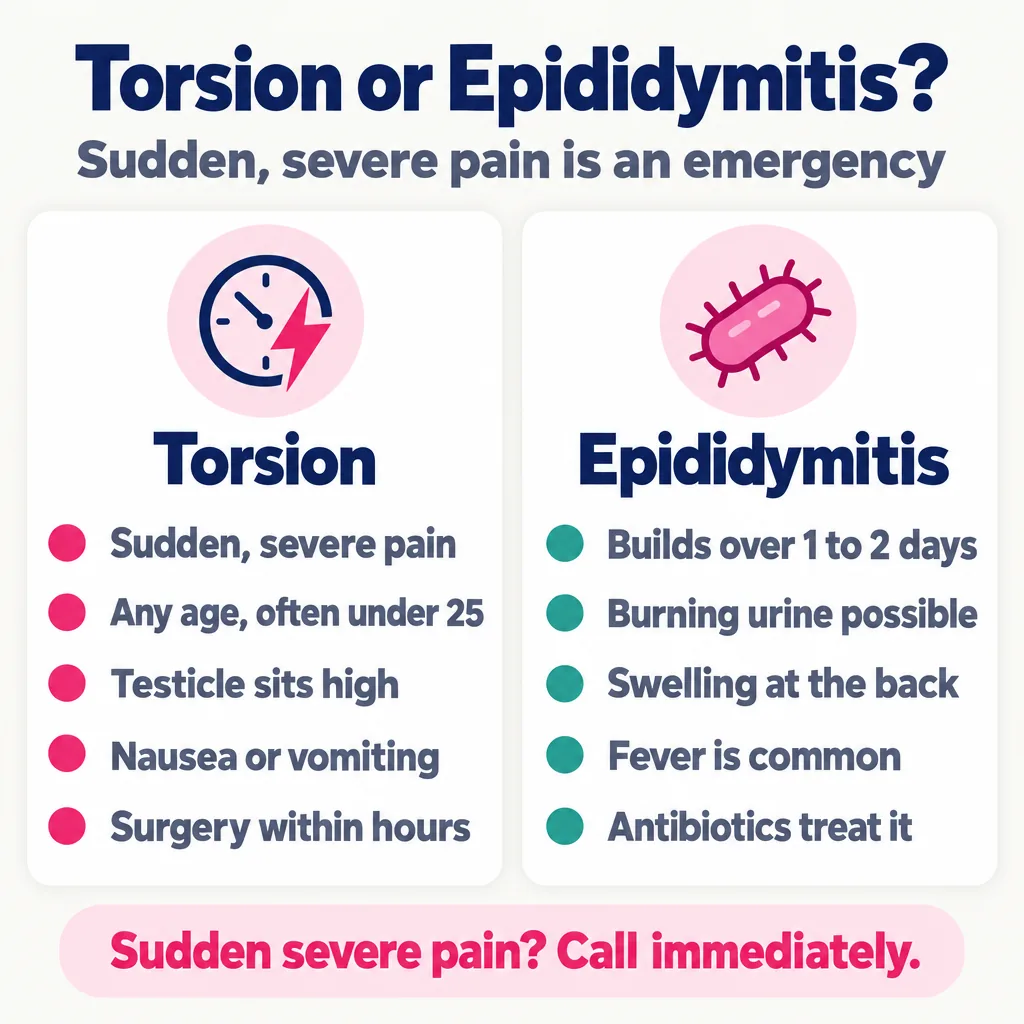
Time decides the outcome. In one series, the testicle was saved in 8 of 9 patients operated within 12 hours, but in only 2 of 15 operated later (Nishimura, 1996). Ideally surgery happens within six hours of reaching hospital, when about 90% of testicles are saved (Langan, 2022).
Confirmed torsion of the spermatic cord: 8 of 9 saved within 12 hours, 2 of 15 after. Every hour counts.
8 of 9
2 of 15
Source: Nishimura, 1996
In a French study of 1,266 torsions, the median time from pain to surgery was 5.5 hours when the testicle was saved, against 51 hours when it was removed. The risk of losing it rose after 6.5 hours (Seizilles, 2023).
Adults get torsion too
Torsion is classically a problem of boys and young men, affecting about 1 in 4,000 males under 25 (Hodoniczki, 2026). But adults are not immune: a 54-year-old treated first for epididymitis was found to have a twisted testicle and lost it (Zais, 2026).
Adults also tend to reach surgery later than children (Zhao, 2024), so an adult with sudden pain needs the same urgency as a young man. For other causes of an aching testicle, see why your testicles hurt.
Torsion or epididymitis: the differences a doctor checks
| Feature | Testicular torsion | Epididymitis |
|---|---|---|
| Onset | Sudden, often severe, may wake you | Gradual, over a day or two (McConaghy, 2016) |
| Usual age | Any age; most often under 25 (Hodoniczki, 2026) | Any age; in older men, often a urinary problem (Eickhoff, 1999) |
| Nausea or vomiting | Common* | Uncommon |
| Burning urine or discharge | Usually absent* | Sometimes present |
| Urine test | Usually normal | Often pus cells (Nagula, 2026) |
| Fever | Less common, but possible | Common (Nagula, 2026) |
| Position of the testicle | High or lying sideways | Normal (Trojian, 2009) |
| Cremasteric reflex | Usually absent* | Usually present (Trojian, 2009) |
| Lifting the testicle (Prehn sign) | Unreliable | Unreliable (Nishimura, 1996) |
| Doppler ultrasound | Reduced flow, twisted cord | Increased flow (Vijayaraghavan, 2006) |
| What happens next | Surgery within hours | Tests and antibiotics |
*Data mainly from studies in children (Ciftci, 2004; Kadish, 1998).
Why lifting the testicle tells you nothing
Many websites say that if lifting the testicle eases the pain (a “positive Prehn sign”), it is epididymitis. Do not rely on it: in confirmed torsion, the Prehn sign was present in 37.5% (Nishimura, 1996). An absent cremasteric reflex, the small lift of the testicle when the inner thigh is stroked, is a far stronger clue to torsion (Kadish, 1998), but even a normal reflex has been seen in boys with torsion (Murphy, 2006).
A normal-looking Doppler scan does not always rule torsion out either. In an Indian study of 250 patients aged 10 to 70, ultrasound picked up only 62% of torsions (Vijayakumar, 2024). Experienced sonographers therefore also look for a twisted “whirlpool” cord, which is the most reliable sign (Vijayaraghavan, 2006).
The TWIST score
TWIST is a doctor’s tool, not a home test: hardness and reflexes cannot be judged on yourself. It adds points for swelling (2), a hard testicle (2), an absent cremasteric reflex (1), a high-riding testicle (1) and nausea or vomiting (1). In adults examined by general surgeons, a score of 2 or less meant no torsion in any patient, and 6 or more meant torsion in every patient (Barbosa, 2021).
The TWIST score in 68 adults, half of whom had torsion (3 to 4 and 5 rows calculated from the published cut-offs)
| TWIST score | Men | Torsion confirmed |
|---|---|---|
| 0 to 2 | 23 | None |
| 3 to 4 | 15 | 7 (47%) |
| 5 | 12 | 9 (75%) |
| 6 or 7 | 18 | All 18 |
If the pain was sudden, do not score yourself and wait. Call 97907 83856.
What causes epididymitis?
Bacteria cause most epididymitis. In young, sexually active men they are often sexually transmitted (chlamydia, gonorrhoea, Mycoplasma genitalium); in older men they are usually urine germs such as E. coli. Less often the cause is TB, brucellosis, a virus, a medicine or an injury.
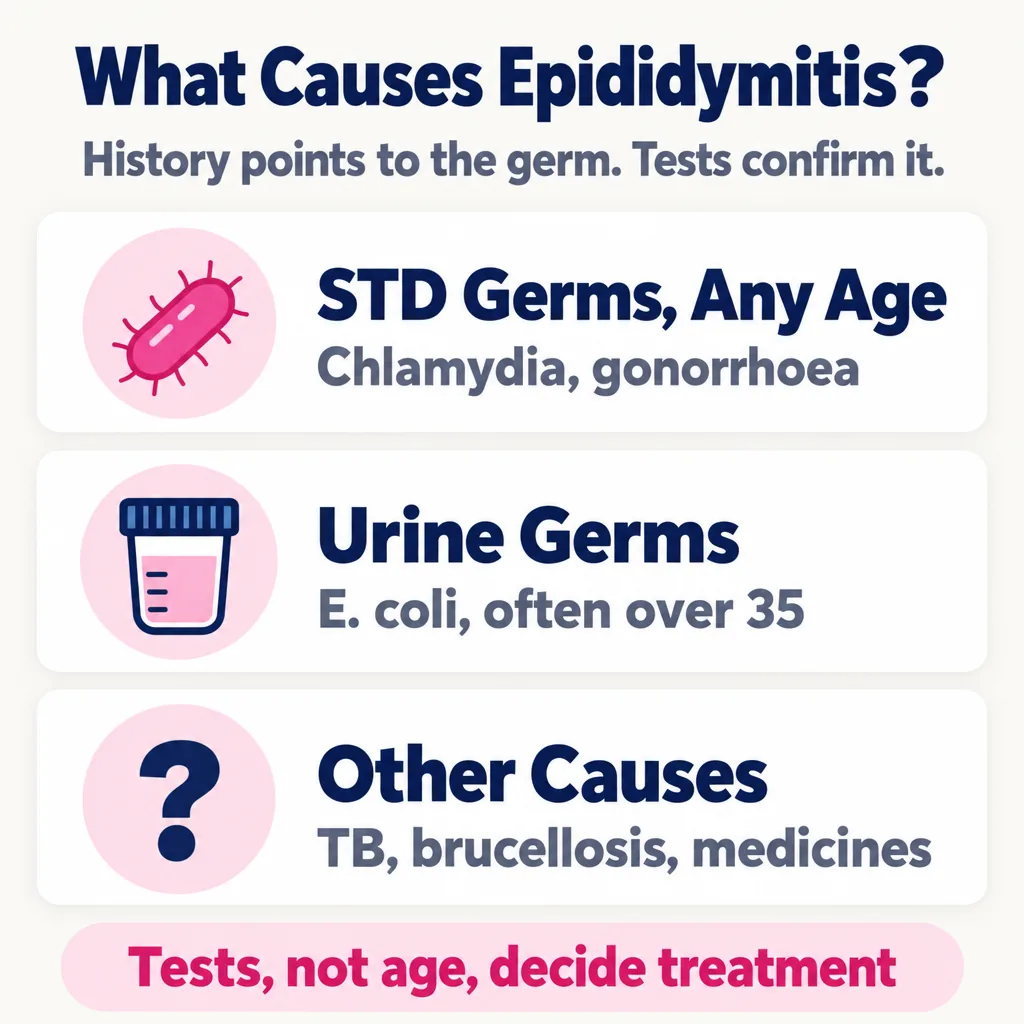
Your history points to the likely germ, and tests at my confidential STD clinic confirm it. When Pilatz’s team in Germany tested 237 men thoroughly, they found a germ in 88% of those who had not yet taken antibiotics.
E. coli was the commonest (56%). Sexually transmitted infections were found in 14%, mostly chlamydia, and they were “not limited to patients aged under 35” (Pilatz, 2015).
The age rule, and why it is only a starting point
Textbooks teach a simple split. Chlamydia and gonorrhoea are the commonest germs in sexually active men aged 14 to 35, and bowel bacteria such as E. coli take over after 35, often because of a prostate or bladder blockage (McConaghy, 2016).
Share of men with acute epididymitis in whom a sexually transmitted infection was found, by study. Methods and age groups differ, so compare with care.
Source: Ito, 2012; Pilatz, 2015; Sivaraj, 2021; Abolghasemi, 2021; Matsumoto, 2026
The rule is a useful start, but only a start. In London, 5 of the 14 STD cases were in men over 35 (Sivaraj, 2021), and a European guideline advises antibiotics that also cover chlamydia for sexually active men over 35 (Street, 2017).
The European guideline chooses treatment by your sexual and urinary history (Justice, 2026). So I test every sexually active man for STDs, whatever his age; a man with no sexual risk gets a urine culture.
One gap is worth stating plainly: I could not find an Indian study that tested men with epididymitis for STDs using DNA tests; the Indian figures I found come from urine cultures (Nagula, 2026).
Urine germs, the prostate and catheters
In men over 35, epididymitis is often linked to a bladder outlet problem such as an enlarged prostate or a urethral stricture, which lets infected urine flow back down the sperm ducts (Ryan, 2018). A urinary catheter carries a high risk of drug-resistant germs (Pilatz, 2016). Men who have insertive anal sex can pick up bowel bacteria through the urethra as well (McConaghy, 2016).
In the Indian study, the background factors were urinary infection (31%), urinary obstruction or a recent procedure (24%), diabetes (23%) and injury (21%) (Nagula, 2026).
Chemical epididymitis
Sometimes urine itself, without germs, is pushed back down the ducts and irritates the epididymis. In adults, sterile reflux is suspected with straining on a full bladder or a blockage to urine flow, though a blockage more often carries bacteria with it (McConaghy, 2016).
How do chlamydia and gonorrhoea cause epididymitis?
The germ first infects the urethra, often silently, and then climbs up the vas deferens to the epididymis. That is why an untreated STD, even one that gave you no symptoms, can turn into a painful, swollen testicle weeks later.
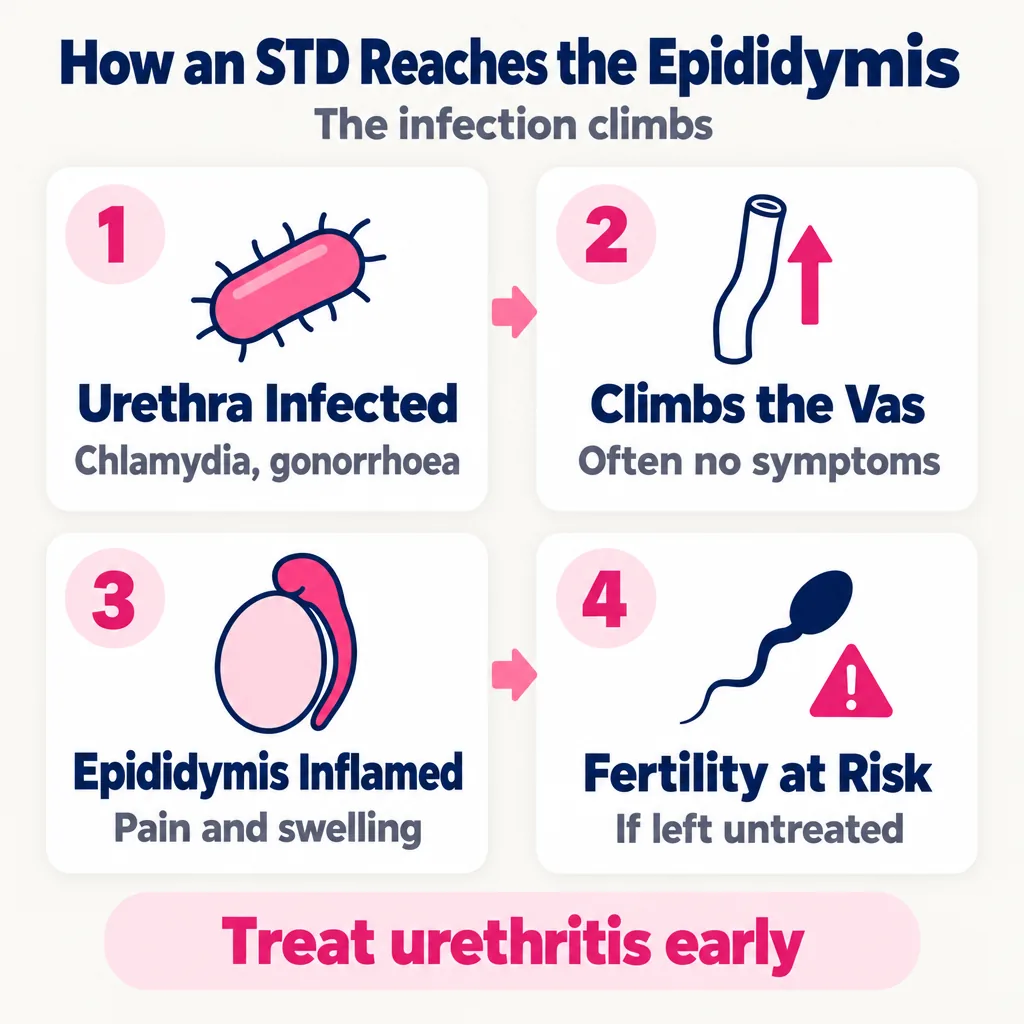
Germs in the urethra can either stay there and cause urethritis, or spread upwards to cause epididymitis (Wong, 1983). Chlamydia is the most commonly diagnosed bacterial STD worldwide, and in men it can cause epididymitis (Hocking, 2023). Read my full guide to chlamydia treatment.
Men under 40 with acute epididymitis, Japan (n=56). A man could carry more than one germ, so the bars do not add up to 100%.
Source: Ito, 2012
In young Japanese men, chlamydia was found in half of all cases (Ito, 2012). Gonorrhoea is a well-known cause too: in an Australian hospital network, 13 of the 48 men treated for gonorrhoea presented with epididymo-orchitis (Loo, 2019).
NGU, Mycoplasma genitalium and trichomonas
When urethritis is not caused by gonorrhoea, we call it non-gonococcal urethritis, or NGU. Mycoplasma genitalium causes 10 to 35% of NGU that is not chlamydia, infection without symptoms is frequent, and the European guideline names epididymitis as one of its complications (Jensen, 2022). See my page on urethritis (NGU) in men.
M. genitalium matters because it is hard to treat. Resistance to the usual macrolide antibiotics now reaches 30 to 50% in Europe and the Americas and over 60% in Asia (Llaca-Díaz, 2026). If the first tests are negative, or treatment is not working, ask for an M. genitalium test.
Trichomonas is a rare cause; a London clinic saw one case among 127 men (Sivaraj, 2021). Read more on trichomoniasis in men.
Why the STD behind epididymitis is so often missed
Many men with epididymitis are never tested for an STD. In a study of more than 23 million US episodes, 15% or fewer men diagnosed with orchitis or epididymitis received a chlamydia or gonorrhoea test (Lillis, 2023).
Treatment choices can miss the STD too. In a UK survey of 79 urologists, 71% used a quinolone first, mainly ciprofloxacin, which is not the best antibiotic for chlamydia (Drury, 2004). A man can feel better for a while and still carry the infection, and pass it on.
For this reason my protocol tests first: a urine NAAT (a DNA test on first-pass urine) and a urethral swab for chlamydia and gonorrhoea. Guidelines also advise HIV and syphilis tests at the same visit (Workowski, 2021). If you are unsure what you were exposed to, start with my guide to STD symptoms in men.
Can you get epididymitis without an STD?
Yes. Urine germs, especially E. coli, are the commonest cause overall, and they are not sexually transmitted. Medicines, injury, TB, brucellosis and viruses can also cause it.
In the Japanese multicentre study, the median age was 67 and E. coli was the most frequent germ; 45% of those E. coli were resistant to fluoroquinolones and 25% were ESBL producers, a type that resists many antibiotics (Matsumoto, 2026). Only two of 110 men had chlamydia, and none had gonorrhoea. In older men, prostate infection and epididymitis often travel together.
Medicines: amiodarone
Amiodarone, a heart-rhythm drug, can cause sterile (germ-free) epididymitis in up to 11% of adults who take it (Hutcheson, 1998). It has been reported after 4 to 71 months, at doses of 200 to 800 mg a day, and usually settles without antibiotics (Sadek, 1993). It has appeared even at 100 mg a day (Cicek, 2014), and in reported cases it has settled once the drug was reduced or stopped (Lyon, 2024).
Never stop a heart medicine yourself; the dose is changed only with your cardiologist.
Injury and immune causes
A blow to the groin can inflame the epididymis; injury was a background factor in 21% of the Indian series (Nagula, 2026). Rarely, an inflammatory disease is the cause. One man’s “antibiotic-resistant” epididymitis turned out to be Behçet’s disease and settled with colchicine (Fukuda, 2025).
“How did my boyfriend get epididymitis?”
It depends on the cause, and only a test can tell. In a young man, an STD from a current or past partner is a common cause, and it may have been silent for weeks or months.
A urine germ, an injury or a medicine are possible too. Epididymitis itself is not contagious, but an STD behind it is, so both partners are tested.
TB, brucellosis and mumps: the causes Indian men must know
In India, epididymitis that does not settle with antibiotics should make a doctor think of tuberculosis. Brucellosis, from animals and raw milk, and mumps are two more causes that Western guides barely mention.
Tuberculous epididymitis
Genitourinary TB is the second most common form of TB outside the lungs, and genital organs alone are involved in 5 to 30% of cases. The epididymis is the genital organ most often affected, and the standard treatment is a 6-month course of anti-TB drugs (Yadav, 2017). Testicular TB almost always starts in the epididymis (Ramachandran, 2021).
TB is the leading cause of long-standing, lumpy (granulomatous) epididymo-orchitis in Asia (Handa, 2018). In two needle-sampling series, TB explained 23% and 31% of lumps in the epididymis (Bharti, 2017; Mondal, 2020).
Signs that point to TB rather than an ordinary infection:
- Swelling that does not settle after a proper course of antibiotics (Lamghari, 2026).
- A firm, painless or only mildly tender lump, often in the tail of the epididymis.
- A thickened, beaded vas, the cord above the testicle.
- Both sides affected; bilateral disease raises the suspicion of TB (Bala, 2026).
- Pus cells in the urine with no germs grown, called sterile pyuria (Jacob, 2008).
- A discharging sinus in the scrotal skin, past TB, or contact with someone who has TB.
TB is confirmed by testing early-morning urine for TB (including a rapid DNA test), the scan, and sometimes a fine-needle sample from the lump. Delay matters: untreated genital TB can lead to infertility and scrotal sinuses (Ramachandran, 2021), and infertility can persist even after successful treatment (Yadav, 2017). Case reports describe TB epididymo-orchitis mistaken for testicular cancer and treated by removing the testicle (Jacob, 2008; Balabhaskar, 2025).
Brucellosis: animals and raw milk
Brucellosis spreads from infected farm animals, such as goats, and through unpasteurised milk and dairy (Yahiaoui, 2024). In a Saudi urology clinic it caused 31% of epididymo-orchitis cases, and every patient had animal contact or had taken raw dairy (Ayed, 2025). It is easily missed in India; a recent report from a tertiary hospital in Madurai found epididymo-orchitis among its culture-confirmed cases (M JF, 2026).
In a Spanish series, 7.6% of men with brucellosis developed epididymo-orchitis; other series report anywhere from 1.6% to 18% of all patients, women included (Mazor, 2025; Yahiaoui, 2024). It is easy to miss: in the Spanish series every man had fever, swelling and pain, but only 4% had urinary symptoms, and the urine test was normal in 69% (Colmenero, 2007). So if you have a fever that comes and goes, joint pains and a swollen testicle, tell me about any animal or raw-milk contact.
Mumps and viral orchitis
Mumps attacks the testicle itself. After puberty, between about 5% and 40% of males with mumps develop orchitis, usually 4 to 11 days after the cheek swelling, and occasionally with no cheek swelling at all (Erpenbach, 1991; Philip, 2006). Both sides are involved in 16 to 65% of these.
Mumps orchitis can shrink the testicle: in one long-term study, 47 of 132 men had an atrophic testicle afterwards (Beard, 1977). MMR vaccination greatly reduces the risk (Philip, 2006), and the recent rise in mumps orchitis has been linked to missed MMR doses (Davis, 2010). India’s free government schedule gives MR (measles and rubella), which does not cover mumps, so check whether you or your son had MMR privately, and ask about a catch-up dose if not.
Other viruses, such as Coxsackie, chickenpox and glandular fever, can also cause orchitis. In a German study of 26 men with orchitis alone, 20 (77%) had a viral cause, mostly Coxsackie B, and 6 of 20 were left with a low sperm count (Pilatz, 2023). Viruses cause only about 1% of epididymitis itself (Pilatz, 2015).
How is epididymitis diagnosed?
By examination, a scrotal Doppler ultrasound, and urine and urethral tests for the germ. The scan rules out torsion and shows complications; the tests decide which antibiotic you need.
Laboratory tests, including a urethral Gram stain, urinalysis and culture, and a DNA (PCR) test for chlamydia and gonorrhoea, guide the treatment (Trojian, 2009). Doppler ultrasound of the scrotum is the usual first scan for sudden scrotal pain, because a delay of as little as six hours can permanently damage a twisted testicle (Wang, 2019).
The order matters: rule out torsion first, then find the germ before antibiotics change the result.
1
2
3
4
5
Source: Trojian, 2009; Wang, 2019; Pilatz, 2015
Test before the first antibiotic
This is the step most often skipped. In Pilatz’s German study, a germ was found in 88% of men tested before any antibiotic, but in only 51% of men who had already taken some (Pilatz, 2015). Swallow a medical-shop antibiotic first and the test may come back blank, leaving the real cause hidden.
The urine NAAT is a DNA test on the first part of the urine stream. NAATs are 86 to 100% sensitive for gonorrhoea, chlamydia, M. genitalium and trichomonas (Tuddenham, 2022). Signs of urethritis on a urine or swab test include a positive leukocyte esterase dipstick, or 10 or more white cells per high-power field (Brill, 2010).
The scrotal Doppler ultrasound
Prospective study, Germany. The 3-month figure is based on the 90 men re-scanned.
Source: Pilatz, 2013
In the Indian study of 250 patients with acute scrotal pain, ultrasound was 97% sensitive and 96% specific for inflammation such as epididymo-orchitis (Vijayakumar, 2024).
When the diagnosis is clearly epididymitis, the scan rarely changes the antibiotics; it earns its place by ruling out torsion and spotting an abscess.
How to read your ultrasound report
- “Bulky, hyperaemic epididymis”: the tube is swollen with extra blood flow. This is epididymitis.
- “Increased testicular vascularity” or “bulky testis”: the testicle is inflamed too, so it is epididymo-orchitis.
- “Reactive hydrocele”: fluid around the testicle from the inflammation. It usually settles with treatment.
- “Collection” or “abscess”: pus has formed. Call me the same day; it needs closer follow-up and sometimes drainage.
- “Reduced or absent flow” or “whirlpool sign”: suspect torsion. Call 97907 83856 immediately.
Blood tests
Blood tests support the picture but do not make the diagnosis. Epididymo-orchitis tends to start slowly, with a CRP above 24 mg/L and increased blood flow on the scan (Crawford, 2014). Guidelines also advise an HIV test and a syphilis test for any man with a possible STD.
What kind of doctor treats epididymitis?
An andrologist or urologist, or a sexual health (STD) doctor. An andrologist adds one thing that matters here: your fertility follow-up after the infection is cured.

Private 1-on-1 consultation
Aching or swollen testicle? Get it checked properly.
A private examination in T Nagar, Chennai, to rule out torsion, find the germ with the right tests, start the right antibiotics, treat your partner in confidence, and check your fertility once you have recovered.
Book a Confidential Consultation
How is epididymitis treated?
With antibiotics chosen for the likely germ, taken as a full course, plus scrotal support and pain relief. Most men feel clearly better within a few days. Your partner needs treatment too if an STD is possible.
For sexually active men aged 14 to 35, a single ceftriaxone injection with 10 days of oral doxycycline is the treatment of choice; for men over 35 without STD risk, levofloxacin or ofloxacin alone is enough (McConaghy, 2016). The 2024 European guideline chooses between these by your history rather than your age (Justice, 2026).
Guideline antibiotic plans by likely cause (what I may prescribe after examining you)
| Likely cause | Guideline plan |
|---|---|
| Sexually transmitted (chlamydia or gonorrhoea likely) | One ceftriaxone injection plus 10 days of doxycycline (McConaghy, 2016; Justice, 2026) |
| STD and bowel germs (for example, insertive anal sex) | Ceftriaxone injection plus levofloxacin or ofloxacin (McConaghy, 2016; Justice, 2026) |
| Urine or bowel germs, no STD risk | Levofloxacin or ofloxacin, usually for 10 days (Justice, 2026); co-trimoxazole only if the culture shows the germ is sensitive (Forestier, 2026) |
| Urinary catheter in place | A fluoroquinolone plus a third-generation cephalosporin until culture results (Pilatz, 2016) |
| Mycoplasma genitalium | Moxifloxacin for 14 days (Jensen, 2022) |
| Tuberculosis | Anti-TB drugs for 6 months (Yadav, 2017) |
| Brucellosis | Doxycycline for about 2 months with a second drug (Colmenero, 2007) |
| Mumps or another virus | No antibiotic; rest, support and pain relief (Pilatz, 2023) |
| Allergy to ceftriaxone or penicillin | A different plan chosen after examination; mention any allergy first |
My protocol
If you are sexually active, whatever your age, I test you for STDs with a urine NAAT and a urethral swab, then give a ceftriaxone injection and doxycycline for 10 days. If you have no sexual risk, I send a urine culture and treat with levofloxacin or ofloxacin, adjusting to the culture. The ceftriaxone injection I give is 1 g.
Alongside this come scrotal support, pain relief and ice for comfort, a Doppler scan to rule out torsion, and a semen analysis once you have recovered. Whether and how your partner is tested and treated depends on what you are comfortable with, and your confidentiality is maintained throughout.
The ceftriaxone dose has changed
Gonorrhoea has developed resistance to every antibiotic once used as first-line treatment (Barbee, 2022), so the ceftriaxone dose has gone up. The US now uses a single 500 mg injection, or 1 g for men weighing 150 kg or more (St Cyr, 2020; Yonke, 2022). Both the UK and the 2024 European guideline use 1 g for sexually acquired epididymo-orchitis (Chirwa, 2021; Justice, 2026), and 1 g is the dose I use.
The old 250 mg dose is out of date everywhere. Read more on gonorrhoea treatment.
Why doxycycline, and not a single azithromycin dose?
In men, azithromycin fails to clear chlamydia more often than doxycycline (risk ratio 2.45) (Páez-Canro, 2019). A meta-analysis found doxycycline up to about 7% more effective for symptomatic urethral chlamydia in men (Kong, 2014), and the 2024 European guideline no longer recommends adding azithromycin (Justice, 2026).
Will 7 days of doxycycline cure epididymitis?
For epididymitis, the course is 10 days (McConaghy, 2016). The 7-day course you may read about is for uncomplicated chlamydia given alongside gonorrhoea treatment (St Cyr, 2020), not for an infected epididymis. Take all 10 days, even when you feel better, and call me if the pain is not easing after 2 to 3 days.
Fluoroquinolones: effective, with caveats
For men who have not yet taken antibiotics, the guideline drugs still work: in Pilatz’s study, more than 85% of germs were sensitive to fluoroquinolones and third-generation cephalosporins (Pilatz, 2015). In men already pre-treated, those figures fell to 42% and 67%.
Resistance is rising, though. In Japan, 45% of E. coli from epididymitis resisted fluoroquinolones (Matsumoto, 2026).
In urinary infections across 13 countries, including the Indian subcontinent, fewer than 60% of E. coli were sensitive to fluoroquinolones or co-trimoxazole at most centres (Rizvi, 2025). That is why a urine culture is sent before treatment.
Two more cautions. Ciprofloxacin from the medical shop is a poor choice for chlamydia (Drury, 2004). And fluoroquinolones occasionally cause nerve pain; one young man developed severe neuropathy on day two of levofloxacin for epididymitis (Estofan, 2018).
- Swallow doxycycline with a full glass of water, sitting up, and do not lie down for 30 minutes.
- Doxycycline makes skin burn easily in the sun; cover up outdoors.
- Keep antacids, iron, calcium and zinc tablets at least 2 hours away from either antibiotic.
- On levofloxacin or ofloxacin, report tendon pain, tingling or burning at once (especially over 60 or on steroids), and check your sugars closely if you are diabetic. Tell me first if you have reacted to this group before or have an aortic aneurysm.
Pain relief and support
Epididymitis is treated with antibiotics, painkillers and scrotal support (Langan, 2022). A painkiller such as ibuprofen or paracetamol helps. Ask me first if you have kidney disease, a stomach ulcer, asthma or heart disease, take a blood thinner, or have ever had fits: some anti-inflammatory painkillers and the levofloxacin/ofloxacin group can together make a seizure more likely.
Men in severe pain or unwell with fever may need antibiotics through a drip (Walker, 2013).
What about Ayurveda or homeopathy?
An acute bacterial infection of the epididymis needs antibiotics. Delay risks an abscess, a damaged testicle and a blocked sperm duct. If you want to use a traditional remedy for comfort, tell me, but never instead of the antibiotic course.
Recovery: how long does epididymitis last?
With the right antibiotics, pain usually eases within about three days and most men are close to normal by four to six weeks. A little firmness of the epididymis can last longer.
In the Indian study, conservative treatment worked in 97% of men, pain fell significantly within 84 hours, and recovery was near-complete by four to six weeks (Nagula, 2026). In Pilatz’s scan study, 16 of 90 men re-scanned still had some epididymal swelling at three months (Pilatz, 2013).
Typical course with the right antibiotics. Your own timeline may differ.
Source: Nagula, 2026; Yonke, 2022
Home care that helps
- Support: wear snug briefs or an athletic supporter, day and night for the first few days.
- Rest and raise: lie down with a folded towel under the scrotum. Avoid heavy lifting, the gym and cycling until the pain has gone.
- Cold for comfort: a cold pack wrapped in a cloth, for 10 to 15 minutes at a time, can ease the pain in the first few days. Once the swelling settles, a warm bath can ease the ache. Neither cures the infection.
- Painkillers as advised, and plenty of fluids.
- No sex until you and your partner have finished treatment and your symptoms have settled.
- Every dose: finish the whole antibiotic course.
How to get rid of epididymitis fast
The fastest route is the right antibiotic on day one, chosen after a test. A few days of a medical-shop antibiotic before testing can hide the germ (Pilatz, 2015), so the right treatment starts later.
Is ejaculating bad for epididymitis?
Yes, during the acute phase: ejaculation is often painful, and sex can pass an STD to your partner, so avoid it until treatment is finished. Once you have recovered, ejaculation is safe.
Will epididymitis go away on its own?
A bacterial infection should not be left to “go away”. Untreated acute epididymitis can lead to infertility and chronic scrotal pain (McConaghy, 2016).
The exceptions are viral orchitis and drug-related epididymitis, which usually settle without antibiotics once correctly identified. After any bacterial attack, a semen analysis about three months later shows whether the sperm have recovered.
Your partner: testing, treatment and when sex can resume
If an STD is possible, your sexual partners from the 60 days before your symptoms need testing and treatment, even if they feel well. Avoid sex until both of you have finished treatment and your symptoms have gone; this is the US CDC guideline advice (Workowski, 2021).
This step is not optional. Not treating the partner at the same time is the most important cause of treatment failure in NGU (Ellis, 1981). Treat only yourself, and you can be reinfected within weeks.
Partners are often infected. In ten US STD clinics, 35% of people who came in as sexual contacts of someone with chlamydia had chlamydia themselves, and 31% of contacts of gonorrhoea had gonorrhoea (Llata, 2025). A woman with an untreated infection risks pelvic inflammatory disease, which can affect her own fertility.
Partner rules that prevent reinfection
- Test and treat partners from the last 60 days, or your last partner if it was longer ago.
- No sex until you have both finished treatment and your symptoms have settled (Workowski, 2021).
- If your partner is a woman who is pregnant or could be, tell me: she needs a different antibiotic and her own follow-up.
- Retest for chlamydia and gonorrhoea about three months later, because reinfection is common (Yonke, 2022).
- Use condoms with any new or casual partner. They reduce the risk of the STDs that can cause epididymitis (Tuddenham, 2022).
Where a partner cannot attend, some guidelines allow expedited partner therapy, in which treatment is given to the patient for the partner (Brill, 2010). How your partner is tested and treated is decided at your pace and comfort, and everything stays confidential. If the condom broke recently, read what to do after a condom breaks.
Can epididymitis cause infertility?
Yes, it can, but most men’s sperm counts improve after prompt treatment. In the older hospital series that reviews quote, about 10% of men had no sperm afterwards and 30% a low count (Schuppe, 2017); the risk is thought to be higher when both sides are affected or treatment is delayed. A semen test about three months after cure tells you which group you are in.
This is the question men worry about most, and the one most websites answer in a single vague line. So here is the full picture, with the numbers.
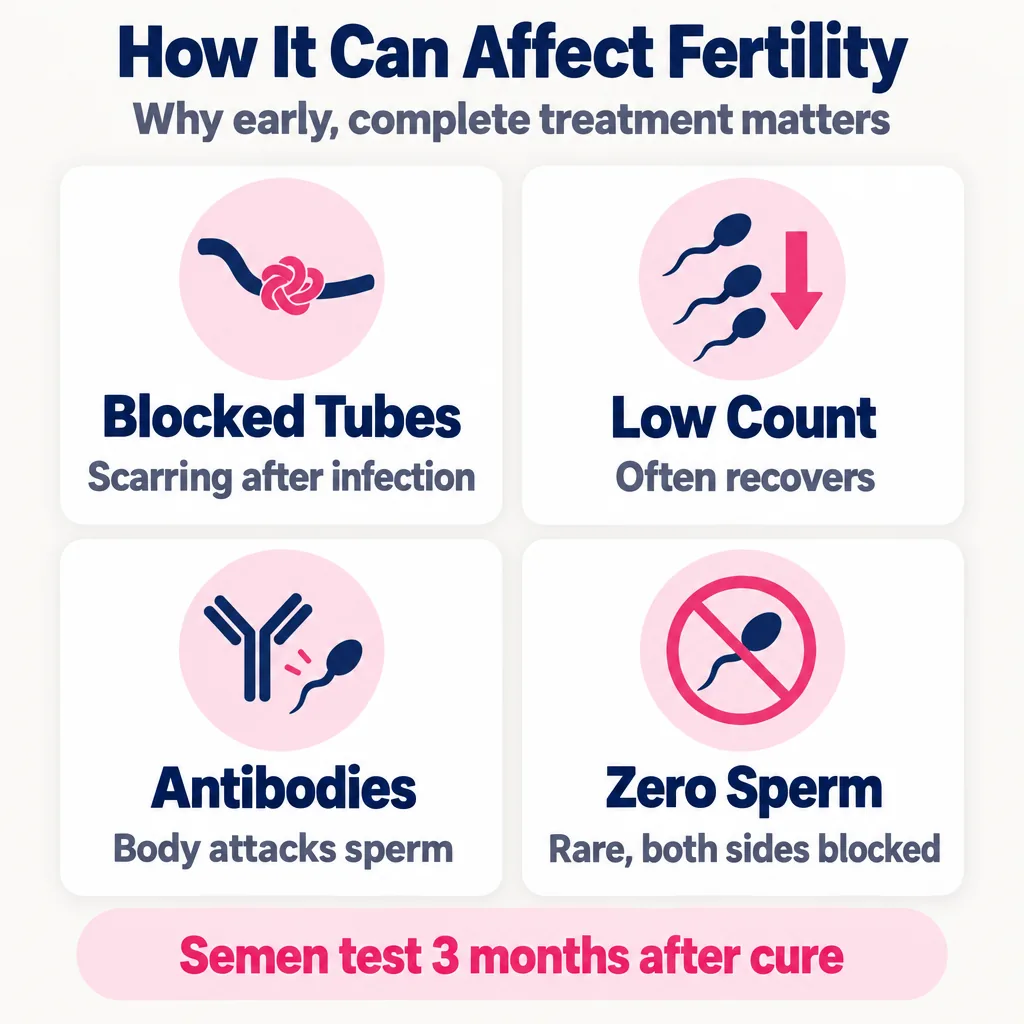
A German review estimates that some degree of reduced fertility, usually mild, follows in up to 4 in 10 hospital patients (Pilatz, 2016). Semen quality usually dips during the infection and can stay below par even after cure (Rusz, 2012), which is why I check it at three months.
1. Blocked sperm ducts
Inflammation can scar the narrow epididymal tube and block it. Blockage of the sperm ducts is one of the two main routes to infertility after epididymitis (Schuppe, 2017).
A man with both sides blocked has normal sperm production but no sperm in his semen. Read more on azoospermia (no sperm in semen).
2. Damaged sperm and lower counts
Fourteen days into epididymitis, semen showed more white cells and inflammatory markers and a lower sperm concentration than in men who had blood in the semen but no epididymitis (Dittmar, 2024). A 2026 meta-analysis linked genital tract infection with lower semen volume and lower sperm concentration (Campbell, 2026).
Most men’s counts improve. In 70 men with one-sided epididymitis, sperm counts and motility improved significantly by 6 and 12 weeks, and only a few were left with azoospermia or poor motility (Weidner, 1990). For what your numbers mean, see low sperm count.
Even “normal” may not be the whole story. Three months after epididymitis, eight men had normal semen analyses, yet 35 sperm proteins were reduced compared with controls (Pilatz, 2014).
3. Antisperm antibodies
The epididymis normally hides sperm from the immune system. Inflammation can break that barrier, and the body may then make antibodies against its own sperm. This antisperm-antibody infertility affects 2.6 to 6.6% of infertile men, and it mostly reduces sperm motility (Silva, 2021).
4. Zero sperm, and a damaged testicle
When both sides are blocked, or the testicle itself is badly inflamed, the semen can contain no sperm at all: about 1 in 10 men in the older series (Schuppe, 2017). Sperm production can suffer after orchitis; 6 of 20 men with viral orchitis were left with a low count (Pilatz, 2023). With adequate antibiotics, bacterial epididymo-orchitis showed no testicular shrinkage on follow-up scans (Pilatz, 2013).
TB and brucellosis: the silent fertility threats
Tuberculous infertility “may persist even after successful chemotherapy”, and assisted reproduction is usually needed when the ducts are blocked in several places (Yadav, 2017). In brucellosis affecting the testicle, 42% of men tested had a low count (Celik, 2023).
Does chlamydia or gonorrhoea itself cause infertility?
Mostly through the complications. A study of 430 men attending for infertility concluded that STDs “have less impact on semen quality except when complicated by orchitis, epididymitis and vasal obstruction” (Bayasgalan, 2004).
For chlamydia, the evidence is mixed: a meta-analysis of 55 studies found no difference in chlamydia rates between fertile and infertile men (Farahani, 2021). The fair summary is that an STD harms fertility mainly when it reaches the epididymis or testicle, which early testing and treatment prevent.
Your fertility plan after epididymitis
The semen test about three months after cure decides what, if anything, comes next.
1
2
3
4
Source: Weidner, 1990; Pilatz, 2014; Long, 2026; Lei, 2026
In my clinic, epididymitis usually comes with problems in the semen as well, such as a lower count, poorer motility or pus cells, so I repeat the semen test after recovery, usually at about three months. That timing has two reasons. Sperm counts were still improving at 12 weeks in the ofloxacin study (Weidner, 1990), and three months is when follow-up studies re-examined these men (Pilatz, 2013).
A sample taken during the infection mostly reflects the inflammation. Learn how to read the result in my guide to semen analysis interpretation.
Test sooner if you are trying for a child now, if both sides were affected, or if your partner has not conceived within a year. A varicocele is another treatable cause worth checking at the same visit.
If the ducts are blocked: what can be done
A blocked epididymis can often be bypassed by microsurgery, called vasoepididymostomy. In 197 men whose epididymal blockage was caused by infection, injury or an unknown cause (not vasectomy), the join stayed open in 80% of those checked. Among couples with an open join followed for an average of 56 months, 73% conceived naturally, some one to three years after surgery (Long, 2026).
If surgery is not suitable, sperm can be retrieved directly from the epididymis or testicle for ICSI. In 1,368 ICSI cycles for obstructive azoospermia, epididymal and testicular sperm gave similar pregnancy and live birth rates (Lei, 2026).
One caveat: antibiotics improve semen quality after a genital infection, but there is no evidence they increase the chance of natural conception on their own (Vives Suñé, 2026). The semen test, not the antibiotic, is the end point. For the bigger picture, see male infertility.
Complications of epididymitis
Most men recover without complications. The ones to watch for are an abscess, loss of blood supply to the testicle, a relapse, and long-term pain.
Abscess
An abscess was present at the first scan in 6% of men (Pilatz, 2013), and developed in 24 of 442 Chinese patients (Zhou, 2025). A German review reports that about 88% of epididymal abscesses settle without an operation (Pilatz, 2016). When they do not, the pus is drained, sometimes through a fine catheter under ultrasound (Alghamdi, 2026).
Testicular infarction
Rarely, the swollen epididymis squeezes the testicle’s blood vessels until the testicle dies. This happened in 4 of 134 adults in Pilatz’s scan study (Pilatz, 2013).
Warning signs of a poor response include sepsis, marked scrotal swelling, severe testicular pain and an inflamed scrotal wall (Rhudd, 2017). In that report, a repeat Doppler showed reversed blood flow before the testicle was lost. If you are getting worse instead of better, call 97907 83856 the same day.
Relapse
Only about one man in ten relapses, and those men should be checked for a blockage below the bladder, such as an enlarged prostate or stricture (Pilatz, 2016).
Does epididymitis cause testicular cancer?
There is no evidence that it does. A Taiwanese study found prior epididymo-orchitis far more often in men with testicular cancer (Kao, 2016), but a study like this cannot show cause, and part of the link is probably tumours first mistaken for inflammation.
The practical lesson: a lump that persists after treatment must be scanned again. Learn how to do a testicular self-exam.
Chronic epididymitis: when the pain does not go away
Chronic epididymitis means pain in the epididymis for 3 months or more. Often no germ is found, so more antibiotics rarely help. Pain control, physiotherapy and, in selected men, surgery do.
In a Canadian study of 50 men aged 21 to 83 (average 46), symptoms had lasted an average of 4.9 years, the average pain score was 4.7 out of 10, and only 16% were reasonably satisfied with their quality of life. Yet 74% had already had antibiotics (Nickel, 2002). The authors divided it into inflammatory, obstructive and pain-only (epididymalgia) types.
Epididymitis, mostly long-standing (average 2.5 years), was diagnosed in 0.9% of more than 6,000 men attending urology clinics (Nickel, 2005). It can also lower sperm count and motility (Haidl, 2008). When inflammation in the semen persists, pus cells in semen and a semen culture help decide whether a germ is still there.
What actually helps
Some guides suggest one long antibiotic course of 4 to 6 weeks when an infection is still suspected. If that has already failed, or no germ is ever found, repeating antibiotics does not help.
The American Urological Association calls for a multidisciplinary approach with supportive counselling, and notes that most options are “off-label” because good data are lacking (Lai, 2025). The usual first steps are anti-inflammatories, a nerve-pain medicine, warm baths and support.
Separate studies of different treatments and different men; not a head-to-head comparison.
Source: Kavoussi, 2021; Cole, 2024; Farrell, 2016
When removing the epididymis, the best results came in men with focal epididymal pain for under a year and no psychiatric history (Cole, 2024). Pelvic floor physiotherapy, in men whose pelvic floor muscles were tender on examination, improved pain in half and removed it completely in 13% (Farrell, 2016).
Pain after a vasectomy is a separate cause to consider. Post-vasectomy pain accounted for about one in five of the testicles operated on for chronic testicular pain (Kavoussi, 2021).
Why does my epididymitis keep coming back?
- The partner was not treated, so the STD returns (Ellis, 1981).
- The wrong antibiotic, one that does not cover the germ, often taken before any test.
- An underlying blockage, such as an enlarged prostate or stricture (Pilatz, 2016).
- An unusual germ: M. genitalium, TB or brucellosis.
- It is no longer an infection but chronic pain, which needs a different plan.
Can chronic epididymitis be cured?
Many men improve substantially, and some become pain-free. It is best managed by one doctor who looks for a treatable cause first, rather than by repeated antibiotic courses.
Epididymitis in men over 40
In older men, epididymitis usually signals a urinary problem, such as an enlarged prostate, that needs looking into.
Why it happens after 40
In a randomised trial in men over 40 with epididymitis, 41% had had a urinary infection before and 27% had had epididymitis before (Eickhoff, 1999). An enlarged prostate and urethral stricture are common underlying causes (Ryan, 2018), and prostatitis often sits alongside.
So in an older man the cause is looked for: a urine flow test, a scan of the bladder after passing urine, and a prostate check. Treating that cause is what stops the next attack.
When should you see a doctor?
Sudden, severe testicular pain needs a call right now. A gradual ache or swelling needs an examination within a day.
- Sudden, severe pain in a testicle, or pain that wakes you up.
- Nausea or vomiting with testicular pain.
- A testicle that sits higher than usual or lies sideways.
- High fever, shivering or feeling very unwell.
- Pain or swelling getting worse after 2 to 3 days of antibiotics.
Call 97907 83856 now. If it looks like torsion, I send you immediately to a general surgeon. Torsion and infarction are treated in hours, not days.
A gradual ache? What to do today
- Wear supportive underwear and take a simple painkiller if it suits you.
- Book an examination within 24 hours: call 97907 83856 or message me on WhatsApp.
- Do not start a medical-shop antibiotic before you are tested.
- Avoid sex until you have been seen.
Also book a visit for burning urine or discharge, blood in the semen, a lump in the epididymis, or discomfort after a recent sexual exposure. Tests are done in privacy at my confidential STD clinic in Chennai.
How to prevent epididymitis
Prevent the infections that cause it: use condoms, test and treat STDs early, treat your partner, and deal with urinary problems. MMR vaccination greatly reduces the risk of mumps orchitis.
- Condoms with new or casual partners reduce the risk of chlamydia and gonorrhoea, two of the commonest causes in young men (Tuddenham, 2022).
- Treat urethritis early. Burning or discharge today can be epididymitis next month.
- Test after a risky exposure, and retest about three months after any STD treatment (Yonke, 2022).
- Treat your partner at the same time as yourself (Ellis, 1981).
- Older men: get prostate and urine-flow problems treated; they drive repeated attacks (Ryan, 2018).
- Avoid unpasteurised milk where brucellosis occurs (Ayed, 2025).
- MMR vaccination greatly reduces the risk of mumps orchitis; missed MMR doses have driven recent rises (Davis, 2010). India’s free government MR vaccine does not include mumps.
Epididymitis myths, corrected
Myth: “No discharge, so it cannot be an STD.” Only one man in three with epididymitis reports signs of urethritis (Pilatz, 2016). Get tested.
Myth: “I am over 35, so it is not sexual.” STDs were not limited to men under 35 in the German study (Pilatz, 2015), and 5 of 14 STD cases in a London clinic were over 35 (Sivaraj, 2021).
Myth: “Lifting the testicle eased the pain, so it is not torsion.” The Prehn sign is unreliable (Nishimura, 1996). Sudden pain is torsion until a doctor says otherwise.
Myth: “Ice and rest alone will cure it.” They ease the pain, but a bacterial infection needs the right antibiotic course.
Myth: “Epididymitis always makes you infertile.” Most men’s sperm counts improve with prompt treatment (Weidner, 1990). The semen test tells you where you stand.
Myth: “Epididymitis turns into cancer.” There is no evidence that it does, but a lump that stays after treatment must be re-scanned, because a tumour can look like inflammation at first.
Dr Shahs notes (from my clinical observation)
Epididymitis is usually easy to treat. The harm comes from delay: waiting, taking a few days of a medical-shop antibiotic, not telling a partner, and never checking the sperm afterwards.
So my advice fits in one line: get examined early, get tested before the first tablet, finish the full course, treat your partner, and check your sperm three months later. Do those five things and, for most men, epididymitis becomes a bad fortnight rather than a lifelong problem.
If your testicle is aching or swollen today, call 97907 83856 or message me on WhatsApp. You will be seen in private, by me, in T Nagar, Chennai.
Frequently asked questions about epididymitis
Is epididymitis a sexually transmitted infection?
Not always. Epididymitis is often caused by an STD such as chlamydia or gonorrhoea, especially in young men, but urine germs like E. coli cause many cases. Epididymitis itself is not contagious; an STD behind it is.
Can I get epididymitis without an STD?
Yes. E. coli and other urine germs are the commonest cause overall, especially after 35 or with prostate problems or a catheter. Injury, amiodarone, TB, brucellosis and mumps can also cause it.
What is the simple definition of epididymis?
The epididymis is a tightly coiled tube lying along the back of each testicle. Sperm made in the testicle mature and are stored there before travelling up the vas deferens during ejaculation.
What is the difference between epididymitis and orchitis?
Epididymitis is inflammation of the coiled tube behind the testicle; orchitis is inflammation of the testicle itself. Orchitis alone is usually viral, such as mumps. When both are inflamed, it is called epididymo-orchitis.
Can orchitis go away by itself?
Viral orchitis, such as mumps, usually settles on its own with rest, scrotal support and pain relief. Bacterial orchitis, usually spread from an infected epididymis, does not: it needs antibiotics, or the testicle can be damaged.
What does it mean if my testicle tube is swollen?
The tube behind the testicle is the epididymis. A swollen, tender epididymis usually means epididymitis, often from an STD or a urine germ; a painless lump there is usually a cyst. Sudden severe pain needs an urgent call.
What is the difference between epididymitis and epididymo-orchitis?
Epididymo-orchitis means the infection has spread from the epididymis into the testicle. It is common: almost half the men in one scan study already had testicular inflammation. Treatment is the same antibiotics.
What are the first symptoms of epididymitis?
Usually a dull ache at the back of one testicle that builds over a day or two, then swelling, warmth and tenderness. Fever, burning urine, discharge or blood in the semen may follow.
What are the symptoms of long-term epididymitis?
A persistent or recurring ache in the epididymis for 3 months or more, a tender or firm lump behind the testicle, and pain spreading to the groin, often worse after sitting, exercise or sex.
Can epididymitis cause pain when sitting?
Yes. Sitting presses on the inflamed epididymis, so long periods of sitting, driving or cycling often worsen the ache. Supportive underwear and short breaks help while treatment works.
What could be causing a swollen testicle with pain?
The commonest causes are epididymitis, orchitis and torsion. Torsion starts suddenly and needs surgery within hours; epididymitis builds over a day or two. Injury and a trapped hernia are other causes.
What are the common antibiotics used to treat epididymitis caused by bacteria?
For STD-related epididymitis, a ceftriaxone injection plus 10 days of doxycycline. For urine-germ epididymitis, levofloxacin or ofloxacin, usually for 10 days. The choice depends on your tests, so be examined first.
What is the best medication for epididymitis?
There is no single best drug. The best antibiotic is the one matched to your germ: ceftriaxone with doxycycline for STD-related cases, levofloxacin or ofloxacin for urine germs, adjusted to test results.
What is the first-line treatment for epididymitis?
If an STD is possible, one ceftriaxone injection with 10 days of doxycycline. If not, levofloxacin or ofloxacin. Add scrotal support and pain relief, and treat your partner when an STD is involved.
What is the best treatment for epididymo-orchitis?
The same as for epididymitis: antibiotics matched to the likely germ, after urine and STD tests, plus scrotal support, pain relief and rest. A scan checks for an abscess or loss of blood flow.
What is the best treatment for orchitis?
It depends on the cause. Mumps and other viral orchitis need rest, support, cold packs and pain relief, not antibiotics. Bacterial orchitis, usually with epididymitis, needs the right antibiotic course.
How long does it take to recover from epididymo-orchitis?
Pain usually eases within about 3 days of the right antibiotics, with near-complete recovery by 4 to 6 weeks. Testicular swelling can take longer to settle, so a follow-up check is worthwhile.
What are the signs of orchitis?
A swollen, tender, heavy testicle, often with fever. In mumps it follows cheek swelling by 4 to 11 days. When the epididymis is inflamed too, the pain is also felt at the back of the testicle.
Can orchitis resolve on its own?
Viral orchitis, such as mumps, usually settles on its own within a week or two with rest and support. Bacterial orchitis needs antibiotics; left untreated it can form an abscess or harm fertility.
Are you still fertile with epididymitis?
Usually yes, especially when only one side is affected and it is treated early. Sperm counts can dip during the infection, so a semen test about three months after cure confirms your fertility.
Is it safe to exercise with epididymitis?
Rest until the pain has settled, often one to two weeks even though it eases within days. Then return gradually, starting with walking, and wear a supporter; avoid heavy lifting, running and cycling until you are pain-free.
What should I avoid if I have epididymitis?
Avoid sex until you and your partner finish treatment, heavy lifting, the gym, cycling and long sitting. Avoid medical-shop antibiotics before testing, and never stop your course early.
How long does epididymitis take to heal?
Pain usually eases within about 3 days of the right antibiotics, and most men are near-normal by 4 to 6 weeks. Some firmness can last: nearly 1 man in 5 re-scanned still had swelling at 3 months.
Can an ice pack help epididymitis?
Yes, for comfort. A cold pack wrapped in cloth for 10 to 15 minutes at a time can ease the pain in the first days. It does not treat the infection; antibiotics do.
Can epididymitis be treated at home?
No, not on its own. Home care eases the pain, but a bacterial infection needs an examination, tests and the right antibiotics. Rest, support and cold packs then speed comfort at home.
Does orchitis cause infertility?
Sometimes. In one study, 6 of 20 men with viral orchitis were left with a low count, and mumps orchitis can shrink the testicle; when both sides are affected, fertility is most at risk.
Can chronic epididymitis affect fertility?
It can lower sperm count and motility through ongoing inflammation. A semen analysis, sometimes with tests for white cells and inflammatory markers, shows whether it is affecting you.
Is orchitis life threatening?
Rarely. Orchitis can be very painful, and a severe bacterial infection can cause an abscess, sepsis or loss of the testicle, but with prompt treatment it is not life threatening.
What specialist treats epididymitis?
An andrologist or urologist, or a sexual health (STD) doctor. An andrologist also checks your fertility after the infection is cured, which matters if you plan to have children.
What is epididymitis surgery?
Most men never need it. Surgery means draining an abscess, removing a dead testicle, removing the epididymis for chronic pain, or a microsurgical bypass for a duct blocked by scarring.
Can stress cause epididymitis?
No. Stress does not cause the infection. It can make chronic scrotal pain feel worse, and tense pelvic floor muscles can mimic it, which is why physiotherapy helps some men.
Can a virus cause testicle pain?
Yes. Mumps and other viruses, such as Coxsackie, cause orchitis, which usually settles without antibiotics. Viruses rarely cause epididymitis itself; that is usually bacterial.
Can testicular pain be a symptom of pelvic floor dysfunction?
Yes. Tight, overactive pelvic floor muscles can refer pain to the testicles. In men whose pelvic floor was tender on examination, physiotherapy improved chronic scrotal pain in half.
Is it normal to get epididymitis years after a vasectomy?
It can happen. Some men develop long-term epididymal pain after a vasectomy, called post-vasectomy pain, and infection is still possible. An examination and urine tests tell them apart.
What are the symptoms of epididymal congestion?
It can feel like a dull, aching fullness behind one or both testicles, often after a vasectomy, without fever. It differs from blue balls (epididymal hypertension), which follows arousal without ejaculation.
How is funiculitis treated?
Funiculitis is inflammation of the spermatic cord. With epididymitis it is treated the same way, but in India it can also be filarial, which needs different tests and treatment. An examination and scan tell them apart.
What is the main cause of epididymo-orchitis?
Bacteria spreading up from the urethra or bladder: chlamydia and gonorrhoea in many young men, and E. coli and other urine germs in older men. Mumps is the main cause of orchitis alone.
Does epididymitis need an ultrasound?
Usually yes. A scrotal Doppler ultrasound rules out torsion, shows orchitis or an abscess, and checks blood flow to the testicle. It is quick and painless.
Still unsure whether your pain is epididymitis? A short, private examination settles it.
Private consultation
Treat it right the first time, and protect your fertility
An examination by a practising andrologist in Chennai, STD and urine tests before the first tablet, the guideline antibiotic course, and a semen check three months later.
References
What epididymitis is, and how common it is
- Pleuger C, et al. Immunological dynamics of the epididymis: from experimental insights to clinical translation. 2026. PMID 42189944.
- Pilatz A, et al. Acute epididymitis in ultrasound: results of a prospective study with baseline and follow-up investigations in 134 patients. 2013. PMID 24094645.
- Walker NA, et al. Managing epididymo-orchitis in general practice. 2013. PMID 23724748.
- Ludwig M. Diagnosis and therapy of acute prostatitis, epididymitis and orchitis. 2008. PMID 18336454.
- Nickel JC, et al. The patient with chronic epididymitis: characterization of an enigmatic syndrome. 2002. PMID 11912391.
- Pilatz A, et al. [Current Aspects of Epididymo-Orchitis]. 2016. PMID 27123660.
- Street EJ, et al. The 2016 European guideline on the management of epididymo-orchitis. 2017. PMID 28632112.
- Trojian TH, et al. Epididymitis and orchitis: an overview. 2009. PMID 19378875.
- Sivaraj V, et al. Epididymitis and its aetiologies in a central London sexual health clinic. 2021. PMID 33292092.
- Nagula SR, et al. Clinical Profile and Management of Acute Epididymo-orchitis in a Tertiary Care Hospital: A Prospective Observational Study. 2026. PMID 42411359.
- Matsumoto M, et al. Clinical and microbiological characteristics of acute epididymitis in Japan: A multicenter study by the Japanese Research Group for Urinary Tract Infection. 2026. PMID 42735787.
- McConaghy JR, et al. Epididymitis: An Overview. 2016. PMID 27929243.
- Abolghasemi S, et al. Etiology and Clinical Features of Epididymo-orchitis: A Single-center Study in Tehran, Iran. 2021. PMID 32067623.
- Dittmar F, et al. Comprehensive evaluation of hematospermia in patients with acute epididymitis compared to patients with isolated hematospermia. 2024. PMID 37401133.
Causes and the STD route
- Pilatz A, et al. Acute epididymitis revisited: impact of molecular diagnostics on etiology and contemporary guideline recommendations. 2015. PMID 25542628.
- Justice ED, et al. The 2024 European guideline on the management of epididymo-orchitis. 2026. PMID 40698982.
- Ryan L, et al. Epididymo-orchitis caused by enteric organisms in men > 35 years old: beyond fluoroquinolones. 2018. PMID 29450767.
- Wong ES, et al. Urethral infections in men and women. 1983. PMID 6344763.
- Hocking JS, et al. Update on the Epidemiology, Screening, and Management of Chlamydia trachomatis Infection. 2023. PMID 37005162.
- Ito S, et al. Prevalence of genital mycoplasmas and ureaplasmas in men younger than 40 years-of-age with acute epididymitis. 2012. PMID 22142497.
- Loo LS, et al. Management of gonorrhoea in a hospital network: are we following best practice?. 2019. PMID 31292064.
- Jensen JS, et al. 2021 European guideline on the management of Mycoplasma genitalium infections. 2022. PMID 35182080.
- Llaca-Díaz J, et al. Antimicrobial resistance in Mycoplasma genitalium and Mycoplasma hominis: a systematic review in urology. 2026. PMID 41645786.
- Lillis R, et al. Outpatient sexually transmitted infection testing and treatment patterns in the United States: a real-world database study. 2023. PMID 37442964.
- Drury NE, et al. Management of acute epididymitis: are European guidelines being followed?. 2004. PMID 15363571.
- Barbee LA, et al. Management of Neisseria gonorrhoeae in the United States: Summary of Evidence From the Development of the 2020 Gonorrhea Treatment Recommendations and the 2021 Centers for Disease Control and Prevention Sexually Transmitted Infection Treatment Guidelines. 2022. PMID 35416971.
- St Cyr S, et al. Update to CDC’s Treatment Guidelines for Gonococcal Infection, 2020. 2020. PMID 33332296.
Medicines and other non-infective causes
- Hutcheson J, et al. Amiodarone induced epididymitis in children. 1998. PMID 9679920.
- Sadek I, et al. Amiodarone-induced epididymitis: report of a new case and literature review of 12 cases. 1993. PMID 8281484.
- Cicek T, et al. Amiodarone induced epididymitis: a case report. 2014. PMID 24719709.
- Lyon BA, et al. Amiodarone-Induced Epididymitis: A Case Report and Review of the Literature. 2024. PMID 38915841.
- Fukuda T, et al. [CASE OF EPIDIDYMITIS LEADING TO DIAGNOSIS OF INCOMPLETE BEHCET’S DISEASE]. 2025. PMID 42002920.
Tuberculosis
- Yadav S, et al. Genital tuberculosis: current status of diagnosis and management. 2017. PMID 28540230.
- Ramachandran A, et al. Male genital tract tuberculosis: A comprehensive review of imaging findings and differential diagnosis. 2021. PMID 33044653.
- Handa U, et al. Granulomatous epididymo-orchitis: diagnosis by fine needle aspiration. 2018. PMID 28534708.
- Bharti JN, et al. Cytomorphological spectrum of epididymal nodules: An institution’s experience. 2017. PMID 29259652.
- Mondal K, et al. Fine needle aspiration cytology of epididymal nodules and its corroboration with ultrasonographic-histological findings. 2020. PMID 31697443.
- Lamghari A, et al. Scrotal Abscess Revealing Epididymal Tuberculosis: A Case Report and Literature Review. 2026. PMID 42292710.
- Bala K, et al. Insights Into Urogenital Tuberculosis: Impact of Microbiological Diagnosis. 2026. PMID 42698400.
- Jacob JT, et al. Male genital tuberculosis. 2008. PMID 18471778.
- Balabhaskar H, et al. Tuberculous epididymo-orchitis mimicking testicular cancer: a diagnostic challenge. 2025. PMID 40983353.
Brucellosis and mumps
- Ayed A. Clinical and therapeutic insights into brucellar epididymo-orchitis: a retrospective analysis in a brucellosis endemic area. 2025. PMID 40350681.
- M JF, et al. Spectrum of Brucella melitensis Infection: A Retrospective Study from a Tertiary Care Hospital in South India. 2026. PMID 42543949.
- Yahiaoui WI, et al. Brucellosis in hospitalized patients and their animals in the agro-pastoral region of Theniet El Had (Algeria) during ten years (2013-2023). 2024. PMID 38681083.
- Colmenero JD, et al. Clinical findings, diagnostic approach, and outcome of Brucella melitensis epididymo-orchitis. 2007. PMID 17141451.
- Celik M, et al. Testicular involvement of Brucellosis: A 10-year, multicentre study. 2023. PMID 37824350.
- Mazor E, et al. Clinical and demographic characteristics of male patients with Brucellar epididymo-orchitis: a retrospective cohort study from an endemic region. 2025. PMID 41209731.
- Philip J, et al. Mumps orchitis in the non-immune postpubertal male: a resurgent threat to male fertility?. 2006. PMID 16336344.
- Erpenbach KH. Systemic treatment with interferon-alpha 2B: an effective method to prevent sterility after bilateral mumps orchitis. 1991. PMID 2056606.
- Beard CM, et al. The incidence and outcome of mumps orchitis in Rochester, Minnesota, 1935 to 1974. 1977. PMID 609284.
- Davis NF, et al. The increasing incidence of mumps orchitis: a comprehensive review. 2010. PMID 20070300.
- Pilatz A, et al. Acute orchitis deciphered: Coxsackievirus B strains are the main etiology and their presence in semen is associated with acute inflammation and risk of persistent oligozoospermia. 2023. PMID 37477797.
Partners and older men
- Workowski KA, et al. Sexually Transmitted Infections Treatment Guidelines, 2021. 2021. PMID 34292926.
- Ellis RE. Chlamydial genital infections: manifestations and management. 1981. PMID 7256329.
- Llata E, et al. Infection Positivity Among Sexual Contacts to Chlamydia and Gonorrhea, STI Surveillance Network, 2021-2023. 2025. PMID 40587331.
- Yonke N, et al. Chlamydial and Gonococcal Infections: Screening, Diagnosis, and Treatment. 2022. PMID 35426632.
- Tuddenham S, et al. Diagnosis and Treatment of Sexually Transmitted Infections: A Review. 2022. PMID 35015033.
- Brill JR. Diagnosis and treatment of urethritis in men. 2010. PMID 20353145.
- Eickhoff JH, et al. A double-blind, randomized, controlled multicentre study to compare the efficacy of ciprofloxacin with pivampicillin as oral therapy for epididymitis in men over 40 years of age. 1999. PMID 10532980.
Torsion and diagnosis
- Ciftci AO, et al. Clinical predictors for differential diagnosis of acute scrotum. 2004. PMID 15543483.
- Zais IE, et al. Testicular torsion among adults: An extremely rare or an extremely under-estimated issue? A case report and a narrative review of the literature. 2026. PMID 41905882.
- Kadish HA, et al. A retrospective review of pediatric patients with epididymitis, testicular torsion, and torsion of testicular appendages. 1998. PMID 9651416.
- Murphy FL, et al. Early scrotal exploration in all cases is the investigation and intervention of choice in the acute paediatric scrotum. 2006. PMID 16602024.
- Nishimura K, et al. [Clinical studies on acute scrotum–focusing on torsion of the spermatic cord]. 1996. PMID 8951463.
- Vijayaraghavan SB. Sonographic differential diagnosis of acute scrotum: real-time whirlpool sign, a key sign of torsion. 2006. PMID 16632779.
- Langan RC, et al. Scrotal Masses. 2022. PMID 35977130.
- Seizilles de Mazancourt E, et al. Cut-off time for surgery and prediction of orchiectomy in spermatic cord torsion: a retrospective multicentric study over 15 years. 2023. PMID 37897515.
- Hodoniczki Á, et al. [Focus on testicular torsion: differential diagnosis of acute scrotum]. 2026. PMID 42571687.
- Zhao K, et al. Practice Patterns Affecting Delays in Care of Testicular Torsion. 2024. PMID 38043906.
- Barbosa JABA, et al. Validation of the TWIST score for testicular torsion in adults. 2021. PMID 32844355.
- Wang CL, et al. ACR Appropriateness Criteria. 2019. PMID 31054757.
- Vijayakumar V, et al. Decoding Acute Scrotum: Diagnostic Accuracy of Ultrasound in Urgent Clinical Settings. 2024. PMID 39507162.
- Crawford P, et al. Evaluation of scrotal masses. 2014. PMID 24784335.
Treatment and recovery
- Chirwa M, et al. United Kingdom British association for sexual health and HIV national guideline for the management of epididymo-orchitis, 2020. 2021. PMID 34009058.
- Páez-Canro C, et al. Antibiotics for treating urogenital Chlamydia trachomatis infection in men and non-pregnant women. 2019. PMID 30682211.
- Kong FY, et al. Azithromycin versus doxycycline for the treatment of genital chlamydia infection: a meta-analysis of randomized controlled trials. 2014. PMID 24729507.
- Rizvi M, et al. Mapping antimicrobial susceptibility of community-acquired uropathogenic Escherichia coli across low, middle and high-income countries highlights significant differences: insights for empiric treatment. 2025. PMID 40822640.
- Estofan LJF, et al. Quinolone-Induced Painful Peripheral Neuropathy: A Case Report and Literature Review. 2018. PMID 29511692.
- Forestier E, et al. Antibiotic treatment of male urinary tract infections: scientific rationale behind the 2026 SPILF guidelines. 2026. PMID 42349553.
Fertility
- Schuppe HC, et al. Urogenital Infection as a Risk Factor for Male Infertility. 2017. PMID 28597829.
- Rusz A, et al. Influence of urogenital infections and inflammation on semen quality and male fertility. 2012. PMID 21748371.
- Campbell KJ, et al. Impact of male genital tract infections on semen quality: a systematic review and meta-analysis. 2026. PMID 41825760.
- Weidner W, et al. [Initial therapy of acute unilateral epididymitis using ofloxacin. II. Andrological findings]. 1990. PMID 2120839.
- Pilatz A, et al. Acute epididymitis induces alterations in sperm protein composition. 2014. PMID 24726218.
- Silva AF, et al. The impact of antisperm antibodies on human male reproductive function: an update. 2021. PMID 34338216.
- Bayasgalan G, et al. Male infertility: risk factors in Mongolian men. 2004. PMID 15546021.
- Farahani L, et al. The semen microbiome and its impact on sperm function and male fertility: A systematic review and meta-analysis. 2021. PMID 32794312.
- Long SY, et al. Long-term pregnancy outcomes after deferential vessel‑sparing microsurgical vasoepididymostomy. 2026. PMID 42293836.
- Lei L, et al. Epididymal Versus Testicular Sperm for ICSI in Obstructive Azoospermia: Embryological, Clinical, and Neonatal Outcomes in a Retrospective Cohort. 2026. PMID 42717709.
- Vives Suñé Á, et al. Infection and inflammation of the seminal tract: A review of its relationship to male fertility. 2026. PMID 41500460.
Complications and chronic pain
- Zhou Y, et al. Epididymitis with abscess formation: experiences from a tertiary center in China. 2025. PMID 40637892.
- Alghamdi ASA, et al. Epididymal and testicular abscesses: A case report and review of the literature. 2026. PMID 42780645.
- Rhudd A, et al. Epididymo-orchitis causing testicular infarction: a serious complication of a common disorder. 2017. PMID 29423147.
- Kao LT, et al. Association between Testicular Cancer and Epididymoorchitis: A Population-Based Case-Control Study. 2016. PMID 26975877.
- Haidl G, et al. Chronic epididymitis: impact on semen parameters and therapeutic options. 2008. PMID 18336457.
- Nickel JC, et al. Prevalence, diagnosis, characterization, and treatment of prostatitis, interstitial cystitis, and epididymitis in outpatient urological practice: the Canadian PIE Study. 2005. PMID 16286098.
- Lai HH, et al. Male Chronic Pelvic Pain: AUA Guideline: Part III Treatment of Chronic Scrotal Content Pain. 2025. PMID 40243106.
- Kavoussi PK, et al. Preoperative Predictors of Failure of Microsurgical Spermatic Cord Denervation for Men With Chronic Orchialgia. 2021. PMID 33253741.
- Cole RM, et al. Epididymectomy Is an Effective Treatment for Chronic Epididymal Pain. 2024. PMID 38226929.
- Farrell MR, et al. Physical therapy for chronic scrotal content pain with associated pelvic floor pain on digital rectal exam. 2016. PMID 27995849.
Visit us in Chennai
A private, judgment-free space to talk through fertility and men’s sexual health. Walk in, or book ahead by phone.
No 21, Sree Kalki Apartments, Ground Floor, Bazullah Road, T-Nagar, Chennai 600017